
The reliable transmission of power and motion in modern machinery is fundamentally dependent on the performance of gear systems. Among various gear types, helical gears are widely preferred for their smooth, quiet operation and higher load-carrying capacity compared to spur gears, due to the gradual engagement of their angled teeth. However, a dominant failure mode for these critical components is surface contact fatigue, often manifesting as pitting or spalling on the active tooth flanks. This type of failure is driven by the repeated, high Hertzian contact stresses generated during meshing. To combat this, surface hardening treatments are essential. Carburizing followed by quenching is a premier thermochemical process for enhancing the surface durability of helical gears. This article delves into an optimized carburizing-quenching process route and presents a comprehensive finite element analysis (FEA) to evaluate the resulting contact fatigue life of the treated helical gears.
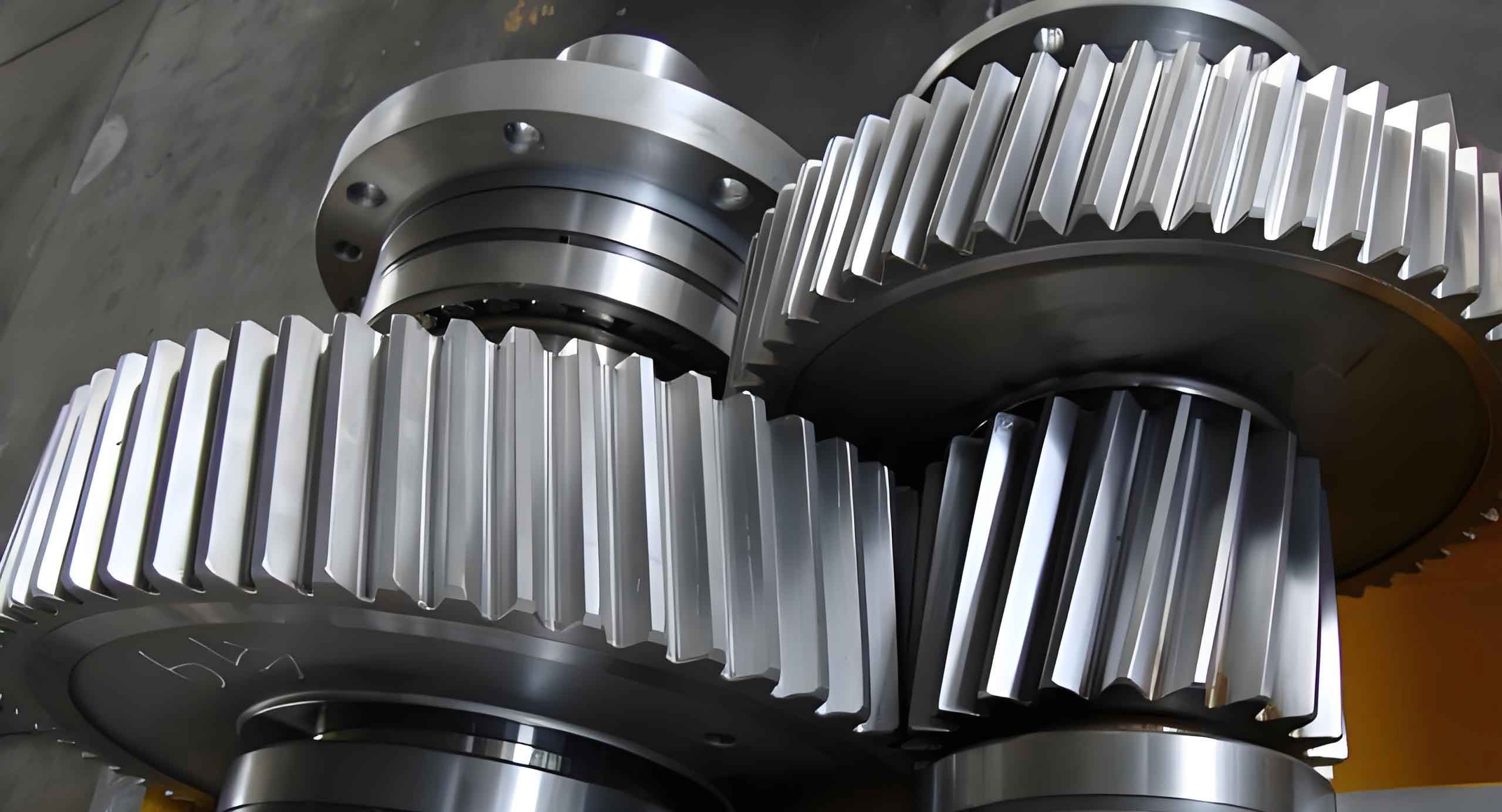
The pursuit of optimal mechanical properties in gear teeth—specifically, a hard, wear-resistant case with a tough, ductile core—has long guided heat treatment development. Conventional methods for helical gears often involve direct quenching after carburizing or a single quenching after carburizing and cooling. These approaches, while common, can lead to undesirable microstructural features such as excessive retained austenite or network carbides at the surface, compromising hardness and introducing residual stresses that may be detrimental under cyclic loading. The subsequent grinding or shot peening often required to rectify these issues can alter the beneficial compressive stress state. The process detailed herein is designed to overcome these limitations through a multi-stage thermal cycle that refines the microstructure and optimizes the stress profile.
Proposed Carburizing-Quenching Process for Helical Gears
The proposed methodology is a systematic sequence aimed at maximizing the service life of helical gears. The core philosophy involves not just surface hardening but also microstructural refinement and stress management through tempering. The complete process flow is delineated below, followed by a detailed explanation of each critical stage.
Process Flow: Carburization → Precooling & First Quench → High-Temperature Tempering → Second Quench → Low-Temperature Tempering.
| Process Stage | Temperature Range | Key Objective | Microstructural Outcome |
|---|---|---|---|
| Carburization | ~920 °C | Enrich surface layer with carbon | High-carbon austenitic case |
| Precooling | ~850 °C | Reduce temp., suppress retained austenite | Conditioned austenite |
| First Quench | ~60 °C Oil | Initiate martensite/bainite transformation | Martensite/Bainite + some retained austenite |
| High-Temp Temper | ~600 °C | Relieve stresses, temper martensite | Tempered martensite, ductility increase |
| Second Quench | ~800 °C | Transform remaining retained austenite | Fresh, fine martensite |
| Low-Temp Temper | 150-180 °C | Relief of quenching stresses, final hardness | Hard, stable tempered martensite |
1. Carburization: The helical gears are exposed to a carbon-rich atmosphere at approximately 920°C. At this temperature, the steel’s FCC austenite phase has high solubility for carbon. Active carbon atoms diffuse into the surface, creating a carbon concentration gradient. The goal is to achieve a surface carbon content typically between 0.7-0.9% to ensure high hardness after quenching, while the core remains at a lower carbon level for toughness.
2. Precooling & First Quench: Instead of quenching directly from the carburizing temperature, the gears are first slowly cooled to an intermediate temperature around 850°C. This precooling step is crucial for two reasons: it reduces the temperature difference before quenching, lowering thermal shock and distortion, and it promotes the partial precipitation of carbides, helping to prevent the formation of a continuous carbide network at the grain boundaries. Subsequently, the gears are quenched in agitated oil at about 60°C. This initiates the transformation of the high-carbon surface austenite into martensite (or a mixture of martensite and lower bainite, depending on cooling rate and alloy composition), resulting in high hardness. The core, with lower carbon, transforms to a stronger, tougher lower-carbon martensite or bainitic structure.
3. High-Temperature Tempering: Conducted within a short period (e.g., 4 hours) after the first quench, this step involves heating the gears to about 600°C. The primary purposes are to relieve the high internal stresses from the initial quench and to temper the formed martensite. Tempering at this temperature increases the ductility and toughness of the core and case, reducing brittleness. It also helps condition any untransformed retained austenite, making it more stable or prone to transformation in the next step.
4. Second Quenching: The gears are reheated to a temperature above the austenite transformation point (Ac3 for the core, typically around 800°C) but below the original carburizing temperature. This reheating austenitizes the material again but with a finer grain structure due to the prior thermal cycle. A subsequent quench then transforms this refined austenite, particularly targeting the remaining retained austenite from the first quench, into fresh, fine martensite. This significantly increases the overall hardness and stability of the case.
5. Low-Temperature Tempering: The final step is a stress-relief temper at 150-180°C. This low-temperature treatment further relieves quenching stresses from the second quench without significantly reducing the high hardness of the martensitic case. A prolonged hold at this temperature is beneficial for maximizing stress relaxation and ensuring dimensional stability of the finished helical gears.
Theoretical Foundation for Contact Fatigue Analysis
To assess the effectiveness of this process, predicting the contact fatigue life is paramount. The analysis is based on the Hertzian theory of elastic contact and modern fatigue life prediction methods. The maximum shear stress ($\tau_{max}$) occurring below the surface is a key driver for subsurface-initiated fatigue. For two cylindrical bodies in contact (approximating the contact zone of helical gear teeth), the Hertzian contact pressure ($p_0$) and half-contact width ($b$) are given by:
$$ p_0 = \sqrt{\frac{F E^*}{\pi L R^*}} $$
$$ b = \sqrt{\frac{4 F R^*}{\pi L E^*}} $$
where $F$ is the normal load per unit face width, $L$ is the length of contact (effective face width of the helical gear), $R^*$ is the equivalent radius of curvature $\left( \frac{1}{R^*} = \frac{1}{R_1} \pm \frac{1}{R_2} \right)$, and $E^*$ is the equivalent modulus $\left( \frac{1}{E^*} = \frac{1-\nu_1^2}{E_1} + \frac{1-\nu_2^2}{E_2} \right)$.
The contact fatigue safety factor ($S_f$) is typically evaluated using the ratio of the material’s endurance limit (or fatigue strength) for contact stress ($\sigma_{H\lim}$) to the calculated or simulated maximum contact stress ($\sigma_{H}$), often adjusted with application factors ($Z_A$, $Z_v$, etc.):
$$ S_f = \frac{\sigma_{H\lim} \cdot Z_L \cdot Z_v \cdot Z_R \cdot Z_W \cdot Z_X}{\sigma_{H} \cdot Z_\epsilon \cdot Z_\beta \cdot K_A \cdot K_v \cdot K_{H\beta} \cdot K_{H\alpha}} $$
For finite element-based analysis, the safety factor is often computed locally at each node or element based on the alternating stress tensor and the material’s S-N curve or fatigue properties, commonly using the von Mises or maximum shear stress criterion.
Finite Element Modeling of Processed Helical Gears
To perform a realistic fatigue analysis, an accurate 3D model of the meshing helical gears is essential. The modeling procedure for the carburized gears is outlined below.
1. Gear Geometry & Parametrization: A pair of meshing helical gears was modeled based on the following specifications:
| Parameter | Pinion (Driver) | Gear (Driven) |
|---|---|---|
| Number of Teeth (z) | 18 | 31 |
| Normal Module (m_n) | 8 mm | |
| Helix Angle (β) | 14° 26′ 43″ (Left Hand for Pinion, Right Hand for Gear) | |
| Face Width (b) | 100 mm | 95 mm |
The tooth profile was generated by defining points along the involute curve in the transverse plane using parametric equations and then sweeping this profile along a helical path. The model was simplified to a five-tooth segment for each gear to balance computational accuracy and resource requirements.
2. Material Properties & Carburized Layer Modeling: The gear material was assigned properties typical of a case-hardened alloy steel (e.g., 20CrMnTi). The carburized case layer, typically 0.8-1.2 mm deep, was explicitly modeled as a distinct region on the tooth flanks. The core and case were assigned different yield strengths and hardness values, though for elastic stress analysis, a common elastic modulus ($E = 2.17 \times 10^5$ MPa) and Poisson’s ratio ($\nu = 0.28$) were used initially.
3. Meshing Strategy: A critical step for contact analysis is mesh refinement. The regions around the potential contact zones on the tooth flanks were densely meshed with fine, high-quality elements (e.g., hexahedral or tetrahedral with high order). The mesh density was gradually coarsened towards the gear bore and web areas to reduce the total number of nodes and elements. Special attention was paid to creating a smooth transition between fine and coarse mesh zones.
4. Loads, Constraints, and Contact Definition: In the static structural analysis preceding the fatigue study, a fixed constraint was applied to the inner cylindrical surface of the driven gear. A driving torque of $T = 2046.4$ N·m was applied to the pinion. A frictional contact pair was established between the mating tooth flanks, with the pinion tooth surfaces defined as the contact side and the gear tooth surfaces as the target side. The initial engagement position was set such that contact occurred near the pitch line of the middle tooth pair.
Contact Fatigue Life Prediction and Safety Evaluation
Using the results from the nonlinear static contact analysis, a fatigue analysis was performed within the FEA environment. The fatigue module utilized the stress-based approach (e.g., using the Goodman or Gerber mean stress correction) and the material’s S-N curve to predict life. The design life was set at $N_D = 3 \times 10^7$ cycles, a common benchmark for high-cycle fatigue of helical gears.
The fatigue analysis yielded life contours across the gear teeth. The results indicated that the minimum predicted life for both the pinion and gear exceeded the target design life of $3 \times 10^7$ cycles, confirming the basic integrity of the design and the assumed material strength from the proposed heat treatment.
A more immediate design metric is the safety factor against contact fatigue failure. The computed safety factor distributions on the active tooth flanks of both helical gears are summarized below.
| Gear Component | Range of Safety Factor (S_f) | Location of Minimum S_f | Approx. Min. S_f Value |
|---|---|---|---|
| Pinion (Driver) | 3.0 – 4.0 | Near the tooth tip, on the contact line | ~3.0 |
| Gear (Driven) | 2.5 – 4.0 | Near the tooth tip, on the contact line | ~2.5 |
The analysis reveals that the vast majority of the tooth surface exhibits high safety factors, well above the typical minimum allowable value of 1.2 to 1.5 for industrial gearing. For the driver, the safety factors predominantly lie between 3 and 4. The driven gear shows a slightly wider range from 2.5 to 4. The zones with the lowest safety factors in both gears are consistently located near the tip region of the contact line. This is expected, as this area can experience higher sliding velocities and specific loads, and sometimes edge contact effects, leading to elevated stress concentrations. The fact that the minimum safety factor remains above 2.5 indicates a very robust design with a significant margin against contact fatigue failure, attributable to the high surface hardness and favorable residual stress profile imparted by the multi-stage carburizing-quenching process.
Conclusion
The performance and longevity of helical gears are critically dependent on their surface condition. The proposed carburizing-quenching process—comprising carburization, precooling and first quench, high-temperature tempering, second quench, and final low-temperature tempering—provides a comprehensive method to engineer a superior microstructure. This process effectively minimizes detrimental retained austenite, refines grain structure, manages internal stresses, and ultimately yields a hard, wear-resistant case integrated with a tough core.
The finite element-based contact fatigue analysis of helical gears treated with this methodology confirms its efficacy. The predicted fatigue life surpasses a demanding target of 30 million cycles. More importantly, the contact fatigue safety factor analysis reveals a substantial design margin, with minimum safety factors exceeding 2.5, located predictably in higher-stress regions near the tooth tips. This integrated approach, combining advanced thermal processing with sophisticated numerical simulation, provides a powerful framework for designing and validating highly reliable helical gear transmissions for demanding applications. The FEA results serve as a valuable virtual prototype, guiding design optimization and reducing reliance on extensive physical endurance testing.