
In my extensive experience working with power transmission systems, the bevel gear stands out as a critical component, especially in applications where space is constrained and high power density is required. The design and manufacturing of bevel gears present unique challenges that demand meticulous attention to detail. This article delves into the intricacies of bevel gear technology, from structural optimization to precise manufacturing and assembly processes. I will share insights gained through practical application, emphasizing the use of formulas and tables to encapsulate key principles. The ultimate goal is to ensure the reliability and smooth operation of bevel gears in demanding environments.
The fundamental role of a bevel gear in transmitting power between intersecting shafts cannot be overstated. In gearboxes where volume is limited, increasing power output without enlarging the gear size necessitates innovative design approaches. My focus has always been on creating compact, lightweight, and efficient bevel gear pairs. One of the primary considerations is the tooth count. While reducing the number of teeth can minimize dimensions, it risks undercutting. Therefore, a balanced tooth number within a rational range is essential. I typically employ the Gleason system with equal-depth teeth, specifically the “equal clearance” type, where the tooth height decreases from the heel to the toe. This design enhances the fillet radius at the toe, reducing stress concentration and improving root strength. It also allows for a larger tool tip radius, extending tool life and preventing thinning at the toe and potential binding due to misalignment.
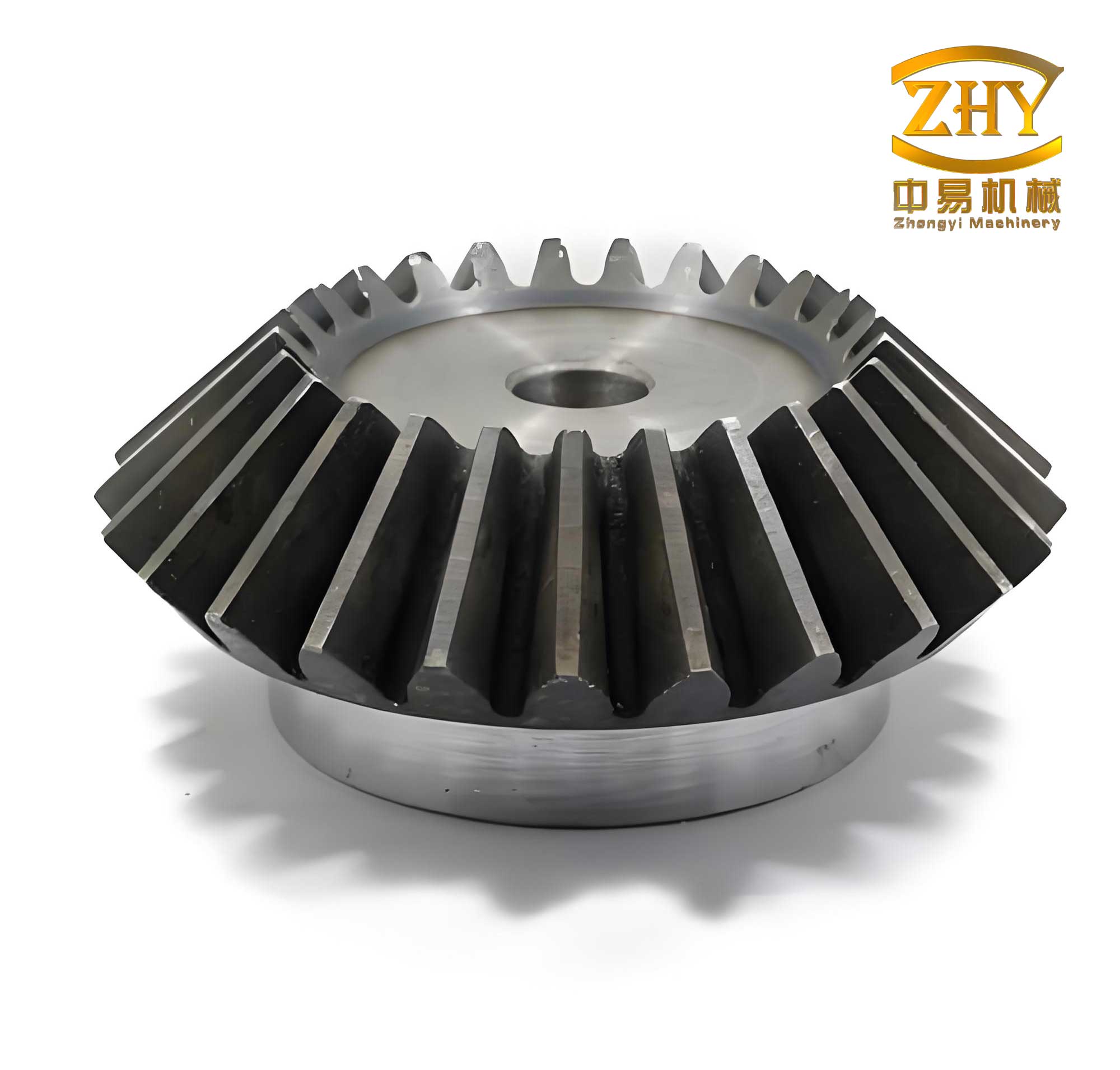
Material selection is paramount for a bevel gear destined for high-power transmission. I prefer nickel-chromium steels due to their superior mechanical properties and minimal heat treatment distortion. The case depth during carburizing is chosen based on the face module. An inadequate depth can lead to surface spalling and indentation, while excessive depth increases brittleness at the tooth corners. The core hardness is equally critical: too low, and plastic deformation in the transition zone may cause deep spalling and pitting; too high, and the risk of brittle tooth fracture rises. To mitigate deformation under load and enhance load capacity, I advocate for simply-supported bearing arrangements for the bevel gear shaft, preventing significant deflection during heavy-duty operation.
My design calculations for spiral bevel gears begin with an initial estimate of the pinion’s pitch diameter at the large end, d₀. The complexity of analyzing conjugate action is simplified by evaluating the equivalent spur gear at the mean cone distance. For Gleason spiral bevel gears with high-spiral angles and profile shift, the following formula is instrumental in determining the circular tooth thickness at the pitch circle on the large end:
$$ S_1 = m_t \left( \frac{\pi}{2} + 2x_1 \tan \alpha_n + x_{t1} \right) $$
$$ S_2 = p – S_1 $$
Here, \( m_t \) is the transverse module at the large end, \( x_1 \) is the profile shift coefficient, \( \alpha_n \) is the normal pressure angle, \( x_{t1} \) is the tangential modification coefficient, and \( p \) is the circular pitch. The subsequent calculations involve determining key angles: pitch cone angle (\( \delta \)), face cone angle (\( \delta_a \)), and root cone angle (\( \delta_f \)). The face width coefficient must be chosen judiciously; an excessively large value leads to a thin toe, small root fillet, and heightened stress concentration. The table below summarizes typical design parameters and their influence for a spiral bevel gear pair.
| Design Parameter | Symbol | Typical Range/Value | Primary Influence |
|---|---|---|---|
| Transverse Module (large end) | \( m_t \) | Determined by load & space | Tooth size, bending strength |
| Number of Teeth (Pinion/Gear) | \( z_1 / z_2 \) | ≥ 12-15 (to avoid undercut) | Size, contact ratio, smoothness |
| Spiral Angle | \( \beta \) | 30° – 40° | Axial thrust, smooth engagement |
| Face Width Coefficient | \( K_{be} \) | 0.25 – 0.3 | Bending & contact strength |
| Profile Shift Coefficient | \( x_1, x_2 \) | Positive for pinion (high ratio) | Balances strength, prevents undercut |
| Pressure Angle (Normal) | \( \alpha_n \) | 20° | Load capacity, risk of interference |
The manufacturing phase of a spiral bevel gear is where design intent is realized, and it is fraught with challenges. Controlling the case depth after grinding is a significant hurdle. The carbon content on the tooth flank after final grinding must not decrease by more than 0.2%. To achieve this, uniform stock allowance during gear cutting is vital, and the consistency of the carburized layer depth is non-negotiable. In my practice, I ensure that the tooth topography error after milling is within 0.05 mm across all measured points. This often necessitates using a larger diameter cutter head. Since the adjustment range of the cutter tip diameter is limited, custom-made shims are fabricated to effectively increase the nominal cutter tip diameter to meet precise machining requirements.
Contact pattern adjustment is arguably the most critical step in qualifying a bevel gear pair. The static contact imprint on the tooth surface is a key indicator of proper meshing. During adjustment, several aberrant patterns on the pinion’s convex flank may appear, such as contact biased toward the heel or toe, the root or top, or diagonal contact. The correction involves modifying the machine tool settings, primarily the cutter head tilt and radial distance. The relationship between pattern movement and machine adjustment can be summarized by the following principle: to move the pattern toward the heel, the machine root angle is decreased; to move it toward the toe, the root angle is increased. A simplified guidance table is provided below.
| Observed Pattern Deviation | Probable Cause / Required Adjustment |
|---|---|
| Contact at Heel | Excessive toe contact during generation. Decrease machine root angle. |
| Contact at Toe | Excessive heel contact during generation. Increase machine root angle. |
| Contact at Root | Excessive top contact. Increase the generating roll ratio or modify cutter profile. |
| Contact at Top | Excessive root contact. Decrease the generating roll ratio. |
| Diagonal Contact | Mismatch in spiral angles. Adjust the cutter head swivel angle. |
Heat treatment distortion remains a persistent challenge in bevel gear manufacturing. The complex geometry of the tooth flank is susceptible to stress concentrations if the machining tool paths are not optimized. During carburizing and quenching, residual stresses reorganize, leading to unpredictable distortion. This can result in uneven case depth, compromising the overall gear strength. If distortion exceeds the grinding allowance, the gear may be rendered unusable. Therefore, selecting optimal machining sequences and heat treatment parameters is crucial. I often rely on finite element analysis (FEA) to simulate the quenching process and predict distortion trends. The governing equation for heat transfer during quenching can be expressed as:
$$ \rho c_p \frac{\partial T}{\partial t} = \nabla \cdot (k \nabla T) + \dot{q} $$
Where \( \rho \) is density, \( c_p \) is specific heat, \( T \) is temperature, \( t \) is time, \( k \) is thermal conductivity, and \( \dot{q} \) is the internal heat generation rate. By controlling the cooling rate and uniformity, distortion can be minimized.
Topography measurement is an indispensable quality assurance tool for spiral bevel gears. A topography map represents the coordinate form of the gear tooth surface, typically captured using a 9×5 grid of points. This grid covers the active flank, starting approximately 5% from the boundaries at the heel, toe, top, and root. One column, usually the mid-point column, is taken as the datum. The measured values for the other 44 points represent the deviation (in micrometers) from their theoretical positions. Positive values indicate the surface is higher than the theoretical point, and negative values indicate it is lower. Analyzing this map allows for precise correction of the grinding process to achieve the desired flank form. The accuracy of this map is vital for ensuring the final performance of the bevel gear.
The assembly and final adjustment of a bevel gear pair are as critical as their design and manufacture. Proper installation ensures the theoretical contact pattern translates into optimal performance under load. Assembly primarily involves setting the correct mounting distance for both the pinion and the gear. The mounting distance is the axial distance from the cone apex to the gear’s mounting back face. In practice, shims are used to adjust this distance, compensating for cumulative axial tolerances from the gears, bearings, and housing. However, due to manufacturing variances, the mounting distance has an allowable adjustment range. The initial backlash is set within specified limits before fine-tuning the contact pattern.
Adjusting the static contact pattern under light braking torque is a delicate art. The goal is to obtain a pattern that is centrally located on the tooth flank, slightly biased toward the toe under no load to ensure it moves to the center under operational loads. The pattern should be as large as possible without reaching the edges to ensure durability and good adjustability. Several conditions indicate a fundamentally faulty bevel gear that cannot be corrected by assembly adjustment and must be replaced: 1) If the pattern is at the top on one flank and at the root on the opposite flank, with the correct mounting distance and backlash. 2) If the pattern is at the heel on one flank and at the toe on the opposite flank. 3) If the pattern is consistently at the heel or toe on both flanks of both gears, even with acceptable backlash.
Other subtle factors significantly influence the accuracy of pattern checking. The type of marking compound is one. I prefer compounds with low oil content, as they produce sharper, more defined imprints. Excessively oily compounds cause smearing, obscuring the true contact area. Backlash is another critical factor. The actual backlash, influenced by component stack-up, should be as close to the nominal value as possible. This ensures the non-working flank is not inadvertently contacted, preventing noise and potential scuffing. The relationship between pattern position and mounting distance adjustments is often guided by established rules, which can be encapsulated in an adjustment matrix. For instance, to move the pattern on the drive side of a hypoid or spiral bevel gear toward the toe, the pinion is moved closer to the gear centerline.
To solidify the understanding of the interrelationships between design, manufacture, and adjustment parameters for a robust bevel gear system, the following comprehensive table integrates key aspects discussed.
| Lifecycle Phase | Key Parameter/Variable | Optimal Target/Consideration | Impact on Gear Performance |
|---|---|---|---|
| Design | Tooth Geometry (Gleason system) | Equal clearance, high spiral angle | Strength, smooth engagement, compactness |
| Material & Heat Treatment | Ni-Cr steel, controlled case/core hardness | Wear resistance, bending strength, fatigue life | |
| Bearing Support | Simply-supported configuration | Minimizes shaft deflection under load | |
| Face Width \( b \) | \( b \approx 0.3 \times \) Cone Distance | Balances strength and manufacturability | |
| Manufacturing | Cutter Head Diameter & Setup | Optimized for stock allowance & topography | Determines final tooth form accuracy |
| Heat Treatment Process Control | Uniform cooling, distortion prediction (FEA) | Ensures dimensional stability, uniform case | |
| Grinding Stock Allowance \( \Delta g \) | \( \Delta g \approx 0.15 \text{ to } 0.25 \text{ mm} \) | Must exceed predicted distortion | |
| Topography Map Accuracy | All 45 points within ±10 µm of theory | Directly correlates with noise & stress | |
| Assembly/Adjustment | Mounting Distance \( A_p, A_g \) | Adjusted via shims within tolerance band | Sets initial mesh geometry |
| Static Backlash \( j \) | \( j_{nom} \pm 0.05 \text{ mm} \) | Prevents binding, allows for thermal expansion | |
| Contact Pattern Size & Location | Central, 30-70% of face height/width | Indicator of correct conjugate action | |
| Marking Compound | Low-viscosity, fast-drying | Provides clear, non-smearing imprint |
In conclusion, the journey of a bevel gear from concept to a reliable component in a power train is a symphony of precision engineering. My approach emphasizes a holistic optimization of the bevel gear structure through calculated design choices. Simultaneously, rigorous control over manufacturing processes—especially grinding, heat treatment, and topography—is non-negotiable. Finally, the art and science of assembly and pattern adjustment bring all previous efforts to fruition. By mastering these interconnected phases, we can consistently produce bevel gear pairs that exhibit exceptional reliability, smooth operation, and extended service life, even under the most demanding conditions. The continuous refinement of these techniques, supported by quantitative analysis through formulas and systematic summaries in tables, forms the bedrock of advanced bevel gear technology.
The mathematical modeling of bevel gear contact stresses further underscores the importance of precise manufacture. The classic Hertzian contact stress formula for the equivalent cylinders at the pitch point can be adapted for spiral bevel gears:
$$ \sigma_H = Z_E \sqrt{ \frac{F_t}{b d_{v1}} \cdot \frac{u+1}{u} \cdot Z_I } $$
Where \( Z_E \) is the elasticity factor, \( F_t \) is the tangential force at the mean cone distance, \( b \) is the face width, \( d_{v1} \) is the pinion’s equivalent pitch diameter, \( u \) is the gear ratio, and \( Z_I \) is the geometry factor accounting for tooth curvature and load sharing. This formula highlights how manufacturing imperfections that alter the local curvature (captured in \( Z_I \)) or load distribution can dramatically affect the surface durability of the bevel gear. Therefore, every step, from designing the blank to the final lapping, must aim to achieve the theoretical geometry as closely as possible. This integrated philosophy ensures that every bevel gear leaving the workshop is not just a component, but a testament to precision engineering.