
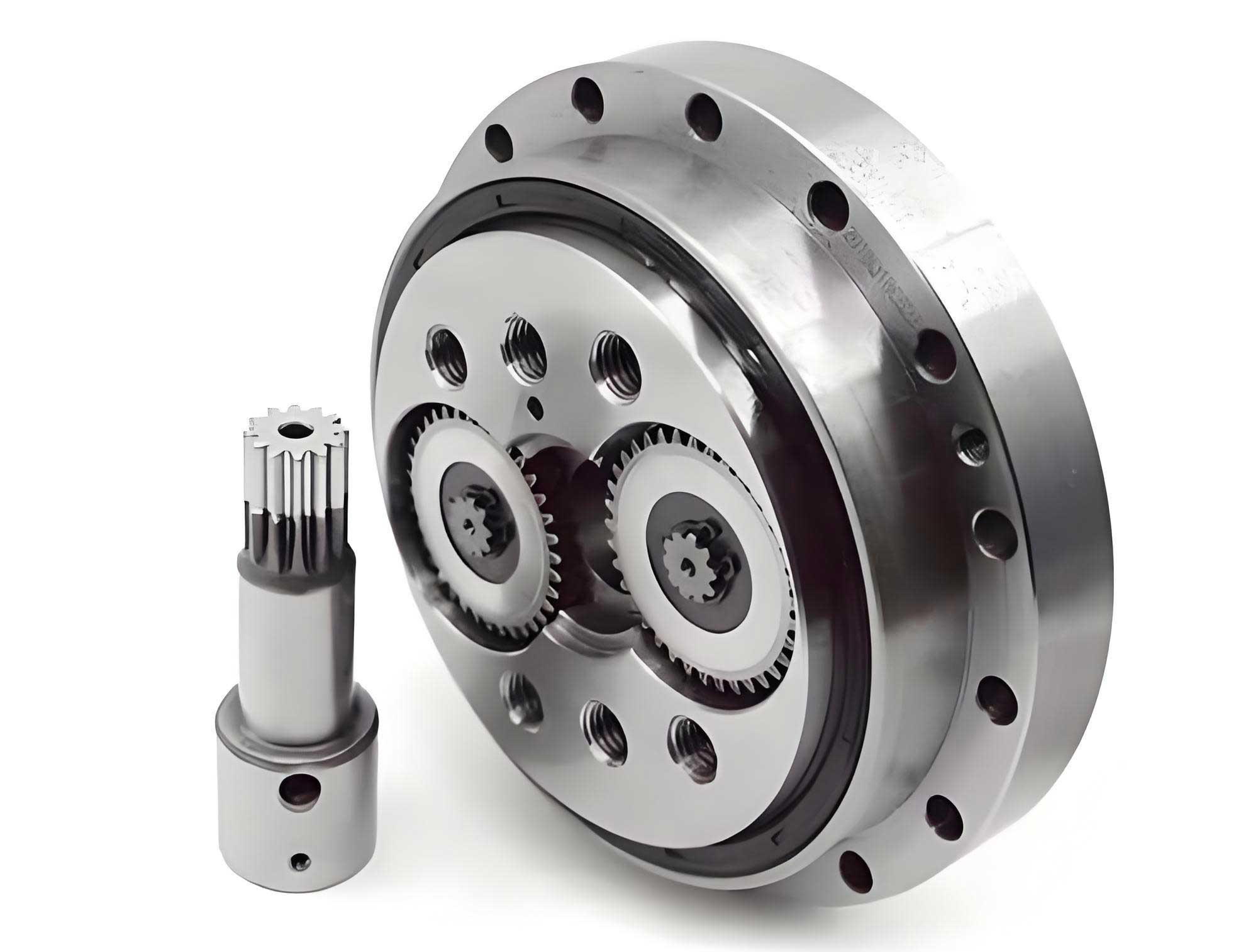
In the rapidly evolving landscape of industrial automation, the RV reducer has emerged as a critical component due to its exceptional advantages, including compact size, lightweight design, wide transmission ratio range, long service life, high precision stability, superior transmission efficiency, and smooth operation. As an essential part of robotics and precision machinery, the performance and reliability of the RV reducer directly impact the overall system efficiency. However, fault diagnosis and management for RV reducers present significant challenges. The fault causes are often complex, and traditional methods rely heavily on manual inspection, which is inefficient, time-consuming, and costly. Existing approaches, such as experiential summaries or theoretical analyses, lack rapid query capabilities and are not easily scalable for widespread use. To address these issues, we propose the construction of a fault knowledge graph specifically for RV reducers. This knowledge graph aims to visualize and make fault-related data retrievable, thereby enhancing the speed and accessibility of fault detection and treatment. In this article, I will detail our methodology, focusing on key technologies like knowledge extraction, representation, fusion, storage, and visualization, with an emphasis on integrating tables and formulas to summarize the process.
The need for an efficient fault management system for RV reducers is pressing. Traditional fault-handling methods often involve labor-intensive processes where technicians must manually identify symptoms, trace causes, and apply solutions based on accumulated experience. For instance, faults in RV reducers can manifest as gear wear, oil leakage, abnormal noise, or vibration, each with multiple underlying causes such as poor manufacturing precision, insufficient design strength, or lubrication failure. This complexity makes it difficult to quickly diagnose and resolve issues, leading to downtime and increased maintenance costs. Moreover, as the adoption of RV reducers grows in industries like manufacturing, aerospace, and automotive, there is a demand for more intelligent, data-driven solutions. Our approach leverages knowledge graph technology to encapsulate fault-related information into a structured, queryable format, enabling faster and more accurate diagnostics.
Knowledge graphs serve as a powerful tool for representing knowledge in a graph-based format, where entities, attributes, and relationships are modeled as nodes and edges. In the context of RV reducer faults, a knowledge graph can capture intricate details about fault types, causes, symptoms, and solutions, facilitating automated reasoning and querying. Broadly, knowledge graphs are categorized into general-purpose and domain-specific types. For RV reducer applications, we focus on building a domain-specific knowledge graph, which requires high accuracy and depth to support decision-making in mechanical fault diagnosis. The construction process involves several key steps: knowledge extraction, knowledge representation, knowledge fusion, knowledge reasoning, and knowledge storage. Each step is crucial for transforming raw data into a usable knowledge base.
First, knowledge extraction deals with acquiring relevant data from various sources. For RV reducers, data sources include technical manuals, research papers, maintenance logs, and sensor data, which can be structured, semi-structured, or unstructured. Since structured data on RV reducer faults is scarce, we primarily handle unstructured text data. Techniques like entity extraction, relation extraction, and event extraction are employed. Entity extraction identifies key terms such as “gear fault,” “bearing vibration,” or “oil seal leakage.” Relation extraction establishes connections between entities, e.g., “gear fault is caused by wear.” Event extraction captures specific incidents, like “a failure occurred due to overload.” We use neural network-based methods for this, as they effectively handle the variability in natural language text. For example, given a sentence like “The RV reducer exhibited noise due to gear misalignment,” the system extracts entities (“RV reducer,” “noise,” “gear misalignment”) and the relation (“exhibited due to”).
To illustrate the data sources and extraction methods, consider Table 1, which summarizes the types of data and corresponding extraction techniques for RV reducer faults.
| Data Type | Examples | Extraction Method | Output Entities |
|---|---|---|---|
| Structured | Databases, spreadsheets | Direct mapping | Fault codes, part numbers |
| Semi-structured | Maintenance reports, logs | Rule-based parsing | Fault symptoms, dates |
| Unstructured | Research papers, manuals | Neural networks (e.g., BERT) | Gear wear, causes, solutions |
After extraction, knowledge representation converts the extracted information into a machine-readable format. We adopt the Resource Description Framework (RDF) triple structure, which forms the basis of our knowledge graph. Each fact is represented as a triple: (subject, predicate, object). For RV reducer faults, this translates to entities like “RV reducer” or “gear” connected by relations like “hasFault” or “causedBy.” For instance, the triple (GearFault, causedBy, Wear) indicates that gear fault is caused by wear. Additionally, attributes are represented as (entity, attribute, value), e.g., (Gear, material, steel). This representation allows for efficient storage and querying. Mathematically, we can express a knowledge graph as a set of triples: $$ KG = \{ (s, p, o) \mid s \in E, p \in R, o \in E \cup V \} $$ where \( E \) is the set of entities, \( R \) is the set of relations, and \( V \) is the set of attribute values. For RV reducers, we define entities such as fault types, components, causes, and solutions, with relations linking them hierarchically.
Knowledge fusion is essential for integrating data from multiple sources. Since information on RV reducer faults may come from diverse documents or databases, fusion ensures consistency and accuracy. Key tasks include entity alignment (resolving different names for the same entity, e.g., “RV reducer” vs. “RV gearbox”) and entity disambiguation (distinguishing between meanings, e.g., “wear” as a fault vs. “wear” as a process). We use similarity metrics and clustering algorithms to merge equivalent entities. For example, if one source mentions “noise” and another mentions “abnormal sound,” they are aligned to a unified entity “acoustic anomaly.” This step reduces redundancy and improves the knowledge graph’s reliability.
Knowledge reasoning enables the inference of new knowledge from existing facts. In the context of RV reducers, reasoning can help predict potential faults or suggest solutions based on known patterns. For instance, if the knowledge graph contains triples (GearFault, causedBy, Wear) and (Wear, preventedBy, Lubrication), a reasoning engine might infer that proper lubrication can prevent gear faults. We employ rule-based reasoning using production rules, which are expressed in the form: $$ \text{IF condition THEN conclusion} $$ For RV reducer faults, a rule could be: IF (component is Gear) AND (symptom is Vibration) THEN (possible cause is Misalignment). This allows the system to provide diagnostic insights beyond explicitly stored data.
For storage, we use graph databases, specifically Neo4j, due to their native support for graph structures. Neo4j stores data as nodes (entities) and edges (relations), making it ideal for representing the interconnected nature of RV reducer fault knowledge. We populate the database with triples derived from our representation step. For example, nodes can represent “RV reducer,” “gear fault,” “wear,” etc., with edges labeled “hasFault” or “causedBy.” This storage method facilitates efficient traversal and querying, such as finding all causes of a specific fault. To quantify the relationships, we can assign weights or probabilities to edges based on frequency or severity, represented as: $$ w(e) = \frac{f(e)}{\sum f} $$ where \( w(e) \) is the weight of edge \( e \), and \( f(e) \) is its occurrence frequency in fault data.
Now, focusing on the construction of the RV reducer fault knowledge graph, we follow a top-down approach combined with bottom-up data integration. This involves defining the schema (ontology) first, then populating it with instances from data. The schema includes entity classes like Fault, Component, Cause, and Solution, with relationships such as occursIn, leadsTo, and resolvedBy. We manually curate the initial schema based on domain expertise, then use automated extraction to add instances. For data processing, we preprocess text documents related to RV reducers, including fault analysis reports and technical specifications. Natural language processing techniques, like tokenization and part-of-speech tagging, help identify key terms. We then apply rule-based systems to map these terms to the schema. For instance, a sentence “Gear wear in RV reducers often results from inadequate lubrication” is parsed to generate triples: (GearWear, occursIn, RVReducer), (GearWear, causedBy, InadequateLubrication).
To enhance clarity, Table 2 provides a breakdown of entity types and their attributes in the RV reducer fault knowledge graph.
| Entity Type | Examples | Attributes | Relationships |
|---|---|---|---|
| Fault | Gear wear, oil leakage | Severity, frequency | hasSymptom, causedBy |
| Component | Gear, bearing, seal | Material, dimensions | partOf, failsIn |
| Cause | Poor machining, overload | Probability, impact | leadsTo, associatedWith |
| Solution | Replace part, adjust load | Cost, effectiveness | resolves, recommendedFor |
Knowledge representation for RV reducer faults is implemented using production rules, which are formalized as triples. Each rule corresponds to a piece of diagnostic knowledge. For example, the rule for gear fault diagnosis can be expressed as: $$ \text{(GearFault, hasSymptom, Noise)} \rightarrow \text{(GearFault, possibleCause, Misalignment)} $$ This means if a gear fault exhibits noise, misalignment is a possible cause. We define hundreds of such rules based on expert input and data analysis, covering various fault scenarios for RV reducers. The rules are stored in a rule engine that interfaces with the knowledge graph for reasoning.
For visualization, we leverage Neo4j’s capabilities to generate interactive graphs. After storing the triples, we use Python scripts to query and display the knowledge graph. The visualization includes nodes for entities (e.g., “RV reducer,” “gear fault,” “wear”) and edges for relationships (e.g., “causes,” “treats”). This allows users to visually explore fault pathways, such as tracing from a symptom to root causes. For instance, starting from “vibration,” one can see connections to “bearing wear” or “imbalance.” The graph typically contains 32 entities (including 10 fault entities like gear and shaft issues, 5 fault manifestations like abnormal sound, 6 causes like poor lubrication, 7 improvements like installation checks, and 4 recommendations like avoiding overload) and 7 relationship types. This visual representation makes the knowledge accessible even to non-experts, reducing the learning curve for RV reducer maintenance.
To further illustrate the relationships, we can model fault propagation using a weighted graph. Let \( G = (V, E) \) be a directed graph where vertices \( V \) represent fault states (e.g., initial symptom, intermediate cause, final failure) and edges \( E \) represent transitions with probabilities. For an RV reducer, the probability of a gear fault leading to system failure might be computed as: $$ P(\text{failure} \mid \text{gear fault}) = \sum_{c \in C} P(\text{failure} \mid c) \cdot P(c \mid \text{gear fault}) $$ where \( C \) is the set of intermediate causes. This formula helps quantify risks and prioritize maintenance actions.
Knowledge question-answering (QA) is a critical application of the RV reducer fault knowledge graph. We develop a QA system that allows users to input natural language queries, such as “What causes noise in an RV reducer?” or “How to fix oil leakage?” The system consists of several modules: question classification, parsing, answer retrieval, and response generation. In the question classification module, we use a script to identify query types based on keywords—for instance, queries containing “cause” are classified as causal inquiries. The parsing module converts the query into a structured format, like a Cypher query for Neo4j. For example, the question “What are the symptoms of gear wear?” is parsed to: $$ \text{MATCH (f:Fault {name: ‘GearWear’})-[:hasSymptom]->(s:Symptom) RETURN s} $$ The answer retrieval module executes this query and fetches results, which are then formatted using templates. The QA interface, built with Python, provides user-friendly interactions, as shown in a mock-up where users type questions and receive instant answers derived from the knowledge graph.
To optimize the QA process, we implement a ranking algorithm for answers based on relevance scores. For a query \( q \) and an answer \( a \), the score can be computed using cosine similarity between their vector representations: $$ \text{score}(q, a) = \frac{\vec{q} \cdot \vec{a}}{|\vec{q}| |\vec{a}|} $$ where vectors are derived from word embeddings of the query and answer text. This ensures that the most pertinent information about RV reducer faults is presented first.
In practice, the construction of the RV reducer fault knowledge graph involves iterative refinement. We continuously update the graph with new fault data from real-world deployments, using feedback loops to improve accuracy. For instance, when a new fault pattern emerges, such as a specific type of bearing failure in high-temperature environments, we extract relevant information, align it with existing entities, and add new rules. This dynamic approach ensures the knowledge graph remains current and comprehensive.
The benefits of this knowledge graph are manifold. It significantly speeds up fault diagnosis for RV reducers—what used to take hours of manual investigation can now be done in minutes via queries. It reduces the difficulty of fault handling by providing structured guidance, making it accessible to technicians with varying experience levels. Moreover, it shortens downtime by enabling quick identification of solutions, thus lowering maintenance costs. From a broader perspective, this methodology can be adapted to other mechanical systems, fostering advancements in predictive maintenance and industrial IoT.
In conclusion, the construction of a fault knowledge graph for RV reducers represents a transformative step in managing mechanical failures. By leveraging knowledge graph technologies, we encapsulate complex fault relationships into an intuitive, queryable format. The integration of data extraction, representation, fusion, reasoning, and visualization creates a robust system that enhances diagnostic speed and accuracy. Through tables and formulas, we have summarized key aspects, such as data sources, entity types, and probabilistic models. The RV reducer serves as a prime example of how domain-specific knowledge graphs can bridge the gap between traditional maintenance and modern data-driven approaches. As industries continue to adopt RV reducers in robotics and automation, this knowledge graph will play a vital role in ensuring reliability and efficiency, ultimately contributing to smarter manufacturing ecosystems.