
Gear transmission is a fundamental mechanism for transmitting motion and power between shafts, renowned for its compact structure, smooth operation, high efficiency, strong load-bearing capacity, and long service life. As a critical finishing process, gear shaving serves to correct errors such as radial runout, pitch deviation, profile error, and lead error, thereby enhancing the operational smoothness and contact strength of the gears. The gear shaving process can be conceptualized as the meshing of a pair of crossed helical gears with zero backlash. However, a persistent challenge arises when using a standard involute helical shaving cutter: the tooth profile of the shaved gear often exhibits an undesired concavity near the pitch circle, known as the mid-concave or “middle depression” error. This concavity detrimentally impacts transmission performance, leading to increased noise and reduced operational life. Therefore, the analysis and mitigation of this concave error are of paramount importance in precision gear manufacturing. This article delves into the mechanical origins of this phenomenon through theoretical deformation analysis and proposes a practical solution via tool modification, supported by numerical curve fitting techniques.
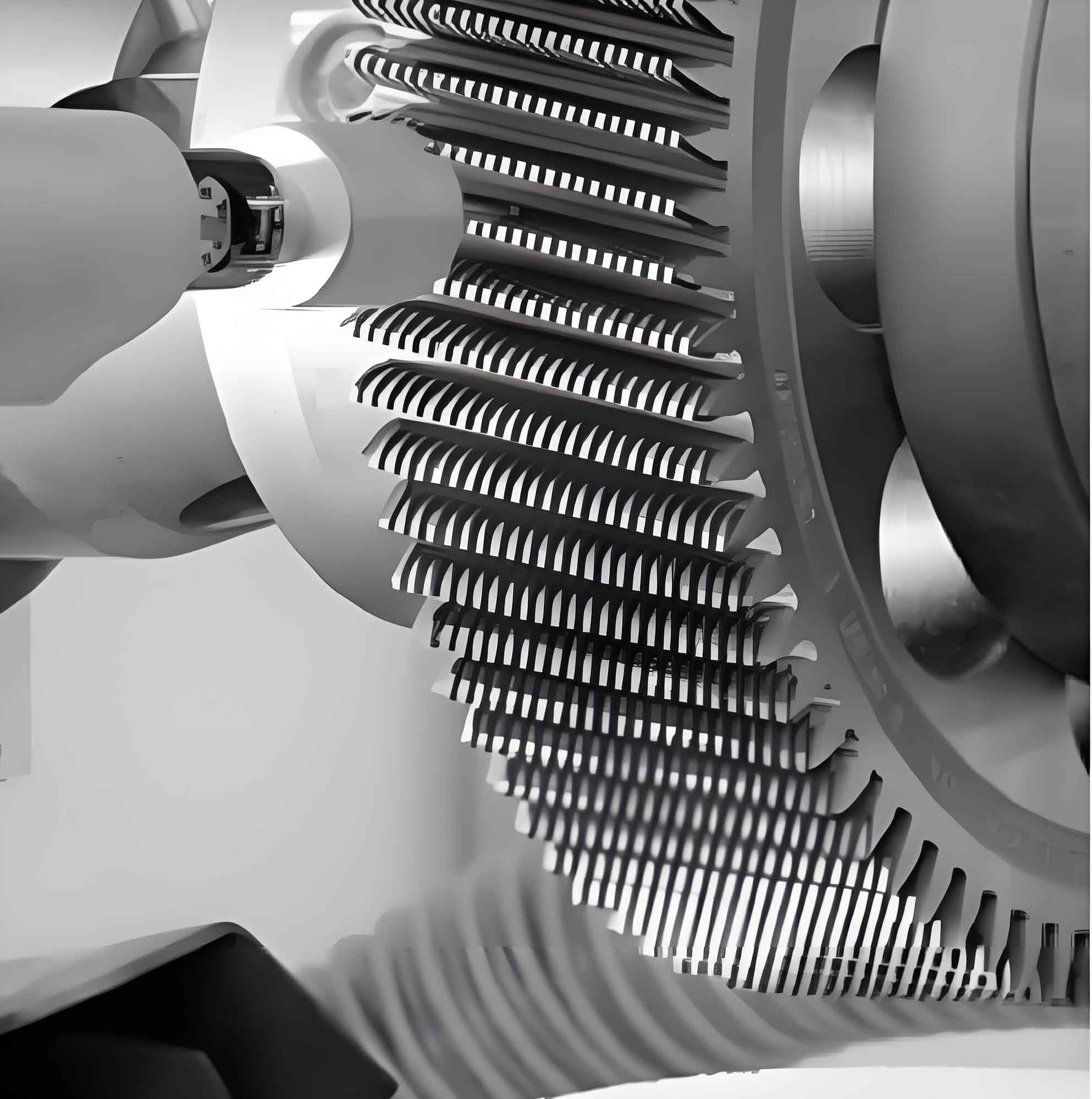
The concave error in gear shaving primarily stems from the elastic deformation of the gear tooth under the cutting and pressing forces applied by the shaving cutter. This total deformation is a composite of localized contact (Hertzian) deformation and global bending deformation of the tooth. To quantify this, a simplified mechanical model is established, considering the varying number of simultaneous contact points between the cutter and the workpiece gear tooth during the meshing cycle. For the common case where the total contact ratio is less than 2, the number of instantaneous contact points varies between 2 and 4.
1. Theoretical Analysis of Deformation in Gear Shaving
1.1 Contact Deformation Analysis
Based on Hertzian contact theory, the local indentation or contact deformation \(\delta_e\) at a point is given by:
$$ \delta_e = \frac{3P}{2a} ( \kappa_1 + \kappa_2 ) K(e) $$
Where \(P\) is the normal load, \(a\) is the semi-major axis of the contact ellipse, \(\kappa_1\) and \(\kappa_2\) are the curvatures of the contacting surfaces, and \(K(e)\) is a complete elliptic integral of the first kind dependent on the ellipticity parameter \(e\). The force distribution among the contact points is statically indeterminate and requires solving equilibrium equations that consider force balance and geometric compatibility (equality of approach at contacting points). For 2, 3, and 4 contact point scenarios, the following equation systems are solved to find the individual contact forces \(F_i\).
For 2 contact points:
$$
\begin{aligned}
F_1 \cos \alpha_y &= F_2 \cos \alpha_y \\
F_1 \cos \alpha_x + F_2 \cos \alpha_x &= F_r
\end{aligned}
$$
For 3 contact points:
$$
\begin{aligned}
F_1 \cos \alpha_x + F_2 \cos \alpha_x + F_3 \cos \alpha_x &= F_r \\
F_1 \cos \alpha_y + F_2 \cos \alpha_y &= F_3 \cos \alpha_y \\
F_1 \cos \alpha_y L_1 + F_2 \cos \alpha_y L_2 &= F_3 \cos \alpha_y L_3
\end{aligned}
$$
For 4 contact points:
$$
\begin{aligned}
F_1 \cos \alpha_x + F_2 \cos \alpha_x + F_3 \cos \alpha_x + F_4 \cos \alpha_x &= F_r \\
F_1 \cos \alpha_y + F_2 \cos \alpha_y &= F_3 \cos \alpha_y + F_4 \cos \alpha_y \\
F_1 \cos \alpha_y L_1 + F_2 \cos \alpha_y L_2 &= F_3 \cos \alpha_y L_3 + F_4 \cos \alpha_y L_4 \\
\delta_{e1} + \delta_{e2} &= \delta_{e3} + \delta_{e4}
\end{aligned}
$$
Here, \(\alpha_x\) and \(\alpha_y\) are the direction angles of the force at a contact point relative to the coordinate axes, \(L_i\) are the moment arms, \(F_r\) is the resultant radial shaving force, and \(\delta_{ei}\) is the contact deformation at point \(i\) calculated via the Hertz formula using the solved force \(F_i\). The solution provides the force distribution, enabling the calculation of contact deformation at each point throughout the mesh cycle.
1.2 Bending Deformation Analysis
For computational simplicity in bending analysis, the helical gear tooth is approximated as a spur gear tooth modeled as a variable-cross-section cantilever beam. The bending deflection at the point of load application is calculated using the principle of superposition and Castigliano’s theorem.
For a single load \(F_A\) acting at point A (as in a single-point contact phase), the total bending deflection \(\delta_w\) in the direction of the force component is:
$$ \delta_w = \sum_{i=1}^{n} \left( \int \frac{M(x)}{E I_i} \cdot \frac{\partial M(x)}{\partial F} \, dx \right) $$
where \(M(x)\) is the bending moment function, \(E\) is Young’s modulus, and \(I_i\) is the area moment of inertia of the \(i\)-th segment of the discretized tooth profile.
For two-point contact, two loading configurations exist, as shown in the models below, requiring careful superposition of deflections and, in one case, slope effects.
Configuration (a): Two forces on opposite sides. The deflection at A is:
$$ \delta_w = \sum_{i=1}^{n_1} \delta_{F_A A}^{wi} – \sum_{i=1}^{n_2} \delta_{F_B B}^{wi} – (x_A – x_B) \sum_{i=1}^{n_2} \theta_{F_B B}^{i} $$
where \(\delta_{F_A A}^{wi}\) is the deflection at A due to \(F_A\), \(\delta_{F_B B}^{wi}\) is the deflection at B due to \(F_B\) projected to A, and \(\theta_{F_B B}^{i}\) is the slope at B due to \(F_B\).
Configuration (b): Two forces on the same side. The deflection at A is:
$$ \delta_w = \sum_{i=1}^{n} \left( \delta_{F_A A}^{wi} – \delta_{F_B A}^{wi} \right) $$
where \(\delta_{F_B A}^{wi}\) is the deflection at A due to the force \(F_B\).
1.3 Total Deformation and Its Implication for Gear Shaving Error
The total deformation \(\delta\) at a specific point on the gear tooth profile during gear shaving is the sum of contact and bending contributions:
$$ \delta = \delta_e \pm \delta_w $$
The sign depends on the direction of the bending deflection relative to the contact indentation. Typically, when forces act to bend the tooth away from the cutter (reducing material removal), a negative sign is used for superposition. This total deformation \(\delta\) represents the instantaneous deviation of the tooth surface from its theoretical position. A plot of \(\delta\) versus the roll angle (or profile position) typically shows a pronounced dip in the pitch region, directly correlating to the observed concave error in the final gear shaving product. The dynamic variation in the number of contact points and force distribution is the root cause of this non-uniform deformation pattern.
2. Tool Modification Strategy to Compensate for Concave Error
Among various methods to combat the mid-concave error (e.g., balanced shaving, profile shift), intentional modification of the shaving cutter profile—”pre-profiling” or “corrective dressing”—is one of the most effective and widely adopted in industrial gear shaving. The principle is to impart a controlled, inverse deviation onto the cutting edges of the shaving cutter. When this modified cutter engages with the workpiece, it removes extra material precisely where the gear tooth would otherwise suffer from insufficient cutting due to elastic deformation, thereby producing a straight or optimally modified profile on the finished gear.
The core challenge lies in determining the exact amount and shape of this required modification \(\Delta_m\). Ideally, \(\Delta_m\) should be equal and opposite to the total calculated deformation \(\delta\) of the workpiece tooth:
$$ \Delta_m(\theta) \approx -\delta(\theta) $$
where \(\theta\) represents the roll angle or position along the tooth profile. Therefore, the deformation analysis provides the direct blueprint for the shaving cutter modification.
3. Numerical Computation and Modification Curve Fitting
To translate theory into a practical modification schedule, numerical computation and curve fitting are essential. The deformation \(\delta\) is computed at discrete points \(i\) along the profile, resulting in a dataset \(\{ \theta_i, \delta_i \}\). A continuous modification curve is then fitted to this data. The Least Squares Method is particularly suitable for this task, providing a smooth, approximating function that minimizes the overall error between the fitted curve and the calculated deformation points, making it ideal for guiding the cutter dressing process.
For a quadratic modification curve of the form:
$$ y(\theta) = a_0 + a_1 \theta + a_2 \theta^2 $$
the normal equations to solve for coefficients \(a_0, a_1, a_2\) are:
$$
\begin{bmatrix}
n & \sum \theta_i & \sum \theta_i^2 \\
\sum \theta_i & \sum \theta_i^2 & \sum \theta_i^3 \\
\sum \theta_i^2 & \sum \theta_i^3 & \sum \theta_i^4
\end{bmatrix}
\begin{bmatrix}
a_0 \\
a_1 \\
a_2
\end{bmatrix}
=
\begin{bmatrix}
\sum \delta_i \\
\sum \delta_i \theta_i \\
\sum \delta_i \theta_i^2
\end{bmatrix}
$$
3.1 Illustrative Numerical Example in Gear Shaving
Consider a gear shaving operation with the following parameters for the shaving cutter and the workpiece gear:
| Parameter | Shaving Cutter | Workpiece Gear |
|---|---|---|
| Normal Module (mm) | 3 | 3 |
| Normal Pressure Angle (°) | 20 | 20 |
| Number of Teeth | 73 | 11 |
| Helix Angle (°) | 15 | 28 |
| Addendum Diameter (mm) | 231.7 | 45.231 |
| Profile Shift Coefficient | -0.17 | 0.3094 |
| Face Width (mm) | 20 | 15 |
| Assumed Radial Force (N) | 750 | |
Using mathematical software (e.g., Mathematica, MATLAB), the contact deformation \(\delta_e\), bending deformation \(\delta_w\), and total deformation \(\delta\) are calculated across the engagement cycle. Key results can be summarized as follows:
| Roll Angle, \(\theta\) (deg) | Contact Points | \(\delta_e\) (µm) | \(\delta_w\) (µm) | Total \(\delta\) (µm) |
|---|---|---|---|---|
| -15 | 2 | 4.2 | -1.8 | 2.4 |
| -10 | 2 | 5.1 | -2.5 | 2.6 |
| -5 | 3 | 8.7 | -6.1 | 2.6 |
| 0 (Pitch Pt) | 4 | 12.3 | -10.9 | 1.4 |
| 5 | 3 | 8.9 | -6.3 | 2.6 |
| 10 | 2 | 5.3 | -2.7 | 2.6 |
| 15 | 2 | 4.3 | -1.9 | 2.4 |
The characteristic “mid-concave” shape is evident, with the total deformation dipping to a minimum (1.4 µm) at the pitch point (\(\theta = 0\)), compared to larger values (2.4-2.6 µm) on the flanks. This indicates less effective material removal at the pitch region during gear shaving.
Fitting the quadratic curve \(y = a_0 + a_1\theta + a_2\theta^2\) to the total deformation data \(\delta(\theta)\) yields the modification curve. Solving the normal equations for the example data gives:
$$
\begin{aligned}
a_0 &= 1.42 \\
a_1 &= 0.002 \\
a_2 &= 0.0053
\end{aligned}
$$
Thus, the recommended modification for the shaving cutter profile, in micrometers, relative to its standard involute, is approximately:
$$ \Delta_m(\theta) \approx – (1.42 + 0.002\theta + 0.0053\theta^2) $$
where \(\theta\) is in degrees. This parabola has its vertex (maximum material to be removed from the cutter, or minimum cutter radius) near \(\theta = 0\), which compensates for the workpiece’s lack of deformation (and thus lack of cutting) at that point.
3.2 Advanced Fitting and Implementation Considerations in Gear Shaving
While a quadratic fit is often sufficient, higher-order polynomials or piecewise splines can provide a more accurate representation of the deformation curve, especially for high-precision gear shaving applications. The general form of the polynomial fit and its normal equations are:
$$ \Delta_m(\theta) = \sum_{k=0}^{m} a_k \theta^k $$
The normal equations for an \(m\)-th degree polynomial are:
$$ \mathbf{X}^T\mathbf{X} \mathbf{a} = \mathbf{X}^T \mathbf{\delta} $$
where \(\mathbf{X}\) is the Vandermonde matrix of \(\theta_i\), \(\mathbf{a}\) is the vector of coefficients \([a_0, a_1, …, a_m]^T\), and \(\mathbf{\delta}\) is the vector of deformation values. The optimal degree \(m\) can be chosen based on statistical metrics like the coefficient of determination \(R^2\).
Furthermore, the calculated modification \(\Delta_m\) is applied to the shaving cutter’s nominal profile. In practice, this is achieved during the cutter grinding process by offsetting the grinding wheel path according to the fitted equation \(\Delta_m(\theta)\). The implementation requires precise mapping from the workpiece’s roll angle \(\theta\) to the corresponding point on the cutter’s profile. This relationship is governed by the kinematics of the crossed-axis gear shaving mesh.
| Aspect | Key Formula/Method | Outcome/Value (Example) | Role in Gear Shaving Analysis |
|---|---|---|---|
| Contact Deformation | Hertz: \(\delta_e = \frac{3P}{2a} ( \kappa_1 + \kappa_2 ) K(e)\) | Varies (e.g., 4.2-12.3 µm) | Calculates local indentation at meshing points. |
| Force Distribution | Static Equilibrium & Compatibility Eqs. | Solves for \(F_1, F_2, …\) | Determines load share among contact points. |
| Bending Deformation | Castigliano’s Theorem on Cantilever Model | Varies (e.g., -1.8 to -10.9 µm) | Calculates tooth deflection as a beam. |
| Total Deformation | \(\delta = \delta_e \pm \delta_w\) | Exhibits mid-concave trend | Predicts the shaving error profile on the gear. |
| Modification Curve | Least Squares Polynomial Fit | \(\Delta_m(\theta) = – (1.42 + 0.002\theta + 0.0053\theta^2)\) | Provides blueprint for corrective cutter dressing. |
| Fitting Accuracy | Coefficient of Determination \(R^2\) | \(R^2 > 0.95\) (typically) | Quantifies the goodness of the fitted modification curve. |
4. Conclusion
The mid-concave error in gear shaving is a direct consequence of the non-uniform elastic deformation of the gear tooth under the dynamically changing multi-point contact conditions of the process. Through a detailed mechanical analysis that combines Hertzian contact theory and cantilever beam bending models, the total deformation profile of the workpiece tooth can be accurately calculated. This calculated deformation serves as the foundational data for devising a corrective strategy. The application of the Least Squares Method to fit a smooth, continuous modification curve to this deformation data transforms a theoretical analysis into a practical tooling solution. By imparting this inversely shaped profile onto the shaving cutter, the deformation-induced error is actively compensated for during the gear shaving operation. This integrated approach of deformation modeling and numerical curve fitting provides a robust, theoretically-sound methodology for optimizing the gear shaving process, enhancing final gear quality, and reducing noise and wear in gear transmissions. Continuous refinement of the models, including 3D finite element analysis and advanced regression techniques, can further improve the accuracy and applicability of this method for high-performance gear manufacturing.