
In mechanical transmission systems, straight bevel gears play a crucial role in transferring motion and power between intersecting shafts. As a design and research focus, the unique geometry of straight bevel gears presents significant challenges for accurate three-dimensional modeling. Traditional approaches often rely on approximate methods, such as using back-cone involutes to substitute spherical involutes, which introduce errors, especially when the spherical radius to module ratio is small. These inaccuracies can affect performance analysis, virtual assembly, and finite element simulations. To address this, I have developed a precise parametric modeling methodology for straight bevel gears based on spherical involute theory and implemented it using UG software (specifically, its expression tools and sweeping functions). This approach, termed the sweep-forming method, enables high-fidelity digital modeling of straight bevel gears, enhancing design efficiency and accuracy for applications like gear transmission analysis and virtual prototyping.
The foundation of this method lies in the mathematical model of spherical involutes, which accurately describe the tooth flank geometry of straight bevel gears. Unlike cylindrical gears, the teeth of straight bevel gears are situated on a conical surface, requiring a spherical coordinate system to capture their true form. The spherical involute is derived from the rolling motion of a plane tangent to a base cone. Let me outline the key equations. Consider a base cone with apex angle $\delta_b$ (base cone angle). A plane is tangent to this base cone along a generatrix. As the plane rolls without slipping on the cone, a radial line in the plane traces out a spherical involute surface. To formulate this, I define a fixed coordinate system $O-xyz$ with the $z$-axis aligned with the cone axis and origin at the cone apex. A moving coordinate system $O-x’y’z’$ is attached to the rolling plane, with $z’$ along the generatrix. The parametric equations for the spherical involute surface in the fixed system are derived through coordinate transformations.
The transformation from moving coordinates $(x’, y’, z’)$ to fixed coordinates $(x, y, z)$ involves rotation matrices based on the rolling angle $\phi$. The radial line in the moving plane has equations: $x’ = r \cos \theta$, $y’ = r \sin \theta$, $z’ = 0$, where $r$ is the radial distance and $\theta$ is an angle parameter. After applying the transformation, the spherical involute surface equations are:
$$x = r \cos \theta \cos \phi – r \sin \theta \sin \phi \cos \delta_b$$
$$y = r \cos \theta \sin \phi + r \sin \theta \cos \phi \cos \delta_b$$
$$z = r \sin \theta \sin \delta_b$$
Here, $\phi$ represents the rolling angle, and $\delta_b$ is the base cone angle. The intersection of this surface with a sphere of radius $R$ yields the spherical involute curve, which is the true tooth profile. For a sphere of radius $R$, we have $x^2 + y^2 + z^2 = R^2$. Combining with the above equations gives the spherical involute equations in parametric form, essential for accurate modeling.
A critical parameter is the base cone angle $\delta_b$, which must be calculated precisely from the gear design parameters. It is smaller than the pitch cone angle $\delta$ and relates to the pressure angle $\alpha$ at the large end of the gear. Using spherical trigonometry on the pitch cone, base cone, and啮合 plane, the base cone angle is derived as:
$$\sin \delta_b = \sin \delta \cos \alpha$$
where $\delta$ is the pitch cone angle and $\alpha$ is the pressure angle. This formula ensures that the spherical involute correctly intersects the pitch cone, maintaining proper啮合 conditions. The accuracy of $\delta_b$ directly influences the tooth flank geometry, making it vital for precision modeling of straight bevel gears.
To implement this in UG software, I utilize a parametric approach via expressions and sweeping operations. The sweep-forming method involves generating the spherical involute curve, creating surface patches along the pitch cone generatrix, and then solidifying them into a complete gear. Below, I detail the steps with tables and formulas to summarize the process.
Parameter Definition and Expression Setup
The modeling starts with defining key gear parameters. I use the large-end module $m$, number of teeth $z$, pitch cone angle $\delta$, pressure angle $\alpha$, addendum coefficient $h_a^*$, dedendum coefficient $c^*$, and tangential shift coefficient $x_t$. These are input into UG’s expression editor to drive the model. The base cone angle $\delta_b$ is computed using the above formula. Table 1 summarizes the primary parameters for a sample straight bevel gear.
| Parameter | Symbol | Value/Formula | Description |
|---|---|---|---|
| Number of teeth | $z$ | 20 | Design input |
| Large-end module | $m$ | 5 mm | Tooth size at large end |
| Pitch cone angle | $\delta$ | 30° | From shaft intersection |
| Pressure angle | $\alpha$ | 20° | Standard value |
| Addendum coefficient | $h_a^*$ | 1.0 | For addendum height |
| Dedendum coefficient | $c^*$ | 0.25 | For dedendum height |
| Base cone angle | $\delta_b$ | $\arcsin(\sin \delta \cos \alpha)$ | Calculated parameter |
| Pitch diameter | $d$ | $m z$ | Large-end diameter |
In UG, I create expressions for these parameters. For example, I define delta_b = asin(sin(delta) * cos(alpha)), where angles are in radians. This automates the calculation and ensures consistency. The spherical involute equations are then coded as parametric curves. I use the Law Curve function in UG, inputting the equations for $x$, $y$, and $z$ in terms of parameters like $r$ and $\theta$. For instance, setting $R = d / (2 \sin \delta)$ as the spherical radius, I define:
$$x = R \cos \theta \cos \phi – R \sin \theta \sin \phi \cos \delta_b$$
$$y = R \cos \theta \sin \phi + R \sin \theta \cos \phi \cos \delta_b$$
$$z = R \sin \theta \sin \delta_b$$
with $\theta$ ranging from 0 to $\theta_{\text{max}}$ (related to the tooth profile extent) and $\phi$ as a function of $\theta$ based on the rolling condition. This generates the spherical involute curve on the sphere, which is the basis for the tooth flank.
Generating the Tooth Flank via Sweeping
With the spherical involute curve created, I proceed to form the tooth flank surface. Since the tooth of a straight bevel gear varies along the cone generatrix, I use a sweeping operation. The guide curve is the pitch cone generatrix, and the section curve is the spherical involute. In UG, I employ the Sweep along Guide command. First, I extract the generatrix from the pitch cone surface. Then, I sweep the spherical involute along this guide, ensuring the section remains normal to the guide. This produces a surface patch representing one side of the tooth flank.
To achieve symmetry, I mirror this surface about a plane through the midpoint of the large-end pitch arc tooth thickness. The arc tooth thickness $s$ at the large end is calculated as:
$$s = m \left( \frac{\pi}{2} + 2 x_t \tan \alpha \right)$$
where $x_t$ is the tangential shift coefficient. I create a temporary plane perpendicular to the pitch arc at its midpoint and use the Mirror Feature to generate the opposing tooth flank surface. This ensures precise bilateral symmetry for the straight bevel gear tooth.
Next, I close the tooth profile by connecting endpoints of the involute curves and adding root fillets. The root curve is typically a circular arc between the dedendum circle and base circle. In UG, I use the Bridge Curve function to blend the spherical involute with the root arc, ensuring continuity. Then, I create additional surfaces for the tooth sides and ends using the Bounded Plane command, forming a closed volume.
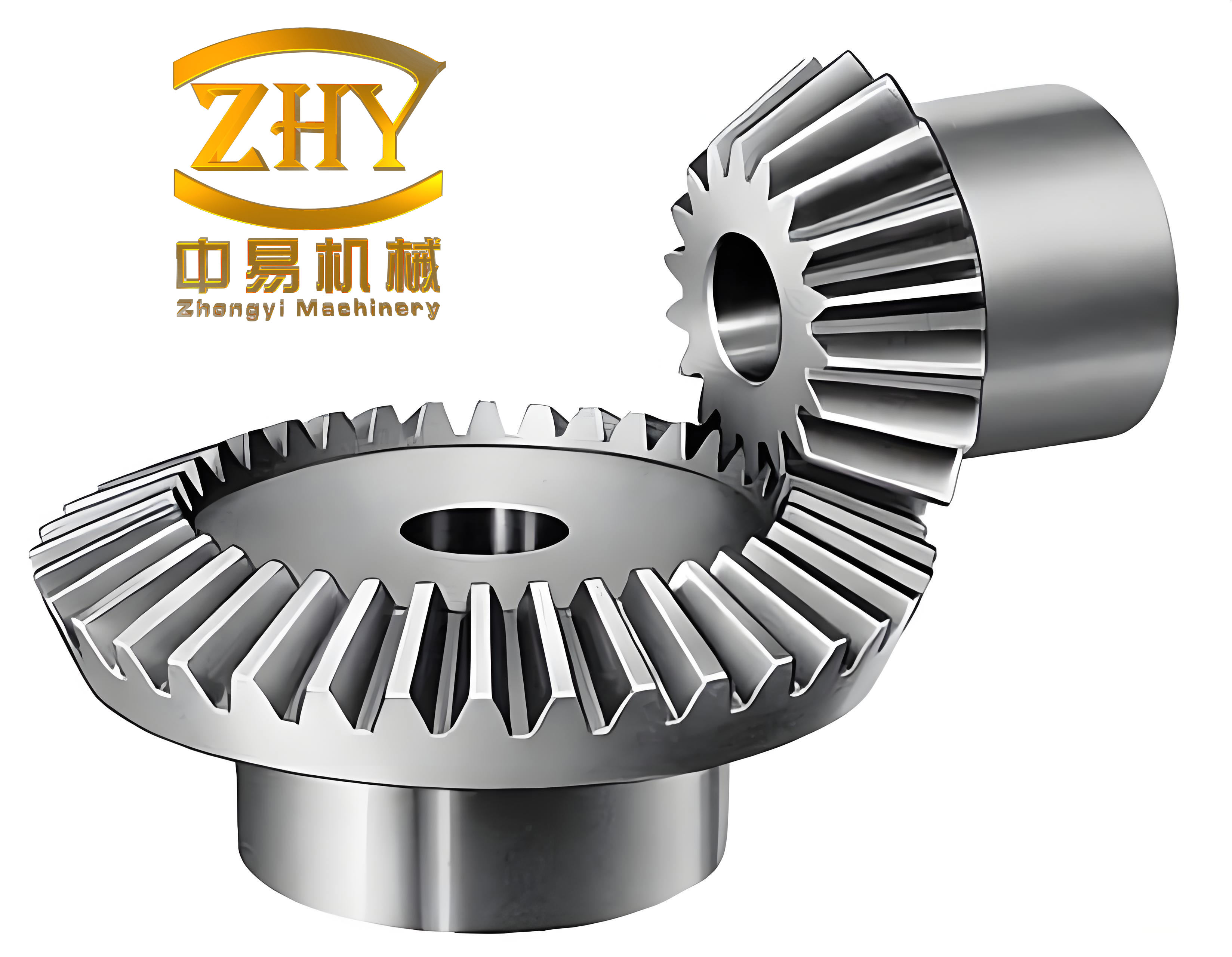
The image above illustrates a modeled straight bevel gear, showcasing the precise tooth geometry achieved through this method. The spherical involute profiles are visible, contributing to accurate啮合 characteristics.
Solid Modeling and Gear Completion
After generating all surface patches for a single tooth, I stitch them into a solid entity using the Sew command in UG. This solid tooth is then patterned around the gear axis. I calculate the angular pitch as $360^\circ / z$ and use the Instance Feature to create a circular array of teeth. For example, with $z=20$, I array the tooth 20 times at $18^\circ$ intervals.
Subsequently, I model the gear blank (hub and web) via rotational sketching. I create a sketch profile of the blank cross-section and revolve it around the gear axis using the Revolve command. Then, I perform a Boolean union operation (Unite) to merge all teeth with the blank, forming the complete straight bevel gear solid. To trim excess material (e.g., for keyways or reliefs), I design additional sketches and use the Trim Body tool with extruded or revolved surfaces as trimming tools. This yields the final gear model ready for analysis or assembly.
Table 2 outlines the key steps in the UG-based modeling process for straight bevel gears, emphasizing the sweep-forming method.
| Step | Action in UG | Description | Mathematical Basis |
|---|---|---|---|
| 1 | Define expressions | Input parameters ($m$, $z$, $\delta$, $\alpha$, etc.) and compute $\delta_b$ | $\delta_b = \arcsin(\sin \delta \cos \alpha)$ |
| 2 | Create spherical involute | Use Law Curve with parametric equations |
Spherical involute equations |
| 3 | Sweep along guide | Sweep involute along pitch cone generatrix | Guide curve from pitch cone |
| 4 | Mirror tooth flank | Mirror surface about pitch arc midpoint plane | $s = m(\pi/2 + 2 x_t \tan \alpha)$ |
| 5 | Close tooth volume | Add root arcs and side surfaces, then stitch | Geometry closure |
| 6 | Pattern teeth | Circular array of single tooth solid | Angular pitch = $360^\circ / z$ |
| 7 | Model blank and union | Revolve sketch for blank, Boolean unite | Rotational solid modeling |
| 8 | Trim and finish | Use trim bodies for final details | Feature-based editing |
Advantages and Applications
This precision modeling method offers several benefits for straight bevel gear design. First, by using spherical involutes instead of approximations, it minimizes geometric errors, which is crucial for high-load applications where tooth contact patterns affect efficiency and noise. Second, the parametric approach in UG allows rapid design iterations; modifying a few parameters (e.g., $m$, $z$, $\alpha$) automatically updates the entire gear model, saving time compared to manual redrawing. Third, the sweep-forming method ensures accurate tooth flank surfaces that can be directly used for finite element analysis (FEA) of stress and deformation, as well as for virtual assembly simulations to check啮合 and interference.
Moreover, the model supports advanced manufacturing preparations, such as generating CNC toolpaths for machining straight bevel gears. The accurate digital twin facilitates reverse engineering and quality inspection. In my experience, this method has proven reliable for designing straight bevel gears with varying specifications, from small precision instruments to heavy machinery transmissions.
Conclusion
In summary, I have presented a comprehensive approach for precision modeling of straight bevel gears using UG software. The core innovation lies in integrating spherical involute theory with UG’s expression tools and sweeping functions to achieve high-fidelity three-dimensional geometry. The method involves deriving exact mathematical equations for spherical involutes, calculating the base cone angle, and systematically building the gear via sweeping, mirroring, and solid operations. By emphasizing parameterization, it enhances design flexibility and accuracy. This methodology not only improves the modeling of straight bevel gears for analysis and virtual prototyping but also serves as a foundation for future extensions to spiral or hypoid bevel gears. The repeated focus on straight bevel gears throughout this process underscores their importance in mechanical systems and the value of precise digital representations.
For further refinement, one could explore automating the process via UG scripting (e.g., using GRIP or NX Open) to create a user-friendly interface for straight bevel gear design. Additionally, integrating this with gear manufacturing software could streamline production. Overall, this work demonstrates how advanced CAD techniques can overcome traditional limitations in gear modeling, paving the way for more efficient and reliable transmission design.