
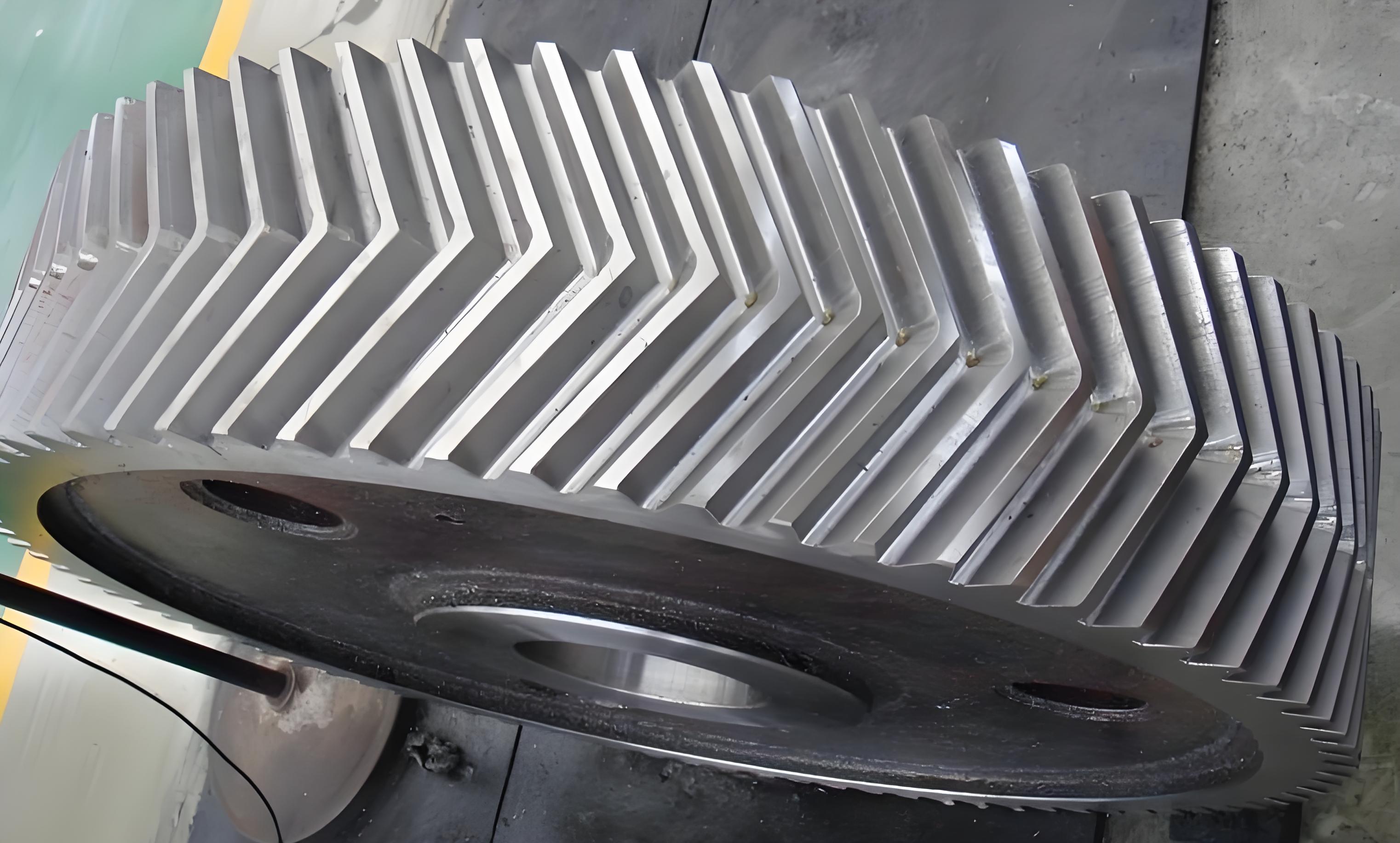
In the design of rolling mills, the structural integrity and precise calculation of the mill housing and the driving herringbone gears unit are paramount. Based on extensive engineering practice and theoretical analysis, I will systematically detail the design philosophies, force analyses, and calculation methodologies for various housing types and the critical herringbone gears assembly.
1. Overview of Rolling Mill Housings
Mill housings are fundamentally categorized into two primary types based on their structural configuration: open-top housings and closed housings. The choice between them is dictated by the required rigidity, roll-changing frequency, and the specific rolling process.
| Housing Type | Key Characteristics | Typical Applications | Advantages & Disadvantages |
|---|---|---|---|
| Open-Top Housing | Features a removable top cap or yoke; rolls are changed through the housing window. | Section mills, rebar mills, and any application requiring frequent roll changes. | Adv: Smaller footprint, simpler guides, easier roll changing without heavy cranes. Disadv: Generally lower rigidity compared to closed housings. |
| Closed Housing | A monolithic, closed-frame structure offering high rigidity. | Plate/Strip mills, cold tandem mills, high-speed wire rod blocks, and blooming/slabbing mills. | Adv: Exceptional stiffness and strength, minimal deformation under load. Disadv: Roll changing requires specialized equipment; larger and more massive. |
Furthermore, within open-top housings for three-high mills, “C-shaped” yokes are often employed to facilitate vertical removal of the roll chocks, simplifying adjustment of the middle roll.
2. External Force Analysis on the Housing
The housing is subjected to complex loading during operation. The primary forces are:
2.1 Vertical Rolling Force (P): This is the dominant load. For a two-high stand, the total rolling force is shared by the two housings. When the force is applied off-center between the bearings, the load on a single housing is calculated by statics. If the distance from the rolled stock to the left and right bearings are a and b respectively, and the total roll force is Ptotal, the force on one housing is:
$$P = \frac{P_{total} \cdot b}{a + b}$$
2.2 Horizontal Force (Q): Significant horizontal forces can arise during incidents such as cobbles, strip breakage in tension-controlled mills, or due to friction if the workpiece’s exit is obstructed. A conservative maximum estimate is derived from the maximum rolling torque:
$$Q_{max} = \frac{2 \cdot M_{max}}{D}$$
where $M_{max}$ is the maximum rolling torque and $D$ is the work roll diameter.
3. Calculation of Open-Top Mill Housings
The open-top housing with its removable top is modeled as a statically indeterminate rectangular frame, fixed at the bottom and with specific connection conditions at the top depending on the design (pin-type, wedge-type, open-type). The horizontal reaction force X at the connection is the key hyperstatic unknown.
3.1 General Force Model and Key Symbols:
| Symbol | Definition |
|---|---|
| $P$ | Max. rolling force on one housing. |
| $Q$ | Horizontal force on one housing. |
| $L_f$ | Neutral axis length of the bottom beam (or top/bottom beam for closed housing). |
| $L_c$ | Neutral axis length of the column. |
| $L_t$ | Neutral axis length of the top cap (for open housing). |
| $I_f$, $I_c$, $I_t$ | Moment of inertia of the beam, column, and top cap cross-sections. |
| $A_t$ | Cross-sectional area of the top cap. |
| $E$ | Modulus of elasticity. |
| $\Delta$ | Gap/clearance at the housing-top cap connection. |
3.2 Hyperstatic Force (X) Formulas for Different Open-Top Housing Types:
Using the force method and evaluating displacements at the connection point, the following general formulas are derived. For a three-high mill, calculations must consider rolling in both the top-middle and middle-bottom passes.
a) Wedge-Type Housing with Slanted Bottom (Top-Middle Rolling):
$$X = \frac{ \frac{P}{2}\left( \frac{L_c^2}{2I_c} + \frac{h_1 L_c}{I_c} \right) + \frac{Q}{2} \left( \frac{L_c^2}{2I_c} + \frac{c L_c}{I_c} \right) – \frac{P \cdot e \cdot L_f}{4 I_f} + \frac{Q \cdot d \cdot L_f}{4 I_f} – \frac{\Delta}{L_t} }{ \frac{L_c^3}{3E I_c} + \frac{L_f^3}{12E I_f} + \frac{L_t}{E A_t} }$$
Where $h_1$, $c$, $d$, $e$ are specific geometric distances defining force application points relative to neutral axes.
b) Wedge-Type Housing with Flat Bottom (Middle-Bottom Rolling):
$$X = \frac{ \frac{P}{2}\left( \frac{L_c^2}{2I_c} – \frac{h_2 L_c}{I_c} \right) + \frac{Q}{2} \left( \frac{L_c^2}{2I_c} + \frac{c L_c}{I_c} \right) + \frac{P \cdot e \cdot L_f}{4 I_f} + \frac{Q \cdot d \cdot L_f}{4 I_f} – \frac{\Delta}{L_t} }{ \frac{L_c^3}{3E I_c} + \frac{L_f^3}{12E I_f} + \frac{L_t}{E A_t} }$$
c) Open-Type (Hook-Type) Housing: The formulas simplify as the connection geometry differs. For top-middle rolling:
$$X = \frac{ \frac{P}{2} \cdot \frac{L_c^2}{2I_c} + \frac{P \cdot g \cdot L_f}{4 I_f} – \frac{\Delta}{L_t} }{ \frac{L_c^3}{3E I_c} + \frac{L_f^3}{12E I_f} + \frac{L_t}{E A_t} }$$
where $g$ is the distance from the roll force application point to the column’s neutral axis.
3.3 Stress Calculation in Housing Sections:
Once the hyperstatic force $X$ is determined, bending moments at critical sections (e.g., column roots, beam center) are calculated using static equilibrium. Stresses are then computed using the bending formula $\sigma = M y / I$ combined with direct stress where applicable. For the curved top cap, curved beam theory must be applied.
4. Calculation of Closed Mill Housings
The closed housing is modeled as a fully fixed rectangular frame. It is a three-fold statically indeterminate structure. The analysis yields formulas for the internal moments at the corners.
4.1 Under Vertical Rolling Force (P):
The internal moment $M_A$ at the corner (junction of beam and column) is given by:
$$M_A = P \cdot e \left[ \frac{1}{2} – \frac{ \frac{L_f}{I_f} }{ 2\left( \frac{L_f}{I_f} + \frac{L_c}{I_c} \right) } \right]$$
The bending moment at the center of the beam $M_{f,center}$ is:
$$M_{f,center} = \frac{P \cdot L_f}{4} – M_A$$
4.2 Under Horizontal Force (Q):
For a horizontal force $Q$ applied at heights $c_1$ and $c_2$ from the beam neutral axis, the corner moment $M_A$ is:
$$M_A = Q \left[ \frac{c_1 + c_2}{2} \cdot \frac{ \frac{L_c}{I_c} }{ 2\left( \frac{L_f}{I_f} + \frac{L_c}{I_c} \right) } – \frac{c_2}{2} \right]$$
5. Calculation of the C-Shaped Yoke
In three-high open-top housings, the C-yoke supports the middle roll chock. It is analyzed as a fixed-fixed arch frame. The two hyperstatic unknowns are the horizontal reaction $X_1$ and the moment $M_1$ at the fixed ends.
The general formulas, considering gaps $\Delta_1$ (between yoke and housing) and $\Delta_2$ (between yoke and chock), are complex. For simplicity, if gaps are negligible ($\Delta_1 = \Delta_2 = 0$), the solutions for a vertical force $P_y$ applied at the center of the yoke’s top beam simplify to:
$$X_1 = \frac{P_y \cdot L_{y1}}{2} \cdot \frac{ \frac{1}{I_{y2}} }{ \frac{L_{y1}}{I_{y1}} + \frac{2L_{y2}}{3I_{y2}} }$$
$$M_1 = \frac{P_y \cdot L_{y1}}{4} – X_1 \cdot L_{y2}$$
where $L_{y1}$, $I_{y1}$ are the length and inertia of the yoke’s horizontal beam, and $L_{y2}$, $I_{y2}$ are those of the vertical leg.
6. Design of Herringbone Gear Units
The herringbone gears unit is the critical drivetrain component transmitting high torque from the motor/pinion stand to the work rolls. Its housing must maintain precise gear alignment under heavy cyclic loading.
| Housing Type | Construction | Advantages | Disadvantages & Design Considerations |
|---|---|---|---|
| Open-Style (Split Horizontally) | One or two-piece cast body with a removable top cover. | Good sealing, robust, commonly used for large center distances. | Heavy single castings; requires large foundry and machining facilities. |
| Assembly-Style (Split Vertically) | Built from multiple steel castings (e.g., 4 segments) bolted together. | Reduces individual casting weight and size, accessible to smaller manufacturers. | Potential for oil leakage if bolts are under-designed; the housing wall between gear journals is a critical high-stress area. |
6.1 Force Analysis on Herringbone Gear Housing:
Forces are derived from the transmitted torque $M_t$, which is related to the maximum rolling torque. The gear mesh generates both tangential (horizontal) and separating (vertical) forces.
- Horizontal Force per Bearing: $Q_h = \frac{M_t}{D_p}$ where $D_p$ is the gear pitch diameter.
- Vertical Force per Bearing: $Q_v = Q_h \cdot \tan(\alpha)$, where $\alpha$ is the pressure angle (typically 20°). For $\alpha=20°$, $Q_v \approx 0.364 \cdot Q_h$.
6.2 Connection Bolt Load Calculation:
In assembly-style housings, the bolts must preload the segments and resist operational prying forces. The tensile load on the top row of bolts is critical and is given by:
$$F_{bolt, top} = \frac{Q_v}{2} + \frac{Q_h \cdot H}{B} + \frac{W_{top}}{2}$$
where $H$ is the height from force application to bolt center, $B$ is the distance between left and right bolt groups, and $W_{top}$ is the weight of the top housing segment.
6.3 Stress Analysis in Herringbone Gear Housing Sections:
Critical sections are analyzed under combined bending and direct stress. For the curved top cover of an open-style housing, curved beam theory is essential. The stress at the outer fiber $\sigma_o$ and inner fiber $\sigma_i$ are:
$$\sigma_o = \frac{M}{A \cdot e} \cdot \frac{r_o}{r_n}, \quad \sigma_i = -\frac{M}{A \cdot e} \cdot \frac{r_i}{r_n}$$
where $M$ is the bending moment, $A$ is the cross-sectional area, $e$ is the distance from the centroidal axis to the neutral axis ($e = R – r_n$), $r_n$ is the radius of the neutral axis, and $r_o$, $r_i$ are the outer and inner radii.
For the thin section between gear journals in an assembly-style housing, stress is a major concern:
$$\sigma = \frac{M}{Z} + \frac{F_{bolt}}{A}$$
where $Z$ is the section modulus and $A$ is the area of the vulnerable cross-section.
7. Summary of Key Formulas
| Component | Key Formula / Principle |
|---|---|
| General Housing Load | $P = \frac{P_{total} \cdot b}{a+b}$; $Q_{max} = \frac{2 M_{max}}{D}$ |
| Open-Top Housing Hyperstatic Force | $X = \frac{[\text{Displacement due to external loads}] – \Delta/L_t}{[\text{Flexibility coefficients}]}$ (See specific forms in Section 3.2) |
| Closed Housing Corner Moment | $M_A = P \cdot e \left[ \frac{1}{2} – \frac{ L_f/I_f }{ 2(L_f/I_f + L_c/I_c) } \right]$ |
| Herringbone Gears Mesh Forces | $Q_h = M_t / D_p$; $Q_v = Q_h \cdot \tan(\alpha)$ |
| Herringbone Gears Housing Bolt Load | $F_{bolt, top} = \frac{Q_v}{2} + \frac{Q_h \cdot H}{B} + \frac{W_{top}}{2}$ |
| Curved Beam Stress (for Housing Caps) | $\sigma_o = \frac{M}{A e} \cdot \frac{r_o}{r_n}$; $\sigma_i = -\frac{M}{A e} \cdot \frac{r_i}{r_n}$ |
In conclusion, the successful design of rolling mill equipment hinges on a rigorous analytical approach to both the mill housing and the herringbone gears drive unit. The housing must be treated as a statically indeterminate structure to accurately determine internal moments and stresses under complex rolling and fault-condition loads. Simultaneously, the herringbone gears unit demands careful attention to force transmission, housing rigidity, and connection design to ensure reliable, long-term operation. The widespread use of herringbone gears in high-power applications is a testament to their smooth torque transmission capability, but their supporting structure requires equally sophisticated engineering to match their performance.