
In the field of precision motion control and power transmission, harmonic drive gears stand out due to their unique operating principle and exceptional performance characteristics. The fundamental mechanism, conceptualized by C.W. Musser, relies on the controlled elastic deformation of a flexible spline, or flexspline, by a wave generator, which meshes with a rigid circular spline. This interaction produces a high reduction ratio in a compact, lightweight package with minimal backlash, high torque capacity, and excellent positional accuracy. These attributes have cemented the harmonic drive gear’s role in demanding applications such as aerospace robotics, satellite positioning systems, industrial automation, and advanced medical equipment.
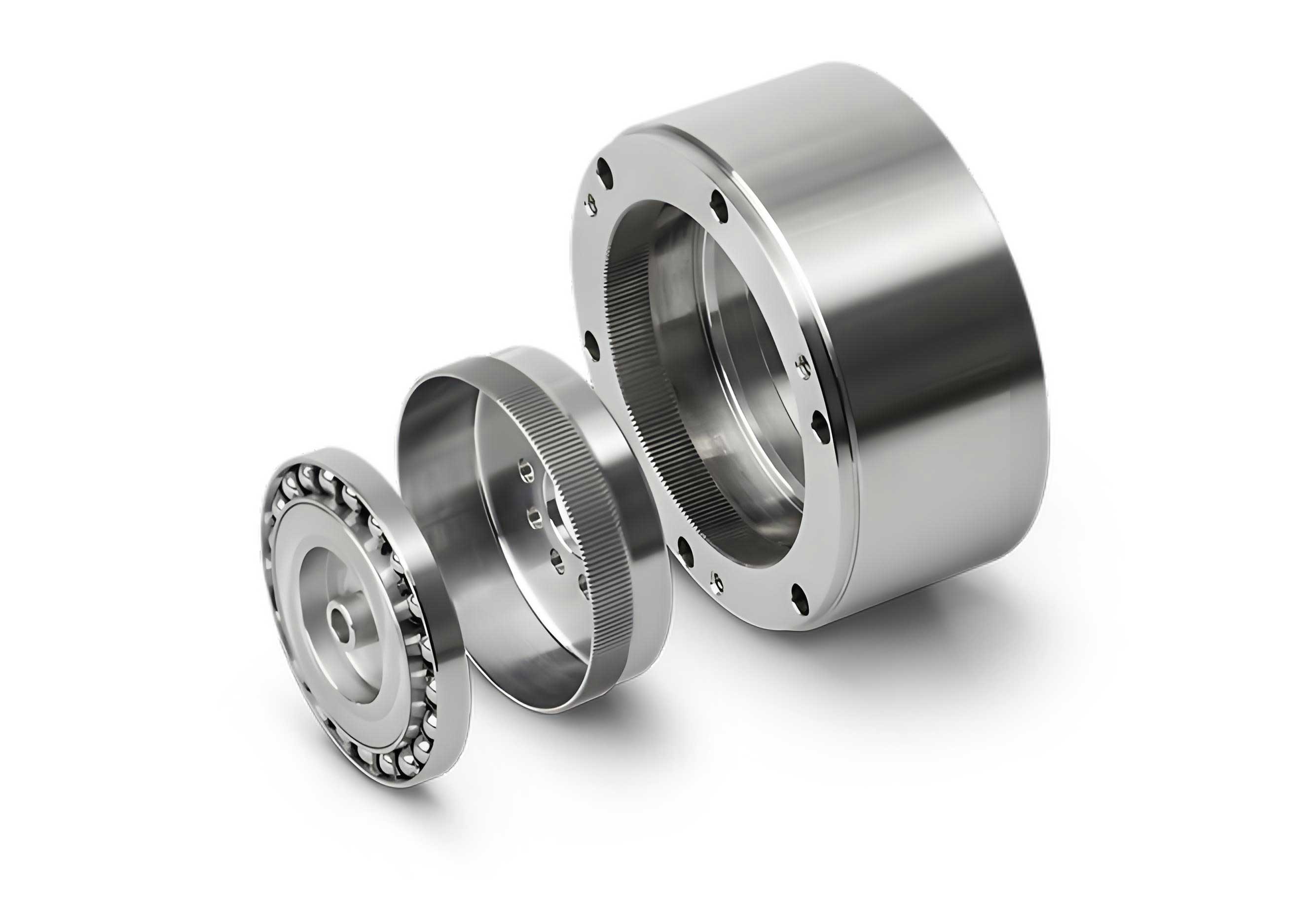
The performance and longevity of a harmonic drive gear are intrinsically linked to the geometry of the teeth on both the flexspline and the circular spline. Traditional designs often employ involute or simple circular-arc profiles. However, research indicates significant advantages in moving towards a double-circular-arc tooth profile. This design, featuring distinct convex and concave arc segments on a single tooth, can substantially improve the stress distribution at the root of the flexspline tooth—a common site for fatigue failure. Furthermore, it promotes more uniform load sharing among a greater number of simultaneously engaged teeth, enhances torsional stiffness, and allows for better control over the meshing clearance, potentially achieving near-zero backlash. This article details a comprehensive methodology for designing the basic double-circular-arc tooth profile for harmonic drive gears, validating the design through three-dimensional CAD modeling and finite element analysis (FEA) to simulate the critical deformation process.
Mathematical Foundation for Double-Circular-Arc Flexspline Design
The design begins with defining the precise geometry of the flexspline tooth. The objective is to create a profile composed of two connected circular arcs: a convex arc near the tooth tip and a concave arc near the tooth root. The coordinate system for the flexspline tooth is established as shown in previous literature, with the y-axis aligned along the tooth’s centerline. The key design parameters for the convex and concave arcs must be determined through an optimization process based on the kinematic and static requirements of the harmonic drive gear meshing. The primary geometric parameters for one flank of the tooth are illustrated and defined as follows:
| Parameter Symbol | Description |
|---|---|
| \( R_1 \) | Radius of the convex arc. |
| \( R_2 \) | Radius of the concave arc. |
| \( A_1 \) | Offset of the convex arc center. |
| \( A_4 \) | Center shift of the convex arc. |
| \( A_7 \) | Center shift of the concave arc. |
| \( A_{10} \) | Offset of the concave arc center. |
| \( t \) | Wall thickness of the flexspline. |
| \( \theta \) | Pressure angle variable on the convex arc. |
| \( \beta \) | Pressure angle variable on the concave arc. |
The coordinates of the arc centers and the parametric equations for the tooth flanks can be derived. For the right-side convex flank, the center coordinates \((x_{o_a}, y_{o_a})\) are given by:
$$ x_{o_a} = -A_1 $$
$$ y_{o_a} = A_6 – A_5 + \frac{t}{2} $$
where \(A_5\) and \(A_6\) are additional geometric constants related to the tooth space. The parametric equation for this convex surface in 3D space is:
$$ \mathbf{r}_{11} = (R_1 \cos \theta – x_{o_a})\mathbf{i} + (R_1 \sin \theta – y_{o_a})\mathbf{j} + u_a \mathbf{k} $$
Here, \(u_a\) is the extrusion parameter along the tooth length (z-direction).
Similarly, for the right-side concave flank, the center coordinates \((x_{o_f}, y_{o_f})\) are:
$$ x_{o_f} = A_9 + A_{10} $$
$$ y_{o_f} = A_7 + \frac{t}{2} $$
The corresponding parametric equation is:
$$ \mathbf{r}_{12} = (x_{o_f} – R_2 \cos \beta)\mathbf{i} + (y_{o_f} – R_2 \sin \beta)\mathbf{j} + u_f \mathbf{k} $$
The parameters \(A_4, A_1, R_1, A_7, A_{10}, R_2\) are not arbitrarily chosen. They are the result of an optimization procedure that ensures proper conjugate motion between the flexspline and circular spline throughout the engagement cycle, minimizing stress concentration and ensuring kinematic correctness. The goal of this optimization for the double-circular-arc harmonic drive gear is to maximize the “double-conjugate” zone, where both the convex and concave flanks of the flexspline are simultaneously in proper contact with their corresponding mating flanks on the circular spline.
Deriving the Circular Spline Profile Using the H-Matrix Method
Once the flexspline tooth profile \(\mathbf{\tilde{R}}\) is defined, the conjugate profile for the circular spline \(\mathbf{\tilde{G}}\) must be derived. A powerful and general method for this is the use of the invariant \(H\)-matrix. This approach formulates the meshing condition for harmonic drive gears directly in matrix form, applicable to any tooth profile and neutral curve deformation. The method avoids repeated velocity calculations for different conjugate surfaces.
Three coordinate systems are defined: \(\{OXY\}\) fixed to the wave generator, \(\{o_1x_1y_1\}\) fixed to the flexspline tooth, and \(\{o_2x_2y_2\}\) fixed to the circular spline tooth space. The fundamental spatial meshing condition requires that the relative velocity at the contact point between the two surfaces is perpendicular to the common normal vector. This condition can be expressed compactly as:
$$ \mathbf{n}^{(1)T} \cdot \mathbf{H_1} \cdot \mathbf{r}^{(1)} = 0 $$
where \(\mathbf{n}^{(1)}\) is the unit normal vector to the flexspline tooth surface at the potential contact point, \(\mathbf{r}^{(1)}\) is the position vector of that point in the flexspline tooth coordinate system, and \(\mathbf{H_1}\) is the spatial meshing matrix.
The matrix \(\mathbf{H_1}\) encapsulates the kinematics of the harmonic drive gear, including the radial (\(w\)) and tangential (\(v\)) displacements of the flexspline’s neutral curve, their spatial derivatives, and the rotation of the wave generator. Its general form is:
$$
\mathbf{H_1} = \begin{bmatrix}
0 & -c_w c_v \dot{\psi} – s_w \dot{\theta}_v & \cdots & 0 \\
c_w c_v \dot{\psi} + s_w \dot{\theta}_v & 0 & \cdots & 0 \\
\vdots & \vdots & \ddots & \vdots \\
0 & 0 & \cdots & 0
\end{bmatrix}
$$
where \(c_\alpha = \cos \alpha\), \(s_\alpha = \sin \alpha\), \(\theta_w = w/L\), \(\theta_v = v/L\), \(L\) is the cylinder length, \(\psi\) is a rotation parameter, and \(\Delta \phi\) is the angle of the wave generator. The dots denote time derivatives.
For planar analysis, a simplified invariant matrix \(\mathbf{H_2}\) can be derived:
$$
\mathbf{H_2} = \begin{bmatrix}
0 & \dot{\psi} & 0 & -\dot{w} \sin \mu – \rho \Delta \dot{\phi} \cos \mu \\
-\dot{\psi} & 0 & 0 & \dot{w} \cos \mu – \rho \Delta \dot{\phi} \sin \mu \\
0 & 0 & 0 & 0 \\
0 & 0 & 0 & 0
\end{bmatrix}
$$
where \(\mu\) is the angle of the normal to the deformed neutral curve and \(\rho\) is a curvature-related parameter. The corresponding planar meshing equation is:
$$ \mathbf{n}^{(1)T} \cdot \mathbf{H_2} \cdot \mathbf{r}^{(1)} = 0 $$
By solving either equation along with the surface equation \(\mathbf{r}^{(1)}(\theta, u)\) for a given wave generator position (i.e., a given \(\Delta \phi\)), one obtains the coordinates of the contact point in the flexspline system. These coordinates are then transformed via the kinematic chain (following the motion of the neutral curve point \(c\) along \(\mathbf{\tilde{C}}\) and the relative rotation) into the circular spline coordinate system \(\{o_2x_2y_2\}\). Repeating this process for successive points on the flexspline tooth and for a full rotation of the wave generator yields the complete conjugate tooth profile of the circular spline for the harmonic drive gear.
Design Example and 3D Modeling Validation
To demonstrate the methodology, a specific design case for a harmonic drive gear is presented. The primary design inputs are based on a common configuration:
| Parameter | Value | Description |
|---|---|---|
| \(z_f\) | 100 | Number of flexspline teeth. |
| \(z_c\) | 102 | Number of circular spline teeth. |
| \(i\) | 50 | Gear ratio (\(z_c / (z_c – z_f)\)). |
| \(m\) | 0.5 mm | Module. |
| \(\omega_0\) | 0.5 | Deformation coefficient. |
| Wave Generator Amplitude | 0.39 mm | Radial deformation (wave height). |
Using the optimization process referenced for the double-circular-arc profile, the following geometric parameters for the flexspline were determined:
$$ A_4 = 1.3 \text{ mm}, \quad A_1 = 4.0 \text{ mm}, \quad R_1 = 5.0 \text{ mm} $$
$$ A_7 = 1.6 \text{ mm}, \quad A_{10} = 1.0 \text{ mm}, \quad R_2 = 0.4 \text{ mm} $$
From these, the key diameters of the harmonic drive gear components were calculated. The flexspline’s tip diameter was found to be Ø62.6 mm and its root diameter Ø61.1 mm. Applying the H-matrix meshing theory, the conjugate circular spline profile was generated, resulting in a tip diameter of Ø63.9 mm and a root diameter of Ø62.3 mm.
The two-dimensional profiles were imported into SolidWorks, a 3D CAD software. The profiles were extruded and cut to create solid models of the flexspline and the circular spline. An elliptical disk representing the wave generator was also modeled. These three components were then assembled coaxially. The assembly clearly visualizes the fundamental operating principle of the harmonic drive gear: at the major axis of the wave generator, the flexspline teeth are fully engaged with the circular spline teeth; at the minor axis, they are completely disengaged. In the quadrants between the axes, the teeth transition through the engagement (meshing-in) and disengagement (meshing-out) phases. This “misalignment” motion, where the wave generator’s rotation causes a progressive shift in the engagement pattern, is the source of the high reduction ratio. The 3D model confirmed the absence of gross geometric interference and provided a clear visual validation of the tooth profile design for the double-circular-arc harmonic drive gear before proceeding to more computationally intensive stress analysis.
Finite Element Analysis of Flexspline Deformation
To assess the structural behavior and validate the design under load, a finite element analysis (FEA) of the flexspline was performed. The flexspline is typically the most critically stressed component in a harmonic drive gear, prone to fatigue failure at the tooth root. The analysis focused on simulating the elastic deformation induced by the wave generator, excluding the dynamic effects of transmitted torque for this initial validation.
The 3D model from SolidWorks was exported in Parasolid format and imported into ANSYS 12.0. The material was defined as 35Si2Mn alloy steel, common for high-stress flexspline applications, with an elastic modulus \(E = 197\) GPa and a Poisson’s ratio \(\nu = 0.3\). The element type SOLID185, an 8-node brick element suitable for 3D modeling of elastic deformation, was selected. Due to the double symmetry of the deformation (about two orthogonal planes through the major and minor axes), only one-quarter of the tooth ring was modeled to significantly reduce computational cost. The thin-walled cup section of the flexspline was omitted, concentrating the mesh on the critical tooth-ring region. The mesh was generated using a sweep method after partitioning the geometry into more regular volumes, resulting in a high-quality hexahedral dominant mesh.
The contact between the flexspline’s inner bore and the wave generator was defined as a surface-to-surface contact pair. The wave generator was treated as a rigid target surface (TARGE169), with a pilot node at its geometric center where all boundary conditions were applied. The inner surface of the flexspline was defined as the deformable contact surface (CONTA173). Friction was initially neglected. Symmetry boundary conditions were applied to the two cut faces of the quarter model. The pilot node of the rigid wave generator was fixed in all degrees of freedom (\(ALL DOF = 0\)), and a radial displacement corresponding to the theoretical wave generator amplitude was applied to the flexspline model indirectly through the contact interaction. The system was then solved for static structural deformation.
The post-processing results, displayed in a cylindrical coordinate system, provided critical insights. The radial displacement contour plot revealed a maximum radial deformation of approximately 0.3884 mm at the major axis region. This value is in excellent agreement with the theoretical design wave amplitude of 0.39 mm, with the minor discrepancy attributable to numerical approximation and the discrete nature of the finite element model. This close correlation validates that the FEA model accurately captures the global deformation kinematics of the harmonic drive gear flexspline.
More importantly, the elastic strain contour plot illuminated the stress distribution within the tooth ring. The analysis showed that the maximum strains were concentrated at the tooth fillet and root regions, as expected. However, the strain gradient appeared smooth without severe localized peaks that would indicate a geometric stress concentrator. The deformation of the tooth profile itself under the applied wave generator displacement was observed to be primarily a smooth bending, without indications of profile distortion that would lead to detrimental interference with the circular spline during meshing. The results suggest that the chosen double-circular-arc profile parameters successfully accommodate the required elastic deformation without inducing critical stress risers, thereby supporting the potential for improved fatigue life in this harmonic drive gear design.
Conclusion
This research presents a complete and systematic approach to the design and preliminary validation of a double-circular-arc tooth profile for harmonic drive gears. The methodology begins with the parametric definition of the flexspline’s convex and concave arc segments, whose dimensions are optimized for favorable meshing conditions. The conjugate circular spline profile is rigorously derived using the invariant H-matrix method, a powerful technique that generalizes the meshing condition for any harmonic drive gear geometry. A practical design example demonstrates the application of these theoretical tools, resulting in specific geometric parameters for both the flexspline and circular spline.
The integration of 3D CAD modeling in SolidWorks provided an essential visual and qualitative check for assembly, interference, and the kinematic sequence of engagement and disengagement inherent to the harmonic drive gear system. The subsequent finite element analysis in ANSYS offered a quantitative assessment of the flexspline’s deformation behavior under the action of the wave generator. The FEA results confirmed that the theoretical radial deformation was accurately achieved and, crucially, that the induced strain patterns in the double-circular-arc tooth were manageable, with no evidence of problematic geometric stress concentrations that could compromise performance or durability.
In summary, the combined use of analytical geometry, kinematic theory via the H-matrix, 3D CAD, and finite element simulation forms a robust, iterative design framework for advanced harmonic drive gear profiles. The double-circular-arc design, validated through this framework, shows significant promise for enhancing the load distribution, torsional stiffness, and fatigue resistance of harmonic drive gears, paving the way for their use in even more demanding precision applications. The seamless integration of CAE and CAD tools, as demonstrated, is indispensable for achieving such performance leaps in complex mechanical system design.