
In modern defense systems, the missile launch vehicle represents a critical component for rapid deployment and firing. Its erection mechanism, responsible for safely raising the missile from a horizontal transport position to a vertical launch stance, relies heavily on precision power transmission components. Among these, the spiral bevel gear pair is pivotal due to its ability to transmit high torque and power between intersecting shafts at high efficiency. However, the operational environment is fraught with uncertainties: missile weight can vary significantly with different mission payloads, and the erection angle may deviate from the planned trajectory. These variations cause the load on the spiral bevel gear transmission to fluctuate, altering meshing forces and dynamic transmission characteristics. Consequently, the system’s dynamic frequency—the vibrational frequency response during operation—becomes unstable. This instability can lead to increased noise, accelerated fatigue, reduced positioning accuracy, and ultimately, a compromise in the system’s reliability and rapid-response capability. Traditional single-loop control strategies often struggle to handle such complex, coupled disturbances in real-time.
To address this challenge, we propose a comprehensive two-tier control methodology for the dynamic frequency of spiral bevel gears in missile launcher erection devices. This approach synergistically combines offline static parameter optimization with online adaptive dynamic control. The first layer involves the static optimization of key spiral bevel gear design parameters using a metaheuristic algorithm to build a robust foundation that inherently minimizes vibration. The second layer implements a real-time, adaptive controller that continuously monitors the system’s vibrational state and compensates for unpredictable load and angle variations. This hybrid strategy ensures stable dynamic frequency across all operational scenarios, enhancing the performance and longevity of the erection system.
1. Real-Time Monitoring of Spiral Bevel Gear Dynamic Frequency
The cornerstone of effective control is accurate state observation. The dynamic frequency of a spiral bevel gear refers to its predominant vibrational frequency during operation, which is directly influenced by meshing stiffness variations, transmission error, and fluctuating loads. To capture this in real-time, we instrument the gearbox housing near the mesh zone with high-sensitivity piezoelectric accelerometers. When the gear vibrates, the piezoelectric crystal inside the sensor deforms, generating a proportional electrical charge.
The fundamental piezoelectric relationship is given by:
$$ A = \phi \cdot m \cdot a $$
where \( A \) is the generated charge, \( \phi \) is the piezoelectric coefficient, \( m \) is the mass of the seismic element, and \( a \) is the vibration acceleration. This charge is converted into a measurable voltage \( U \) by the sensor’s internal capacitance \( C \):
$$ U = \frac{A}{C} $$
The actual vibration acceleration is then derived using the sensor’s sensitivity \( S \):
$$ a = S \cdot U $$
The raw signal \( a(t) \) is inevitably contaminated with noise from bearings, motors, and other mechanical sources. To isolate the true gear vibration signature, we employ Blind Source Separation (BSS) via Independent Component Analysis (ICA). The observed mixed signal \( \mathbf{X}(t) \) is assumed to be a linear combination of independent source signals \( \mathbf{S}(t) \) (gear vibration and noise):
$$ \mathbf{X}(t) = \mathbf{M} \mathbf{S}(t) $$
where \( \mathbf{M} \) is an unknown mixing matrix. ICA estimates a separation matrix \( \mathbf{W} \) to recover the independent components \( \hat{\mathbf{S}}(t) \):
$$ \hat{\mathbf{S}}(t) = \mathbf{W} \mathbf{X}(t) $$
The gear vibration signal \( \hat{a}(t) \) is extracted from \( \hat{\mathbf{S}}(t) \). Finally, the dynamic frequency spectrum \( F(\omega) \) is obtained by applying the Fast Fourier Transform (FFT) to the cleaned signal:
$$ F(\omega) = \int_{-\infty}^{\infty} \hat{a}(t) e^{-j\omega t} dt $$
The dominant frequency component \( \omega_d \) in this spectrum is identified as the real-time dynamic frequency of the spiral bevel gear system.
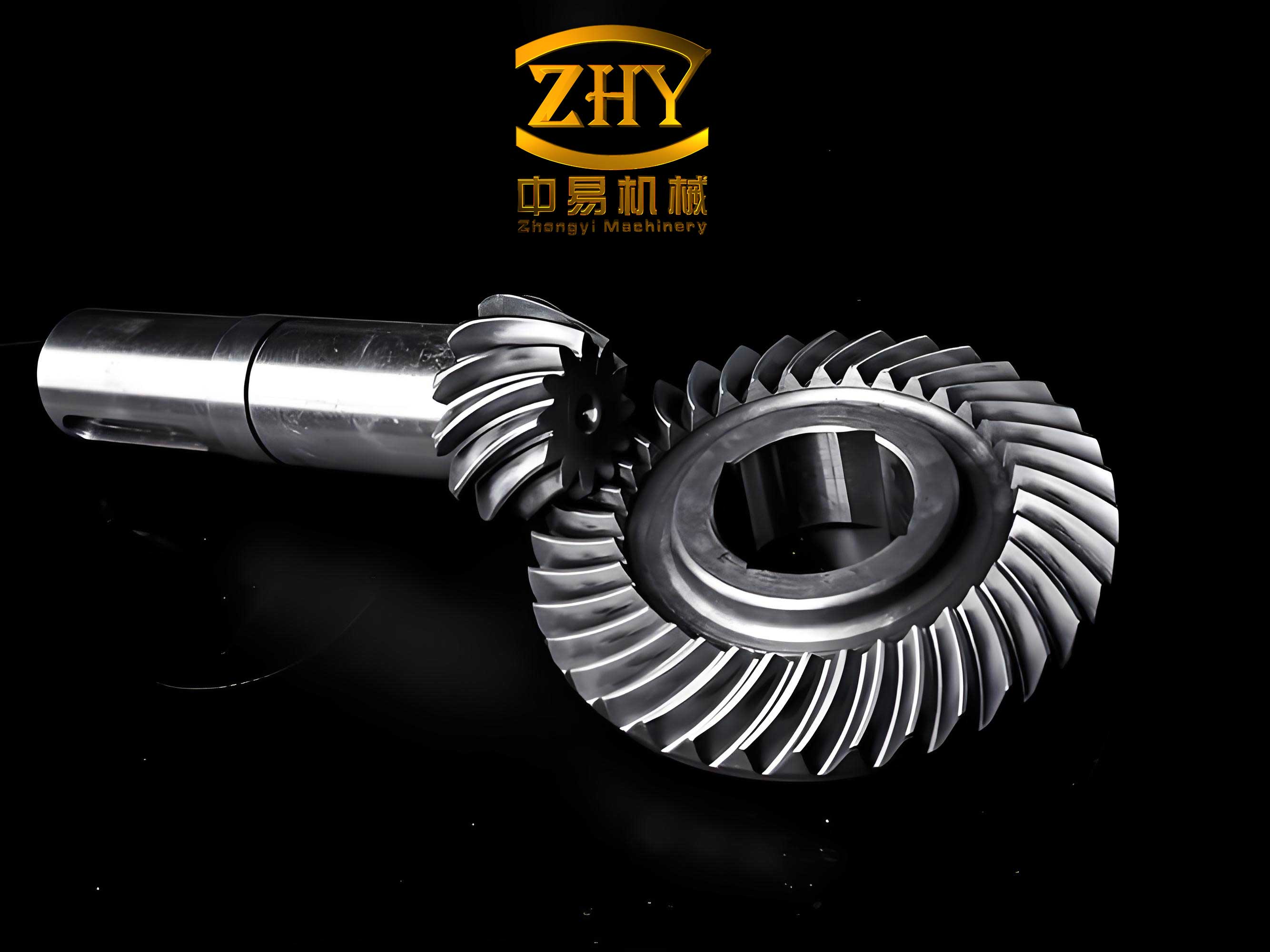
2. Static Control Layer: Parameter Optimization Using the Seagull Optimization Algorithm (SOA)
Manufacturing inaccuracies and assembly errors (e.g., profile error, axial misalignment) introduce inherent excitations that destabilize dynamic frequency. The static control layer aims to mitigate this by optimizing key design parameters of the spiral bevel gear pair to create a geometry less susceptible to vibration. We focus on four critical parameters, as defined below:
| Parameter | Definition | Typical Range |
|---|---|---|
| Pressure Angle (\( \alpha \)) | Angle between the tooth profile normal and the pitch circle tangent at the contact point. | 20° – 25° |
| Spiral Angle (\( \beta \)) | Angle between the tooth trace and the generatrix of the pitch cone. | 25° – 35° |
| Axial Backlash (\( B_a \)) | Clearance between non-working flanks along the gear axis. | 0.05 – 0.15 mm |
| Radial Backlash (\( B_r \)) | Clearance between non-working flanks along the radial direction. | 0.8 – 2.4 mm |
We formulate the optimization problem with the objective of minimizing the Root Mean Square (RMS) of vibration acceleration, a direct indicator of dynamic severity. The Seagull Optimization Algorithm (SOA), which mimics the migration and attacking behaviors of seagulls, is employed to solve this problem due to its strong global search capability and convergence speed.
Optimization Problem Formulation:
Find the parameter set \( \mathbf{P} = [\alpha, \beta, B_a, B_r] \) within their respective bounds that minimizes:
$$ f(\mathbf{P}) = \sqrt{\frac{1}{T} \int_0^T a^2(\mathbf{P}, t) \, dt } $$
where \( a(\mathbf{P}, t) \) is the simulated or measured vibration acceleration over time \( T \) for a given parameter set.
SOA Implementation Steps:
- Initialization: A population of \( N \) seagulls (candidate solutions \( \mathbf{P}_i \)) is randomly generated within the defined parameter ranges.
- Fitness Evaluation: The fitness \( f(\mathbf{P}_i) \) for each seagull is computed.
- Behavior Simulation:
- Migration (Exploration): Seagulls move towards the best-known position \( \mathbf{P}_{best} \) while avoiding collisions:
$$ \mathbf{D}_s = | \mathbf{A} \cdot \mathbf{P}_i + \mathbf{C} \cdot (\mathbf{P}_{best} – \mathbf{P}_i ) | $$
where \( \mathbf{A} \) and \( \mathbf{C} \) are control coefficients for exploration and balancing. - Attack (Exploitation): Seagulls perform spiral movements during the dive:
$$ \mathbf{P}_i^{new} = \mathbf{D}_s \cdot (x’ \cdot y’ \cdot z’) + \mathbf{P}_{best} $$
The coordinates \( x’, y’, z’ \) define the spiral attack path.
- Migration (Exploration): Seagulls move towards the best-known position \( \mathbf{P}_{best} \) while avoiding collisions:
- Update & Check: Update positions, enforce boundary constraints, and re-evaluate fitness.
- Termination: Repeat steps 3-4 until the maximum iteration count is reached, outputting the optimal parameter set \( \mathbf{P}_{opt} \).
The optimized parameters are then implemented in the gear design and assembly phase, constituting the static control action that reduces the system’s inherent tendency for dynamic frequency fluctuation.
3. Dynamic Control Layer: Adaptive Regulation via Fractional-Order Internal Model PID (FO-IMC-PID)
While static optimization provides a robust baseline, it cannot compensate for real-time, unpredictable disturbances like sudden payload changes. The dynamic control layer closes this loop. It uses the real-time monitored dynamic frequency \( \omega_d(t) \) as feedback. The error between this value and the desired setpoint \( \omega_{set} \) is fed into an advanced controller.
We design a Fractional-Order Internal Model PID (FO-IMC-PID) controller for its superior robustness and ability to handle system nonlinearities and model uncertainties common in spiral bevel gear dynamics.
Controller Design Process:
1. Process Model: A first-order-plus-dead-time (FOPDT) model is often sufficient to represent the dominant dynamics from control input (e.g., servo motor torque adjustment) to output dynamic frequency:
$$ G_p(s) = \frac{K}{\tau s + 1} e^{-\theta s} $$
where \( K \) is gain, \( \tau \) is time constant, \( \theta \) is time delay.
2. Internal Model Control (IMC) Design: The IMC controller \( Q(s) \) is designed as the inverse of the process model’s invertible part, filtered for robustness:
$$ Q(s) = G_{p-}^{-1}(s) F(s) = \frac{\tau s + 1}{K} \cdot \frac{1}{(\lambda s + 1)^r} $$
where \( \lambda \) is the filter time constant and \( r \) is its order.
3. Equivalent Feedback Controller: The IMC structure is converted to an equivalent classical feedback controller \( G_c(s) \):
$$ G_c(s) = \frac{Q(s)}{1 – G_p(s)Q(s)} $$
Substituting the FOPDT model and using a first-order Padé approximation for the delay \( e^{-\theta s} \approx (1 – \frac{\theta}{2}s)/(1 + \frac{\theta}{2}s) \), we derive the PID-like structure.
4. Fractional-Order Enhancement: To gain more tuning flexibility, the standard PID is extended to a Fractional-Order PID (FOPID) form:
$$ G_c(s) = K_p + K_i s^{-\lambda} + K_d s^{\mu} $$
where \( K_p, K_i, K_d \) are proportional, integral, and derivative gains, and \( \lambda, \mu \) are the fractional orders of integration and differentiation (\( 0 < \lambda, \mu < 1 \)).
5. Control Law: The final control signal \( u(t) \) computed by the FO-IMC-PID controller is:
$$ u(t) = K_p e(t) + K_i D_t^{-\lambda} e(t) + K_d D_t^{\mu} e(t) $$
where \( e(t) = \omega_{set} – \omega_d(t) \) is the frequency error, and \( D_t \) denotes the fractional-order differential operator.
This controller continuously adjusts the actuation (e.g., fine-tuning the drive motor’s torque or speed) to suppress any deviation in the spiral bevel gear‘s dynamic frequency caused by operational disturbances, ensuring stable meshing conditions.
4. Experimental Validation and Performance Analysis
The proposed hybrid method was validated on a dedicated test rig simulating a missile launcher erection drive train. The setup included a spiral bevel gearbox, an electro-hydraulic loading system to simulate variable missile weight, and a servo drive for angle positioning. Vibration was monitored using calibrated piezoelectric accelerometers.
4.1 Static Control Results
The SOA was executed to optimize the four key parameters. The results before and after optimization are summarized below:
| Parameter | Initial Value | SOA-Optimized Value |
|---|---|---|
| Pressure Angle (\( \alpha \)) | 22° | 23.5° |
| Spiral Angle (\( \beta \)) | 30° | 28.2° |
| Axial Backlash (\( B_a \)) | 0.12 mm | 0.07 mm |
| Radial Backlash (\( B_r \)) | 1.05 mm | 0.92 mm |
The effect of this static optimization was quantified by the reduction in vibration acceleration RMS under a standard load. A finite element analysis simulation of the gear dynamics confirmed the improvement:
$$ RMS_{initial} \approx 22.5 \, \text{g} \quad \rightarrow \quad RMS_{optimized} \approx 15.8 \, \text{g} $$
This significant reduction (nearly 30%) validates the effectiveness of the parameter optimization in building a passively stable gear system.
4.2 Dynamic Control Performance
The performance of the FO-IMC-PID controller was tested under two demanding transient conditions and compared against three established methods: a Neural Network Controller (NNControl), a Self-Tuning PID Controller (AutoPID), and an RBF Neural Network Controller (RBFNNControl). The key performance metric was the maximum overshoot (%) in dynamic frequency following a disturbance.
| Control Method | Overshoot (%) | |
|---|---|---|
| Condition 1: Speed Step Change | Condition 2: Load Torque Step Change | |
| NNControl | 4.2 | 6.8 |
| AutoPID | 3.5 | 5.1 |
| RBFNNControl | 2.1 | 3.3 | Proposed FO-IMC-PID | 0.8 | 0.9 |
The results clearly demonstrate the superiority of the proposed FO-IMC-PID. Its overshoot remained below 1.0% in both highly dynamic scenarios, substantially outperforming the other methods. This indicates an exceptional ability to dampen oscillations and quickly regulate the spiral bevel gear dynamic frequency back to its setpoint.
4.3 Overall Hybrid System Performance
The combined effect of static and dynamic control was evaluated by tracking the dynamic frequency over an extended operational sequence involving load and angle variations. The static-only control showed improved stability over an uncontrolled system but exhibited drift and larger deviations over time. The integration of the FO-IMC-PID dynamic controller effectively eliminated this drift, maintaining the frequency within a tight band around the desired 1.0 Hz reference, with a settling time of under 2 seconds for disturbances.
Furthermore, the system’s robustness was tested under varying environmental conditions. The control stability—defined as the percentage of time the dynamic frequency was maintained within ±5% of the setpoint—was evaluated.
| Environmental Condition | Control Stability (%) |
|---|---|
| Ambient (20°C, 40% RH) | 98.7 |
| Elevated Temperature (20°C → 25°C) | 96.5 |
| Elevated Humidity (40% → 60% RH) | 97.1 |
The method maintained stability above 96.5% in all cases, proving its resilience to ambient changes.
5. Conclusion
This research successfully developed and validated a novel two-tier hybrid control strategy for managing the dynamic frequency of spiral bevel gears in missile launcher erection systems. The methodology addresses the core challenge of coupled uncertainties from variable payloads and trajectory angles.
The static control layer employs the Seagull Optimization Algorithm to optimally design gear parameters (pressure angle, spiral angle, axial and radial backlash), creating a physical system intrinsically less prone to vibration. The dynamic control layer features a sophisticated Fractional-Order Internal Model PID controller that provides real-time, adaptive compensation for unpredictable disturbances, ensuring rapid stabilization of the dynamic frequency.
Experimental validation confirms the efficacy of this approach. The static optimization reduced vibration RMS by approximately 30%. The FO-IMC-PID controller demonstrated exceptional performance, limiting overshoot to below 1.0% during severe transient tests, outperforming several conventional and intelligent control methods. The integrated system showed robust stability exceeding 96.5% under various environmental conditions.
This work provides a comprehensive solution that enhances the dynamic response, accuracy, and reliability of missile launcher erection mechanisms. The proposed framework is not limited to this specific application but offers a generalizable paradigm for the high-performance control of spiral bevel gear dynamics in other demanding mechanical transmission systems where load and operating conditions are subject to significant variation.