
Power transmission systems across critical industries such as mining machinery, aerospace, and rail transportation heavily rely on gear drives. Among these, the helical gear is prized for its smooth operation, high load-bearing capacity, and reduced noise compared to spur gears. This performance is fundamentally tied to the sliding and rolling contact between the conjugate tooth surfaces during meshing. However, under challenging operational environments, inadequate lubrication, overloading, or surface imperfections can lead to progressive tooth surface wear.
Even minor wear alters the surface topography and load distribution, increasing transmission error and degrading positional accuracy. Severe wear precipitates elevated vibration, noise, and temperature rise, which can initiate other failure modes like pitting, spalling, and ultimately, tooth fracture. Therefore, a profound understanding and predictive capability for tooth surface wear in helical gear pairs are paramount for enhancing their durability, reliability, and operational efficiency.
Modeling wear in helical gears presents significant complexity due to their time-varying contact conditions, including changing contact line length, load sharing, and sliding velocities along the face width. This analysis establishes a quasi-static computational framework for adhesive wear prediction in involute helical gears operating under dry friction. By equivalencing the gear contact to that of opposing conical rollers and employing the Archard wear model, we simulate the evolution of cumulative wear depth on both pinion and gear teeth. Furthermore, we systematically investigate the influence of key geometrical and operational parameters on wear severity and distribution.
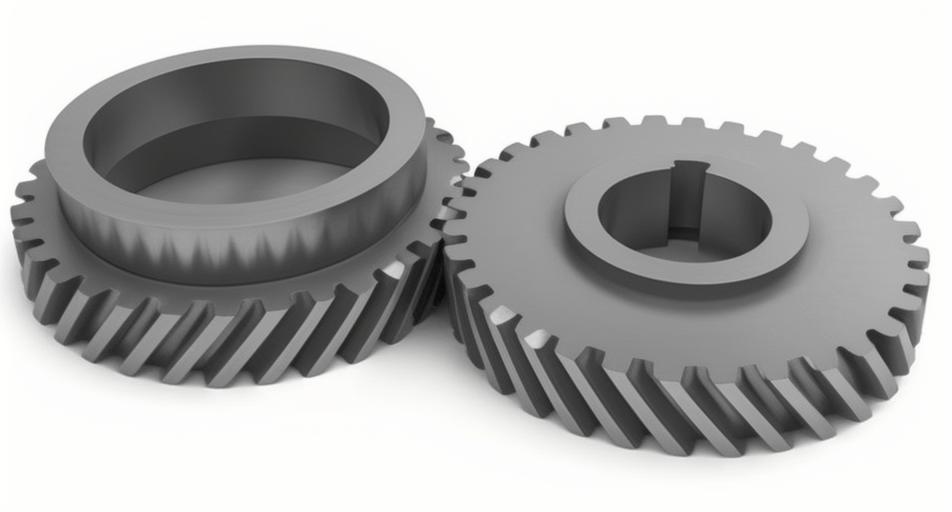
Meshing Characteristics of Involute Helical Gears
The analysis begins with a detailed examination of the unique meshing behavior of parallel-axis involute helical gears, which is foundational for accurate wear calculation.
Contact Line Length and Load Distribution
The contact pattern on the plane of action is characterized by lines of contact whose total length varies periodically during mesh. This variation depends on the relationship between the transverse contact ratio ($\varepsilon_{\alpha}$) and the overlap ratio ($\varepsilon_{\beta}$). The contact line length for a single tooth pair, $l(1,t)$, over a meshing period $T_m$ is given by:
Case 1: $\varepsilon_{\alpha} \leq \varepsilon_{\beta}$
$$
l(1,t) =
\begin{cases}
\frac{P_{bt}}{\sin\beta_b} \cdot \frac{t}{T_m}, & 0 \leq t \leq \varepsilon_{\alpha}T_m \\[1em]
\frac{P_{bt}}{\sin\beta_b} \cdot \varepsilon_{\alpha}, & \varepsilon_{\alpha}T_m < t \leq \varepsilon_{\beta}T_m \\[1em]
\frac{P_{bt}}{\sin\beta_b} \cdot \left(\varepsilon_{\gamma} – \frac{t}{T_m}\right), & \varepsilon_{\beta}T_m < t \leq \varepsilon_{\gamma}T_m \\[1em]
0, & \varepsilon_{\gamma}T_m \leq t \leq \lceil \varepsilon_{\gamma} \rceil T_m
\end{cases}
$$
Case 2: $\varepsilon_{\alpha} > \varepsilon_{\beta}$
$$
l(1,t) =
\begin{cases}
\frac{P_{bt}}{\sin\beta_b} \cdot \frac{t}{T_m}, & 0 \leq t \leq \varepsilon_{\beta}T_m \\[1em]
\frac{P_{bt}}{\sin\beta_b} \cdot \varepsilon_{\beta}, & \varepsilon_{\beta}T_m < t \leq \varepsilon_{\alpha}T_m \\[1em]
\frac{P_{bt}}{\sin\beta_b} \cdot \left(\varepsilon_{\gamma} – \frac{t}{T_m}\right), & \varepsilon_{\alpha}T_m < t \leq \varepsilon_{\gamma}T_m \\[1em]
0, & \varepsilon_{\gamma}T_m \leq t \leq \lceil \varepsilon_{\gamma} \rceil T_m
\end{cases}
$$
where $P_{bt}$ is the transverse base pitch, $\beta_b$ is the base helix angle, $\varepsilon_{\gamma} = \varepsilon_{\alpha} + \varepsilon_{\beta}$ is the total contact ratio, and $\lceil \varepsilon_{\gamma} \rceil$ is the smallest integer greater than $\varepsilon_{\gamma}$.
The total contact line length at any meshing instant $t$ is the sum over all $M$ contacting tooth pairs: $$L(t) = \sum_{i=1}^{M} l(i, t)$$
The total normal load on the teeth is determined by the input torque $T_1$: $$F_n = \frac{2 T_1}{d_1 \cos\alpha_n \cos\beta_b}$$ where $d_1$ is the pinion pitch diameter and $\alpha_n$ is the normal pressure angle.
Using the “percentage of contact line” method, the load on a segment of a single tooth pair’s contact line is: $$F(1,t) = F_n \frac{l(1,t)}{L(t)}$$
Kinematic Analysis and Sliding Distance Calculation
The helical gear contact is modeled as an equivalent pair of reversed tapered rollers. The contact line is discretized into small segments, each treated as a spur gear contact. For any discrete point $A(i,j)$ along the contact line:
The radii of curvature for the pinion and gear are:
$$R_1(i,j) = \frac{N_1B_2 + (i-1)\Delta L}{\cos\beta_b}, \quad R_2(i,j) = \frac{N_1N_2 – [N_1B_2 + (i-1)\Delta L]}{\cos\beta_b}$$
where $N_1N_2$ is the length of the path of contact and $\Delta L$ is the segment length.
The tangential velocities at the contact point are:
$$u_1(i,j) = \omega_1 R_1(i,j) \cos\beta_b, \quad u_2(i,j) = \omega_2 R_2(i,j) \cos\beta_b$$
The sliding velocity ($u_s$), entrainment velocity ($u_r$), and slide-to-roll ratio ($S_r$) are:
$$u_s(i,j) = |u_1(i,j) – u_2(i,j)|$$
$$u_r(i,j) = \frac{u_1(i,j) + u_2(i,j)}{2}$$
$$S_r(i,j) = \frac{u_s(i,j)}{u_r(i,j)}$$
The sliding distances for the pinion and gear tooth surfaces at the contact point, over one engagement cycle, are:
$$S_1(i,j) = \frac{2b |u_1(i,j) – u_2(i,j)|}{u_1(i,j)}, \quad S_2(i,j) = \frac{2b |u_1(i,j) – u_2(i,j)|}{u_2(i,j)}$$
where $b$ is the semi-width of the Hertzian contact band in the direction of sliding:
$$b = \sqrt{\frac{4 w R}{\pi E’}}$$
Here, $w$ is the load per unit length, $R$ is the equivalent radius of curvature $\left( \frac{1}{R} = \frac{1}{R_1} + \frac{1}{R_2} \right)$, and $E’$ is the reduced elastic modulus.
Adhesive Wear Modeling for Helical Gear Tooth Surfaces
Under dry or boundary lubricated conditions, adhesive wear is a dominant mechanism. The classic Archard wear equation forms the basis of the model:
$$V_{dry} = K \frac{F S}{H}$$
where $V_{dry}$ is the wear volume, $K$ is the dimensionless wear coefficient, $F$ is the normal load, $S$ is the sliding distance, and $H$ is the material hardness.
Rewriting for wear depth $h_{dry}$ over an area $A$, and noting that pressure $p = F/A$, we get:
$$h_{dry} = k \cdot p \cdot S$$
where $k = K/H$ is the dimensional wear coefficient (e.g., $\text{mm}^3/\text{N}\cdot\text{mm}$ or $\text{Pa}^{-1}$).
For a discrete point $A(i,j)$ on a helical gear tooth surface, the contact pressure under dry conditions is approximated using the Hertzian line contact formula, adjusted for load sharing:
$$p(i,j) = \frac{4 F(1,t)}{3 \pi b l(1,t)}$$
Therefore, the wear depth after one meshing cycle for the pinion and gear is:
$$h_{dry1}(i,j) = k \cdot p(i,j) \cdot S_1(i,j)$$
$$h_{dry2}(i,j) = k \cdot p(i,j) \cdot S_2(i,j)$$
The cumulative wear depth after $N$ load cycles is the summation:
$$h_{z1,2}(i,j) = \sum_{n=1}^{N} h_{dry1,2}(i,j)$$
| Parameter | Symbol | Value | Unit |
|---|---|---|---|
| Pinion/Gear Teeth | $z_1 / z_2$ | 23 / 32 | – |
| Normal Module | $m_n$ | 3 | mm |
| Face Width | $B$ | 50 | mm |
| Normal Pressure Angle | $\alpha_n$ | 20 | ° |
| Helix Angle | $\beta$ | 15 | ° |
| Pinion Speed | $n_1$ | 3000 | rpm |
| Input Torque | $T_p$ | 200 | Nm |
| Wear Coefficient | $K$ | 1×10⁻¹⁶ | – |
| Material Hardness | $H$ | ~2.5 | GPa |
Results and Discussion: Wear Characteristics and Parametric Studies
The numerical solution follows the process of first determining the time-varying meshing characteristics (load, pressure, slip) and then iteratively applying the Archard wear law over successive cycles.
Meshing Behavior of the Helical Gear Pair
The dynamic meshing characteristics for the baseline helical gear parameters reveal the complex interaction. The total contact line length $L(t)$ varies in a trapezoidal pattern, rising upon engagement, stabilizing during middle engagement (if $\varepsilon_{\beta} > 1$), and declining during disengagement. The unit load $F(1,t)/l(1,t)$ fluctuates cyclically, with higher loads typically occurring at the engagement and disengagement points where fewer tooth pairs share the load. The maximum contact pressure closely follows the unit load trend, being highest at the tips and roots of the teeth.
The kinematics show distinct patterns: the equivalent radius of curvature increases slightly then decreases along the path of contact, while the entrainment velocity increases linearly. Most critically for wear, the sliding velocity and slide-to-roll ratio exhibit a characteristic “V” shape, approaching zero at the pitch point and reaching maxima near the tips and roots. Consequently, the sliding distances $S_1$ and $S_2$ are highest at the root (for the driving pinion) and tip regions, and virtually zero at the pitch point.
Cumulative Wear Depth Distribution
After $N = 1 \times 10^4$ load cycles under dry conditions, the predicted cumulative wear depth distributions for both the pinion and gear are plotted. The key observations are:
- Spatial Distribution: The wear depth distribution is nearly symmetric between pinion and gear in pattern but asymmetric in magnitude. Maximum wear consistently occurs in the dedendum (root region) of the driving pinion and the addendum (tip region) of the driven gear. The wear depth is minimal around the pitch line.
- Magnitude Asymmetry: The pinion suffers significantly greater wear depth than the gear. This is attributed to two factors: first, the pinion tooth undergoes more contact stress cycles per revolution; second, for a typical gear ratio, the sliding distance $S_1$ at the pinion root is larger than $S_2$ at the gear tip for the same meshing point.
- Pitch Point Immunity: At the pitch point, pure rolling occurs ($u_s = 0$), resulting in negligible sliding wear, which aligns with theoretical expectations.
| Varying Parameter | Condition | Max Wear Depth (x10⁻⁴ mm) | Trend |
|---|---|---|---|
| Helix Angle $\beta$ | 10° | 2.15 | Slight Decrease |
| 15° (Baseline) | 2.09 | ||
| 20° | 2.03 | ||
| Face Width $B$ | 30 mm | 3.48 | Significant Decrease |
| 50 mm (Baseline) | 2.09 | ||
| 70 mm | 1.49 | ||
| Input Torque $T_p$ | 100 Nm | 1.04 | Significant Increase |
| 200 Nm (Baseline) | 2.09 | ||
| 300 Nm | 3.13 | ||
| Load Cycles $N$ | 5 x 10³ | 1.04 | Linear Increase |
| 1 x 10⁴ (Baseline) | 2.09 | ||
| 2 x 10⁴ | 4.18 |
Influence of Key Parameters on Wear
A parametric study was conducted by varying helix angle, face width, input torque, and number of load cycles, with results summarized in Table 2.
Helix Angle ($\beta$): Increasing the helix angle from 10° to 20° leads to a slight decrease in maximum wear depth. This is primarily due to the increased total contact length ($L(t) \propto B/\cos\beta_b$) which reduces the unit load and consequently the contact pressure ($p \propto 1/\sqrt{L}$). The effect is moderate because a larger $\beta$ also slightly alters the sliding kinematics.
Face Width ($B$): Increasing the face width has a very pronounced effect in reducing wear depth. This is a direct consequence of the increased load-sharing capacity. A wider helical gear dramatically increases $L(t)$, lowering both unit load and Hertzian pressure ($p \propto 1/\sqrt{B}$), which quadratically reduces the wear rate in the Archard model ($h \propto p$).
Input Torque ($T_p$): Torque has the most direct and severe impact on wear. Wear depth increases almost linearly with torque. Higher torque increases the normal load $F_n$ linearly, which increases the contact pressure ($p \propto \sqrt{F_n}$), leading to a proportional increase in wear depth per cycle.
Number of Load Cycles ($N$): Under the assumption of a constant wear coefficient $k$, the Archard model predicts linear accumulation of wear depth with the number of cycles. This linear relationship is clearly observed in the simulation, highlighting wear as a progressive damage mechanism.
Extended Discussion: Model Considerations and Implications
The presented model provides a robust quasi-static framework. However, real helical gear dynamics involve vibrations and dynamic load factors that could amplify instantaneous pressures, particularly near resonance. Future models could integrate dynamic load distributions. Furthermore, the wear coefficient $k$ is treated as constant. In reality, $k$ may evolve with surface roughness, the formation of tribo-layers, or changes in lubrication condition, suggesting a need for adaptive wear models.
The implications for helical gear design are clear. To mitigate adhesive wear under dry or poor lubrication:
1. Optimize Face Width and Helix Angle: Select a sufficient face width to ensure low contact pressure. A higher helix angle can be beneficial for smoothness and slightly reduced pressure, but may increase axial thrust.
2. Derate for High Torque: For high-torque applications, careful material selection (high hardness $H$) and surface treatments (e.g., nitriding) are crucial to lower the effective wear coefficient $k$.
3. Monitor and Maintain Lubrication: While this study focuses on dry contact, the presence of even a boundary lubricant can reduce the wear coefficient by orders of magnitude, drastically extending helical gear life.
Conclusion
This analysis developed and applied a computational methodology for predicting adhesive wear in involute helical gear pairs under dry contact conditions. By combining detailed meshing mechanics with the Archard wear law, the model successfully predicts the characteristic wear distribution and its evolution.
The key findings are:
1. The driving pinion experiences greater wear depth than the driven gear, with the maximum wear located at the pinion dedendum.
2. Wear is negligible at the pitch line due to pure rolling and is severe in regions of high sliding (tip/root).
3. Operational parameters like input torque and the number of cycles have a strongly linear influence on wear depth.
4. Geometric parameters like face width have a powerful, non-linear reducing effect on wear due to load sharing, while the helix angle has a milder reducing effect.
This modeling approach serves as a valuable tool for the design and failure analysis of helical gear transmissions, enabling engineers to preemptively assess wear life and optimize geometric parameters for enhanced durability in demanding applications.