
In my experience working with high-end speed reducers, the integrity of gear shafts is paramount for reliable operation. I recently encountered a critical failure involving a bevel gear shaft from a reducer that seized and cracked after service. This incident prompted a thorough investigation to determine the root cause and prevent future occurrences. The gear shafts in question are forged from 18CrNiMo7-6 steel and undergo a series of heat treatments, including carburizing, quenching, and tempering. The failure manifested as longitudinal cracking along the shaft axis, originating from the bearing fit area, and exhibited delayed propagation even after shutdown. Through detailed metallurgical analysis, I aim to elucidate the mechanisms behind this failure, emphasizing the role of hydrogen embrittlement and residual stresses. This analysis will incorporate extensive data, formulas, and tables to provide a deep understanding of the factors affecting gear shafts durability.
The initial observation revealed that the gear shafts had seized with the bearing, leading to bearing sintering. Upon disassembly, a crack approximately 240 mm in length was found along the axial direction, extending from the bearing fit region toward both the bevel gear and spline ends. Notably, the crack continued to propagate during storage, indicating a delayed fracture phenomenon. This behavior is atypical for properly processed gear shafts and suggested an underlying material or processing issue. The shaft had been subjected to a standard heat treatment cycle: normalizing at 920°C, tempering at 650°C, machining, carburizing at 920°C for 10.5 h with diffusion for 5.5 h, quenching at 820°C, and finally tempering at 150°C for 4 h. To systematically analyze the failure, I employed multiple techniques: macro- and micro-fractography, energy-dispersive X-ray spectroscopy (EDS), metallography, hardness testing, and hydrogen content measurement. Each method provided insights into the failure mode, particularly focusing on the susceptibility of high-strength gear shafts to hydrogen-induced cracking.
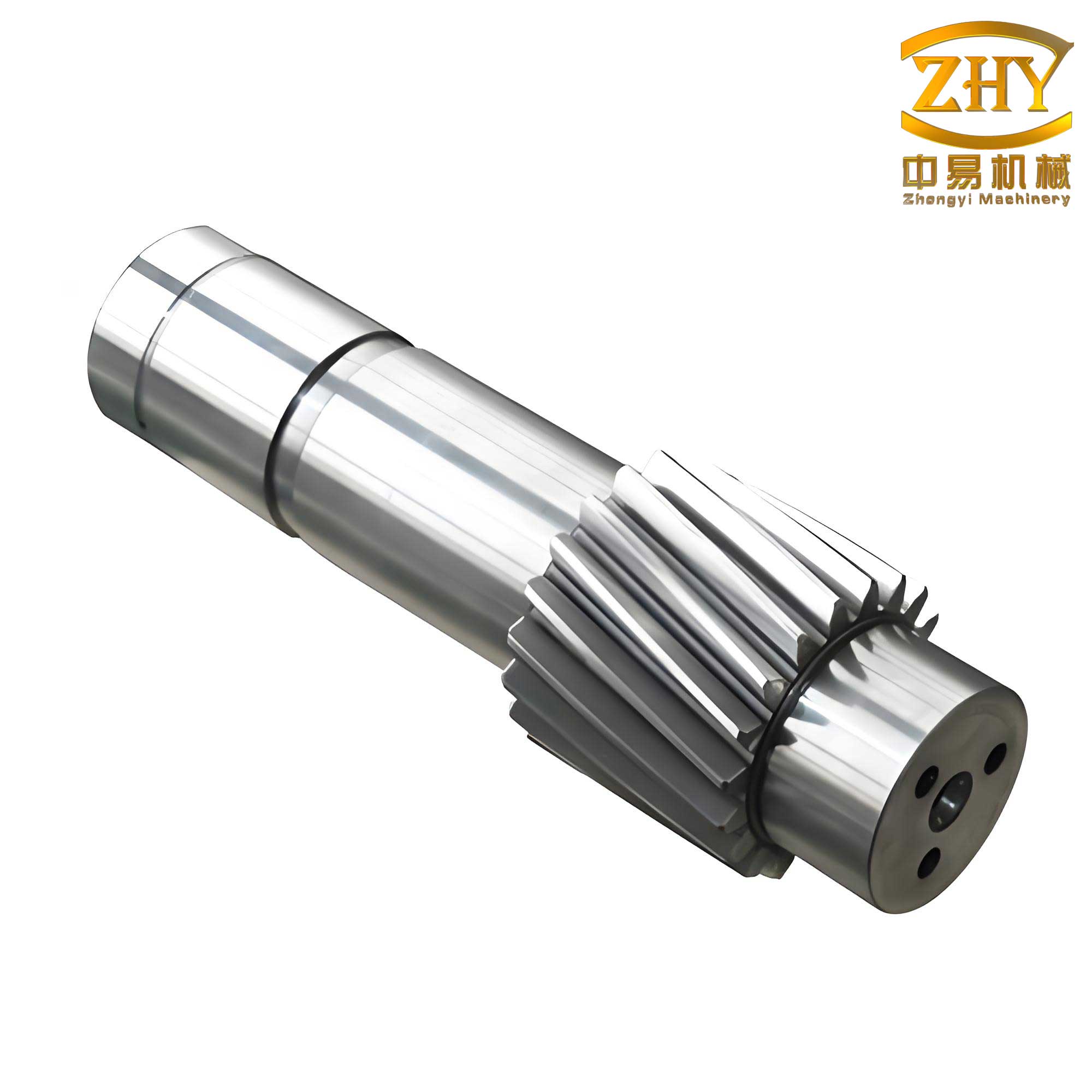
Macroscopic examination of the fractured gear shafts showed a relatively flat fracture surface with minimal plastic deformation, characteristic of brittle failure. The crack initiated at the stress concentration site where the shaft interfaces with the bearing inner race. This location is critical in gear shafts as it experiences cyclic loading and frictional forces during operation. The seizure event likely exacerbated the stress state, creating a favorable condition for crack initiation. Micro-fractography using scanning electron microscopy (SEM) revealed intergranular fracture features at both the crack origin and propagation zones. In contrast, an artificially fractured sample from the base material exhibited ductile dimples, indicating that the inherent toughness of the material was compromised during service. EDS analysis of the fracture surface detected no corrosive elements beyond minor oxidation, ruling out environmental corrosion as a primary factor. The intergranular morphology is a hallmark of hydrogen embrittlement, especially in high-strength steels used for gear shafts.
Metallographic analysis was conducted on transverse sections of the cracked gear shafts. The macrostructure showed no significant defects or segregation, confirming the quality of the forging. Microscopically, the carburized case exhibited a normal microstructure without network carbides, and the core consisted of tempered martensite, both meeting specifications. The crack path was observed to propagate through the microstructure without apparent microstructural anomalies adjacent to it. This suggests that the failure was not due to intrinsic material defects but rather to external factors affecting the gear shafts. Hardness measurements were taken from the core material using Vickers hardness testing, and the values were converted to HRC per GB/T 1172-1999. The results are summarized in Table 1, indicating compliance with the required hardness (≥35 HRC). However, the high hardness itself contributes to hydrogen embrittlement susceptibility in gear shafts.
| Hardness (HV0.5) Measurements | Average HV0.5 | Converted HRC | Specification Requirement |
|---|---|---|---|
| 329.36, 355.88, 336.28, 354.60, 367.66 | 348.76 | 36.5 – 37.0 | ≥35 HRC (or ≥280 HV) |
Hydrogen content analysis is crucial for assessing embrittlement risks in gear shafts. Samples from the base material were analyzed using thermal desorption spectroscopy. The results, shown in Table 2, revealed hydrogen concentrations exceeding 3 ppm, which is above the typical threshold of 2 ppm for such components. In high-strength steels, even hydrogen levels below 1 ppm can induce cracking under stress. The measured hydrogen content, combined with the high strength of the gear shafts, created a perfect storm for hydrogen-assisted failure. The primary sources of hydrogen in this case likely originated from the manufacturing processes, such as carburizing and quenching, where hydrogen can be absorbed from furnace atmospheres or cooling media. The low-temperature tempering at 150°C for 4 hours was insufficient to fully degas the hydrogen or relieve residual stresses, leaving the gear shafts vulnerable.
| Hydrogen Content Measurements (ppm) | Average (ppm) | Technical Requirement (ppm) |
|---|---|---|
| 1, 3, 4, 4, 4 | >3 | ≤2 |
To understand the failure mechanism quantitatively, I consider the theory of hydrogen-induced delayed cracking. The time to failure \( t_f \) under static stress can be modeled using an Arrhenius-type equation related to hydrogen diffusion and crack growth:
$$ t_f = A \cdot \exp\left(\frac{Q}{RT}\right) \cdot \sigma^{-n} $$
where \( A \) is a pre-exponential factor, \( Q \) is the activation energy for hydrogen diffusion, \( R \) is the gas constant, \( T \) is the absolute temperature, \( \sigma \) is the applied stress, and \( n \) is a stress exponent. For high-strength gear shafts, the stress intensity factor \( K \) at the crack tip plays a key role. When hydrogen segregates at grain boundaries, it reduces the cohesive energy, leading to intergranular fracture. The critical stress intensity for hydrogen-assisted cracking \( K_{IH} \) can be expressed as:
$$ K_{IH} = K_{IC} – \alpha \cdot C_H $$
where \( K_{IC} \) is the plane-strain fracture toughness, \( \alpha \) is a material constant, and \( C_H \) is the hydrogen concentration at the crack tip. In this case, the residual stresses from heat treatment and the operational stresses from bearing seizure significantly elevated the local stress intensity, promoting crack initiation even at moderate hydrogen levels. The residual stress \( \sigma_{res} \) in carburized and quenched gear shafts can be approximated by:
$$ \sigma_{res} = E \cdot \alpha \cdot \Delta T \cdot f(\text{cooling rate}) $$
with \( E \) as Young’s modulus, \( \alpha \) as the coefficient of thermal expansion, and \( \Delta T \) as the temperature gradient during quenching. For the 18CrNiMo7-6 steel, typical values are \( E \approx 210 \) GPa and \( \alpha \approx 12 \times 10^{-6} \) /°C. The quenching process induces compressive stresses in the case but tensile stresses in the core, which can interact with hydrogen to cause cracking in gear shafts.
The seizure event between the bearing and the gear shafts further increased the stress concentration factor \( K_t \) at the fit area. The nominal stress \( \sigma_n \) due to interference fit can be calculated using Lame’s equations for thick-walled cylinders. For a shaft with outer radius \( b \) and inner radius \( a \) (though solid here, \( a=0 \)), under an interference pressure \( p \), the tangential stress at the surface is:
$$ \sigma_\theta = -p \cdot \frac{b^2 + a^2}{b^2 – a^2} $$
For a solid shaft, this simplifies to \( \sigma_\theta = -p \). The frictional forces during seizure add shear stresses, complicating the state. The combined stress likely exceeded the threshold for hydrogen-assisted crack growth in the gear shafts. Additionally, the continued crack propagation after shutdown is a classic sign of delayed fracture driven by residual stresses, which act as a sustained load on the hydrogen-charged material.
To mitigate such failures in gear shafts, several improvements are recommended. First, the tempering process should be optimized to enhance hydrogen effusion and stress relief. Increasing the tempering temperature to 180°C and extending the time to 8 hours can significantly reduce hydrogen content. The diffusion of hydrogen in steel follows Fick’s second law:
$$ \frac{\partial C}{\partial t} = D \frac{\partial^2 C}{\partial x^2} $$
where \( D \) is the diffusion coefficient, which increases with temperature. For example, at 180°C, \( D \) for hydrogen in iron is approximately \( 1.5 \times 10^{-10} \) m²/s, compared to \( 5 \times 10^{-11} \) m²/s at 150°C, allowing more efficient degassing. Second, controlling the carburizing atmosphere to minimize hydrogen ingress is crucial. Using dry processes or post-carburizing oxidation treatments can help. Third, non-destructive testing methods, such as ultrasonic inspection, should be employed to detect early cracks in gear shafts before assembly. Finally, design modifications to reduce stress concentrations at bearing fits, such as using larger fillet radii, can enhance fatigue and fracture resistance.
In conclusion, the cracking of the bevel gear shafts was primarily due to hydrogen-induced delayed brittle fracture under residual and operational stresses. The high strength of the material, combined with elevated hydrogen content and stress concentration at the bearing fit, created conditions favorable for intergranular cracking. This analysis underscores the importance of comprehensive heat treatment control and hydrogen management in manufacturing high-performance gear shafts. By implementing the suggested measures, similar failures can be prevented, ensuring the reliability and longevity of speed reducer components. Future work could involve finite element analysis to model stress distributions in gear shafts under seizure conditions and experimental studies on hydrogen trapping mechanisms.