
In the field of mechanical transmission for instruments, office equipment, and household appliances, plastic gears have gained widespread adoption due to their excellent formability and transmission performance. Among these, helical gears are often prioritized by designers for critical transmission applications because of their uniform contact, reduced meshing impact, and smooth operation. The inherent advantages of helical gears, such as improved load distribution and quieter performance, make them ideal for precision devices. However, the injection molding of helical gears presents unique challenges, particularly in demolding due to their helical teeth. This study focuses on a double plastic helical gear used as an intermediate reducer gear in office equipment. We employ numerical simulation to optimize the injection molding process and design an advanced ejection mechanism to ensure high-quality production.
The helical gear in question is a dual-component design with two different diameter involute cylindrical helical gears combined into a single piece. Both gears feature a right-hand helix angle of 12°, and there is no relative positional requirement between the helical teeth of the two gears. The gear body has a uniform wall thickness, with both the inner and outer rings adopting a ribbed reinforcement structure consisting of 12 thin ribs. The overall contour dimensions are Φ43 mm × 30 mm. When selecting materials for plastic gears, polyamide (PA) and polyoxymethylene (POM) are top choices due to their mechanical properties. However, for this application, POM was selected over PA because of its larger flash gap tolerance (approximately 0.04 mm for POM versus 0.02 mm for PA). This is crucial for the demolding process, which involves rotational movement of the gear cavity inserts, requiring precise gaps to prevent interference and ensure smooth operation.
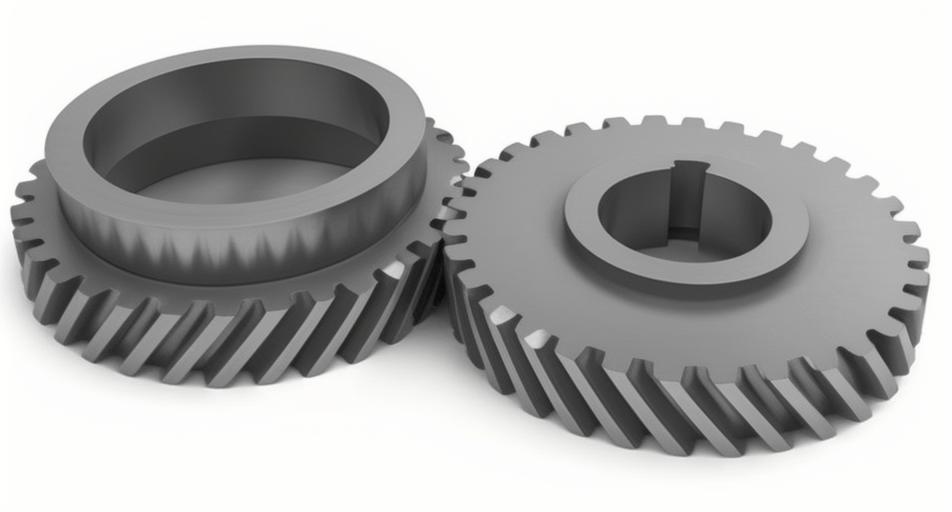
To achieve optimal molding conditions, we conducted a comprehensive numerical simulation using Moldflow software. The 3D model of the helical gear was created in Pro/Engineer and imported into Moldflow via STL format. A surface mesh (Fusion type) was generated, resulting in a model with 29,438 triangular elements. The mesh quality was assessed, showing a maximum aspect ratio of 25.008 and a mesh matching rate of 82.8%, which are within acceptable limits for accurate simulation. The material selected was Delrin 100 NC010 (POM) from DuPont. Initial analysis for gate location indicated that the best gate positions were around the central hole area. Based on this, we designed a single-cavity mold with a three-point gate system evenly distributed at 120° intervals on the结合面 of the two gear faces. This ensures balanced melt flow during injection, which is critical for maintaining the dimensional accuracy and structural integrity of helical gears.
The injection molding process involves complex fluid dynamics and heat transfer. To describe the melt flow, we can use the Hele-Shaw approximation for thin cavities, where the flow is governed by the pressure equation: $$ \nabla \cdot (S \nabla p) = 0 $$ where \( p \) is pressure and \( S \) is the fluidity coefficient. For non-Newtonian fluids like POM, the viscosity \( \eta \) is described by the Cross-WLF model: $$ \eta = \frac{\eta_0}{1 + (\lambda \dot{\gamma})^{1-n}} $$ where \( \eta_0 \) is zero-shear viscosity, \( \dot{\gamma} \) is shear rate, \( \lambda \) is relaxation time, and \( n \) is power-law index. These equations underpin the simulation of fill time, which showed a complete cavity fill in 1.651 seconds. The contour display of fill time indicated uniform melt front advancement, with minimal time differences between key points, confirming the absence of short shots or hesitation. This is essential for helical gears to avoid defects that could impair their meshing performance.
| Parameter | Value |
|---|---|
| Number of Triangular Elements | 29,438 |
| Connectivity Regions | 1 |
| Free Edges | 0 |
| Maximum Aspect Ratio | 25.008 |
| Mesh Matching Rate | 82.8% |
Weld lines and air traps are common issues in injection molding. The simulation revealed that weld lines occurred in non-critical areas and could be mitigated through proper venting in the mold design. Air traps were predicted at mold assembly gaps, allowing for easy gas escape. Thus, no significant defects are expected on the helical gear surfaces. The melt front temperature distribution showed a maximum variation of 22.4°C, which is within acceptable limits for POM. The volume temperature reached a peak of 232.5°C near the gates, still below the degradation temperature of 240°C, ensuring material stability. These results validate the gate design for helical gears, ensuring consistent material properties across the gear teeth.
Cooling analysis was performed with a manually created cooling system consisting of channels with an inner diameter of 6 mm. The cooling circuit layout was designed to maintain uniform mold temperature. The simulation output for mold surface temperature showed a maximum of 81.68°C near the gates, below the set mold temperature of 90°C. The part average temperature after cooling was 82.54°C, which is lower than the ejection temperature setting of 90°C, indicating sufficient cooling. The coolant temperature rise was only 0.24°C (from 24.99°C to 25.23°C), and the temperature difference between the coolant and pipe wall was 3.12°C, both within recommended ranges for precision parts like helical gears. This effective cooling minimizes cycle time and reduces thermal stresses that could warp the gear teeth.
| Process Parameter | Value |
|---|---|
| Injection Volume (g) | 17.48 |
| Injection Pressure (MPa) | 85 |
| Holding Pressure (MPa) | 80 |
| Clamping Force (kN) | 63 |
| Mold Temperature (°C) | 90 |
| Fill Time (s) | 2 |
| Holding Time (s) | 20 |
| Cooling Time (s) | 35 |
Based on the simulation results, we designed an injection mold with a focus on demolding mechanisms for helical gears. The mold adopts a three-plate structure with three parting planes to facilitate automatic degating and part ejection. The gating system uses three point gates, each equipped with an inverted cone-shaped puller to separate the sprue from the part during opening. This ensures that the浇注系统 is automatically removed without manual intervention, crucial for automated production of helical gears. The ejection system combines ejector pins and an ejector sleeve. Twelve ejector pins are evenly distributed near the inner side of the gear teeth to push the part out uniformly, while the ejector sleeve acts on the central hub to prevent distortion.
The demolding of helical gears is challenging due to the helical angle of the teeth. During ejection, the gear cavity must rotate relative to the part to release the helical teeth smoothly. To achieve this, we incorporated angular contact ball bearings between the moving mold inserts. Specifically, one bearing is placed between the动模镶块 I and the gear cavity insert II, and another between the two gear cavity inserts. This allows the cavity inserts to rotate inversely during ejection, reducing demolding resistance and preventing damage to the helical gears. The rotation is synchronized through the bearings, addressing any timing differences between the two gear cavities due to their different helical pitches. The clearance between the cavity inserts and the mold plate is designed to be larger than the flash gap of POM, ensuring free rotation.
The demolding sequence involves three stages of mold opening. First, parting plane I opens under spring force, separating the point gates from the part via the pullers. Second, parting planes II and III open sequentially through the action of limit rods and drag plates, fully opening the mold. The distances are set as: \( L_1 > \text{diagonal length of浇注系统} + 6-8 \text{ mm} \), \( L_2 = 5-6 \text{ mm} \), and \( L_3 = 1.2-1.5 \times \text{maximum part dimension} \). This ensures complete separation of the runner system and allows the helical gear to be ejected without obstruction. During ejection, the mold’s push plate activates the ejector pins and sleeve, slowly pushing the part out while the cavity inserts rotate via the bearings. Limit blocks on the parting surface prevent excessive axial movement of the inserts, maintaining alignment for the helical gears.
The effectiveness of this design can be analyzed through mechanical principles. The demolding force for helical gears can be estimated by considering the friction and helical angle. The force required to eject a helical gear involves both axial and rotational components. The torque \( T \) needed to rotate the cavity insert can be expressed as: $$ T = F_f \cdot r $$ where \( F_f \) is the frictional force and \( r \) is the effective radius. The frictional force depends on the normal force and coefficient of friction \( \mu \): $$ F_f = \mu N $$ For a helical gear with helix angle \( \beta \), the normal force during ejection has an axial component related to the demolding force \( F_e \): $$ N = \frac{F_e}{\sin \beta} $$ Thus, the ejection force must overcome both axial and rotational resistances. By using bearings, we reduce \( \mu \), minimizing \( F_e \) and preventing deformation of the helical gears. This optimization is critical for maintaining the precision of the helix angle, which directly affects the meshing performance of helical gears.
| Component | Specification |
|---|---|
| Number of Cavities | 1 |
| Gate Type | Three-point point gates |
| Ejection System | 12 ejector pins + 1 ejector sleeve |
| Bearing Type | Angular contact ball bearings (2 sets) |
| Parting Planes | 3 (I, II, III) |
| Cooling Channel Diameter | 6 mm |
| Material | POM (Delrin 100 NC010) |
In conclusion, the numerical simulation using Moldflow provided valuable insights for optimizing the injection molding process of helical gears. The three-point gate system ensures balanced filling, and the cooling design achieves uniform temperature control. The mold structure incorporates an innovative ejection mechanism that uses bearings to enable rotational demolding, effectively solving the synchronization issue between dual helical gear cavities. This design reduces demolding resistance, prevents part deformation, and supports automated production. The optimized process parameters, such as an injection pressure of 85 MPa and mold temperature of 90°C, contribute to high-quality helical gears with precise helical angles. Future work could explore the use of advanced materials or multi-cavity molds for mass production of helical gears, further enhancing efficiency and cost-effectiveness.
The success of this project underscores the importance of integrated simulation and design in manufacturing complex components like helical gears. By leveraging tools like Moldflow, we can predict and mitigate potential issues early, reducing trial-and-error in mold making. The helical gear, with its superior transmission characteristics, benefits from such precision molding techniques, ensuring reliable performance in applications such as reducers and drives. As demand for lightweight and durable plastic gears grows, continued innovation in molding technology will be key to producing high-performance helical gears for various industries.
To further elaborate on the material properties, POM offers excellent mechanical strength, low friction, and good dimensional stability, making it ideal for helical gears. The choice of POM over PA is reinforced by its higher flash gap, which accommodates the necessary clearances in rotational demolding. In terms of geometry, the helical gears in this study have a helix angle of 12°, which provides a smooth transmission but requires careful demolding. The gear parameters can be defined using standard gear equations. For example, the transverse pitch \( p_t \) is related to the normal pitch \( p_n \) by: $$ p_t = \frac{p_n}{\cos \beta} $$ where \( \beta \) is the helix angle. This relationship affects the mold design, as the cavity must accurately replicate these dimensions to ensure proper meshing of helical gears.
In the simulation, we also considered factors like shrinkage and warpage. POM has a typical shrinkage rate of 1.5-2.0%, which was accounted for in the mold dimensions. The warpage analysis showed minimal deformation due to the uniform cooling and balanced filling. This is crucial for helical gears, as any distortion could lead to noise and reduced efficiency in transmission systems. The use of ribbed reinforcements in the gear design further enhances stiffness, mitigating warpage risks. Overall, the combination of simulation and mechanical design has resulted in a robust solution for producing high-quality helical gears via injection molding.
From a broader perspective, the methodologies applied here can be extended to other complex plastic parts with undercuts or helical features. The integration of bearings into mold inserts for rotational demolding is a versatile technique that can be adapted for various applications. Additionally, the three-plate mold design with multiple parting planes offers flexibility for different gating and ejection needs. As industries continue to seek miniaturization and precision, such advanced mold technologies will play a pivotal role in manufacturing components like helical gears, which are essential for modern mechanical systems.
In summary, this study demonstrates a comprehensive approach to injection molding helical gears, from simulation to mold design. The key achievements include an optimized gate and cooling system validated through Moldflow, and an ejection mechanism that ensures smooth demolding via rotational movement. These contributions advance the production of plastic helical gears, supporting their use in high-performance applications. The repeated emphasis on helical gears throughout this work highlights their significance in transmission engineering, and the solutions presented here provide a reliable framework for future developments in plastic gear manufacturing.