
The pursuit of higher performance in power transmission systems has consistently driven innovation in gear design and manufacturing. Among various gear types, helical gears are renowned for their smooth, quiet operation and high load-bearing capacity, making them indispensable in high-speed and heavy-duty mechanical applications. The surface quality and geometric accuracy of these gear teeth are paramount, directly influencing the operational efficiency, noise levels, vibration, and service life of the entire transmission assembly. To meet the stringent demands of modern machinery, hardened tooth surfaces are often required, with grinding serving as the definitive finishing process to rectify distortions introduced by heat treatment. Furthermore, intentional tooth surface modification, or “relieving,” is a critical technique employed to optimize contact patterns, mitigate edge loading, dampen vibrations, and consequently extend operational longevity. This paper delves into the methodologies for the comprehensive, in-situ measurement and precise characterization of surface errors in topologically modified helical gears.
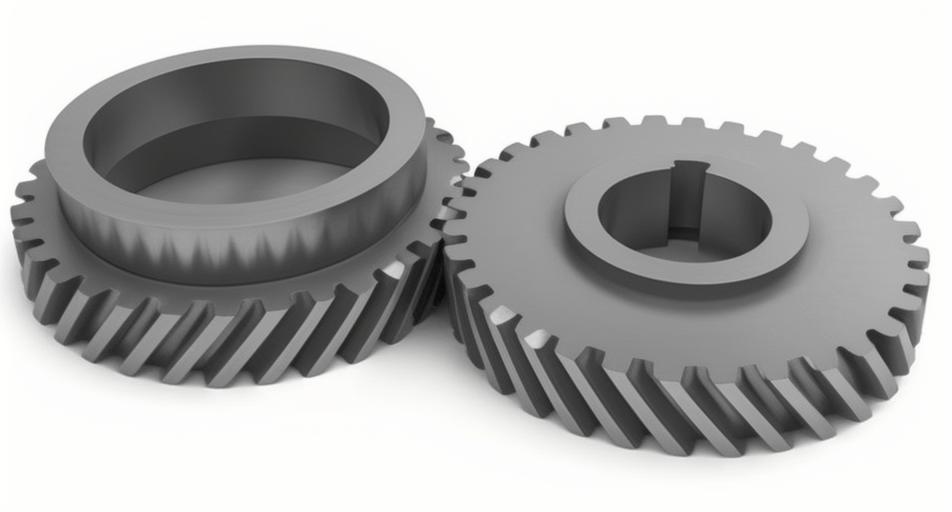
The performance gains from modifying helical gears are well-documented, yet the accurate verification of these complex, three-dimensional surface forms presents a significant metrological challenge. Traditional gear measurement techniques, while effective for standard involute profiles, often fall short when applied to topologically modified surfaces. Conventional methods typically involve scanning a single profile trace along the tooth height at the mid-face width and a single lead trace along the face width at the pitch diameter. While this provides data for simple profile and lead modifications, it is fundamentally insufficient for capturing the complete error landscape of a surface that has been altered in both the profile and lead directions simultaneously—a topological modification. The inherent limitation lies in the sparse data sampling, which can miss local deviations, waviness, or irregular error distributions across the entire active flank. Therefore, a topological measurement approach, which maps the entire tooth surface through a dense grid of points, is essential for a holistic quality assessment of advanced helical gears.
On-machine measurement (OMM) emerges as a powerful solution, integrating the inspection process directly into the manufacturing environment, such as on a CNC form grinding machine. This paradigm eliminates the need for post-process handling and alignment on a separate coordinate measuring machine (CMM), reducing cycle time, avoiding re-clamping errors, and enabling immediate feedback for potential process correction. For helical gears ground by the form grinding method, where the grinding wheel’s profile is replicated onto the gear tooth, OMM is particularly apt. The machine’s inherent axes—radial (X), axial (Z), and rotational (C)—can be precisely controlled to guide a touch-trigger or analog probe across the tooth surface, emulating the polar coordinate measurement principle. This work focuses on developing and implementing a sophisticated on-machine, point-to-point topological measurement strategy specifically tailored for form-ground, topologically modified helical gears, establishing a closed-loop between digital design, physical manufacturing, and quantitative verification.
Mathematical Foundation for Topological Modification and Measurement
The cornerstone of accurate measurement is a precise mathematical model of the theoretical tooth surface. For topologically modified helical gears produced by form grinding, the surface generation is a direct result of the controlled relative motion between the grinding wheel and the gear workpiece. The modification is typically achieved through two synchronized mechanisms: profile modification by dressing the grinding wheel to a non-involute axial contour, and lead modification by orchestrating a variable center distance between the wheel and workpiece along the gear axis.
Coordinate Transformation and Surface Generation
The derivation begins by defining a series of coordinate systems. Let \( S_1 (x_1, y_1, z_1) \) be the coordinate system rigidly connected to the gear workpiece, with its origin at the gear’s rotational center and the \( z_1 \)-axis aligned with the gear axis. The theoretical, unmodified involute tooth surface of a standard helical gear can be represented in \( S_1 \) by a vector function dependent on two parameters, typically a surface length parameter \( u \) and a roll angle parameter \( \theta \):
$$ \mathbf{r}_1(u, \theta) = [x_1(u, \theta), y_1(u, \theta), z_1(u, \theta)]^T $$
Its corresponding unit normal vector is:
$$ \mathbf{n}_1(u, \theta) = [n_{x1}(u, \theta), n_{y1}(u, \theta), n_{z1}(u, \theta)]^T $$
To model the grinding process, we define a machine coordinate system \( S_a \) fixed to the grinding machine bed, a wheel coordinate system \( S_t \) attached to the grinding wheel, and a wheel axial profile coordinate system \( S_w \). The transformation from the workpiece system \( S_1 \) to the wheel system \( S_t \) involves several motions: the workpiece rotation \( \phi_1 \) (C-axis), the radial infeeding \( E_x \) (X-axis), the axial shifting \( L_t \) (Z-axis), and the wheel tilt angle \( \gamma_m \). The homogeneous transformation matrix \( \mathbf{M}_{t1} \) encapsulates all these movements:
$$ \mathbf{r}_t(u, \theta, \phi_1) = \mathbf{M}_{t1}(\gamma_m, E_x, L_t, \phi_1) \cdot \mathbf{r}_1(u, \theta) $$
where a detailed form of \( \mathbf{M}_{t1} \) is:
$$
\mathbf{M}_{t1} =
\begin{bmatrix}
1 & 0 & 0 & 0 \\
0 & \cos\gamma_m & -\sin\gamma_m & 0 \\
0 & \sin\gamma_m & \cos\gamma_m & 0 \\
0 & 0 & 0 & 1
\end{bmatrix}
\cdot
\begin{bmatrix}
1 & 0 & 0 & -E_x \\
0 & 1 & 0 & 0 \\
0 & 0 & 1 & -L_t \\
0 & 0 & 0 & 1
\end{bmatrix}
\cdot
\begin{bmatrix}
\cos\phi_1 & \sin\phi_1 & 0 & 0 \\
-\sin\phi_1 & \cos\phi_1 & 0 & 0 \\
0 & 0 & 1 & 0 \\
0 & 0 & 0 & 1
\end{bmatrix}
$$
Contact Line and Grinding Wheel Profile Derivation
In form grinding, the workpiece tooth surface is the envelope of the family of grinding wheel profiles. The condition for contact is that the common normal vector \( \mathbf{n}_t \) at the contact point on the wheel surface, the wheel axis direction vector \( \mathbf{y}_t \), and the position vector \( \mathbf{r}_t \) are coplanar. This condition leads to the equation of meshing:
$$ f(u, \theta, \phi_1) = \mathbf{n}_t(u, \theta, \phi_1) \cdot \left[ \mathbf{y}_t \times \mathbf{r}_t(u, \theta, \phi_1) \right] = 0 $$
The unit normal \( \mathbf{n}_t \) is calculated from the partial derivatives of the surface in \( S_t \):
$$ \mathbf{n}_t = \frac{\partial \mathbf{r}_t}{\partial u} \times \frac{\partial \mathbf{r}_t}{\partial \theta} \Bigg/ \left\| \frac{\partial \mathbf{r}_t}{\partial u} \times \frac{\partial \mathbf{r}_t}{\partial \theta} \right\| $$
For a given point on the desired tooth surface (often defined at the mid-face, mid-height as the “master” contact line), we solve for the corresponding wheel axial profile coordinates \( (X_w, Y_w) \) in system \( S_w \):
$$
\begin{aligned}
R_w &= \sqrt{x_t^2(u, \theta, \phi_1) + z_t^2(u, \theta, \phi_1)} \\
X_w &= R_w \\
Y_w &= y_t(u, \theta, \phi_1)
\end{aligned}
$$
This \( (X_w, Y_w) \) profile, when dressed onto the grinding wheel, will generate the intended contact condition. To introduce topological modification, the nominal radial distance \( E_x \) is varied as a function of the axial position \( z_1 \) (for lead crowning) and/or the wheel profile \( X_w(Y_w) \) is dressed to a non-involute curve, such as a parabola (for profile relief). A common model for variable center distance is a parabolic function:
$$ E_x(z_1) = E_{x0} + a_{ml} \cdot (z_1 – z_{mid})^2 $$
where \( E_{x0} \) is the nominal center distance at the mid-face width \( z_{mid} \), and \( a_{ml} \) is the lead crowning coefficient.
By incorporating these modifications back into the transformation equations and solving the envelope condition, we obtain the final mathematical model of the theoretical topologically modified tooth surface of the helical gear:
$$ \mathbf{r}_1^{mod}(u, \theta) = [x_1^{mod}(u, \theta), y_1^{mod}(u, \theta), z_1^{mod}(u, \theta)]^T $$
$$ \mathbf{n}_1^{mod}(u, \theta) = [n_{x1}^{mod}(u, \theta), n_{y1}^{mod}(u, \theta), n_{z1}^{mod}(u, \theta)]^T $$
This model serves as the absolute reference for all subsequent measurement and error analysis.
On-Machine Topological Measurement Strategy
The measurement system is integrated into a 5-axis CNC form grinding machine. The machine’s axes used for measurement are the radial X-axis (controlling probe depth), the axial Z-axis (traversing along the gear face width), and the rotary C-axis (indexing the gear tooth). A one-dimensional analog probe (e.g., LVDT) is mounted on the wheel head, capable of moving in the X and Z directions. It measures the radial deviation of the tooth surface from a nominal path. The analog signal is digitized and fed back to the machine’s CNC system, forming the core of the measurement loop.
Measurement Point Planning and Grid Generation
To capture the complete surface topology, the active tooth flank must be measured at a dense grid of points. Standards such as AGMA and ISO provide guidelines for grid density. A common scheme for comprehensive evaluation involves dividing the profile (tooth height) and lead (face width) directions into a number of segments.
The measurement area is bounded by the start and end of active profile (SAP/EAP) and the usable face width. Let \( L \) be the total face width and \( H \) be the total active profile height. The grid is defined by \( m \) points along the lead direction and \( n \) points along the profile direction, resulting in \( m \times n \) measurement points. A typical grid for a quality inspection might be 9 points along the lead and 5 points along the profile (45 points total). The spacing should be less than 10% of the face width and less than 5% of the active profile height (with an upper limit, e.g., 0.6 mm).
The coordinates of each target point \( M^*_i \) on the tooth surface are defined in a plane that is a projection of the tooth. Its location is specified by a radial coordinate \( x^*_i \) (related to roll angle/radius) and an axial coordinate \( z^*_i \). For each \( (x^*_i, z^*_i) \) pair, we must find the corresponding surface parameters \( (u_i, \theta_i) \) that satisfy the surface equation and the grid location constraint:
$$
\begin{cases}
\sqrt{[x_1^{mod}(u_i, \theta_i)]^2 + [y_1^{mod}(u_i, \theta_i)]^2} = x^*_i \\[6pt]
z_1^{mod}(u_i, \theta_i) = z^*_i
\end{cases}
$$
This is a system of two nonlinear equations solved numerically (e.g., via Newton-Raphson method) for each grid point. Once \( (u_i, \theta_i) \) are known, they are substituted into the theoretical surface model \( \mathbf{r}_1^{mod} \) and \( \mathbf{n}_1^{mod} \) to obtain the exact 3D coordinates and surface normal for that point on the ideal modified flank of the helical gear.
| Parameter | Symbol | Typical Value / Rule |
|---|---|---|
| Number of Lead Points | \( m \) | 9 |
| Number of Profile Points | \( n \) | 5 |
| Total Measurement Points | \( m \times n \) | 45 |
| Max. Lead Spacing | \( \Delta L_{max} \) | \( \min(0.1b, 0.6 \text{ mm}) \) |
| Max. Profile Spacing | \( \Delta H_{max} \) | \( \min(0.05H, 0.6 \text{ mm}) \) |
Theoretical Probe Path and Coordinate Transformation for Measurement
The probe does not contact the theoretical surface point directly; it contacts the physical surface. The theoretical path for the probe center (or stylus tip center for a spherical tip) is offset from the theoretical surface by the probe tip radius \( R \) along the surface normal. For a spherical tip, the theoretical probe center position \( \mathbf{r}_e \) for grid point \( i \) is:
$$ \mathbf{r}_e^{(i)} = \mathbf{r}_1^{mod}(u_i, \theta_i) + R \cdot \mathbf{n}_1^{mod}(u_i, \theta_i) $$
During the on-machine measurement, the gear is indexed to bring the target tooth into the measurement position. This involves a rotation \( \theta \) of the workpiece coordinate system \( S_1 \) relative to the machine’s measurement coordinate system \( S_c \), and potentially an axial offset \( L \). The transformation from the workpiece system to the measurement system is given by matrix \( \mathbf{M}_{c1} \):
$$
\mathbf{M}_{c1}(\theta, L) =
\begin{bmatrix}
\cos\theta & \sin\theta & 0 & 0 \\
-\sin\theta & \cos\theta & 0 & 0 \\
0 & 0 & 1 & L \\
0 & 0 & 0 & 1
\end{bmatrix}
$$
Therefore, the theoretical probe center position and the theoretical surface normal, as expressed in the measurement coordinate system \( S_c \), are:
$$
\begin{aligned}
\mathbf{r}_c^{(i)} &= \mathbf{M}_{c1} \cdot \mathbf{r}_e^{(i)} \\
\mathbf{n}_c^{(i)} &= \mathbf{M}_{c1} \cdot \mathbf{n}_1^{mod}(u_i, \theta_i)
\end{aligned}
$$
The machine’s CNC program is generated to sequentially move the X, Z, and C axes to position the probe such that its expected contact point aligns with each \( \mathbf{r}_c^{(i)} \), following the planned grid order.
Error Calculation and Characterization
The core objective of the measurement is to extract the manufacturing error \( \Delta E \) from the raw measurement data. The probe reading \( \Delta \rho_i \) at grid point \( i \) represents the measured deviation along the probe’s sensitive direction (typically radial, aligned with the surface normal in the measurement setup). This raw deviation \( \Delta \rho_i \) contains two main components:
- The Intentional Topological Modification \( \delta_i \): This is the designed departure of the modified surface from a standard involute surface.
- The Unintentional Manufacturing Error \( \Delta E_i \): This is the actual deviation of the manufactured surface from the designed (modified) surface, caused by machine errors, wheel wear, thermal effects, etc.
Mathematically, this relationship is expressed as:
$$ \Delta \rho_i = \delta_i + \Delta E_i $$
Therefore, to isolate the pure manufacturing error, the designed modification must be subtracted from the measured data:
$$ \Delta E_i = \Delta \rho_i – \delta_i $$
The modification amount \( \delta_i \) at point \( i \) is calculated as the normal distance between the theoretical modified surface and the theoretical standard involute surface \( \mathbf{r}_1^{std} \):
$$ \delta_i = \left[ \mathbf{r}_1^{mod}(u_i, \theta_i) – \mathbf{r}_1^{std}(u_i, \theta_i) \right] \cdot \mathbf{n}_1^{mod}(u_i, \theta_i) $$
This calculation requires the mathematical model for both the modified and standard surfaces of the helical gear. The final error \( \Delta E_i \) is a scalar value for each grid point \( i \), representing the normal error of the actual tooth flank relative to its intended designed form.
Error Representation and Analysis
The set of \( \Delta E_i \) values for all \( m \times n \) grid points forms a discrete error map over the tooth flank. The most intuitive and informative way to represent this data is through a contour plot (isoline plot) or a color-mapped 3D surface plot.
- Contour Plot: Displays lines of constant error magnitude across the tooth flank (with axes representing profile and lead position). It clearly shows gradients and the location of maximum and minimum errors.
- 3D Error Surface: Plots the error values on the Z-axis against the tooth flank’s X (profile) and Y (lead) coordinates. This provides a direct visual analogy of the surface “topography” of errors.
- Summary Statistics: Key metrics can be extracted, such as:
- Maximum Positive Error (\( \max(\Delta E_i) \))
- Maximum Negative Error (\( \min(\Delta E_i) \))
- Total Profile Error (range of errors along a constant lead line)
- Total Lead Error (range of errors along a constant profile line)
- Root Mean Square (RMS) Error: \( \Delta E_{RMS} = \sqrt{\frac{1}{N}\sum_{i=1}^{N} (\Delta E_i)^2 } \)
This comprehensive characterization allows for a thorough assessment of the grinding process’s capability. It can diagnose issues like twist, bias, poor crowning form, or localized waviness on the helical gear flanks.
Application and Implementation on a CNC Form Grinding Machine
The methodology was applied to measure a topologically modified helical gear on a dedicated 5-axis CNC form grinding machine. The gear parameters and modification coefficients are summarized below:
| Parameter | Symbol | Value |
|---|---|---|
| Number of Teeth | \( z \) | 44 |
| Normal Module | \( m_n \) | 8 mm |
| Normal Pressure Angle | \( \alpha_n \) | 20° |
| Helix Angle | \( \beta \) | 12.102° |
| Face Width | \( b \) | 70 mm |
| Profile Modification Coefficient | \( a_{mp} \) | 0.0003 |
| Lead Modification Coefficient | \( a_{ml} \) | 0.0006 |
The measurement grid followed a 9×5 scheme (45 points). The probe, with a known stylus tip radius, was moved point-to-point under CNC control. The raw deviation \( \Delta \rho_i \) was recorded for each point on the right flank. The initial data representation plotted \( \Delta \rho_i \), which showed the combined effect of modification and error. The plot exhibited a characteristic saddle-like shape, with larger negative deviations (relative to a nominal involute) at the tooth corners (toe/top and heel/top, heel/root) due to the crowning, and smaller deviations near the center of the flank. For instance, the maximum combined deviation was approximately -42.7 µm at the corners, while the central region showed about -4.9 µm.
Applying the error separation formula \( \Delta E_i = \Delta \rho_i – \delta_i \) yielded the pure manufacturing error map. The resulting contour plot of \( \Delta E_i \) revealed the true accuracy of the ground surface. In this application, the error values ranged from a minimum of 4.5 µm to a maximum of 7.0 µm. The error was not uniformly distributed; the maximum errors were concentrated near the ends of the face width (heel and toe), while the most accurate zone (minimum error) was in the central region of the flank, both in profile and lead directions. This error map provides actionable feedback: it confirms the correct application of the topological modification (as the large-scale saddle shape was removed) and pinpoints the areas where the grinding process introduces the greatest geometric deviations on the helical gear.
Conclusion
The integration of on-machine topological measurement represents a significant advancement in the quality assurance of high-performance helical gears. By developing a rigorous mathematical model that encompasses the generation of topologically modified tooth surfaces through form grinding, a precise theoretical reference is established. Leveraging the inherent axes of a CNC form grinding machine to execute a point-to-point polar measurement strategy enables the dense sampling of the entire active tooth flank. The critical step of computationally separating the intentional design modification from the raw measurement data is essential for isolating the genuine manufacturing error. The final characterization through error contour maps or 3D plots provides an unambiguous, complete, and quantitative picture of the gear’s geometric quality.
This methodology closes the loop in digital manufacturing. The theoretical surface model used for CNC path generation becomes the same datum for quality verification. Deviations identified can be analyzed for root cause (e.g., machine tool inaccuracies, wheel dressing errors, thermal drift) and can even inform adaptive compensation strategies in future manufacturing cycles. For industries relying on precision helical gears—such as aerospace, automotive, and energy—this capability is crucial for ensuring reliability, efficiency, and noise compliance. Future work may focus on enhancing measurement speed with scanning probes, integrating real-time error compensation, and extending the methodology to other complex gear types like crowned bevel gears, further solidifying the role of intelligent, integrated metrology in advanced gear manufacturing.