
In my extensive experience in gear design and manufacturing, I have consistently encountered the intricate challenges associated with bevel gears, particularly miter gears. The tooth profile of a straight bevel gear, including miter gears, varies continuously along the tooth length, meaning that at different positions and in different sectional directions, the tooth form is not identical. This variability necessitates precise calculation of tooth profile coordinates and the plotting of enlarged tooth form curves, which serve as critical foundations for machining and inspection. To achieve satisfactory meshing performance and produce gears that meet stringent standards, it is essential to inspect not only the tooth form and dimensions at the large end but also at the small end, mid-section, or even extended portions. Moreover, both normal section and transverse section tooth profiles must be evaluated. For specific applications such as inspection gears, standard product gears, and electrode gears used in electrical discharge machining for precision gear shaping—where tooth thickness and pressure angle may vary—separate calculations and plotting of tooth profile diagrams are required. Consequently, machining a single gear can demand dozens of sets of tooth profile calculation data and enlarged drawings, representing a substantial workload. Manual computation and plotting using coordinate plotters are nearly impractical, but with the assistance of microcomputers, this task becomes remarkably straightforward. I have developed a universal program for calculating tooth profiles across various sections of bevel gears and plotting enlarged tooth form diagrams, which has been successfully implemented in production practices. Utilizing a microcomputer and a plotter, the entire process from calculation to graphical output requires only a few minutes. This article will briefly introduce the derivation of formulas for tooth profile coordinate calculations across different sections and outline the computational program flow, with a focus on miter gears.
The fundamental principle underlying tooth profile calculation for miter gears revolves around the geometric relationships in the unfolded back-cone surface. Consider the tooth profile on the unfolded back-cone at the large end, where the theoretical outer diameter vertex is taken as the coordinate origin for ease of detection. For any point on the involute tooth profile, the coordinates can be derived based on pressure angle and angular parameters. However, a direct calculation using preset pressure angle values leads to irregular intervals in the radial coordinates, complicating inspection and comparison. To address this, I employed a bisection method in the microcomputer program, ensuring that the radial coordinate values are integer multiples of a specified step, thereby facilitating controlled and consistent measurement points. This approach is particularly beneficial for miter gears, where symmetry and precision are paramount.
The calculation of tooth profile coordinates involves several key parameters, which I summarize in the following table to provide a clear overview:
| Parameter | Symbol | Description | Formula |
|---|---|---|---|
| Pitch diameter | $$d$$ | Diameter at the pitch circle in the unfolded back-cone | $$d = d_m / \cos \delta$$ |
| Theoretical outer diameter | $$D_e$$ | Outer diameter at the large end | $$D_e = d + 2h_a$$ |
| Base circle radius | $$r_b$$ | Radius of the base circle in the unfolded back-cone | $$r_b = \frac{d}{2} \cos \alpha$$ |
| Arc tooth thickness at pitch circle | $$s$$ | Arc thickness at the pitch circle in the unfolded back-cone | $$s = \frac{\pi m}{2} + 2x m \tan \alpha$$ |
| Pressure angle at any point | $$\alpha_x$$ | Pressure angle at a given point on the involute | $$\alpha_x = \arctan\left(\frac{\theta_x}{\cos \alpha}\right)$$ |
For the large end normal section, the coordinates $$(x, y)$$ of any point on the involute can be computed using the following equations, where $$\theta_x$$ is the roll angle and $$\alpha_x$$ is the pressure angle:
$$x = r_b (\cos \theta_x + \theta_x \sin \theta_x)$$
$$y = r_b (\sin \theta_x – \theta_x \cos \theta_x)$$
However, to ensure that the radial distance $$R_x$$ from the origin is an integer multiple of a step value, the bisection method is applied to solve for $$\theta_x$$ iteratively. This method is crucial for miter gears, as it allows for systematic inspection points along the tooth profile. The pressure angle at the tooth tip, $$\alpha_a$$, is determined by the outer diameter and base circle radius:
$$\alpha_a = \arccos\left(\frac{r_b}{R_a}\right)$$
where $$R_a$$ is the tip radius in the unfolded back-cone, calculated as $$R_a = \frac{D_e}{2 \cos \delta}$$. This ensures that the involute profile terminates correctly at the tooth tip.
When considering the small end of the miter gear, the tooth profile parameters scale proportionally with the cone distance. For the small end normal section, the modified parameters are derived using a proportionality factor $$k$$ based on the cone distance ratio:
$$k = \frac{L – b}{L}$$
where $$L$$ is the cone distance and $$b$$ is the face width. The small end pitch diameter $$d’$$, tooth addendum $$h_a’$$, and arc tooth thickness $$s’$$ are then:
$$d’ = k \cdot d$$
$$h_a’ = k \cdot h_a$$
$$s’ = k \cdot s$$
Using these parameters, the tooth profile coordinates for the small end normal section can be calculated similarly to the large end. However, for inspection purposes, the transverse section at the small end is often more accessible. The transverse tooth profile, though not a true involute, can be derived from the normal section coordinates through geometric transformations. For any point on the normal section with coordinates $$(x_n, y_n)$$, the corresponding transverse section coordinates $$(x_t, y_t)$$ are given by:
$$x_t = x_n$$
$$y_t = \frac{y_n}{\cos \delta}$$
This transformation accounts for the cone angle $$\delta$$ and ensures accurate representation for miter gears, where the shaft angle is typically 90 degrees. To maintain consistency in inspection, the transverse coordinates are also computed with $$y_t$$ values as integer multiples of a step, using the same bisection approach.
In the case of electrode gears for electrical discharge machining, a backless design is often employed to extend usability. These gears are elongated, and after each use, the small end is machined down by 1–2 mm before resharpening, allowing for multiple reuses. For such gears, the large end back-cone tooth form is absent, and inspection must focus on the large end transverse section or cylindrical section tooth profiles. The transverse section is preferred due to easier measurement with gear tooth calipers. The calculation involves determining a hypothetical normal section at the large end transverse plane. The parameters for this section are derived based on the cone distance increment and geometric relations, followed by conversion to transverse coordinates. The coordinate origin shifts accordingly, and the formulas account for the absence of the back-cone, which is common in miter gears used for tooling.
For intermediate inspections during production, the actual outer diameter at the large end may deviate from the theoretical value. In such cases, it is necessary to compute the theoretical tooth profile on the normal section corresponding to the actual outer diameter. Given the measured outer diameter $$D’_e$$ and the face cone angle $$\gamma$$, the actual cone distance $$L’$$ is:
$$L’ = \frac{D’_e}{2 \sin \gamma}$$
The modified parameters for this normal section are then calculated using proportional scaling similar to the small end, ensuring that the tooth profile data reflect the as-manufactured geometry. This adaptability is vital for quality control in miter gear production, where dimensional tolerances are critical.
To streamline these calculations, I developed a comprehensive program in BASIC language, which automates the computation and plotting processes. The program flowchart, as implemented, includes the following steps: input of basic gear parameters (e.g., module, number of teeth, pressure angle, cone angle), selection of calculation type (e.g., large end normal, small end transverse, backless large end transverse, arbitrary normal section), iterative computation using the bisection method to achieve integer-multiple coordinate steps, and finally, plotting of the enlarged tooth profile diagram with annotations for key circles (tip, pitch, base) and chordal tooth thickness at specified addendum intervals. The program efficiently handles various gear types, with special considerations for miter gears to ensure accuracy in symmetric configurations.
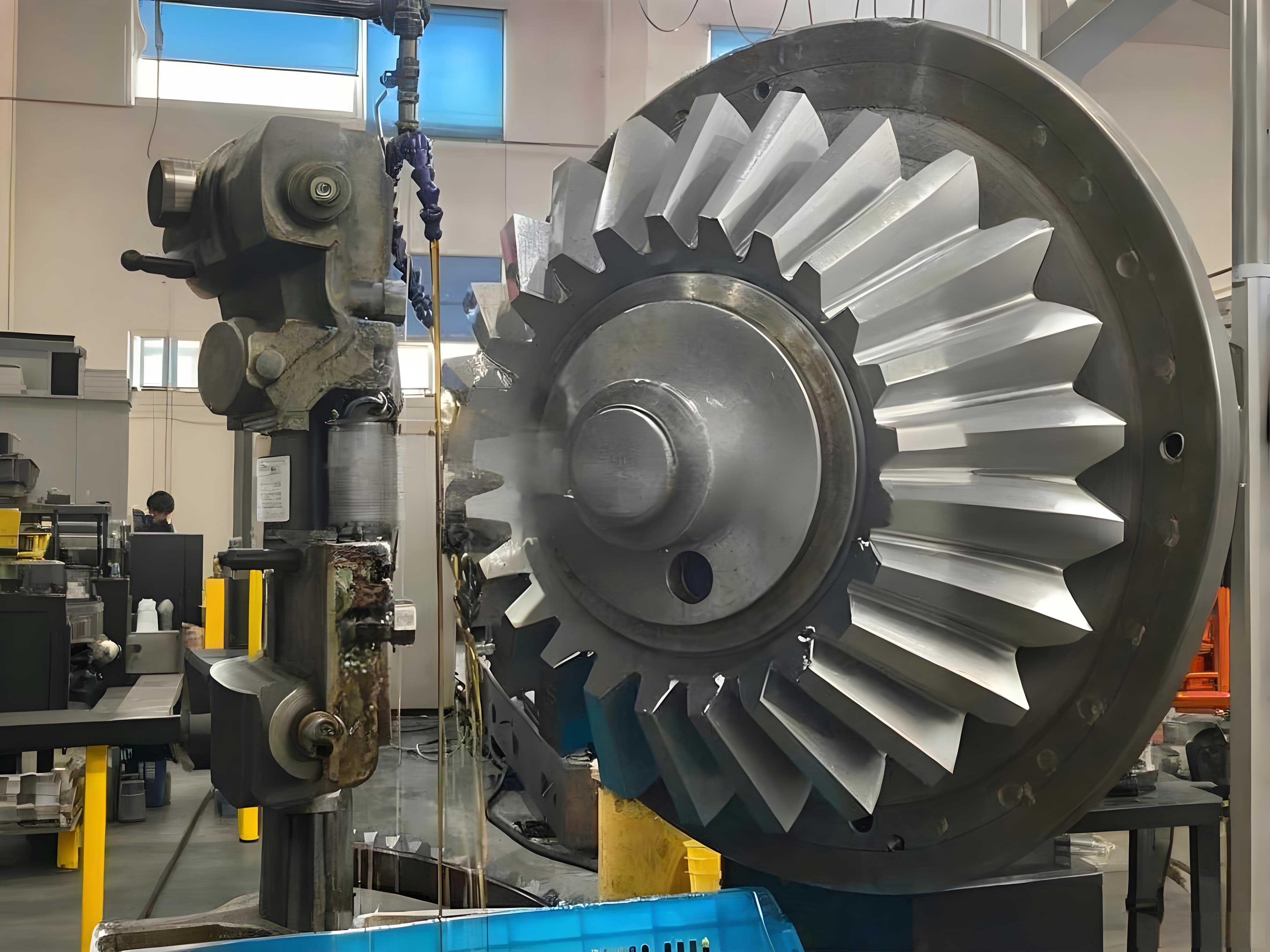
The advantages of using microcomputer-aided calculation and plotting for miter gears are manifold. Firstly, it significantly reduces the time and effort required for tooth profile analysis, enabling rapid prototyping and inspection. Secondly, the precision of the bisection method ensures consistent and repeatable measurement points, enhancing comparability across different gears or sections. Thirdly, the ability to generate multiple tooth profile diagrams for various sections and conditions supports comprehensive quality assurance, which is essential for high-performance applications of miter gears in power transmission systems. Additionally, the graphical output facilitates visual inspection and error detection, allowing engineers to identify deviations from the theoretical profile quickly.
In practical applications, this approach has proven invaluable for manufacturing miter gears used in automotive differentials, industrial machinery, and aerospace components. For instance, in a recent project involving precision miter gears for a robotic joint, the program enabled the generation of over fifty tooth profile diagrams for different sections and tolerance ranges, ensuring that the final product met rigorous meshing and noise requirements. The integration with a plotter allowed for immediate hardcopy outputs, which were used on the shop floor for real-time inspection during machining. This synergy between computation and visualization underscores the importance of digital tools in modern gear engineering.
Looking ahead, further enhancements could involve integrating these calculations with CAD/CAM systems for direct toolpath generation or incorporating finite element analysis to predict tooth stress distributions. For miter gears, where load distribution and wear patterns are critical, such advancements could lead to optimized designs and extended service life. Moreover, the program’s logic can be adapted for other gear types, such as spiral bevel or hypoid gears, by modifying the geometric transformations and parameter sets.
In conclusion, the computer-aided calculation and plotting of tooth profiles for miter gears represent a significant advancement in gear manufacturing technology. By leveraging microcomputers and algorithmic methods like bisection, engineers can achieve unprecedented accuracy and efficiency in tooth form analysis. This not only streamlines production processes but also enhances the reliability and performance of miter gears in various mechanical systems. As industry demands for precision and customization grow, such computational tools will continue to play a pivotal role in gear design and quality control, ensuring that miter gears meet the ever-evolving standards of modern engineering.