
In modern mechanical transmission systems, gear shafts play a critical role in ensuring efficient power transfer and operational reliability. As a key component, gear shafts are often subjected to demanding conditions, necessitating enhanced surface properties through heat treatment processes such as carburizing and quenching. However, the complex thermal and phase transformation cycles involved in carburizing and quenching frequently lead to significant distortion, particularly in large gear shafts with substantial cross-sectional variations and extended tooth widths. This distortion can compromise precision, increase manufacturing costs due to excessive machining allowances, and result in uneven carburized layer depths and hardness distributions. Traditional approaches, such as adjusting process parameters or increasing post-heat-treatment machining, often prove inefficient and lack precision. To address this, we employ finite element analysis (FEA) to systematically investigate the distortion mechanisms in large carburized gear shafts and develop optimized control strategies. By leveraging numerical simulation, we can couple temperature, phase transformation, and stress fields to predict and mitigate distortion, ultimately improving product quality and reducing costs. This article details our methodology, from initial FEA modeling of conventional oil quenching to the implementation of improved heating techniques and salt bath quenching, demonstrating significant reductions in distortion for large gear shafts.
The gear shafts under consideration are manufactured from 17CrNiMo6 alloy steel, a material commonly used for high-strength applications due to its favorable hardenability and toughness. The chemical composition of this steel is crucial for understanding its behavior during heat treatment, as it influences phase transformation kinetics and residual stress development. Below is a summary of the key alloying elements and their mass percentages:
| Element | Carbon (C) | Silicon (Si) | Manganese (Mn) | Chromium (Cr) | Molybdenum (Mo) | Nickel (Ni) |
|---|---|---|---|---|---|---|
| Mass Fraction (%) | 0.17 | 0.27 | 0.65 | 1.61 | 0.29 | 1.57 |
These elements contribute to the formation of martensite during quenching, with nickel enhancing toughness and chromium improving hardenability. The gear shaft geometry features a module of M = 22, 23 teeth, a tip diameter of approximately 550 mm, and a tooth width of 400 mm. Such dimensions make the gear shaft prone to distortion due to non-uniform cooling rates along the tooth width. To facilitate efficient FEA, we exploit geometric symmetry by modeling a half-tooth section along the tooth width direction. The mesh model employs tetrahedral elements, with approximately 60,000 nodes and elements, ensuring computational accuracy while managing resources. Boundary conditions include symmetric constraints on the side faces and mid-tooth width, and fixed constraints at the shaft end to mimic actual hanging during heat treatment. The initial carburizing process involves a two-stage cycle: strong carburizing at 920°C for 40 hours with a carbon potential of 1.2%, followed by diffusion at 920°C for 20 hours with a carbon potential of 0.8%. This is succeeded by furnace cooling to room temperature. The FEA results indicate a carburized case depth of 5.2 mm, measured at the 0.35% carbon content threshold, meeting the technical requirement of 5.0–5.5 mm. The carbon concentration profile shows a surface carbon content of up to 0.79%, gradually decreasing toward the core, as described by the diffusion equation: $$ \frac{\partial C}{\partial t} = D \nabla^2 C $$ where \( C \) is carbon concentration, \( t \) is time, and \( D \) is the diffusion coefficient, which is temperature-dependent. This successful carburizing sets the stage for the subsequent quenching analysis.
Conventionally, large gear shafts are quenched in oil due to its moderate cooling rate and widespread industrial use. For our analysis, we simulate quenching in fast oil at 60°C for 1 hour. The heat transfer coefficient for oil quenching is derived from experimental cooling curves and incorporated into the FEA model. The quenching process induces martensitic transformation in the carburized surface layer, with martensite volume fraction reaching up to 92% in the tooth surface region. The transformation is governed by the Koistinen-Marburger equation: $$ f_m = 1 – \exp[-k(M_s – T)] $$ where \( f_m \) is the martensite fraction, \( k \) is a material constant, \( M_s \) is the martensite start temperature, and \( T \) is the temperature. The high martensite content leads to significant volumetric expansion, contributing to distortion. The FEA results reveal a saddle-shaped distortion pattern along the tooth width: the outer diameter contracts, with maximum contraction of 2.2 mm at the mid-width and reduced contraction of 0.8 mm at the ends. This results in a mid-tooth凹陷 (concavity) of 1.4 mm and warpage of 1.4 mm, exceeding the allowable limits of 1.5 mm for both parameters. The distortion stems from differential cooling rates: the mid-width region cools slower due to heat accumulation, while the ends cool faster, creating a thermal gradient. This gradient, combined with sequential martensite transformation, generates substantial thermal and transformational stresses. The stress distribution along the tooth width, from mid-width to the end, shows compressive stresses up to 116 MPa in the mid-region, transitioning to tensile stresses up to 29 MPa near the ends. The combined stress state can be expressed as: $$ \sigma_{total} = \sigma_{thermal} + \sigma_{phase} $$ where thermal stress \( \sigma_{thermal} = \alpha E \Delta T \) (with \( \alpha \) as thermal expansion coefficient, \( E \) as Young’s modulus, and \( \Delta T \) as temperature difference) and phase transformation stress \( \sigma_{phase} = \beta \Delta V \) (with \( \beta \) as a transformation constant and \( \Delta V \) as volumetric change). This stress imbalance drives the saddle-shaped distortion, highlighting the inadequacy of oil quenching for large gear shafts.
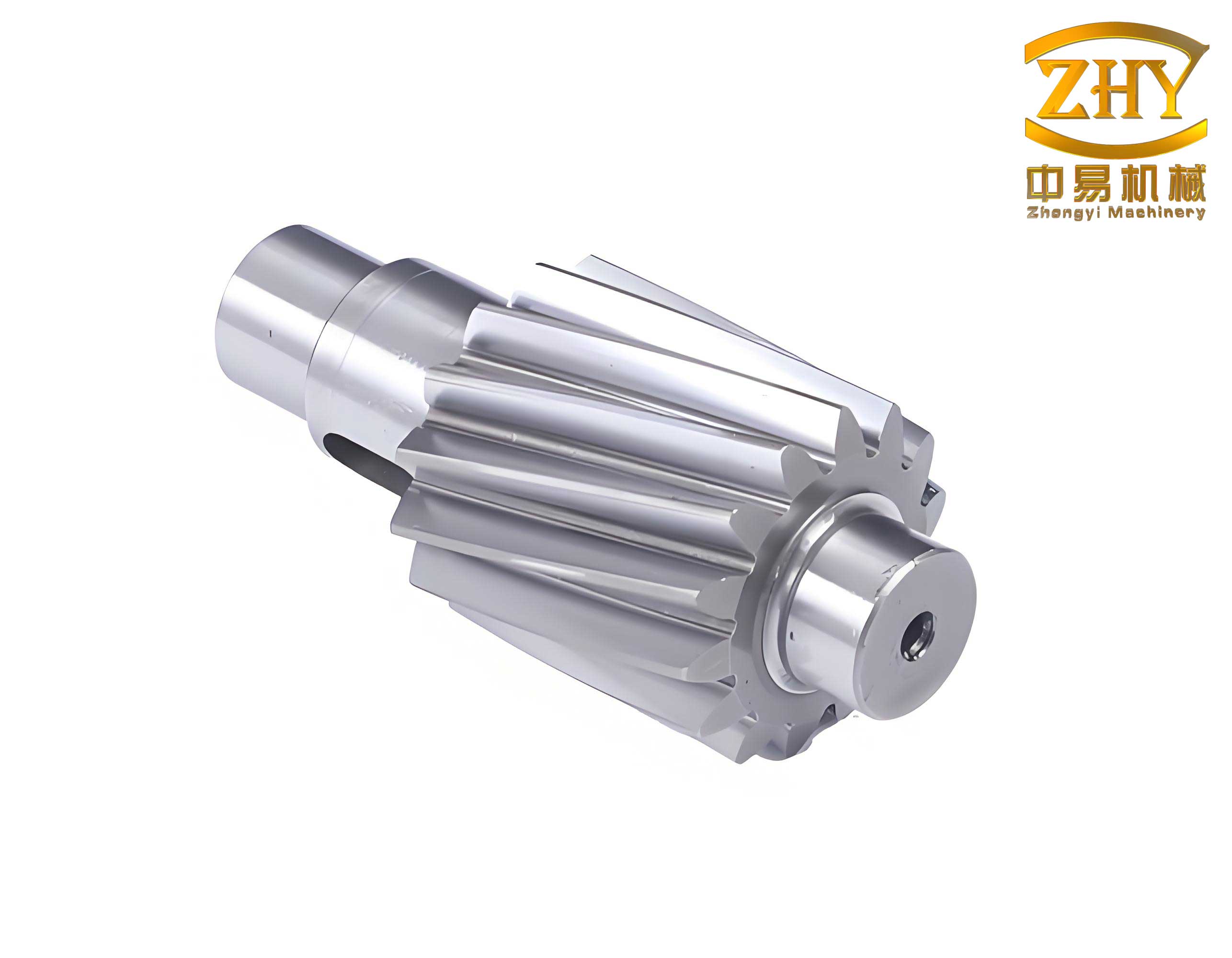
To address these issues, we refine the heating and quenching strategies. First, we modify the heating process to reduce thermal gradients. Instead of direct heating to the quenching temperature, we implement a two-stage heating approach: initially heating to 560°C and holding for 3 hours, followed by gradual heating to 820°C over 9 hours. This minimizes thermal shock and homogenizes temperature distribution, as described by the heat conduction equation: $$ \rho c_p \frac{\partial T}{\partial t} = \nabla \cdot (k \nabla T) $$ where \( \rho \) is density, \( c_p \) is specific heat, and \( k \) is thermal conductivity. Second, we replace oil quenching with salt bath quenching, utilizing a nitrate salt mixture of 55% KNO3 and 45% NaNO2 with 0.7% water content. Salt baths offer advantageous cooling characteristics: high heat extraction at elevated temperatures (peak heat transfer coefficient of 22 W/(mm²·°C) around 560°C) and slower cooling at lower temperatures, reducing both thermal and transformational stresses. The cooling curve for the salt bath is incorporated into the FEA model, and the quenching sequence involves immersion in 180°C salt bath for 2 hours, followed by air cooling and tempering at 180°C for 12 hours. The tempering stabilizes the microstructure by converting martensite to tempered martensite and transforming retained austenite, thereby relieving residual stresses. The FEA results for this improved process show a dramatic reduction in distortion: the mid-tooth凹陷 decreases to 1.41 mm, and warpage reduces to 0.9 mm, both within the specified limits. The outer diameter contraction becomes more uniform along the tooth width, with values ranging from 0.5 mm at the ends to 1.41 mm at the center. The stress distribution is also more homogeneous, with compressive stresses in the mid-region lowered to approximately 80 MPa and tensile stresses near the ends around 15 MPa. This improvement is attributed to the controlled cooling of the salt bath, which allows the low-carbon core to transform first, followed by the high-carburized surface, minimizing stress accumulation. The martensite fraction in the surface layer remains high at about 90%, ensuring hardness requirements are met without excessive distortion.
The effectiveness of the salt bath quenching process can be further understood by comparing the heat transfer coefficients of different media. Below is a table summarizing key parameters for fast oil and salt bath quenching:
| Quenching Medium | Maximum Heat Transfer Coefficient (W/(mm²·°C)) | Temperature at Peak (°C) | Cooling Characteristics |
|---|---|---|---|
| Fast Oil (60°C) | 5.6 | 450 | Moderate cooling, higher low-temperature rate |
| Salt Bath (180°C) | 22 | 560 | Rapid high-temperature cooling, slow low-temperature cooling |
The salt bath’s higher peak coefficient at a higher temperature facilitates faster heat removal during the initial quenching stage, reducing the temperature gradient. Meanwhile, its slower cooling in the martensitic transformation range diminishes transformational stresses. This dual advantage makes salt bath quenching particularly suitable for large gear shafts. Additionally, the refined heating method reduces initial thermal stresses, as the gradual temperature rise allows for more uniform expansion. The combined approach can be modeled using a coupled thermomechanical analysis, where the total strain rate is given by: $$ \dot{\epsilon}_{total} = \dot{\epsilon}_{thermal} + \dot{\epsilon}_{plastic} + \dot{\epsilon}_{phase} $$ Each component contributes to the final distortion, and by optimizing the process, we minimize their adverse effects. For instance, the phase transformation strain rate \( \dot{\epsilon}_{phase} \) is controlled by adjusting the cooling profile to delay surface martensite formation until after core transformation.
Beyond distortion control, this approach has practical implications for manufacturing. By reducing distortion, the required machining allowance for gear shafts can be decreased from over 2 mm to about 1.5 mm. This not only lowers material and machining costs but also mitigates issues like uneven carburized layer depth and hardness variations post-machining. In industrial settings, implementing salt bath quenching for large gear shafts may involve modifications to equipment and process controls, but the long-term benefits in terms of product quality and cost savings justify the investment. Furthermore, the FEA methodology provides a predictive tool for optimizing other heat treatment parameters, such as carburizing time, temperature, and quenching media composition. For example, we can simulate different salt bath mixtures or quenching durations to fine-tune distortion outcomes. The versatility of FEA allows for virtual experimentation, reducing the need for costly trial-and-error in production.
In conclusion, our study demonstrates that finite element analysis is a powerful tool for understanding and controlling distortion in large carburized gear shafts. By analyzing conventional oil quenching, we identified saddle-shaped distortion caused by differential cooling rates and sequential martensite transformation along the tooth width. Through improved heating techniques and salt bath quenching, we achieved significant distortion reduction, with mid-tooth凹陷 and warpage falling within acceptable limits. This approach enhances the precision and reliability of gear shafts while reducing manufacturing costs. Future work could explore other advanced quenching media, such as polymer solutions or high-pressure gas quenching, and incorporate machine learning algorithms to optimize process parameters automatically. Nonetheless, the integration of FEA into heat treatment design represents a significant advancement for the production of high-performance gear shafts in industries like wind energy, automotive, and heavy machinery.
To further illustrate the technical details, below is a table comparing the distortion results for oil quenching and salt bath quenching processes:
| Process | Mid-Tooth凹陷 (mm) | Warpage (mm) | Outer Diameter Contraction Range (mm) | Maximum Surface Stress (MPa) |
|---|---|---|---|---|
| Oil Quenching | 2.2 | 1.4 | 0.8 to 2.2 | 116 (compressive) |
| Salt Bath Quenching | 1.41 | 0.9 | 0.5 to 1.41 | 80 (compressive) |
The data clearly shows the superiority of salt bath quenching for distortion control. Additionally, we can express the relationship between distortion and process parameters through empirical formulas. For instance, the mid-tooth凹陷 \( \delta \) might be approximated as: $$ \delta = k_1 \cdot \Delta T_{max} + k_2 \cdot \Delta V_{max} $$ where \( k_1 \) and \( k_2 \) are constants, \( \Delta T_{max} \) is the maximum temperature gradient, and \( \Delta V_{max} \) is the maximum volumetric change due to phase transformation. By minimizing these terms through optimized heating and cooling, we achieve better outcomes. This holistic approach, combining simulation and practical adjustments, ensures that large gear shafts meet stringent quality standards in modern engineering applications.