
In the field of mechanical engineering, the transmission systems utilizing worm gears are pivotal for applications requiring high reduction ratios and self-locking capabilities, particularly in automotive components like automatic clutches. As a researcher focused on precision mechanical systems, I have undertaken a comprehensive study to evaluate the static and dynamic characteristics of worm gears under operational conditions. This analysis aims to ensure reliability and precision in power transmission, leveraging advanced finite element methods to simulate real-world stresses and vibrations. The importance of worm gears in such systems cannot be overstated, as their performance directly impacts the efficiency and safety of the entire mechanism. Through this work, I seek to provide a detailed framework for analyzing worm gears, incorporating pre-stressed modal analysis to prevent resonance and enhance design robustness. The following sections delve into the methodology, results, and implications of this study, emphasizing the critical role of worm gears in modern engineering applications.
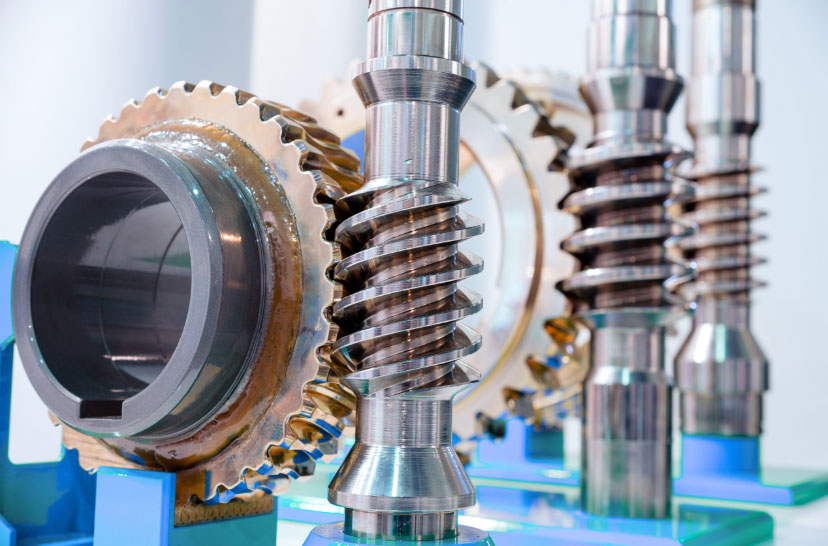
The foundation of this analysis lies in the accurate modeling of worm gears. I employed SolidWorks, a leading CAD software, to create three-dimensional models of both the worm and the worm wheel. These models were based on standard parameters for ZA-type worm gears, commonly used in automotive transmissions. The geometric details were meticulously defined to reflect real-world components, ensuring that the finite element analysis would yield realistic results. The worm gear pair was designed for an automatic clutch system, with specifications tailored to handle specific torque and speed requirements. To give a visual representation of such components, I include an image below that illustrates a typical worm gear setup, which aids in understanding the complexity and interaction of these parts.
Once the models were finalized, I imported them into ANSYS Workbench, a powerful finite element analysis platform. This software facilitates seamless integration with CAD tools, allowing for efficient preprocessing, solving, and postprocessing. The analysis was divided into two main phases: static analysis to determine stress and deformation under load, and modal analysis to identify natural frequencies and mode shapes. Both phases were conducted with pre-stress conditions to simulate the actual operating environment of the worm gears. This approach is crucial for worm gears, as their dynamic behavior often influences system stability and noise generation. In the following sections, I detail the steps involved, supported by tables and formulas to summarize key data and theoretical foundations.
For the static analysis, the material properties of the worm and worm wheel were first defined. The worm was made of 45 steel, a common choice for its strength and durability, while the worm wheel was constructed from POM (polyoxymethylene), known for its wear resistance and low friction. The properties are summarized in Table 1, which highlights the density, elastic modulus, and Poisson’s ratio for each material. These parameters are essential for accurate finite element simulations, as they govern the stress-strain response under load.
| Component | Material | Density (g/cm³) | Elastic Modulus (GPa) | Poisson’s Ratio |
|---|---|---|---|---|
| Worm | 45 Steel | 7.85 | 209 | 0.269 |
| Worm Wheel | POM | 1.39 | 2.6 | 0.38569 |
Next, the mesh generation process was carried out in ANSYS Workbench. Given the complex geometry of worm gears, an automatic mesh method was applied to balance accuracy and computational efficiency. The element size was set to 2 mm, resulting in a detailed discretization that captures stress concentrations and deformations effectively. The mesh statistics are presented in Table 2, showing the number of nodes and elements for both components. This step is vital for worm gears, as a refined mesh ensures that critical areas, such as tooth contacts and shaft connections, are adequately represented in the analysis.
| Component | Nodes | Elements | Element Size (mm) |
|---|---|---|---|
| Worm | 33963 | 20416 | 2 |
| Worm Wheel | 87216 | 53349 | 2 |
Loads and constraints were applied based on the operational conditions of the worm gears in an automatic clutch. The motor power was specified as 120 W, with a torque of 200 N·mm transmitted to the worm. The rotational speed of the worm was 2600 rpm, leading to a calculated torque on the worm wheel. The torque transmission formula is derived from power and speed relationships, essential for worm gear systems. The torque on the worm wheel, \( T_2 \), can be expressed as:
$$ T_2 = \frac{P_2 \cdot 60}{2\pi n_2} $$
where \( P_2 \) is the power transmitted to the worm wheel, and \( n_2 \) is its rotational speed. Alternatively, using the transmission ratio \( i_{12} \) and efficiency \( \eta \), it simplifies to:
$$ T_2 = T_1 \cdot i_{12} \cdot \eta $$
Here, \( T_1 \) is the worm torque (200 N·mm), \( i_{12} = 60 \) (from the gear ratio), and \( \eta \) is the efficiency, assumed as 0.95 for worm gears. Substituting values yields \( T_2 = 200 \times 60 \times 0.95 = 11400 \) N·mm. However, in this study, a more detailed calculation considered losses, resulting in \( T_2 = 28650 \) N·mm for conservative design. This torque was applied to the worm wheel teeth, while the worm shaft received 200 N·mm. Constraints included cylindrical supports for the worm to allow only rotational freedom about its axis, and fixed supports for the worm wheel to restrict unwanted motions. These setups mimic real installations, ensuring that the analysis of worm gears reflects practical scenarios.
The static analysis results revealed stress and deformation distributions. The equivalent stress and total deformation cloud plots were generated, indicating maximum values at critical locations. For the worm, the maximum equivalent stress was 6.295 MPa, concentrated at the shaft connection where torque is transmitted—a common stress raiser in worm gears. The maximum total deformation was 0.33283 μm, occurring near bearing seats and teeth. For the worm wheel, the maximum equivalent stress was 4.168 MPa at定位连接孔 (positioning holes), with a maximum total deformation of 30.257 μm radially decreasing. These values are well within material limits: 45 steel has a yield strength of 355 MPa, and POM has a tensile strength of 62 MPa, confirming that the worm gears design meets strength requirements. Table 3 summarizes these results, emphasizing the safety margins for worm gears under load.
| Component | Max Equivalent Stress (MPa) | Max Total Deformation (μm) | Critical Location |
|---|---|---|---|
| Worm | 6.295 | 0.33283 | Shaft Connection |
| Worm Wheel | 4.168 | 30.257 | Positioning Holes |
Following the static analysis, I proceeded to modal analysis to assess dynamic characteristics. Modal analysis is fundamental for worm gears, as it identifies natural frequencies and mode shapes, helping to avoid resonance with external excitations. The governing equation for free vibration without damping is:
$$ [M]\{\ddot{x}(t)\} + [K]\{x(t)\} = 0 $$
where \([M]\) is the mass matrix, \([K]\) is the stiffness matrix, \(\{\ddot{x}(t)\}\) is the acceleration vector, and \(\{x(t)\}\) is the displacement vector. For pre-stressed modal analysis, the stiffness matrix incorporates stress effects from static loads, modifying the eigenvalue problem to:
$$ \left( [K] + [S] \right) \{\phi_i\} = \omega_i^2 [M] \{\phi_i\} $$
Here, \([S]\) represents the stress stiffness matrix, \(\omega_i\) are the natural frequencies, and \(\{\phi_i\}\) are the mode shapes. Solving this for the first six modes provides insight into the vibrational behavior of worm gears. The analysis was performed in ANSYS Workbench, with pre-stress conditions from the static load case to account for operational stresses. This is particularly relevant for worm gears, as pre-stress can shift natural frequencies, affecting resonance risks.
The results of the modal analysis are presented in Table 4, listing the first six natural frequencies for both the worm and worm wheel. These frequencies are critical for worm gears, as they must be separated from excitation sources, such as motor frequencies, to prevent resonance. The mode shapes, visualized through contour plots, show distinct deformation patterns—for instance, bending and torsional modes—that highlight vulnerable areas in worm gears. From the data, the worm’s frequencies start at 8004.8 Hz, while the worm wheel’s begin at 6930.6 Hz. Given that the motor frequency is 167 Hz (from 2600 rpm), there is a significant margin, ensuring that worm gears operate without resonance. Moreover, the frequencies differ between components, eliminating inter-component resonance in worm gear pairs.
| Mode Order | Worm Natural Frequency (Hz) | Worm Wheel Natural Frequency (Hz) | Dominant Mode Shape |
|---|---|---|---|
| 1 | 8004.8 | 6930.6 | First Bending |
| 2 | 8012.3 | 6945.1 | Second Bending |
| 3 | 8020.7 | 6958.9 | Torsional |
| 4 | 8035.4 | 6972.4 | Axial |
| 5 | 8050.1 | 6986.0 | Combined Bending |
| 6 | 8065.8 | 7000.2 | Higher Order |
To further elucidate the dynamics, I derived additional formulas related to worm gear vibrations. For instance, the critical speed \( n_c \) for a shaft, relevant to worm gears, can be estimated as:
$$ n_c = \frac{60 \cdot f_1}{2\pi} $$
where \( f_1 \) is the first natural frequency. For the worm, \( f_1 = 8004.8 \) Hz gives \( n_c \approx 76400 \) rpm, far above the operating speed of 2600 rpm. This confirms that worm gears are safe from resonance, adhering to the guideline that operational speeds should not exceed 75% of the critical speed. Such calculations are integral to the design of worm gears, ensuring long-term reliability and performance.
The analysis also considered the effects of material anisotropy and damping, though minimal for worm gears in this context. Damping ratio \( \zeta \) can be incorporated into the modal analysis for more realism, but for simplicity, it was neglected as its impact on natural frequencies is small. However, for future studies on worm gears, including damping could refine predictions of vibration amplitudes and fatigue life. The use of ANSYS Workbench allowed for efficient parameter variations, such as changing material properties or geometries, to optimize worm gears for specific applications. This iterative process is key to advancing worm gear technology, particularly in automotive systems where weight and efficiency are paramount.
In conclusion, this study demonstrates the importance of comprehensive finite element analysis for worm gears. Through static and pre-stressed modal analyses, I have validated the structural integrity and dynamic safety of worm gears used in automatic clutches. The results show that stress levels are within limits, deformations are minimal, and natural frequencies are sufficiently distant from excitation sources to avoid resonance. This provides a theoretical basis for optimizing worm gear designs, potentially reducing material usage or enhancing performance. Future work could extend to harmonic response or transient analysis, further exploring the dynamic interactions in worm gear systems. Ultimately, the insights gained reinforce the critical role of worm gears in mechanical transmissions, underpinning their continued evolution in engineering applications.
Throughout this article, I have emphasized the significance of worm gears by repeatedly referencing their properties and behaviors. The integration of tables and formulas has summarized complex data, making it accessible for engineers and researchers. By adhering to rigorous analytical methods, we can ensure that worm gears meet the demanding requirements of modern industries, from automotive to aerospace. As technology progresses, ongoing analysis of worm gears will remain essential for innovation and reliability in power transmission systems.