
In the manufacturing of spiral bevel gears, a critical challenge is controlling deformation during heat treatment processes. As a professional engaged in gear production, I have observed that post-quenching distortions often lead to issues such as misaligned contact patterns and pairing failures, resulting in increased scrap rates and production costs. Spiral bevel gears, with their complex geometry and high precision requirements, are particularly susceptible to these deformations. Through systematic analysis and process optimization, focusing on the entire heat treatment cycle, effective measures have been developed to minimize distortions, ensuring improved quality and performance for spiral bevel gears.
Heat treatment-induced deformation in spiral bevel gears arises from the interplay of stress, plasticity, and time across various stages. The primary factors are thermal stress and transformational stress, which act synergistically to cause shape changes. Understanding these mechanisms is essential for implementing control strategies in spiral bevel gear production.
Thermal stress deformation occurs due to temperature gradients within the workpiece during heating and cooling. Consider a cylindrical component heated below the phase transformation temperature. Initially, the surface expands, generating compressive stress on the surface and tensile stress in the core, as described by the thermal stress equation: $$\sigma_{th} = E \alpha \Delta T$$ where $\sigma_{th}$ is the thermal stress, $E$ is Young’s modulus, $\alpha$ is the coefficient of thermal expansion, and $\Delta T$ is the temperature difference. As heating continues, the stress may exceed the yield strength, causing plastic deformation. For instance, during cooling, the surface contracts first, leading to tensile stress on the surface and compressive stress in the core. Ultimately, this results in a barrel-shaped distortion, which is analogous to effects observed in spiral bevel gears with their tapered geometry.
Transformational stress, or organizational stress, stems from volume changes during phase transformations, such as martensite formation in quenching. When the surface of a spiral bevel gear cools below the Ms (martensite start) temperature, martensite transformation occurs with a volume expansion of approximately: $$\Delta V = \beta \cdot C$$ where $\Delta V$ is the volume change, $\beta$ is the expansion coefficient for martensite, and $C$ is the carbon content. This expansion is constrained by the untransformed core, inducing compressive stress on the surface and tensile stress in the core. As cooling proceeds, the core transforms, reversing the stress state to tensile on the surface and compressive in the core. This stress reversal contributes to distortions like twisting or warping in spiral bevel gears, affecting their meshing accuracy.
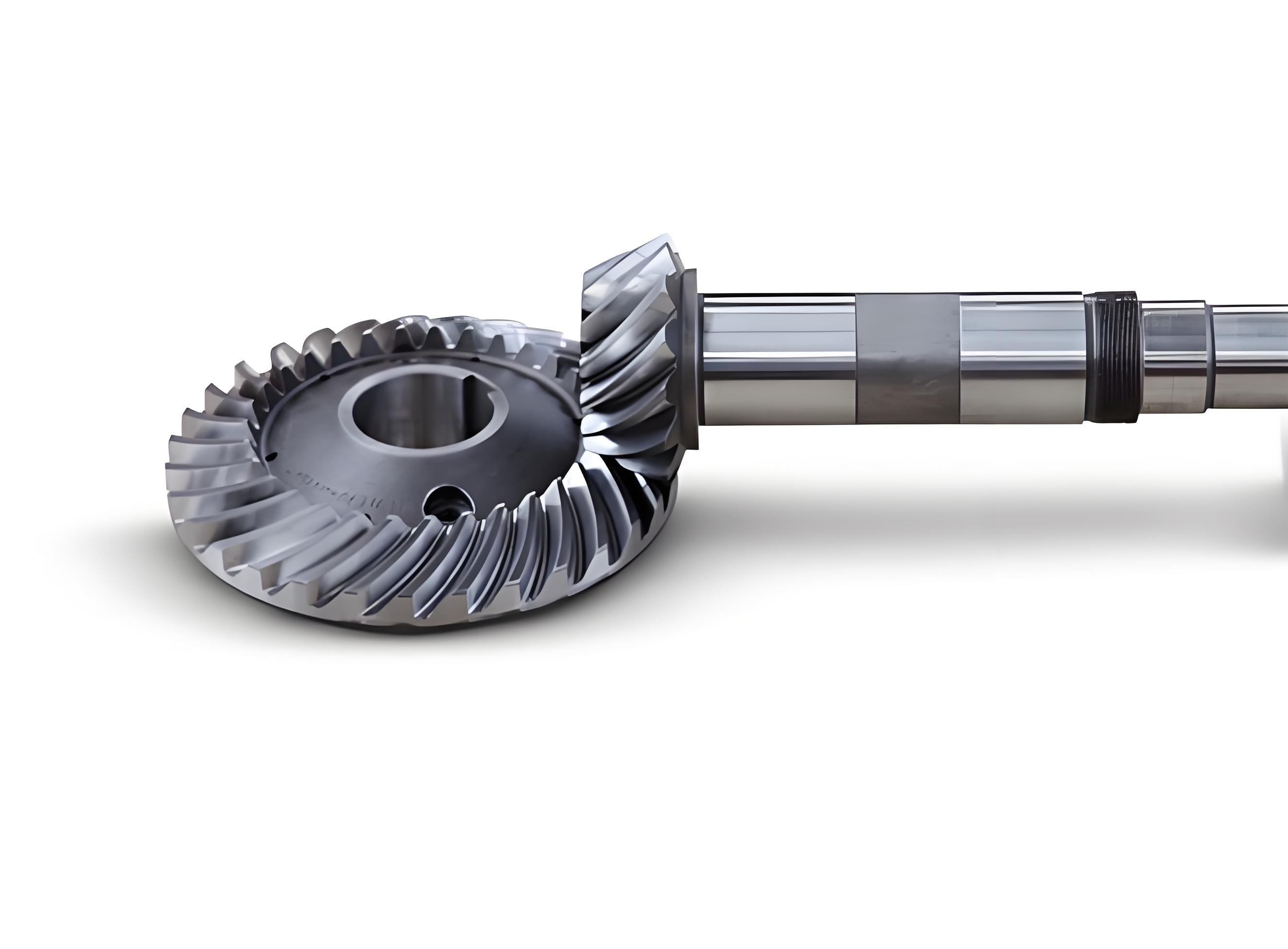
The deformation characteristics of spiral bevel gears are influenced by their design parameters, such as cone angle, module, and tooth count. For example, a driven spiral bevel gear with an outer diameter of 850 mm, bore diameter of 260 mm, thickness of 75 mm, and cone angle of 50° is prone to distortion due to its thin-web structure. Material selection, like 20CrMnTi steel, further impacts the response to heat treatment. Below, I detail control measures applied throughout the production of spiral bevel gears to mitigate these issues.
Normalizing, as a preliminary heat treatment, plays a pivotal role in refining microstructure and reducing final heat treatment distortions for spiral bevel gears. Traditional normalizing often results in inconsistent hardness and microstructure due to uneven furnace temperature and cooling rates. To address this, forced-air cooling systems have been implemented, where spiral bevel gear blanks are spread in cooling boxes with fans to ensure uniform cooling. The hardness data after primary forced-air normalizing for spiral bevel gear blanks are shown in Table 1.
| Sample No. | 1 | 2 | 3 | 4 | 5 | 6 | 7 | 8 | 9 | 10 | 11 | 12 | 13 | 14 | 15 |
|---|---|---|---|---|---|---|---|---|---|---|---|---|---|---|---|
| Hardness (HRB) | 181 | 182 | 186 | 192 | 188 | 187 | 187 | 193 | 191 | 186 | 192 | 188 | 186 | 189 | 187 |
| Hardness (HRB) | 186 | 189 | 192 | 186 | 188 | 188 | 191 | 187 | 186 | 192 | 187 | 192 | 182 | 193 | 187 |
| Hardness (HRB) | 193 | 187 | 186 | 193 | 188 | 193 | 192 | 187 | 187 | 191 | 189 | 192 | 193 | 192 | 192 |
This table indicates a hardness scatter within 12 HRB, demonstrating improved uniformity compared to conventional methods. To further eliminate residual stresses and homogenize microstructure, a secondary normalizing process is added after rough machining of spiral bevel gears. The hardness results after secondary forced-air normalizing are presented in Table 2.
| Sample No. | 1 | 2 | 3 | 4 | 5 | 6 | 7 | 8 | 9 | 10 | 11 | 12 | 13 | 14 | 15 |
|---|---|---|---|---|---|---|---|---|---|---|---|---|---|---|---|
| Hardness (HRB) | 184 | 182 | 183 | 188 | 186 | 184 | 187 | 184 | 188 | 184 | 181 | 187 | 184 | 186 | 185 |
| Hardness (HRB) | 185 | 184 | 186 | 182 | 184 | 188 | 184 | 189 | 183 | 184 | 185 | 182 | 187 | 187 | 187 |
| Hardness (HRB) | 182 | 186 | 182 | 181 | 187 | 188 | 189 | 185 | 182 | 187 | 189 | 184 | 188 | 188 | 189 |
The hardness scatter is reduced to within 8 HRB, showcasing enhanced microstructure refinement. The relationship between normalizing quality and final distortion can be expressed as: $$D_f = k_1 \cdot \sigma_{res} + k_2 \cdot H_{var}$$ where $D_f$ is the final distortion, $\sigma_{res}$ is the residual stress after normalizing, $H_{var}$ is the hardness variation, and $k_1$, $k_2$ are material constants. For spiral bevel gears, minimizing these terms through controlled normalizing is crucial.
Carburizing of spiral bevel gears introduces additional complexities due to carbon diffusion and layer formation. Deformation during carburizing can exacerbate during quenching, necessitating careful process control. Key measures include modifying furnace loading, optimizing temperature, and regulating carbon potential. For thin-web spiral bevel gears, traditional horizontal stacking is replaced by vertical hanging to ensure uniform temperature and gas flow, reducing weight-induced distortions. The carburizing temperature is lowered to minimize thermal stress, adhering to the principle: $$T_{carb} = T_0 – \Delta T_{opt}$$ where $T_{carb}$ is the carburizing temperature, $T_0$ is a reference temperature, and $\Delta T_{opt}$ is an optimized reduction based on gear geometry. Typically, for spiral bevel gears made of 20CrMnTi, temperatures around 920-940°C are used.
Carbon potential control is vital to achieve desired surface carbon concentration and case depth. Using a programmable carbon potential controller, the atmosphere is set to 1.0% C, limiting surface carbon to 0.8-1.1% to avoid excessive carbides. The case depth ($d_c$) for spiral bevel gears is controlled within 1.0-1.5 mm, as per the equation: $$d_c = \sqrt{D \cdot t} \cdot f(C_p)$$ where $D$ is the diffusion coefficient, $t$ is time, and $f(C_p)$ is a function of carbon potential. Carbide levels are maintained below grade 2 to ensure good mechanical properties and reduced distortion in spiral bevel gears.
Quenching is the final heat treatment step where accumulated stresses are released, making it critical for spiral bevel gear accuracy. To control distortion, quenching temperature is selected at the lower end of the range, balancing hardness and non-martensitic formation. For spiral bevel gears, the quenching temperature ($T_q$) can be derived from: $$T_q = A_{c3} – \delta$$ where $A_{c3}$ is the austenitizing temperature and $\delta$ is a safety margin, typically 10-20°C. Additionally, specialized quenching presses with pulsating pressure are employed. These presses apply dynamic force on the inner and outer rims and bore of spiral bevel gears, using tailored molds and expanders to maintain flatness and roundness. The pulsating action helps relieve stress, as modeled by: $$\sigma_{rel}(t) = \sigma_0 \cdot e^{-t/\tau}$$ where $\sigma_{rel}$ is the relieved stress, $\sigma_0$ is the initial stress, $t$ is time, and $\tau$ is a relaxation constant. This approach ensures that spiral bevel gears meet dimensional tolerances and hardness specifications.
Further analysis of distortion mechanisms in spiral bevel gears involves finite element modeling to simulate stress distributions. The total distortion ($D_{total}$) can be approximated as: $$D_{total} = \int_V (\epsilon_{th} + \epsilon_{tr}) dV$$ where $\epsilon_{th}$ is thermal strain and $\epsilon_{tr}$ is transformational strain integrated over the volume $V$ of the gear. For spiral bevel gears with asymmetric shapes, this integral is complex, but empirical data from production shows that control measures reduce distortion by up to 50%. Table 3 summarizes key parameters and their effects on distortion for spiral bevel gears.
| Parameter | Optimal Range | Effect on Distortion | Control Measure |
|---|---|---|---|
| Normalizing Hardness Uniformity | ±5 HRB | High uniformity reduces residual stress | Forced-air cooling, secondary normalizing |
| Carburizing Temperature | 920-940°C | Lower temperature minimizes thermal stress | Precise furnace control |
| Carbon Potential | 0.9-1.1% C | Optimal carbon limits carbide formation | Programmable carbon controllers |
| Quenching Temperature | 810-830°C | Lower temperature reduces transformational stress | Temperature monitoring |
| Quenching Pressure | Pulsating, 5-10 MPa | Dynamic pressure relieves stress | Specialized presses with molds |
Material science principles also play a role; for instance, the hardenability of steel used in spiral bevel gears affects distortion. The ideal critical diameter ($D_I$) can be calculated using Grossmann’s equation: $$D_I = k \cdot \sqrt{C}$$ where $k$ is a constant and $C$ is carbon content. For 20CrMnTi spiral bevel gears, this ensures sufficient depth without excessive distortion. Additionally, phase transformation kinetics during quenching can be described by the Koistinen-Marburger equation for martensite formation: $$f_m = 1 – e^{-\alpha (M_s – T)}$$ where $f_m$ is the martensite fraction, $\alpha$ is a constant, $M_s$ is the martensite start temperature, and $T$ is temperature. This helps predict volume changes and stresses in spiral bevel gears.
In practice, statistical process control is applied to monitor heat treatment of spiral bevel gears. Data on distortion metrics, such as runout or tooth profile deviation, are collected and analyzed using control charts. For example, the process capability index ($C_{pk}$) is maintained above 1.33 to ensure consistency. The relationship between process parameters and gear quality is often expressed as: $$Q = \beta_0 + \beta_1 X_1 + \beta_2 X_2 + \epsilon$$ where $Q$ is a quality metric (e.g., distortion magnitude), $X_1$ and $X_2$ are factors like normalizing hardness scatter or carburizing time, $\beta$ are coefficients, and $\epsilon$ is error. This multivariate approach allows continuous improvement in spiral bevel gear production.
Environmental and operational factors, such as furnace atmosphere uniformity and cooling medium stability, also impact spiral bevel gears. For instance, oil quenching for spiral bevel gears requires precise temperature control to avoid vapor blanket formation, which can cause uneven cooling. The cooling rate ($\frac{dT}{dt}$) is critical and should follow the ideal quenching curve: $$\frac{dT}{dt} = -h(T – T_m)$$ where $h$ is the heat transfer coefficient and $T_m$ is the medium temperature. By optimizing these parameters, distortion in spiral bevel gears is minimized.
In conclusion, controlling deformation in the heat treatment of spiral bevel gears involves a holistic approach across multiple stages. Factors such as material selection, process optimization, and advanced equipment are interlinked. Normalizing sets the foundation by refining microstructure, carburizing requires precise carbon control, and quenching benefits from dynamic pressure applications. Through these measures, spiral bevel gears achieve dimensional accuracy and performance reliability. The key takeaway is that while deformation in spiral bevel gears is influenced by complex interactions, systematic control from raw material to final heat treatment can effectively mitigate it, ensuring high-quality gears for demanding applications. Future advancements may include real-time monitoring and AI-based process adjustments to further enhance spiral bevel gear production.