
The demand for high-precision power transmission components has surged with the rapid advancement of the electric vehicle industry. Among these, planetary gear reducers, prized for their compactness, high reduction ratios, and efficiency, are pivotal. The internal ring gear, particularly the helical gears variant, is a core component whose performance directly dictates the reducer’s overall capability. The finishing of hardened tooth surfaces on these internal helical gears presents a significant manufacturing challenge, creating a critical bottleneck for high-performance applications.
Traditional hard-finishing methods for internal helical gears primarily include power skiving, honing, and form grinding. While power skiving offers high efficiency through continuous rotary cutting, it inherently suffers from theoretical tooth surface deviations, limiting its ability to achieve the top-tier accuracy and optimal topological form required for premium transmissions. Honing produces a unique surface texture beneficial for noise, vibration, and harshness (NVH) performance, but its capacity for correcting geometric form errors is limited. Form grinding can achieve high geometric accuracy (e.g., Grade 4 or better); however, its single-tooth indexing process severely compromises efficiency. This low throughput is fundamentally mismatched with the high-volume, short-cycle production demands of the electric vehicle market. Therefore, there is an urgent need for an innovative, high-efficiency, and high-precision finishing technology for internal helical gears.
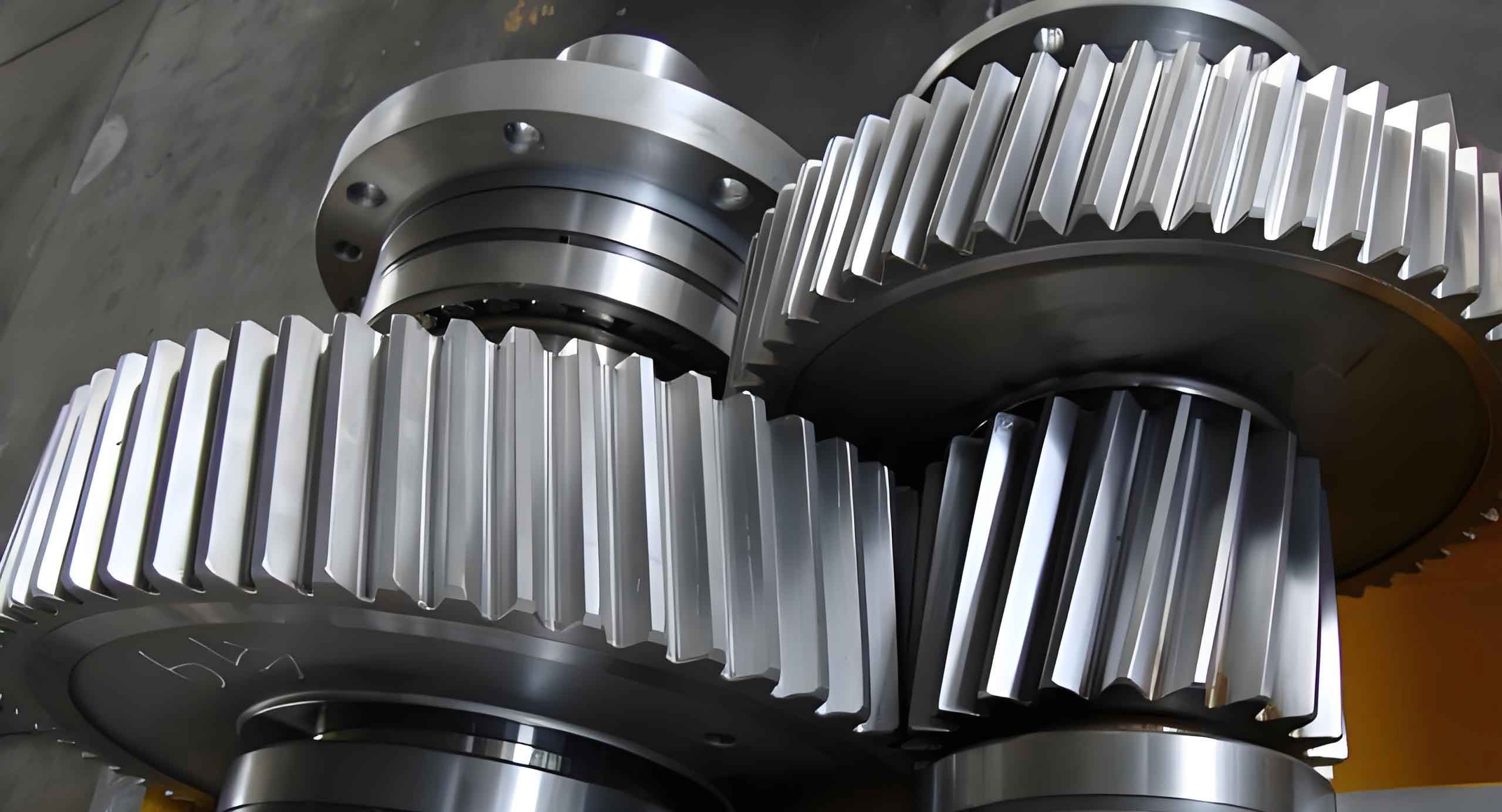
This paper proposes a novel generating grinding method for internal helical gears utilizing a spherical worm grinding wheel. The method aims to combine the continuous, high-speed engagement characteristic of skiving with the precision material removal capability of grinding. We systematically construct the mathematical foundation for this process, derive the essential geometrical and kinematic models, and validate the approach through detailed numerical simulation.
Theoretical Foundation: Mathematical Modeling of the Grinding System
The proposed method is based on the theory of conjugate surface generation. The spherical worm grinding wheel itself is generated by an imaginary generating gear (a virtual gear shaper cutter). Subsequently, this precisely defined worm wheel is used to grind the final internal helical gears workpiece in a continuous generating motion. The core of the methodology lies in establishing the mathematical mapping between these three entities: the virtual cutter, the worm wheel, and the workpiece.
1. Profile of the Virtual Generating Gear (Gear Shaper Cutter)
The tooth surface of a standard helical gear shaper cutter can be defined by its transverse section profile, which is an involute, extended along a helix. The coordinate system for the cutter’s transverse section is defined, where the Z-axis coincides with the cutter’s axis.
Let \( r_b \) be the base circle radius, and \( \mu \) be the involute roll angle parameter. For any point \( M \) on the involute, the length of the tangent segment from \( M \) to the base circle is \( r_b \mu \). Including the helical motion parameter \( \theta \) (rotation around Z-axis), the tooth surface equation of the virtual cutter in its own coordinate system \( O_s – X_s Y_s Z_s \) is given by:
$$ \mathbf{r_s}(\mu, \theta) = \begin{bmatrix} x_s \\ y_s \\ z_s \\ 1 \end{bmatrix} = \begin{bmatrix} r_b [\cos(\mu + \theta – \delta_0) + \mu \sin(\mu + \theta – \delta_0)] \\ r_b [\mp \sin(\mu + \theta – \delta_0) \pm \mu \cos(\mu + \theta – \delta_0)] \\ p \theta \\ 1 \end{bmatrix} $$
where \( p \) is the helical parameter (\( p = p_z / 2\pi \), with \( p_z \) being the lead), \( \delta_0 \) is the angle defining the start of the involute relative to the \( X_s \)-axis, and the upper/lower signs correspond to the right/left flanks of the helical gears tooth, respectively.
2. Generation of the Spherical Worm Grinding Wheel Surface
The spherical worm grinding wheel is formed as the envelope of the virtual cutter’s tooth surface in an internal meshing configuration. The coordinate systems for this generation process are established, comprising static and rotating frames for both the cutter (index \( m \)) and the worm wheel (index \( n \)).
The key parameters are: the center distance \( E_{mn} \), the shaft angle \( \gamma_{sw} \), the worm lead angle \( \lambda_w \), and the helix angle \( \beta \) of the virtual cutter. The transformation matrix from the cutter coordinate system \( O_m – X_m Y_m Z_m \) to the worm wheel coordinate system \( O_n – X_n Y_n Z_n \) is derived as:
$$ \mathbf{M}_{nm}(\Phi_m) = \begin{bmatrix} -\cos \Phi_m \sin \Phi_d + \sin \lambda_w \sin \Phi_m \cos \Phi_d & -\sin \Phi_m \sin \Phi_d – \sin \lambda_w \cos \Phi_m \cos \Phi_d & \cos \lambda_w \cos \Phi_d & E_{mn} \sin \Phi_d \\ \cos \Phi_m \cos \Phi_d + \sin \lambda_w \sin \Phi_m \sin \Phi_d & \sin \Phi_m \cos \Phi_d – \sin \lambda_w \cos \Phi_m \sin \Phi_d & \cos \lambda_w \sin \Phi_d & -E_{mn} \cos \Phi_d \\ -\cos \lambda_w \sin \Phi_m & \cos \lambda_w \cos \Phi_m & \sin \lambda_w & 0 \\ 0 & 0 & 0 & 1 \end{bmatrix} $$
Here, \( \Phi_m \) and \( \Phi_d \) are the rotation angles of the cutter and worm wheel, related by their tooth numbers \( N_s \) and \( N_w \): \( N_w \Phi_d = N_s \Phi_m \).
According to the theory of gearing, the worm wheel surface \( \mathbf{r}_n \) in frame \( O_n – X_n Y_n Z_n \) and the corresponding meshing equation are:
$$ \begin{cases} \mathbf{r}_n(\Phi_m, \mu, \theta) = \mathbf{M}_{nm}(\Phi_m) \cdot \mathbf{r}_m^s(\mu, \theta) \\ f_{nm}(\Phi_m, \mu, \theta) = \mathbf{N}_m^s \cdot \mathbf{v}_m^{sw} = 0 \end{cases} $$
where \( \mathbf{N}_m^s \) is the unit normal vector of the cutter surface expressed in the cutter frame, and \( \mathbf{v}_m^{sw} \) is the relative velocity vector at the contact point between the cutter and the worm wheel, also expressed in the cutter frame. Solving the meshing equation \( f_{nm}=0 \) allows the elimination of one parameter (e.g., \( \theta \)), yielding the worm wheel surface as a function of two parameters: \( \mathbf{r}_n(\mu, \Phi_m) \).
3. Determination of the Worm Wheel Lead Angle
The lead angle \( \lambda_w \) of the spherical worm grinding wheel is crucial for correct kinematic coupling. It is determined by enforcing the meshing condition at a specific reference point, typically the pitch point. Analyzing the relative velocity and the normal vector at this point leads to the following closed-form expression:
$$ \lambda_w = \arcsin\left( \frac{N_w r_{ps} \cos \beta}{N_s (E_{mn} + r_{ps})} \right) $$
where \( r_{ps} \) is the pitch radius of the virtual generating gear (cutter). This equation ensures that the worm wheel and the virtual cutter maintain proper tangency along their line of contact.
4. Tooth Surface of the Internal Helical Gear
The finished tooth surface of the internal helical gears workpiece is generated via the simulating process of gear shaping using the same virtual cutter. A separate set of coordinate systems is established for this generation, relating the cutter frame to the internal gear workpiece frame \( O_f – X_f Y_f Z_f \).
The transformation from the cutter frame to the internal gear frame involves the center distance \( L \) and their respective rotations \( \Phi_m \) and \( \Phi_f \), governed by \( \Phi_f N_f = \Phi_m N_s \), where \( N_f \) is the tooth number of the internal helical gears. The combined transformation matrix is:
$$ \mathbf{M}_{fm}(\Phi_m, \Phi_f) = \mathbf{M}_{fe}(\Phi_f) \cdot \mathbf{M}_{ea} \cdot \mathbf{M}_{am}(\Phi_m) $$
Consequently, the internal helical gears tooth surface, as the envelope of the cutter surface, is given by:
$$ \mathbf{r}_f(\mu, \theta, \Phi_m) = \mathbf{M}_{fm}(\Phi_m, \Phi_f(\Phi_m)) \cdot \mathbf{r}_m^s(\mu, \theta) $$
Thus, the complete mathematical chain linking the worm wheel surface \( \mathbf{r}_n \) to the final internal gear surface \( \mathbf{r}_f \) through the virtual cutter is established as:
$$ \mathbf{r}_n(\Phi_m, \mu, \theta) = \mathbf{M}_{nm}(\Phi_m) \cdot \mathbf{M}_{mf} \cdot \mathbf{r}_f(\mu, \theta, \Phi_m) $$
subject to the same meshing condition \( f_{nm}=0 \).
Numerical Example and Model Generation
To demonstrate the methodology, a specific set of design parameters is chosen for the virtual cutter, the spherical worm grinding wheel, and the target internal helical gears. The calculations are performed programmatically.
| Parameter | Virtual Gear Shaper Cutter | Spherical Worm Grinding Wheel | Internal Helical Gear |
|---|---|---|---|
| Module (mm) | 3 | 3 | 3 |
| Pressure Angle (°) | 25 | 25 | 25 |
| Number of Teeth / Starts | 25 | 1 (Start) | 120 |
| Center Distance (mm) | – | 80 | – |
| Helix Hand | Right | Left | Right |
| Helix / Lead Angle (°) | 10 (β) | Calculated (λ_w) | 10 (β) |
| Face Width (mm) | 25 | – | 100 |
Using the derived equations, the worm wheel’s lead angle is first calculated:
$$ \lambda_w = \arcsin\left( \frac{1 \times r_{ps} \times \cos(10^\circ)}{25 \times (80 + r_{ps})} \right) \approx 2.29061^\circ $$
The shaft angle during worm generation is therefore \( \gamma_{sw} = 90^\circ – \beta + \lambda_w = 82.29061^\circ \).
The coordinates of points on the spherical worm grinding wheel surface are computed by solving the meshing equation numerically and applying the coordinate transformation. A point cloud representing the worm wheel tooth surface is generated. This data is then imported into CAD software to construct a precise 3D solid model of the spherical worm grinding wheel. Similarly, the point cloud for the internal helical gears tooth surface is calculated and used to build its 3D model, confirming the theoretical meshing relationship among the three components.
Simulation of the Generating Grinding Process
The feasibility and accuracy of the proposed method are validated through a virtual machining simulation using Vericut software, which is an industry-standard platform for CNC simulation and verification.
1. Machine Kinematics and Setup Angle
The generating grinding process requires synchronized multi-axis motion. The key kinematic parameters for the CNC program are the setup angle \( A \) between the worm wheel axis and the workpiece axis, and the electronic gear ratio.
The setup angle compensates for the helical structure and is given by:
$$ A = \beta – \lambda_w = 10^\circ – 2.29061^\circ = 7.70939^\circ $$
During grinding, the workpiece rotates continuously (C-axis), and the worm wheel rotates at a proportional speed (B-axis) while simultaneously traversing along the workpiece axis (Z-axis). The exact rotational relationship must account for this axial feed to correctly generate the helix. The number of worm wheel revolutions \( n \) per one revolution of the internal helical gears workpiece is:
$$ n = \frac{N_f}{N_w} + \frac{S_n}{T} \cdot \frac{N_f}{N_w} $$
where \( S_n \) is the axial feed per workpiece revolution (e.g., 1 mm/rev), and \( T \) is the lead of the internal helical gears helix (\( T = \pi d \cot \beta \), with \( d \) as a reference diameter).
For the given parameters:
$$ T = \pi \times d_f \times \cot(10^\circ) \approx 6513.1062 \text{ mm} $$
$$
n = \frac{120}{1} + \frac{1}{6513.1062} \times \frac{120}{1} \approx 120.0184 \text{ revolutions}
$$
This precise ratio is implemented via the CNC system’s electronic gearing functionality.
2. Virtual Machine Setup and Simulation
A virtual 5-axis gear grinding machine is constructed within Vericut. The machine components (bed, headstock, footstock, wheel head, etc.) are assembled in a kinematic tree, and their corresponding 3D models are attached. The spherical worm grinding wheel model is mounted on the B-axis (wheel spindle), and the internal helical gears blank model is mounted on the C-axis (workpiece spindle). The relative positions are set according to the calculated center distance and setup angle. A Siemens 840D control system is configured to interpret the NC code containing the synchronized B, C, and Z-axis motions.
The simulation process follows these steps: The machine initializes at the start position. Upon cycle start, the B and C axes begin rotating at the precise ratio \( n:1 \). Simultaneously, the Z-axis (or the wheel head X-axis) moves linearly, causing the worm wheel to traverse the full face width of the internal helical gears blank. The material removal is calculated in real-time based on the Boolean intersection between the wheel model and the blank model.
3. Simulation Results and Accuracy Analysis
The simulation runs successfully, demonstrating a continuous generating grind from one end of the workpiece to the other. The resulting ground internal helical gears model is visually inspected and shows a clean, fully formed tooth space.
To quantitatively assess accuracy, Vericut’s “Auto-Diff” module is employed. This module compares the as-simulated workpiece geometry against the ideal, designed CAD model of the internal helical gears. The comparison generates a color-coded error map showing both overcut (gouging) and undercut (remaining stock) regions.
| Tooth Region | Error Type | Maximum Magnitude | Analysis & Conclusion |
|---|---|---|---|
| Left Flank | Overcut / Undercut | ~0 μm | No discernible deviation. The generated flank matches the theoretical design perfectly. |
| Right Flank | Overcut / Undercut | ~0 μm | No discernible deviation. The generated flank matches the theoretical design perfectly. |
| Root Fillet / Bottom Land | Undercut (Residual Material) | Defined by process | As expected, material remains in the root area. This is standard practice, as grinding typically does not target the root circle; clearance is provided during pre-grinding rough cutting. |
The critical finding is that the active, functional tooth flanks of the internal helical gears show virtually zero deviation from their theoretical surfaces. The only “error” is the intentional residual material in the non-contact root region, which does not affect the gear’s meshing performance. This result provides strong numerical evidence that the derived mathematical model for the spherical worm grinding wheel profile and the associated generating kinematics are correct. The method is capable of theoretically producing a perfect conjugate tooth surface on the internal helical gears.
Discussion and Industrial Implications
The proposed spherical worm grinding method presents a significant potential advancement over traditional techniques for finishing internal helical gears. The key advantage lies in its synthesis of continuous, high-speed engagement (like skiving) with the precise, hardened material removal of grinding. This combination directly addresses the efficiency bottleneck of form grinding while promising the high geometrical accuracy that honing and skiving struggle to achieve consistently.
The successful simulation validates the core mathematical and kinematic principles. However, the transition to physical implementation involves several critical engineering challenges not covered in this theoretical and simulation study. The most prominent among these is the dressing of the complex spherical worm grinding wheel profile. Achieving and maintaining the precise theoretical form on a physical abrasive wheel requires advanced multi-axis CNC dressing technology, likely using diamond rotary or profile tools. The wear characteristics of the wheel and in-process correction strategies would also be vital areas for research. Furthermore, the dynamic stability of the process, optimal grinding parameters (speed, feed, depth of cut), and thermal management to prevent metallurgical damage are crucial for achieving the desired surface integrity and gear quality in practice.
| Method | Primary Advantage | Primary Limitation | Typical Application Scope |
|---|---|---|---|
| Power Skiving | Very High Productivity | Limited Form Accuracy, Tool Wear on Hard Materials | Soft/pre-hard state roughing/finishing; Mass production of non-premium gears. |
| Honing | Excellent Surface Texture (NVH), Good for Removal of Heat Treat Distortion | Limited Form Correction Capability | Final finishing for noise-sensitive applications after heat treatment. |
| Form Grinding | Very High Geometrical Accuracy, Excellent Profile/Lead Modification Flexibility | Very Low Productivity (Single-tooth Indexing) | High-precision, low-to-medium volume production (e.g., aerospace, premium automotive). |
| Proposed Spherical Worm Generating Grinding | High Potential Accuracy with High Productivity (Continuous Grind) | Complex Wheel Dressing, Process Development Required | Potential for high-volume production of high-accuracy hardened internal helical gears (e.g., EV reducers). |
Conclusion and Outlook
This paper has presented a comprehensive methodological framework for the generating grinding of internal helical gears using a spherical worm grinding wheel. The core contributions are:
- Mathematical Foundation: A complete kinematic chain and set of coordinate transformations were established, linking the virtual generating gear, the spherical worm grinding wheel, and the target internal helical gears. Closed-form solutions for critical parameters like the worm lead angle were derived.
- Numerical Modeling: The theoretical models were implemented computationally, enabling the generation of precise 3D models for both the tool and the workpiece, confirming their conjugate relationship.
- Process Simulation & Validation: A full virtual machining simulation was conducted using industrial-standard software (Vericut). The results demonstrated that the proposed method can theoretically generate the tooth flanks of an internal helical gears with perfect conformity to the designed geometry, thereby validating the underlying theory.
The study confirms the fundamental feasibility and accuracy potential of the spherical worm generating grinding method as a promising alternative for high-precision, high-efficiency finishing of internal helical gears, particularly for demanding applications like electric vehicle drivetrains. It provides a solid theoretical and numerical reference for subsequent research and development.
The primary challenge for practical realization, as identified, is the high-precision dressing of the complex spherical worm wheel profile. Future work must, therefore, focus intensively on developing and validating robust dressing methodologies. This includes the design of dressing tools, the generation of dressing paths, and the analysis of errors introduced during the dressing process and their propagation to the ground gear. Subsequent experimental research is essential to investigate the real-world process dynamics, wheel wear, surface integrity, and ultimately, to demonstrate the manufacturability of high-quality internal helical gears that meet the stringent standards of modern precision gearing applications.