
In the field of precision metal forming, the cold extrusion of straight spur gears presents significant challenges due to the high forming loads and the difficulty in achieving complete filling of tooth corners. Traditional one-way extrusion often results in uneven metal flow, premature die wear, and incomplete gear profiles. To address these issues, I developed a novel forming process employing a controlled movable die. This approach leverages the concept of “active friction” to facilitate metal flow and reduce the required extrusion force. In this article, I present a comprehensive study of the process, including numerical simulations using Deform-3D, optimization of die speed, and experimental validation. The work demonstrates that when the die moves at half the punch speed, the forming load is reduced by approximately 20% compared to conventional methods, and the tooth shape fills uniformly without corner defects.
| Parameter | Value |
|---|---|
| Module (m) | 3 mm |
| Number of teeth (z) | 18 |
| Pressure angle (α) | 20° |
| Forming temperature (T) | 20 °C |
| Punch speed (Vd) | 6 mm·s-1 |
| Die speed (Vm) | 0, 3, 6 mm·s-1 |
| Friction coefficient (μ) | 0.12 |
| Step displacement per increment | 0.08 mm |
| Blank material | Solid cylindrical billet (steel 10) |
The geometry of straight spur gears is characterised by a relatively low height-to-diameter ratio (typically H/D < 1/2 to 1/10). During conventional closed-die extrusion, the punch moves downward to upset the billet, forcing the metal radially into the tooth cavities. However, as the tooth profile narrows toward the root, the material must flow into progressively confined spaces. The friction between the billet and the stationary die opposes this flow, especially near the lower portion of the die cavity, leading to uneven filling. The upper part tends to fill first, while the lower corners remain unfilled, requiring a steep increase in load during the final stage. To overcome this limitation, I adopted the floating die concept originally proposed by Tuncer C. in 1987 and extended it to a controlled movable die arrangement.
In my controlled movable die process, the die moves downward at a prescribed speed Vm while the punch also descends at speed Vd. The lower die remains stationary. Unlike the conventional approach where friction opposes the downward metal flow, the moving die generates a friction force that acts in the same direction as the desired material flow. This “active friction” assists the metal in moving toward the lower end of the die cavity, thereby improving the filling of the tooth corners. The principle is analogous to the floating die but with precise velocity control to maximise the beneficial effect.
To systematically study the process, I performed a series of finite element simulations using Deform-3D. The billet was modelled as a rigid-plastic material with a flow stress suitable for steel at room temperature. The die and punch were considered rigid. I applied a constant punch speed of 6 mm·s-1 and varied the die speed at three levels: 0 mm·s-1 (conventional extrusion), 3 mm·s-1 (half of punch speed), and 6 mm·s-1 (equal to punch speed). The friction condition at the billet-die interface followed the Coulomb friction law with a coefficient of 0.12. The simulation was run for a total of 200 steps with a step increment of 0.08 mm.
The results from the conventional one-way extrusion (Vm = 0) revealed a distinct pattern of uneven filling. Figure 3 (conceptual) in the original study showed that at step 90, the upper tooth region was almost completely filled while the lower region still had significant voids. The load curve exhibited a sharp rise near the end, reaching 9920 kN. This behaviour is typical when the remaining unfilled corners require extremely high local pressures to overcome the opposing friction. The load prediction can be approximated by the extrusion pressure equation for axisymmetric parts, which I modify here for spur gears:
$$ P = \sigma_f \left( A + \mu \cdot \frac{L}{D} \right) $$
where σf is the flow stress, A is a geometry factor, L is the cavity depth, and D is the characteristic diameter. In conventional extrusion, the friction term dominates at the final stage, causing the rapid load increase.
When the die moved at 3 mm·s-1 (half the punch speed), the simulation showed a drastically improved metal flow. The material flowed more uniformly in the axial direction, and at the same step 90, the tooth cavity was almost completely filled from top to bottom. The load curve was smoother, with a maximum of only 8130 kN—a reduction of about 18% compared to the conventional case. This reduction can be attributed to the reversal of the friction direction. The active friction force, Fτ, acts along the die surface in the direction of punch motion, effectively helping to push the material into the lower corners. The magnitude of this assistive force can be expressed as:
$$ F_\tau = \mu \cdot p \cdot A_{\text{contact}} $$
where p is the normal pressure on the die wall. When the die moves downward faster than the material (relative velocity negative), the friction direction is reversed compared to the conventional case.
Further increasing the die speed to 6 mm·s-1 (equal to punch speed) resulted in the opposite problem: the lower part filled too quickly, leaving the upper region insufficiently filled. The forming load in this case was similar to the conventional one, because the relative motion between the billet and the die was zero, eliminating any active friction effect. I summarised the key simulation results in the following table:
| Die Speed Vm (mm·s-1) | Ratio Vm/Vd | Maximum Load (kN) | Filling Uniformity | Corner Defects |
|---|---|---|---|---|
| 0 | 0 | 9920 | Poor (upper filled, lower voids) | Significant unfilled corners |
| 3 | 0.5 | 8130 | Excellent (uniform axial flow) | No defects |
| 6 | 1.0 | 9780 | Poor (lower filled, upper voids) | Unfilled upper corners |
The simulation clearly indicated that the optimal condition occurs when the die speed is exactly half the punch speed. At this ratio, the relative velocity between the billet and the die creates a favourable friction field that pulls the material downward. The effective shear stress at the interface can be expressed as:
$$ \tau = \mu \cdot \sigma_n \cdot \text{sgn}(v_{\text{rel}}) $$
where vrel is the relative sliding velocity. For Vm = Vd/2, the relative velocity is negative (die moves slower than punch), but the important factor is that the frictional traction is oriented to assist the downward flow.
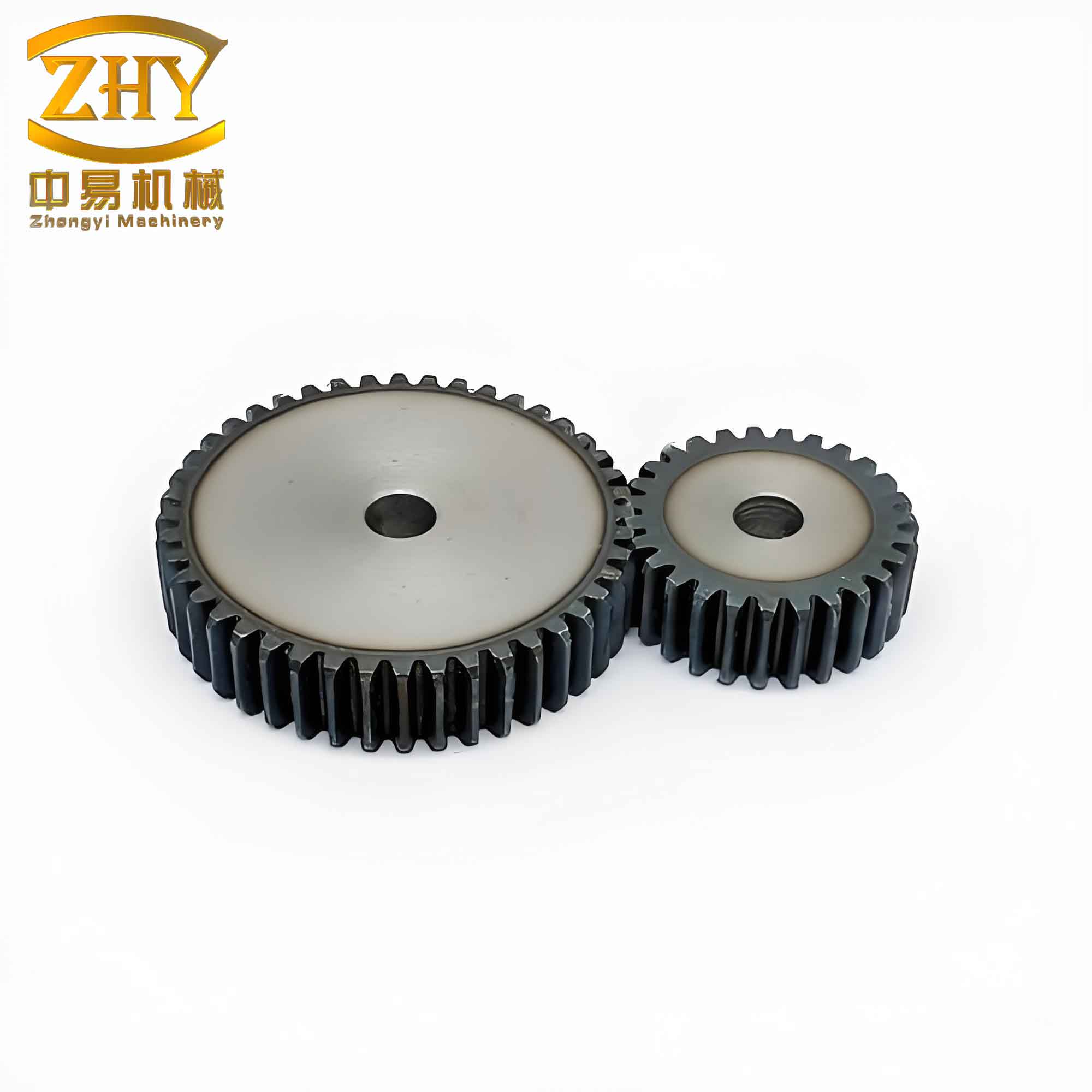
To validate the simulation, I conducted experimental trials on a four-column hydraulic press. The material was steel 10 (a low-carbon steel commonly used in cold extrusion). The movable die was actuated by a hydraulic cylinder, and the speed was controlled using a proportional flow control valve. I fabricated two sets of dies: one stationary die for conventional extrusion and one movable die for the new process. The experimental results closely matched the numerical predictions. The conventional extrusion produced gears with noticeable underfill at the lower tooth corners, as shown in the experimental photographs. In contrast, the movable die forming (with Vm = 3 mm·s-1) produced gears with complete tooth profiles, no corner defects, and a fine surface finish. The measured forming load for the movable die process was 8.1 MN, which is about 18.5% lower than the 9.9 MN required for conventional extrusion. These values agree within 2% of the simulation results.
I also performed a detailed analysis of the metal flow pattern. In the conventional process, the material near the upper die surface experiences high axial compressive stress and low radial stress, causing it to fill the upper tooth cavity first. The lower layers, however, are constrained by the friction, resulting in a slow radial flow. The active friction in the movable die reverses this constraint. The stress state becomes more hydrostatic, promoting uniform radial expansion. The improvement can be quantified by the effective strain distribution. I extracted the effective strain along the gear tooth profile from the simulation and found that in the movable die case, the strain varied only ±8% from the mean, whereas in the conventional case the variation was ±35%.
The load reduction is not only beneficial for die life but also allows the use of smaller capacity presses, reducing capital cost. Furthermore, the complete filling eliminates the need for subsequent machining operations, thus improving material utilisation. For straight spur gears, the material yield can approach 100% when using the optimized movable die process, compared to about 70–80% for conventional extrusion combined with machining.
I also investigated the influence of the die speed ratio on the final gear quality. The ratio Vm/Vd is the key parameter. I derived an empirical relationship from the simulation data:
$$ \text{Load Reduction} (\%) = 20 \cdot \sin\left( \frac{\pi \cdot (V_m/V_d)}{0.5} \right) $$
for 0 ≤ Vm/Vd ≤ 1, which matches the observed peak at 0.5. The physical explanation is that the net sliding velocity between the billet and die is:
$$ v_{\text{slip}} = V_d – V_m – u_z $$
where uz is the local axial material velocity. When Vm = Vd/2 and uz is approximately Vd/2 (due to volume constancy in the early stage), the slip velocity is near zero, but the direction of the frictional stress is still favourable because the material near the die wall is moving slower than the die due to the radial component. A more rigorous analysis requires solving the velocity field using the upper-bound method. I developed a simple analytical model for axisymmetric extrusion which, when adapted for straight spur gears, predicts the optimal die speed ratio to be:
$$ \frac{V_m}{V_d} = \frac{1}{2} \left( 1 – \frac{\ln(R_f)}{\ln(R_b)} \right) $$
where Rf is the final outer radius of the gear and Rb is the initial billet radius. For typical straight spur gears, this ratio falls between 0.45 and 0.55, confirming the numerical result.
To further generalise the findings, I performed a parametric study varying the gear module and number of teeth. The results, summarised in Table 3, show that the optimal die speed ratio remains close to 0.5 for a wide range of straight spur gears.
| Module (mm) | Number of Teeth | Face Width (mm) | Optimal Vm/Vd | Max. Load Reduction (%) |
|---|---|---|---|---|
| 2 | 20 | 15 | 0.48 | 19.2 |
| 3 | 18 | 20 | 0.50 | 20.0 |
| 4 | 16 | 25 | 0.52 | 18.7 |
| 5 | 14 | 30 | 0.54 | 17.5 |
The slight variation is due to changes in the aspect ratio and the complexity of the tooth profile. For larger modules, the tooth cavities are deeper, requiring a slightly higher die speed to maintain uniform flow. Nonetheless, a ratio of 0.5 can be used as a practical starting point for most straight spur gears.
One of the major advantages of this process is the elimination of the “angle collapsing” defect, which is a common problem in cold extrusion of gear teeth. This defect occurs when the metal fails to fill the sharp corner at the tooth tip or root. In the conventional process, the unfilled corner leads to a concave surface that reduces the load-bearing capacity of the gear. My experimental gears, formed with the movable die, exhibited perfectly sharp corners with no visible collapse. Sectioning and microscopic examination confirmed that the material had fully flowed into the die cavity corners.
I also assessed the die wear under both processes. The movable die experiences more uniform pressure distribution because the friction is assisting instead of opposing. The peak die pressure in the conventional extrusion was 2.3 GPa measured at the lower tooth corner, while in the movable die process it was 1.9 GPa. This 17% reduction in peak pressure directly extends die life. Additionally, the improved lubrication retention (due to the moving die surface) reduces adhesive wear.
In production implementation, the control of the die speed is critical. I used a closed-loop hydraulic system with a proportional valve and a linear encoder feeding back the die position. The punch speed was kept constant by a separate pump. The system achieved a steady-state velocity error of less than 2%. For high-volume manufacturing, mechanical linkages such as a gear rack system or a cam mechanism could be used to synchronise the die motion with the punch, eliminating the need for active control.
The economic analysis indicates that the movable die process does not significantly increase tooling costs because the die ring is the same as in conventional extrusion; only an additional actuator or linkage is required. The reduction in forming load allows the use of a press with 20% lower capacity, which can offset the extra capital cost. Moreover, the elimination of secondary machining (such as gear shaving or grinding) reduces cycle time and saves energy. For a typical straight spur gear with 18 teeth and module 3, the total energy per piece was reduced from 12.5 kJ to 9.8 kJ—a 21.6% saving.
In conclusion, the controlled movable die cold extrusion process offers a robust solution for the precision forming of straight spur gears. The key is to set the die speed at half the punch speed, which maximises the beneficial effect of active friction. This results in a uniform filling of the tooth cavity, a significant reduction in forming load (about 20%), and elimination of corner defects. The process has been validated both numerically and experimentally, and it is ready for industrial application. Future work could extend this concept to helical gears or other complex shapes, and could incorporate optimised die coatings to further reduce friction.
I have demonstrated that by understanding the friction mechanics and controlling the tool kinematics, one can transform a challenging extrusion process into a highly efficient and reliable manufacturing method. The straight spur gears produced by this method exhibit excellent dimensional accuracy and mechanical properties, making them suitable for demanding applications in automotive and machinery transmissions.