
As a mechanical design engineer, I frequently work with screw gears, which are essential components in transmission systems for motion and power transfer between non-parallel shafts. The design process for screw gears is often complex and iterative, requiring meticulous attention to geometric parameters and meshing conditions. To streamline this process and enhance efficiency, I have developed a parametric design methodology using UG software, a powerful CAD/CAM/CAE tool from Siemens PLM Software. This approach leverages UG’s expression functionality to create dynamic, parameter-driven models of screw gears, allowing for rapid modifications and updates. Additionally, I integrate motion simulation to validate the design, ensuring proper meshing and interference-free operation. In this article, I will detail the step-by-step procedure for parametric design and simulation of involute screw gears, emphasizing the use of mathematical expressions, tables, and formulas to achieve a robust and adaptable design system.
UG software is renowned for its comprehensive parametric modeling capabilities, which enable users to define relationships between design variables. This feature is particularly beneficial for screw gears, where dimensions such as module, pressure angle, tooth count, and helix angles are interdependent. By using expressions, I can establish these relationships mathematically, ensuring that any change in a primary parameter automatically propagates through the entire model. This parametric approach not only accelerates design iterations but also reduces errors associated with manual recalculations. Furthermore, UG’s motion simulation module provides a virtual environment to analyze the kinematic behavior of screw gear assemblies, offering insights into meshing dynamics and potential interferences.
The foundation of parametric design lies in defining the basic parameters and their computational formulas. For screw gears, these parameters include geometric dimensions, coefficients, and angular relationships. I have compiled these into a structured table below, which serves as a reference for initial values and formulas used in the UG expressions.
| Parameter Name | Symbol | Calculation Formula | Initial Value |
|---|---|---|---|
| Module | m | 2 | |
| Pressure Angle | α | 20° | |
| Number of Gear Teeth | Z2 | 36 | |
| Addendum Coefficient | ha* | 1 | |
| Dedendum Coefficient | c* | 0.25 | |
| Gear Pitch Diameter | d | d = Z2 × m | Calculated |
| Gear Base Diameter | db | db = d × cos(α) | Calculated |
| Gear Addendum Diameter | da | da = (Z2 + 2ha*) × m | Calculated |
| Gear Dedendum Diameter | df | df = (Z2 – 2ha* – 2c*) × m | Calculated |
| Gear Width | B | 30 | |
| Number of Worm Threads | Z1 | 3 | |
| Worm Diameter Coefficient | q | 13 | |
| Worm Pitch Diameter | d1 | d1 = m × q | Calculated |
| Worm Thickness Coefficient | Tr | 1 | |
| Worm Normal Modification Coefficient | Xn | 0 | |
| Worm Length | H | 60 | |
| Worm Lead Angle | γ | γ = arctan(Z1 / q) | Calculated |
| Gear Helix Angle | β | β = γ | Calculated |
| Center Distance | a | a = m × (Z2 + q) / 2 | Calculated |
These parameters are input into the UG expression editor, where they are defined as variables with associated formulas. For instance, the module m is set to 2, and the gear pitch diameter d is expressed as d = Z2 * m. This linkage ensures that modifying Z2 or m automatically updates d and all dependent dimensions, such as the base diameter db and addendum diameter da. The mathematical rigor of this approach guarantees consistency and accuracy throughout the design process.
For the gear component of the screw gears, I focus on generating the involute tooth profile using parametric equations. The involute curve is fundamental to gear design, as it ensures smooth meshing and constant velocity ratio. In UG, I use the “Law Curve” command to create these curves based on explicit mathematical expressions. First, I define parameters for the involute generation. Let t1 be a normalized variable ranging from 0 to 1. The rolling angle u1 and arc length s1 are given by:
$$ u1 = 60 \times t1 \quad \text{(in degrees)} $$
$$ s1 = \frac{\pi \times db \times t1}{4} $$
Then, the Cartesian coordinates for one side of the involute are expressed as:
$$ x1t = \frac{db}{2} \cos(u1) + s1 \sin(u1) $$
$$ y1t = \frac{db}{2} \sin(u1) – s1 \cos(u1) $$
$$ z1t = 0 $$
For the opposing side, the coordinates are mirrored across the axis:
$$ x2t = x1t $$
$$ y2t = -y1t $$
$$ z2t = z1t $$
These equations are entered into UG’s expression editor, and the “Law Curve” function generates the corresponding curves. Subsequently, I sketch the gear’s fundamental circles—base circle, pitch circle, addendum circle, and dedendum circle—on the XC-YC plane, constraining them to be concentric. The involute curves are trimmed and filleted at their intersection with the dedendum circle to form a complete tooth profile curve. This profile serves as the cross-section for the gear teeth.
To incorporate the helical nature of screw gears, I create spiral curves that define the tooth orientation along the gear width. Using another set of parametric equations, I define a spiral path. Let t2 vary from 0 to 1, and u2 = 60 × t2. The coordinates for one spiral are:
$$ x3t = a – B \cos(u2) $$
$$ y3t = -B \tan(\gamma) \times t2 $$
$$ z3t = B \times t2 $$
For the complementary spiral:
$$ x4t = x3t $$
$$ y4t = -y3t $$
$$ z4t = -z3t $$
Again, the “Law Curve” command generates these spirals. Through geometric transformations, I replicate the spirals to cover the required angular span. Then, I use the “Sweep” command, with the spiral as the guide curve and the tooth profile as the section, to create a solid representation of the gear tooth space. This tooth space is circularly patterned around the gear axis with an angular increment of $360^\circ / Z2$ and a count of Z2, producing the full set of teeth. Additional features, such as a central bore and keyway, are added based on standard specifications, resulting in a complete gear model.
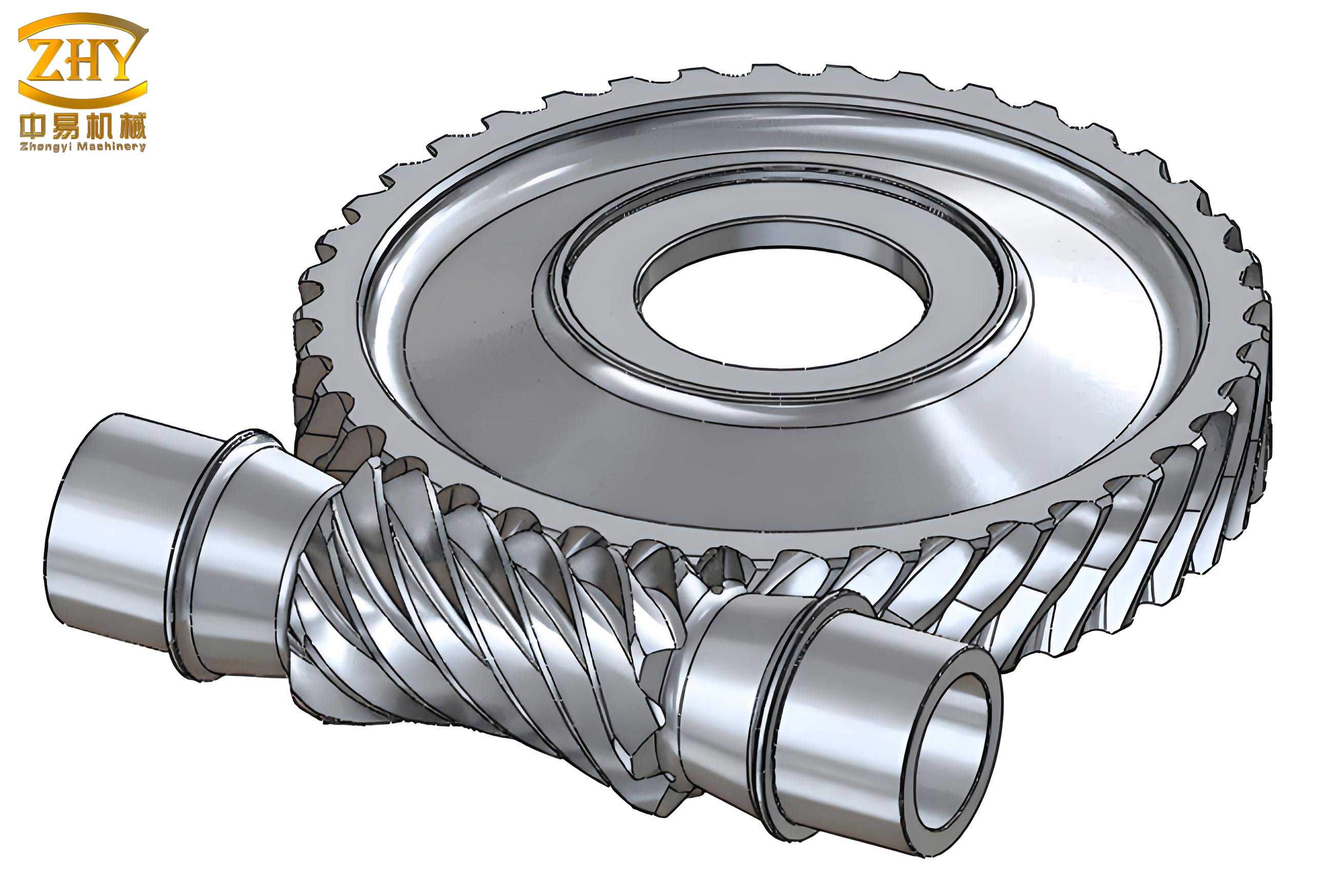
For the worm component, I follow a similar parametric strategy but adapt the equations to account for its threaded structure. I input the worm’s basic parameters and specific function variables into UG expressions. The worm profile also relies on involute geometry, with modifications for helix alignment. Defining variables such as ro, diva, qo, and k, the coordinates for one side of the worm involute are:
$$ x5t = \frac{ro \cos(diva + qo)}{\cos(k)} $$
$$ y5t = \frac{ro \sin(diva + qo)}{\cos(k)} $$
$$ z5t = 0 $$
For the opposite side:
$$ x6t = x5t $$
$$ y6t = -y5t $$
$$ z6t = z5t $$
Using “Law Curve,” I generate these curves and sketch the worm’s cross-sectional profile, which includes line segments and arcs. To create the helical thread, I define a helical path function:
$$ ft = t \times \deg\left( \frac{H \tan(bp)}{rp} \right) $$
where deg denotes conversion to degrees, and bp and rp are derived parameters. Applying the “Sweep” command with this helical path as the guide and the cross-section as the section, I produce a single worm thread. This thread is then arrayed around the worm axis with a count of Z1 to form the complete threaded section. Further solid operations, such as adding cylindrical bodies for the worm shaft, yield the final worm model.
The parametric design’s core advantage is its dynamic updatability. By altering key parameters in the expressions, the entire screw gear model regenerates automatically. For example, changing the gear tooth count Z2 from 36 to 24, or the module m from 2 to 3, triggers a cascade of updates across all related dimensions. This capability eliminates manual redesign efforts and ensures consistency. Below is a table summarizing the effects of such parameter changes on critical dimensions, demonstrating the parametric system’s responsiveness.
| Modified Parameter | New Value | Affected Dimension | Resulting Value |
|---|---|---|---|
| Gear Tooth Count Z2 | 24 | Pitch Diameter d | 48 mm |
| Addendum Diameter da | 52 mm | ||
| Dedendum Diameter df | 43 mm | ||
| Module m | 3 | Pitch Diameter d | 72 mm |
| Center Distance a | 58.5 mm | ||
| Worm Pitch Diameter d1 | 39 mm |
These updates occur instantaneously in UG, highlighting the efficiency of parametric design for screw gears. This flexibility is invaluable for exploring design alternatives and optimizing performance without starting from scratch.
To validate the screw gear design, I conduct motion simulation within UG. The simulation workflow involves assembling the worm and gear models, defining kinematic links, applying joints, setting up gear pairs, and running dynamic analyses. First, I create an assembly with the worm and gear positioned according to the calculated center distance. In the motion simulation module, I define the worm as link L001 and the gear as link L002. I assign rotational joints to both: J001 for the worm and J002 for the gear. The worm is designated as the driving element with a rotational velocity of 360 degrees per second to simulate motion. A gear pair J003 is established between J001 and J002, encapsulating the screw gear transmission ratio.
Interference detection is a critical aspect of the simulation. I configure an interference check with the type set to “Highlight,” selecting the worm as the first set and the gear as the second set. During simulation, if any collision occurs, the interfering geometries highlight, and the simulation pauses, allowing for immediate identification of issues. I define a solution with a time duration of 20 seconds and 300 steps to ensure smooth animation. Upon solving, the simulation displays the worm and gear meshing dynamically. The absence of highlighting confirms no interference, verifying that the parametric design yields a functionally sound screw gear pair. This virtual validation reduces the need for physical prototypes and accelerates the design cycle.
The mathematical underpinnings of the parametric equations deserve further elaboration. The involute curve, central to screw gear design, is derived from the geometry of a base circle. For a base circle of radius $r_b$, the parametric equations of an involute are:
$$ x = r_b (\cos(\theta) + \theta \sin(\theta)) $$
$$ y = r_b (\sin(\theta) – \theta \cos(\theta)) $$
where $\theta$ is the involute angle in radians. In my UG expressions, I adapt this formulation to incorporate design-specific parameters like pressure angle and module. For screw gears, the helix angles $\gamma$ and $\beta$ are equal, ensuring proper meshing. The lead angle $\gamma$ is calculated from the worm parameters:
$$ \gamma = \arctan\left( \frac{Z1}{q} \right) $$
This angle influences the spiral equations, which are essential for generating the helical paths. The precision of these mathematical relationships ensures that the modeled screw gears adhere to theoretical principles, resulting in accurate and reliable designs.
Beyond design creation, the parametric framework facilitates optimization. By linking UG with optimization algorithms, I can automate parameter adjustments to meet criteria such as weight minimization, strength maximization, or efficiency improvement. For instance, the center distance $a$ can be optimized for compactness while maintaining required transmission ratios. The expressions allow for seamless integration with external tools, enabling advanced analyses like finite element analysis (FEA) for stress evaluation. This holistic approach combines design, simulation, and optimization into a cohesive workflow, enhancing the overall engineering process for screw gears.
In conclusion, the parametric design and motion simulation of screw gears using UG offer a robust methodology for efficient and accurate gear development. By harnessing expressions, I establish dynamic relationships between parameters, enabling rapid model updates and iterations. The motion simulation module provides a powerful validation tool, ensuring interference-free operation and proper meshing. This approach significantly reduces design time, minimizes errors, and supports optimization efforts. The principles outlined here are not limited to screw gears; they extend to other mechanical components like bearings and various gear types, demonstrating broad applicability. As engineering demands evolve, such parametric and simulation-driven techniques will continue to play a pivotal role in advancing mechanical design practices.