
The pursuit of manufacturing efficiency and cost-effectiveness in gear production necessitates continuous innovation in finishing processes. Among these, chamfering the end face tooth profiles of cylindrical gears is a critical step to remove burrs from previous operations, reduce stress concentrations, and prevent damage during subsequent handling and assembly. Traditional methods often fall short in terms of speed, consistency, or suitability for mass production. This article delves into a sophisticated methodology for achieving this task: chamfering based on the principle of rotary indexing machining. This approach promises high efficiency by integrating the cutting and indexing motions into a single, continuous process, analogous to gear hobbing. We will systematically develop the mathematical foundation, detail the tool design process, and present simulation-based verification.
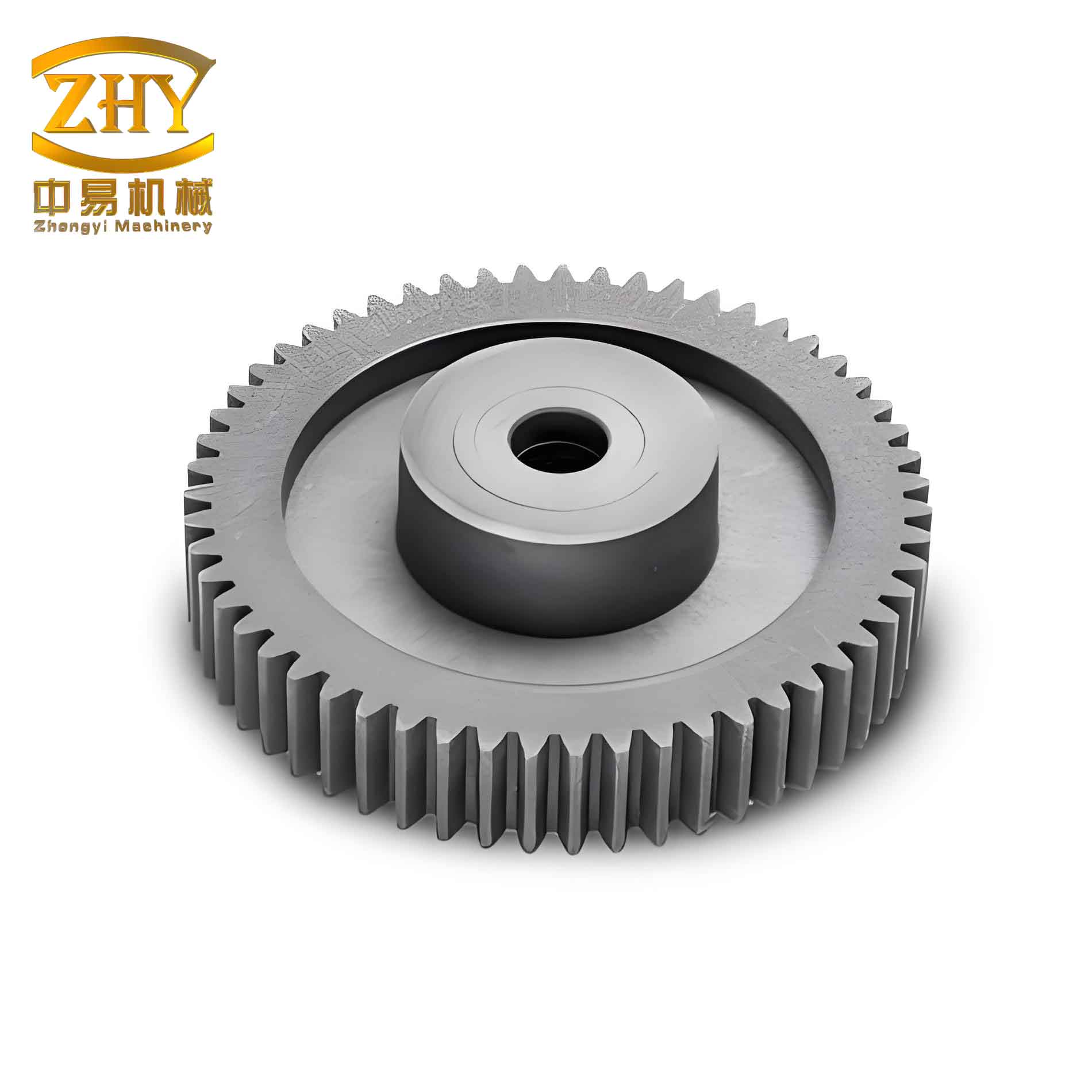
The widespread application of cylindrical gears across industries such as automotive, aerospace, and marine engineering is a testament to their excellent performance characteristics, including high transmission efficiency, smooth operation, and strong load-bearing capacity. However, the quality of the final gear is not determined solely by the primary tooth-flank generation but also by the quality of secondary operations like chamfering. Inefficient or inconsistent chamfering can lead to several issues: residual burrs can flake off during operation, causing abrasive wear on mating surfaces and increasing noise; sharp edges are prone to chipping during handling; and they act as stress risers, potentially initiating cracks under cyclic loading. Therefore, a fast, reliable, and automated chamfering process is indispensable for modern, high-volume gear manufacturing lines. The proposed method leverages the kinematics of rotary indexing, where the tool and workpiece rotate in a timed relationship, to generate the desired chamfer on the entire end face profile in a single, continuous operation, offering a significant advantage over manual or sequential methods.
Mathematical Modeling of the Swept Surface for Rotary Indexing Chamfering
The core of designing a tool for rotary indexing chamfering lies in accurately modeling the “swept surface.” This surface represents the envelope of all positions occupied by the cutting edge of the tool relative to the stationary gear blank during the synchronized rotation of both components. To construct this model, we must first define the geometry of the gear end face and then establish the kinematic relationship between the tool and the workpiece.
Geometry of the Cylindrical Gear End Face Profile
The transverse cross-section of an involute cylindrical gear features a periodic profile consisting of left and right involute flanks connected by root fillets. For the purpose of tool design, a precise mathematical description is required. The left involute flank can be parameterized in a workpiece coordinate system as follows:
$$ \mathbf{r_L}(u) = \begin{bmatrix} x_L(u) \\ y_L(u) \\ z_L \\ 1 \end{bmatrix} = \begin{bmatrix} r_b \sin(u + \eta_b) – r_b u \cos(u + \eta_b) \\ r_b \cos(u + \eta_b) + r_b u \sin(u + \eta_b) \\ 0 \\ 1 \end{bmatrix} $$
where \( u \) is the involute roll angle, \( r_b \) is the base circle radius, and \( \eta_b \) is the base half-space width angle, calculated as:
$$ \eta_b = \frac{\pi – 4x \tan\alpha_n}{2Z} – \text{inv}\alpha_t $$
Here, \( x \) is the profile shift coefficient, \( Z \) is the number of teeth, \( \alpha_n \) is the normal pressure angle, and \( \alpha_t \) is the transverse pressure angle. The right flank is symmetrical about the x-axis. The root fillet, typically a circular arc, connects the endpoints of the involute curves to the root circle. The coordinates of its center \( O_c \) and its parametric equation are derived from the start-of-involute point defined by \( u_s \).
Kinematic Setup and Coordinate Transformations
The machining setup involves two primary rotating bodies: the gear (workpiece) and the chamfering cutter (tool). We define four key coordinate systems, as summarized in the table below:
| Coordinate System | Symbol | Description | Motion |
|---|---|---|---|
| Workpiece Static | \( S_g(O_g, x_g, y_g, z_g) \) | Fixed to the machine bed, reference frame. | Stationary |
| Workpiece Moving | \( S_{g1}(O_{g1}, x_{g1}, y_{g1}, z_{g1}) \) | Fixed to the gear, rotates with it. | Rotates with angle \( \theta_g \) |
| Tool Static | \( S_t(O_t, x_t, y_t, z_t) \) | Fixed to the machine bed, reference frame. | Stationary |
| Tool Moving | \( S_{t1}(O_{t1}, x_{t1}, y_{t1}, z_{t1}) \) | Fixed to the cutter, rotates with it. | Rotates with angle \( \theta_t \) |
The relative positioning is defined by the center distance \( P \), the vertical offset (center height) \( H \), and the machine setting angle \( \Sigma \). The fundamental kinematics dictate that the tool and workpiece rotate synchronously with a fixed ratio:
$$ i_{gt} = \frac{\omega_g}{\omega_t} = \frac{\theta_g}{\theta_t} = \frac{Z_t}{Z} $$
where \( Z_t \) is the number of starts (threads) on the cutter. The transformation between these coordinate systems is crucial. The transformation from the tool static system \( S_t \) to the tool moving system \( S_{t1} \) is a rotation about its axis:
$$ \mathbf{M_{t1}}(\theta_t) = \begin{bmatrix} \cos\theta_t & 0 & \sin\theta_t & 0 \\ 0 & 1 & 0 & 0 \\ -\sin\theta_t & 0 & \cos\theta_t & 0 \\ 0 & 0 & 0 & 1 \end{bmatrix} $$
The transformation from the workpiece static system \( S_g \) to the tool static system \( S_t \) involves the spatial offsets \( P \) and \( H \), and the angle \( \Sigma \):
$$ \mathbf{M_{gt}} = \begin{bmatrix} 1 & 0 & 0 & P \\ 0 & \cos\Sigma & -\sin\Sigma & 0 \\ 0 & \sin\Sigma & \cos\Sigma & H \\ 0 & 0 & 0 & 1 \end{bmatrix} $$
Finally, the transformation from the workpiece static system \( S_g \) to the workpiece moving system \( S_{g1} \) is a simple rotation:
$$ \mathbf{M_{g1}}(\theta_g) = \begin{bmatrix} \cos\theta_g & \sin\theta_g & 0 & 0 \\ -\sin\theta_g & \cos\theta_g & 0 & 0 \\ 0 & 0 & 1 & 0 \\ 0 & 0 & 0 & 1 \end{bmatrix} $$
Derivation of the Swept Surface Equation
The initial cutting edge profile, denoted as \( \mathbf{r_{RL}^{(g)}} \), is first defined. A logical choice is the transverse gear profile (including left flank, root fillet, and right flank), offset axially by the desired chamfer depth \( d_c \). This profile is expressed in the workpiece static system \( S_g \).
To find its trajectory, we map this initial edge through the kinematic chain into the workpiece moving system \( S_{g1} \). This represents the path of the tool edge as seen from the rotating gear:
$$ \mathbf{r_{RL}^{(g1)}}(P, H, \Sigma, \theta_t) = \mathbf{M_{g1}}(i_{gt}\theta_t) \cdot \mathbf{M_{gt}} \cdot \mathbf{M_{t1}}(\theta_t) \cdot \mathbf{M_{gt}^{-1}} \cdot \mathbf{r_{RL}^{(g)}} $$
For a given set of machine settings \( (P, H, \Sigma) \) and a fixed ratio \( i_{gt} \), the variable \( \theta_t \) (the tool rotation angle) parameterizes a family of curves. The envelope of this family, as \( \theta_t \) varies over a sufficient range, constitutes the swept surface. This surface, when intersected with the solid model of the cylindrical gear, defines the volume of material to be removed. The selection of \( P, H, \) and \( \Sigma \) is critical as they control the shape and orientation of the swept surface, ensuring it engages both left and right flanks of the gear tooth end face uniformly to create a consistent chamfer.
Tool Design: Constructing the Rake Face and Clearance Face
The swept surface defines the theoretical material removal boundary. The practical tool design involves defining the actual cutting edge, the rake face where chips flow, and the clearance face to avoid interference with the workpiece.
Determining the Cutting Edge and Rake Face
While any curve on the swept surface connecting one tooth tip to the other could serve as a cutting edge, practical considerations of chip formation and tool strength guide the selection. The initial profile \( \mathbf{r_{RL}^{(g)}} \) is not ideal as it would engage the entire profile simultaneously. Instead, a curve resulting from the intersection of the swept surface with a designed rake plane is chosen. This rake plane is typically a flat surface, chosen for ease of grinding. It is defined by passing through a reference point on the initial edge (e.g., the midpoint of a tooth tip) and oriented with a specified rake angle \( \gamma_t \).
The cutting edge \( \mathbf{l_1} \) is then the intersection curve between the swept surface \( \mathbf{r_{RL}^{(g1)}} \) and the rake plane. The equation of the rake plane in the tool moving system \( S_{t1} \) is given by its normal vector \( \mathbf{n_E} \), which is the z-axis vector rotated by the rake angle:
$$ \mathbf{n_E} = \begin{bmatrix} \cos\gamma_t & \sin\gamma_t & 0 & 0 \\ -\sin\gamma_t & \cos\gamma_t & 0 & 0 \\ 0 & 0 & 1 & 0 \\ 0 & 0 & 0 & 1 \end{bmatrix} \cdot \begin{bmatrix} 0 \\ 0 \\ 1 \\ 0 \end{bmatrix} = \begin{bmatrix} 0 \\ 0 \\ 1 \\ 0 \end{bmatrix} $$
The actual cutting edge is found by solving the system:
$$ \begin{cases} \mathbf{n_E} \cdot (\mathbf{M_{t1}^{-1}}(\theta_t) \cdot \mathbf{r^{(t1)}}) = 0 \\ \mathbf{r^{(t1)}} = \mathbf{M_{t1}^{-1}}(\theta_t) \cdot \mathbf{M_{gt}^{-1}} \cdot \mathbf{M_{g1}^{-1}}(i_{gt}\theta_t) \cdot \mathbf{r_{RL}^{(g1)}} \end{cases} $$
This yields the cutting edge coordinates in the tool’s own moving coordinate system, which is essential for manufacturing the cutter.
Constructing the Clearance Face
The clearance face, or flank face, must be designed to provide adequate relief behind the cutting edge to prevent rubbing against the newly generated chamfer surface. Furthermore, its design must ensure that after the tool is reground (by resharpening the rake face), the new cutting edge maintains the correct profile. This is achieved using the “tool backing-off” principle. The clearance surface is generated as an envelope of the cutting edge positions as the tool is conceptually rotated and simultaneously translated along its axis. The relationship between the axial regrind distance \( b \), the radial setback \( a \), and the designed clearance angle \( \alpha_d \) is:
$$ \alpha_d = \arcsin\left(\frac{a}{b}\right) $$
For tools with helical gashes (spiral flutes), the helix angle \( \beta_t \) must also be considered to avoid interference between the clearance face and the workpiece during the cutting arc. The condition \( \beta_t = \arcsin(a / g) \) must be satisfied, where \( g \) is a related kinematic distance. The 3D model of the chamfering tool is constructed by generating the helical rake surface containing the cutting edge \( \mathbf{l_1} \), and then applying the backing-off motion to create the clearance surface.
Simulation-Based Verification and Analysis
To validate the mathematical model and the designed tool without the cost and lead time of physical trials, a virtual machining simulation was conducted. A multi-axis CNC simulation platform was used to model a hobbing-type machine environment. The gear and tool parameters, along with the calculated machine settings, are listed below:
| Parameter | Symbol | Value |
|---|---|---|
| Gear (Workpiece) | ||
| Normal Module | \( m_n \) | 2.1 mm |
| Number of Teeth | \( Z \) | 45 |
| Helix Angle | \( \beta \) | 20° |
| Normal Pressure Angle | \( \alpha_n \) | 20° |
| Face Width | \( B \) | 20 mm |
| Chamfering Cutter (Tool) | ||
| Number of Starts | \( Z_t \) | 4 |
| Helix Angle | \( \beta_t \) | 14° |
| Rake Angle | \( \gamma_t \) | 15° |
| Clearance Angle | \( \alpha_d \) | 12° |
| Outer Diameter | \( d_t \) | 60 mm |
| Machine Settings | ||
| Center Distance | \( P \) | 68.69 mm |
| Center Height | \( H \) | 21 mm |
| Machine Angle | \( \Sigma \) | 6° |
| Chamfer Depth (Target) | \( d_c \) | 0.5 mm |
The 3D models of the gear and the designed cutter were imported into the virtual environment. The kinematic relationship was programmed such that the tool and workpiece rotated synchronously with the ratio \( i_{gt} = Z_t / Z = 4/45 \). The simulation successfully demonstrated the continuous rotary indexing chamfering process, removing material along the entire end-face profile of the cylindrical gear in a single operation. A visual inspection confirmed a uniform chamfer on both flanks and the root region.
To quantitatively assess the consistency of the chamfer depth, measurement points were selected on the left flank, root, and right flank of a simulated tooth. The axial distance from the original end face to the bottom edge of the chamfer was measured at these points within the simulation software. The results are presented below:
| Measurement Point Location | Measured Depth (mm) | Deviation from 0.5 mm (mm) |
|---|---|---|
| Left Flank (Point 1) | 0.506 | +0.006 |
| Left Flank (Point 2) | 0.508 | +0.008 |
| Left Flank (Point 3) | 0.500 | 0.000 |
| Root (Point 4) | 0.495 | -0.005 |
| Right Flank (Point 5) | 0.491 | -0.009 |
| Right Flank (Point 6) | 0.505 | +0.005 |
| Right Flank (Point 7) | 0.503 | +0.003 |
The measured depths show excellent consistency with the target value of 0.5 mm. The minor deviations (within ±0.01 mm) are attributable to the discrete nature of the simulation mesh and the precision of point selection within the software, not to a fundamental flaw in the method. Furthermore, collision detection analysis confirmed that the designed clearance face did not interfere with the workpiece during the entire cutting cycle. These simulation results provide strong evidence for the feasibility and correctness of the proposed rotary indexing chamfering method for cylindrical gears.
Conclusion
This study presents a comprehensive methodology for the high-efficiency chamfering of cylindrical gear end faces based on the principle of rotary indexing machining. The process begins with the establishment of a precise mathematical model that defines the swept surface generated by a theoretical cutting edge moving in synchronized rotation with the gear workpiece. This model, built upon coordinate transformations and the kinematics of the process, forms the critical theoretical foundation. Subsequently, the practical tool design is addressed by detailing the procedure to extract the actual cutting edge through intersection with a defined rake plane and constructing the clearance face using tool backing-off principles to ensure non-interference and regrindability. The validity of the entire approach was conclusively demonstrated through a detailed virtual machining simulation. The simulation replicated the continuous cutting and indexing motion, successfully generating a uniform chamfer across the tooth profile. The measured chamfer depths confirmed high consistency, aligning closely with the design target. This method offers a significant advantage for mass production environments, enabling the integration of efficient chamfering into the gear manufacturing sequence, potentially in a combined operation with other processes like hobbing. Future work may focus on optimizing the machine setting parameters (P, H, Σ) for different gear geometries to maximize chamfer uniformity and tool life, as well as investigating the physical implementation and performance of manufactured tools based on this design framework.