
In the realm of precision mechanical transmission, the worm gear drive has long been a cornerstone for applications demanding high torque and accurate motion control, such as in CNC rotary tables. However, traditional worm gear drives face a persistent challenge: under high torque conditions, wear on the tooth contact surfaces inevitably leads to an increase in backlash. This backlash degradation directly compromises transmission accuracy and long-term operational stability. To address this fundamental limitation, I embarked on the design and development of a novel dual-lead worm gear drive system. The core innovation of this system lies in its ability to dynamically adjust the meshing clearance, thereby maintaining high precision throughout its service life. This article details the comprehensive design process, theoretical validation, finite element analysis, and experimental testing of this advanced worm gear drive.
The conceptual foundation of my design stems from the principle of the dual-lead worm. In a conventional single-lead worm gear drive, the lead (and consequently the tooth thickness) is constant along the worm’s axis. In the dual-lead configuration I adopted, the tooth thickness of the worm increases proportionally along its axial length, while the tooth thickness of the mating worm wheel remains uniform. This deliberate asymmetry allows for a crucial adjustment mechanism: by axially displacing the worm, the effective meshing position between the worm and wheel changes. Moving the worm to a region with a thicker tooth profile effectively reduces the operational clearance between the teeth, compensating for wear-induced backlash. Conversely, if needed, clearance can be increased. This adjustability is the key to preserving the precision of the worm gear drive under demanding conditions.
The overall system architecture was designed to support this advanced worm gear drive within a high-capacity rotary assembly. The primary components include the dual-lead worm and worm wheel pair, two large-diameter slewing bearings for radial and axial support, and dedicated bearing housings for the worm shaft. The targeted performance specifications were rigorous: an output torque exceeding 100,000 N·m, a rotational speed range from 0.2°/s to 5°/s, a positioning accuracy better than ±0.01°, and operational capability across a pressure range of 1–250 kPa and a temperature range of -5 to 50°C. These requirements guided every aspect of the component selection and design calculations.
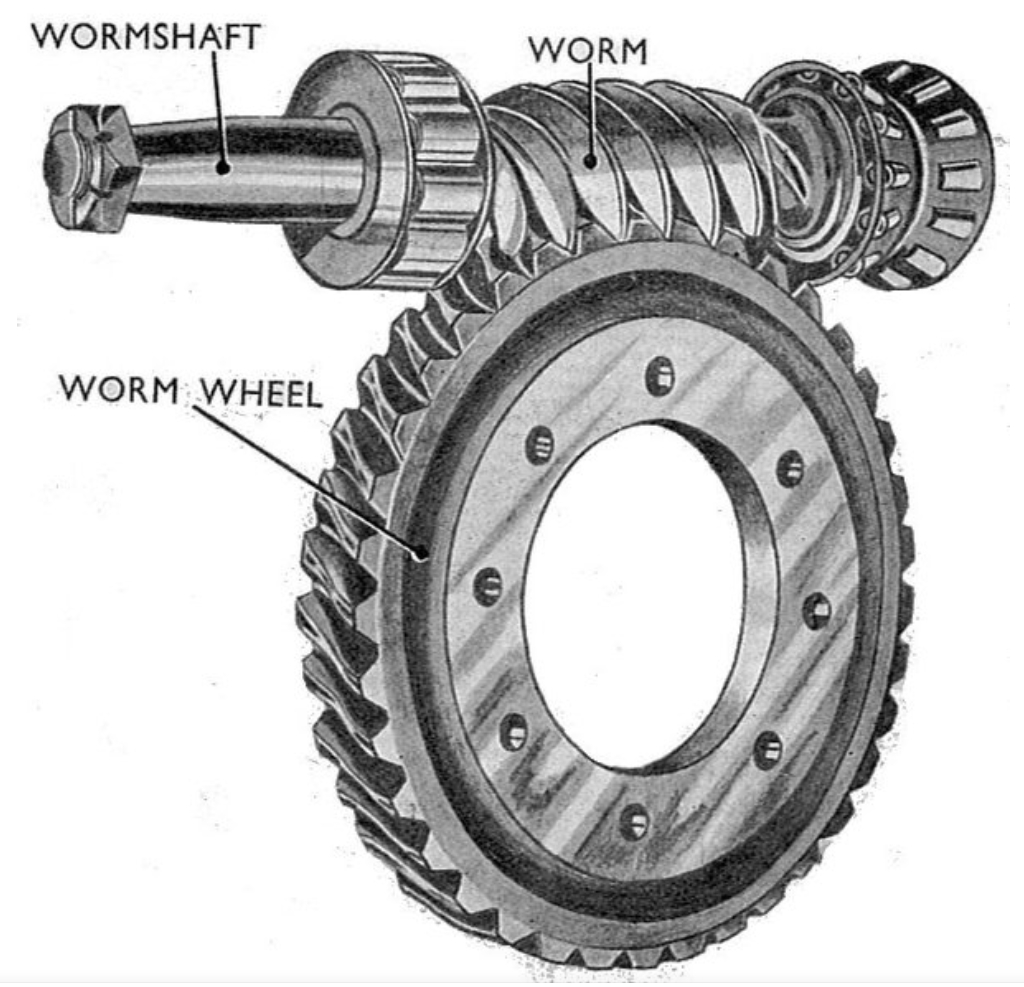
The heart of the system is the dual-lead cylindrical worm gear pair. I selected key geometric parameters to balance strength, wear resistance, and manufacturability. The primary parameters are summarized in the table below:
| Parameter Name | Symbol | Value |
|---|---|---|
| Nominal Module | m | 16 mm |
| Number of Worm Threads | Z₁ | 1 |
| Number of Worm Wheel Teeth | Z₂ | 125 |
| Diameter Factor | q | 25 |
| Axial Pressure Angle | α₀ₐ, α₀ₙ | 15° |
| Addendum Coefficient | f₀ | 1 |
| Dedendum Clearance Coefficient | c₀ | 0.2 |
| Root Cutting Clearance Coefficient | c₀’ | 0.25 |
| Profile Shift Coefficient | x₂ | 0 |
| Center Distance | a | 1140 mm |
The worm material was chosen as 38CrMoAl alloy steel forging, known for its high strength and excellent nitriding potential to enhance surface hardness and wear resistance. The worm wheel was manufactured from ZCuAl10Fe4Ni4 aluminum bronze, a material renowned for its good tribological properties when paired with hardened steel, making it ideal for the sliding-contact conditions in a worm gear drive.
Supporting the rotating platform are two specialized slewing bearings. A cross cylindrical roller slewing bearing was selected for its exceptional capacity to handle combined axial load, radial load, and tilting moment simultaneously. Its compact design with rollers arranged crosswise at a 1:1 ratio provides high rigidity. A four-point contact ball slewing bearing complements the system, offering high load capacity in a relatively lightweight package. The specifications for these bearings were meticulously calculated based on the static and dynamic loads expected from the application.
The worm shaft itself is supported by bearing housing assemblies at both ends. To accommodate thermal expansion and ensure precise alignment, a fixed-end and a floating-end configuration were designed. The fixed-end housing incorporates a multi-row cylindrical roller bearing to provide rigid locational support, while the floating-end uses a single-row cylindrical roller bearing to allow for axial displacement. This arrangement is critical for the proper functioning of the worm gear drive, ensuring that the worm can be adjusted axially without inducing undue stress or misalignment.
With the conceptual design in place, rigorous theoretical design calculations were performed to verify the strength and suitability of the worm gear drive parameters. The calculations followed established standards and formulas from mechanical design handbooks, focusing on contact (pitting) strength and bending (root) strength. The following key formulas were applied, where \(T_2\) is the output torque on the worm wheel, \(K\) is the application factor (load factor), \(d_1\) and \(d_2\) are the reference diameters of the worm and worm wheel respectively, and \(\gamma\) is the lead angle of the worm.
The design formula for contact strength based on the module \(m\) and diameter factor \(q\) is:
$$ m \sqrt[3]{q} \geqslant \sqrt{\left( \frac{15150}{Z_2 \sigma_{Hp}} \right)^2 K T_2 } $$
The verification formula for contact stress \(\sigma_H\) is:
$$ \sigma_H = \frac{14783}{d_2} \sqrt{ \frac{K T_2}{d_1} } \leqslant \sigma_{Hp} $$
The verification formula for bending stress \(\sigma_F\) at the worm wheel tooth root is:
$$ \sigma_F = \frac{2000 T_2 K}{d_2′ d_1′ m Y_2 \cos \gamma} \leqslant \sigma_{Fp} $$
In these equations, \(\sigma_{Hp}\) and \(\sigma_{Fp}\) represent the permissible contact stress and permissible bending stress for the materials, respectively. \(Y_2\) is the tooth form factor for the worm wheel. For the calculation, I used the parameters and safety factors listed in the following table:
| Parameter Name | Symbol | Value |
|---|---|---|
| Permissible Contact Stress | \(\sigma_{Hp}\) | 245 N/mm² |
| Permissible Bending Stress | \(\sigma_{Fp}\) | 80 N/mm² |
| Load Factor | K | 1.1 |
| Output Torque | \(T_2\) | 100,000 N·m |
| Contact Life Factor | \(Z_N\) | 1.5 |
| Bending Life Factor | \(Y_N\) | 1 |
| Tooth Form Factor | \(Y_2\) | 0.47 |
| Sliding Influence Factor | \(Z_S\) | 1 |
Substituting all the known geometric and material parameters into the verification formulas yielded the results below. The calculated stresses are well within the permissible limits, confirming the theoretical adequacy of the proposed worm gear drive design for the 100,000 N·m load case.
| Verification Item | Formula Left Side | Formula Right Side (Limit) | Conclusion |
|---|---|---|---|
| Contact Strength Design | \(m \sqrt[3]{q} = 41.53\) | \(\geq 24.78\) | Pass |
| Contact Stress | \(\sigma_H = 165.27 \, N/mm^2\) | \(\leq 367.5 \, N/mm^2\) | Pass |
| Bending Stress | \(\sigma_F = 66.59 \, N/mm^2\) | \(\leq 80 \, N/mm^2\) | Pass |
While theoretical calculations provide a essential foundation, modern engineering demands a more detailed understanding of stress distribution, deformation, and fatigue life. To this end, I conducted a comprehensive finite element analysis (FEA) on the worm gear drive assembly. A half-symmetry model was created to reduce computational cost while maintaining accuracy. The mesh, comprising primarily hexahedral and tetrahedral elements, was refined in the critical contact regions between the worm and wheel teeth, as well as around the bearing supports. The overall mesh quality was ensured to provide reliable results.
The boundary conditions simulated the real-world mounting: the worm wheel hub was fixed to a massive support structure, and the 100,000 N·m torque was applied to the worm wheel’s inner circumference. The worm shaft was supported by the bearing reactions in its housings. Contact elements were defined between the worm and wheel tooth flanks, accounting for the non-linear behavior of metal-to-metal contact. The analysis solved for static structural stresses and deformations under the full rated load.
The results were insightful. The maximum deformation in the gear mesh region was found to be approximately 0.017 mm, indicating a very stiff system, which is paramount for precision in a worm gear drive. The stress distribution on the contacting teeth was cyclical as the worm rotated. The peak von Mises stress on the worm tooth surface reached about 244.9 MPa, while the peak stress on the worm wheel tooth was around 196.72 MPa. Importantly, these peak values occur during the initial engagement and stabilize into a periodic pattern with stress levels fluctuating between 175 MPa and 190 MPa during steady-state operation. A summary of the maximum stresses against the material yield strengths confirms the design’s safety margin.
| Component | Max. Stress (MPa) | Material Yield Strength (MPa) | Safety Factor |
|---|---|---|---|
| Worm (38CrMoAl) | 244.9 | ≥745 | >3.0 |
| Worm Wheel (ZCuAl10Fe4Ni4) | 196.7 | ~245 | ~1.25 |
| Fixed Bearing Housing (45 Steel) | 36.2 | ≥355 | >9.8 |
| Floating Bearing Housing (45 Steel) | 41.1 | ≥355 | >8.6 |
The FEA also included a fatigue life assessment for the worm, which is typically the more critically loaded component in a worm gear drive due to its cyclic bending stresses. Using the material S-N (stress-life) curve for 20CrMnTi steel (a material with similar properties to 38CrMoAl for fatigue analysis), an equivalent constant-amplitude load cycle was assumed based on the calculated alternating stresses. The fatigue analysis predicted a contact fatigue life for the worm of approximately \(2.0646 \times 10^5\) cycles. This life calculation, while based on simplified assumptions, provides a valuable indicator of the durability of the dual-lead worm under the specified operating conditions. The fatigue life distribution, damage analysis, and safety factor contours from the simulation all supported the robustness of the design.
The final and most crucial phase was the physical realization and testing of the worm gear drive system. After precise manufacturing and careful assembly, the complete system was installed on a test rig. The primary objectives were to validate the static load capacity, measure the transmission accuracy under load, and test the functionality of the axial adjustment mechanism for backlash control. The system was subjected to incremental loading up to the full rated torque of 100,000 N·m while monitoring parameters like rotational stiffness, angular positioning error, and temperature rise.
The test results were highly satisfactory. The worm gear drive operated smoothly under full load without any signs of distress. The most significant validation came from the backlash adjustment feature. By axially shifting the dual-lead worm using the provided adjustment mechanisms, the operational backlash could be consistently reduced to a minimum, effectively compensating for any initial clearance or simulated wear. Measurements of the transmission error and hysteresis under load confirmed that the system met and exceeded the target accuracy of better than ±0.01°. Furthermore, the contact pattern observed on the worm wheel teeth after the test run aligned very well with the contact stress distribution predicted by the finite element analysis. This congruence between simulation and physical test strongly validated the design methodology and the effectiveness of the dual-lead approach in creating a high-performance, adjustable worm gear drive.
In conclusion, the design, analysis, and testing of this dual-lead worm gear drive system have successfully addressed the inherent drawback of traditional worm drives—progressive loss of precision due to wear. The innovative use of a dual-lead worm with a linearly varying tooth thickness enables precise axial adjustment to eliminate operational backlash, a feature that is instrumental for long-term accuracy retention. The theoretical design calculations, backed by detailed finite element analysis, confirmed the structural integrity and sufficient fatigue life of all critical components under the extreme torque of 100,000 N·m. Finally, the experimental prototype demonstrated flawless performance, validating the entire design process. This project underscores the potential of advanced, adjustable worm gear drive systems in applications where uncompromising precision and high torque capacity are paramount, paving the way for their wider adoption in precision machinery, robotics, and aerospace mechanisms. The success of this system opens avenues for further optimization, including material pairings for even lower wear, integrated sensors for automatic backlash compensation, and advanced lubrication strategies for higher efficiency.
Reflecting on the entire process, the integration of classical mechanical design formulas with modern simulation tools like FEA proved to be a powerful combination. It allowed for a deep exploration of the worm gear drive’s behavior that would be impossible with hand calculations alone. The ability to visualize stress concentrations, predict deformation, and estimate fatigue life virtually significantly de-risked the physical prototyping phase. Furthermore, the project highlighted the importance of a systems-level approach. The performance of the worm gear drive is not solely dependent on the gear pair itself but is intimately tied to the design of the supporting bearings, housings, and the overall stiffness of the structure. Every interface and component must be designed in harmony to achieve the desired system-level precision and reliability.
Looking forward, the principles applied in this dual-lead worm gear drive can be extended and refined. For instance, the lead variation profile along the worm axis could be optimized using topological methods to achieve more uniform stress distribution or to create a non-linear adjustment response tailored for specific wear patterns. The incorporation of real-time condition monitoring, using vibration or acoustic emission sensors, could be coupled with the axial adjustment mechanism to create a truly “smart” and self-compensating worm gear drive that maintains optimal performance autonomously throughout its lifespan. Additionally, exploring alternative manufacturing techniques, such as precision grinding of hardened worms or powder metallurgy for worm wheels, could further enhance the performance and reduce the cost of such high-end transmission systems. The journey of perfecting the worm gear drive continues, driven by the relentless pursuit of higher precision, greater reliability, and more intelligent functionality in mechanical power transmission.