
In my extensive experience with aero-engine components, the reliability of gear shafts is paramount for operational safety. This article delves into a detailed investigation of a fatigue crack failure observed in the oil collection groove of a star gear shaft within an air turbine starter. Through a first-person perspective, I will recount the analytical process, emphasizing how resonance phenomena critically impact gear shafts. The objective is to provide a thorough technical exposition that underscores the importance of dynamic analysis in the design of such components.
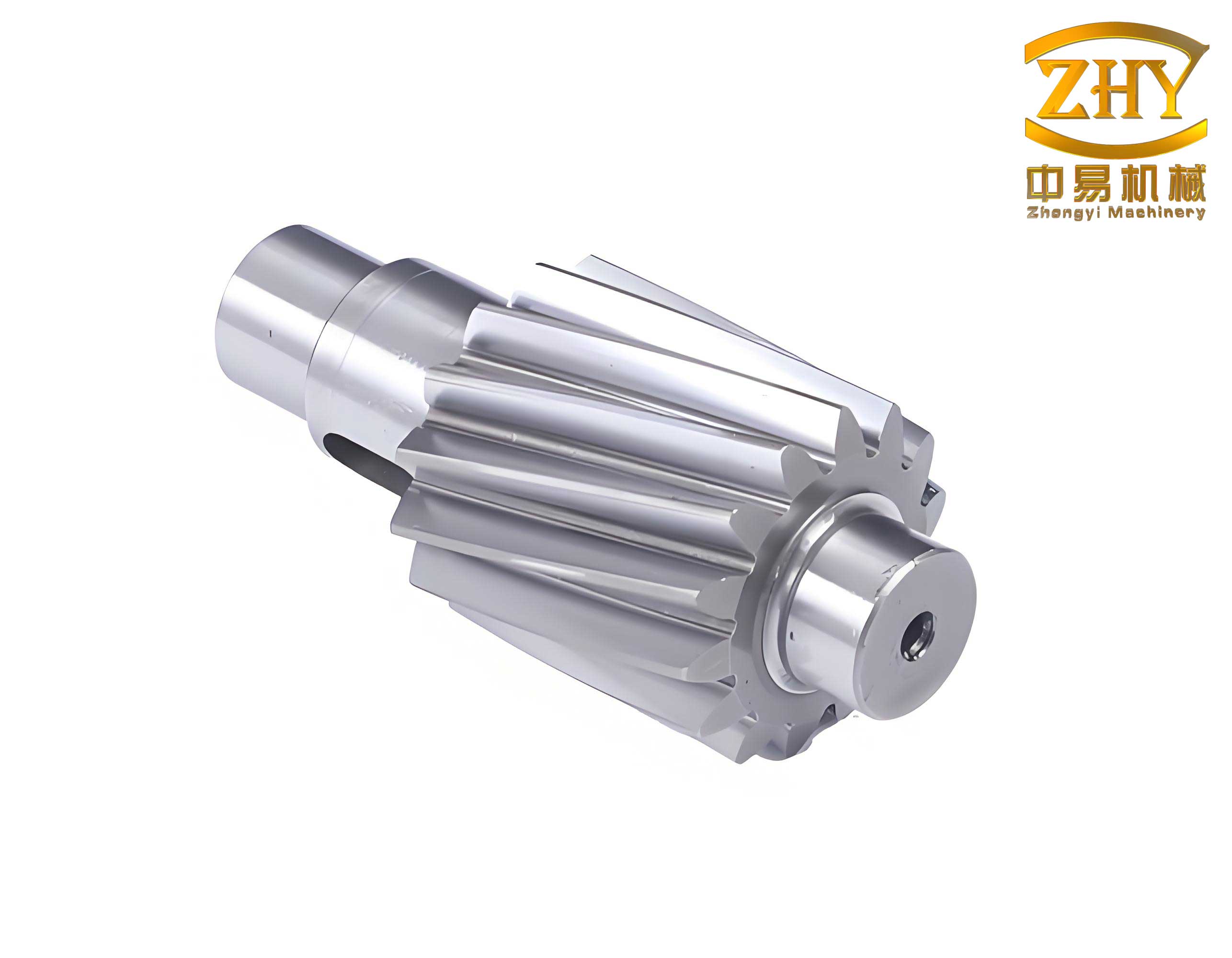
The air turbine starter is a pivotal system, utilizing high-pressure gas to generate shaft power for initiating main engine operations. Central to its reduction gearbox are the gear shafts, which transmit torque and support rotating elements. The subject component, a hollow star gear shaft, functions as an inner race for needle bearings and a support for intermediate gears. Its extended oil collection groove, a cantilevered structure, is designed to channel lubricant. During a routine post-field inspection, we discovered a pervasive crack at the transition between the groove’s斜面 and horizontal surfaces. The crack propagated circumferentially, covering approximately half to three-quarters of the circumference, though complete fracture had not occurred. Fractographic analysis revealed classic fatigue striations, confirming a high-cycle fatigue mechanism originating from the inner surface of the transition radius.
We initiated a fault tree analysis with the gear shaft crack as the top event. Given that the gear shaft is a stationary component, classical overloading was discounted. The investigation branched into two primary avenues: inadequate fatigue resistance and excessive vibrational stress. Potential root causes included undersized fillet radii, material defects, and insufficient resonance margin. Preliminary material tests and non-destructive inspections ruled out metallurgical deficiencies or manufacturing flaws, directing our focus toward the dynamic behavior of the gear shafts.
A critical step was performing a detailed vibrational characteristic analysis on the gear shaft assembly. Finite element method (FEM) simulations were employed to model the complex geometry. The stress concentration factor (K_t) for a fillet radius in a shaft under bending is a key parameter, often approximated by empirical formulas. For the initial design with a minimal radius (approximately R0.5), the stress concentration can be significantly high. The maximum vibrational stress was consistently located at the fillet transition, correlating perfectly with the crack initiation site. The fundamental natural frequency of the gear shaft’s first bending mode was computed under various conditions, including ambient temperature, elevated oil temperatures (up to 140°C), and with/without oil mass in the groove. The governing equation for the natural frequency of a cantilever beam, which models the oil groove, is given by:
$$f_n = \frac{1}{2\pi} \sqrt{\frac{k_{eq}}{m_{eq}}}$$
where $f_n$ is the natural frequency, $k_{eq}$ is the equivalent stiffness, and $m_{eq}$ is the equivalent mass. For a uniform cantilever beam, the fundamental frequency is:
$$f_1 = \frac{1}{2\pi} \left( \frac{3.515}{L^2} \right) \sqrt{\frac{EI}{\rho A}}$$
Here, $L$ is length, $E$ is Young’s modulus, $I$ is area moment of inertia, $\rho$ is density, and $A$ is cross-sectional area. Our FEM results, accounting for temperature-dependent material properties (E(T), ρ(T)) and added fluid mass, are summarized in Table 1.
| Condition | Temperature (°C) | Oil in Groove? | 1st Bending Mode Frequency (Hz) |
|---|---|---|---|
| Ambient | 25 | No | 5927 |
| Elevated | 110 | No | 5870 |
| Elevated | 110 | Yes | 5764 |
| Maximum | 140 | Yes | 5744 |
Simultaneously, we calculated the excitation frequencies within the gear train. The primary forcing function originates from gear meshing. The meshing frequency $f_m$ for any gear pair is:
$$f_m = \frac{N \times \omega}{60}$$
where $N$ is the number of teeth and $\omega$ is the rotational speed in RPM. For the 23-tooth gear in the reduction stage, the meshing frequency varies with the starter’s operational speed. Table 2 compares these excitation frequencies across different test scenarios.
| Operational State | Starter Speed (RPM) | 23-Tooth Gear Meshing Frequency (Hz) |
|---|---|---|
| Field Cold Run | 3250 – 3900 | 5037 – 6045 |
| Bench Test | 4690 | 7270 |
| Power Measurement | 4300 | 6665 |
The analysis revealed a critical overlap: the gear shaft’s first natural frequency under field conditions (with hot oil and collected mass) fell within the excitation frequency range of the 23-tooth gear during field cold runs. This indicated a potential resonance condition, a severe threat to the integrity of gear shafts.
To isolate the effect of fillet radius on fatigue strength, we conducted a series of vibration fatigue tests. Specimens were prepared: two replicating the original small-radius design and five with an increased fillet radius to R5. The fatigue limit, the stress amplitude below which failure does not occur in $10^7$ cycles, is described by the Basquin equation:
$$S_a = \sigma_f’ (2N_f)^b$$
where $S_a$ is the stress amplitude, $N_f$ is the number of cycles to failure, $\sigma_f’$ is the fatigue strength coefficient, and $b$ is the fatigue strength exponent. The test setup involved mounting modified gear shafts on a shaker, with strain gauges placed at the critical fillet. A known mass was added to tune the resonance to a manageable frequency for the test apparatus. The results, presented in Table 3, were pivotal.
| Specimen Type | Specimen ID | Resonant Frequency (Hz) | Fatigue Limit (MPa) | Failure Location |
|---|---|---|---|---|
| Original (R~0.5) | 1 | 2260 | 230.4 | Oil Groove Fillet |
| 2 | 2290 | 205.7 | Oil Groove Fillet | |
| Modified (R5) | 3 | 2279 | 206.2 | No Failure |
| 4 | 2279 | 204.8 | No Failure | |
| 5 | 2267 | 292.3 | Clamp Area | |
| 6 | 2418 | 254.2 | Clamp Area | |
| 7 | 2434 | 238.5 | Oil Groove Fillet |
The data showed that merely increasing the fillet radius did not produce a consistent, significant uplift in the fatigue limit of the gear shafts’ critical region. Some modified specimens failed at stresses similar to the original, while others failed in the clamping area, indicating a shift in the stress concentration. This led us to conclude that the small fillet was not the predominant cause of failure; rather, it was a stress riser that became critical only under specific dynamic conditions.
We then performed sweep tests on a complete starter assembly to capture real-world dynamic response. Strain data from the oil groove of both original and modified gear shafts were recorded as the starter speed increased. The results, shown graphically in Figure 1 (conceptual), demonstrated a pronounced resonance peak for the original gear shaft at 3747 RPM starter output speed, corresponding to a vibration frequency of 5807 Hz and a stress amplitude of 357 microstrain. The modified gear shaft resonated at a higher speed (4171 RPM, 6465 Hz) with a much lower amplitude (68.6 microstrain). Crucially, the original gear shaft’s resonance point lay squarely within the field cold-run speed range.
A resonance dwell test was the definitive proof. We operated the starter at the resonant speed of 3747 RPM for a cumulative duration of 13 minutes and 30 seconds. Post-test inspection under a stereomicroscope revealed a nascent fatigue crack in the original gear shaft at the exact fillet location, mirroring the field failure. The modified gear shaft showed no damage. This experiment irrefutably demonstrated that resonance under field operating conditions was the root cause of the fatigue crack in these gear shafts.
The failure mechanism can be synthesized as follows: The cantilevered oil collection groove on the star gear shaft possessed a first bending mode natural frequency that, when influenced by operational temperature and fluid mass, descended into the excitation frequency band produced by the 23-tooth gear meshing during field cold-run operations. The relationship for resonance is:
$$f_{excitation} = f_{natural}$$
When this condition was met, the gear shaft experienced resonant amplification of vibrational stress. The stress amplitude at resonance $\sigma_{res}$ can be related to the static stress $\sigma_0$ by the amplification factor Q (quality factor):
$$\sigma_{res} \approx Q \cdot \sigma_0$$
For lightly damped metal structures like these gear shafts, Q can be high, leading to stress magnitudes sufficient to initiate and propagate fatigue cracks from the inherent stress concentration at the small fillet radius. The crack growth rate per cycle, da/dN, governed by Paris’ law, accelerated under these sustained high cyclic stresses:
$$\frac{da}{dN} = C (\Delta K)^m$$
where $\Delta K$ is the stress intensity factor range, and C and m are material constants.
The solution was to redesign the oil groove geometry to increase its fundamental natural frequency, thereby moving it away from the excitation range. The modifications included increasing the groove’s height, shortening its length, adding a larger end chamfer, and increasing the critical fillet radius. The new design’s stiffness $k_{new}$ and mass $m_{new}$ were altered to shift the frequency. Using the simplified frequency formula, the improvement is evident:
$$f_{new} = \frac{1}{2\pi}\sqrt{\frac{k_{new}}{m_{new}}} > f_{old}$$
FEM analysis predicted the new first natural frequency to be 8386 Hz at ambient temperature, a substantial increase. Validation tests were conducted. Dwell tests at the previously problematic 3747 RPM resulted in a maximum measured strain of only 63.3 microstrain on the improved gear shafts, a reduction of over 80% compared to the original. Subsequent fluorescent penetrant inspections of both test units and field-returned engines (with over 490 starts) equipped with the modified gear shafts revealed no cracks.
In conclusion, this investigation underscores several critical principles for the design and analysis of gear shafts in aerospace applications. First, the crack was unequivocally identified as high-cycle fatigue. Second, while stress concentrators like small fillet radii are detrimental, their impact can be secondary if the gear shafts are not subjected to resonant conditions. The core cause of failure was the coincidence of the gear shaft’s natural frequency with a persistent meshing excitation frequency during specific field operations, leading to resonance and accelerated fatigue. This case highlights that for stationary yet cantilevered components like certain gear shafts, a comprehensive dynamic analysis is non-negotiable. Design practices must include thorough modal and forced-response simulations across all anticipated environmental and operational envelopes to ensure sufficient resonance margin. The successful rectification through geometric modification, validated by rigorous testing, provides a robust template for addressing similar vibration-induced failures in gear shafts and other critical static structures subjected to dynamic loads.