
In the field of parallel-axis gear transmissions, spur gears are widely used due to their simplicity and efficiency. However, traditional involute spur gears exhibit limitations such as high relative curvature at meshing points, leading to increased contact stress and reduced load capacity. Additionally, significant sliding friction between tooth surfaces can cause wear and thermal issues. To address these challenges, researchers have explored alternative tooth profiles, including cosine curve gears, stepped triple circular-arc gears, and non-Hertz contact gears. Among these, constant relative curvature (CRC) gears have shown promise in reducing stress and improving mesh stiffness, but they often suffer from decreased contact ratios, which can exacerbate vibrations and impacts during transmission. In this study, we propose a novel design methodology for spur gears based on time-varying relative curvature control. By adjusting the relative curvature profile according to meshing characteristics, we develop non-involute tooth profiles that enhance performance without compromising strength. This approach involves deriving conjugate tooth profiles from controlled relative curvature equations, followed by finite element analysis to evaluate stress distribution and mesh stiffness. The results demonstrate that our method effectively optimizes gear design, offering improved load capacity and dynamic behavior for spur gears.
The relative curvature at the meshing point is a critical geometric parameter influencing the contact and bending stresses in spur gears. It directly affects the Hertzian contact pressure and the structural integrity of the tooth. Traditional involute spur gears feature a straight path of contact, resulting in constant pressure angles and specific relative curvature distributions. In contrast, non-involute spur gears can be designed with curved paths of contact, allowing for tailored relative curvature profiles. This study focuses on controlling the relative curvature throughout the meshing cycle to achieve desired performance characteristics. We begin by establishing the fundamental equations for generating conjugate tooth profiles based on a given path of contact. The coordinate systems for gear generation are defined, where the pinion, gear, and rack profiles are derived from the meshing line equation. The relative curvature control equation is expressed as:
$$ K_r = \left| \frac{(r_1 + r_2) \sin \alpha}{[r_1 \sin \alpha + r (r_1 \cos \alpha \frac{d\alpha}{dr} + 1)] [r_2 \sin \alpha + r (r_2 \cos \alpha \frac{d\alpha}{dr} – 1)]} \right| $$
Here, \( r \) and \( \alpha \) represent the polar coordinates of the meshing line, while \( r_1 \) and \( r_2 \) denote the pitch circle radii of the pinion and gear, respectively. By solving this differential equation numerically, we obtain the meshing line coordinates, which are then used to generate the tooth profiles for spur gears. The rack profile equations are derived as:
$$ x_3 = \int -\tan \alpha (r’ \sin \alpha + r \cos \alpha) d\alpha + C $$
$$ y_3 = r \sin \alpha $$
where \( r’ \) is the derivative of \( r \) with respect to \( \alpha \), and \( C \) is an integration constant. The pinion and gear profiles are subsequently calculated using transformation equations, ensuring conjugate action. This formulation allows for precise control over the relative curvature, enabling the design of spur gears with optimized stress and stiffness properties.
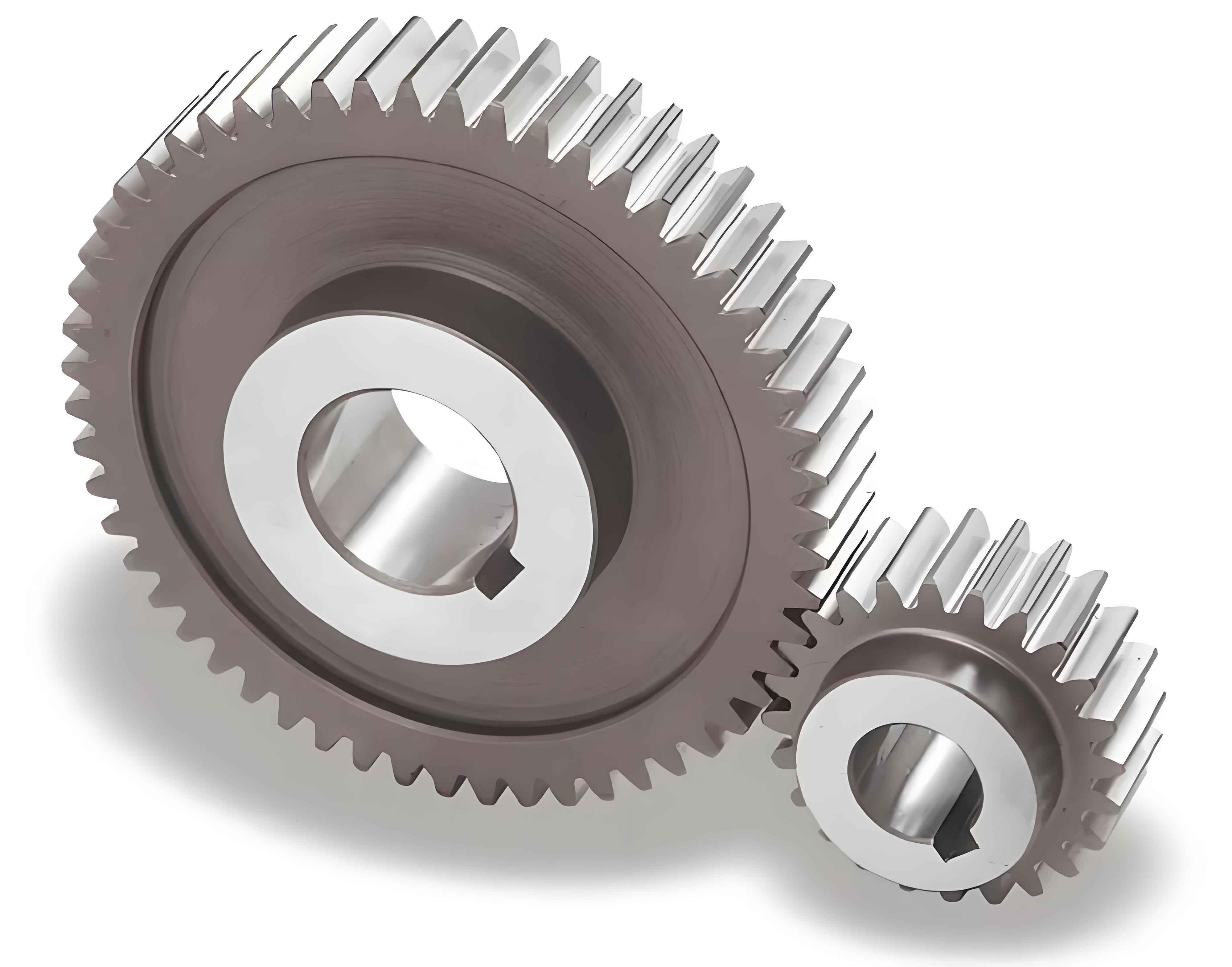
To implement relative curvature control, we consider the time-varying meshing process of spur gears. During operation, spur gears experience single-tooth and double-tooth meshing zones. In the single-tooth zone, one pair of teeth bears the entire load, leading to peak stresses. Thus, it is beneficial to minimize the relative curvature in this region to reduce contact and bending stresses. Conversely, in the double-tooth zone, the load is shared, allowing for higher relative curvature to increase the contact ratio and mitigate stiffness variations. We explore three control strategies: constant relative curvature (CRC), parabolic relative curvature (PRC), and sigmoid relative curvature (SRC). For CRC spur gears, the relative curvature is held constant, but this can result in low contact ratios. PRC and SRC spur gears incorporate variable relative curvature profiles to enhance performance. The control functions for these designs are summarized in the table below:
| Control Function Type | Relative Curvature Equation | Parameters |
|---|---|---|
| CRC Gear 1 | \( K_r = 0.1114 \, \text{mm}^{-1} \) | Base value from involute gear minimum |
| CRC Gear 2 | \( K_r = 0.16 \, \text{mm}^{-1} \) | Higher constant for comparison |
| PRC Gear 1 | \( K_r = 0.00138r^2 + 0.1114 \) | Parabolic increase in double-tooth zone |
| PRC Gear 2 | \( K_r = 0.00108r^2 + 0.1114 \) | Modified parabolic function |
| SRC Gear | \( K_r = \frac{0.04}{1 + e^{-5(r-2.5)}} + 0.12 \) | Sigmoid function for smooth transition |
The gear parameters used in this study are standard for spur gears, as shown in the following table:
| Parameter | Value |
|---|---|
| Gear Ratio | 23/47 |
| Module (mm) | 3 |
| Addendum Coefficient | 1 |
| Bottom Clearance Coefficient | 0.25 |
| Pressure Angle at Pitch Point (°) | 20 |
Using these parameters, we generate tooth profiles for each design. The meshing lines for PRC and SRC spur gears are obtained by solving the differential equations numerically and fitting the results with polynomial or Gaussian functions. For example, the SRC spur gear meshing line requires Gaussian curve fitting due to the complexity of the sigmoid function. The resulting tooth profiles exhibit distinct shapes compared to involute spur gears, with thickened roots and sharper tips in some cases to optimize stress distribution.
To evaluate the performance of the designed spur gears, we conduct finite element analysis (FEA) using a quasi-static meshing simulation. The FEA model includes full ring-shaped gear bodies to accurately capture mesh stiffness effects, as the size of the central hole influences stiffness calculations. The model parameters are consistent across all spur gear designs to ensure fair comparison. The material properties and loading conditions are as follows:
| Parameter | Value |
|---|---|
| Elastic Modulus (GPa) | 206 |
| Poisson’s Ratio | 0.269 |
| Pinion Load (N·m) | 50 |
| Pinion Hole Radius (mm) | 15 |
| Gear Hole Radius (mm) | 30 |
| Tooth Width (mm) | 20 |
The mesh generation employs linear reduced-integration elements (C3D8R) to avoid shear locking and hourglass issues. The element size along the tooth profile is set to one-third of the minimum Hertz contact half-width (approximately 0.04 mm) to ensure stress accuracy. Each spur gear model contains about 80,000 elements, with total model sizes around 160,000 elements. The FEA simulation extracts data on bending stress, contact stress, and torsional stiffness at various meshing positions.
Mesh stiffness is a critical factor in the dynamic behavior of spur gears. For involute spur gears, the meshing line is straight, and the contact force direction remains constant. However, for non-involute spur gears with curved meshing lines, the contact force direction varies during double-tooth meshing, complicating stiffness calculation. To address this, we use torsional stiffness as a metric, defined as the ratio of applied torque to angular displacement deviation. The torsional stiffness \( K_T \) is given by:
$$ K_T = \frac{T}{\theta} $$
where \( T \) is the load torque and \( \theta \) is the angular displacement error from the theoretical value. The contact ratio and maximum mesh impact ratio are also analyzed to assess transmission smoothness. The results for different spur gear designs are summarized below:
| Gear Design | Contact Ratio | Maximum Mesh Impact Ratio | Torsional Stiffness (N·m/rad) |
|---|---|---|---|
| Involute Spur Gear | 1.6677 | 1.396 | Base value |
| CRC Spur Gear 1 | 1.5234 | 1.405 | Higher than involute |
| CRC Spur Gear 2 | 1.8053 | 1.451 | Lower than involute |
| PRC Spur Gear 1 | 1.6186 | 1.404 | Similar to involute |
| PRC Spur Gear 2 | 1.5994 | 1.396 | Similar to involute |
| SRC Spur Gear | 1.6871 | 1.394 | Higher than involute |
The CRC spur gear with higher relative curvature (0.16 mm⁻¹) shows increased contact ratio but reduced torsional stiffness and higher mesh impact, making it less desirable. In contrast, PRC and SRC spur gears maintain or improve contact ratios while minimizing stiffness variations. The SRC spur gear, in particular, exhibits a higher contact ratio and lower mesh impact ratio than the involute spur gear, indicating smoother operation.
Stress analysis focuses on the maximum bending stress and contact stress during the meshing cycle. Bending stress is evaluated using the von Mises criterion from FEA results, while contact stress is derived from Hertzian theory and FEA field outputs. The load distribution in double-tooth meshing is accounted for using the minimum potential energy principle. The maximum stresses for each spur gear design are as follows:
| Gear Design | Maximum Bending Stress (MPa) | Maximum Contact Stress (MPa) |
|---|---|---|
| Involute Spur Gear | 63.43 | 617.1 |
| CRC Spur Gear 1 | 60.29 | 557.5 |
| CRC Spur Gear 2 | 64.36 | 648.1 |
| PRC Spur Gear 1 | 58.27 | 565.6 |
| PRC Spur Gear 2 | 60.24 | 561.9 |
| SRC Spur Gear | 59.92 | 575.2 |
The results indicate that all designed spur gears, except CRC Spur Gear 2, achieve lower bending stresses than the involute spur gear. The PRC spur gears show significant reductions in bending stress, while the SRC spur gear maintains a competitive level. For contact stress, the CRC Spur Gear 1 and PRC spur gears demonstrate substantial improvements, with values close to the minimum contact stress of the involute spur gear in the single-tooth zone. The SRC spur gear also performs well, with contact stress slightly higher than PRC designs but still lower than the involute baseline. This confirms that relative curvature control in the single-tooth meshing zone is effective in reducing peak contact stress.
The relative curvature distribution along the meshing line for each design is plotted using the derived equations. For involute spur gears, the relative curvature is constant at specific values, while for non-involute spur gears, it varies according to the control functions. The Hertz contact stress distribution can be calculated using the relative curvature and load sharing factors. The equation for Hertz contact stress \( \sigma_H \) is:
$$ \sigma_H = \sqrt{\frac{F}{\pi b} \cdot \frac{1}{\frac{1-\nu_1^2}{E_1} + \frac{1-\nu_2^2}{E_2}} \cdot \frac{1}{\rho}} $$
where \( F \) is the normal load, \( b \) is the face width, \( \nu \) is Poisson’s ratio, \( E \) is the elastic modulus, and \( \rho \) is the equivalent radius of curvature. For spur gears, the relative curvature \( K_r \) is related to \( \rho \) by \( \rho = 1/K_r \). By integrating this with the load distribution model, we obtain the contact stress profiles for each spur gear design.
In conclusion, the design of spur gears based on relative curvature control offers significant advantages over traditional involute spur gears. By employing time-varying control strategies such as PRC and SRC, we can achieve higher contact ratios, reduced stresses, and improved mesh stiffness. The FEA results validate the effectiveness of this approach, showing that PRC and SRC spur gears outperform involute spur gears in key performance metrics. This methodology provides a robust framework for optimizing spur gear designs, enhancing their durability and efficiency in various applications. Future work could explore the application of these principles to helical gears or other gear types, further expanding the benefits of relative curvature control.