
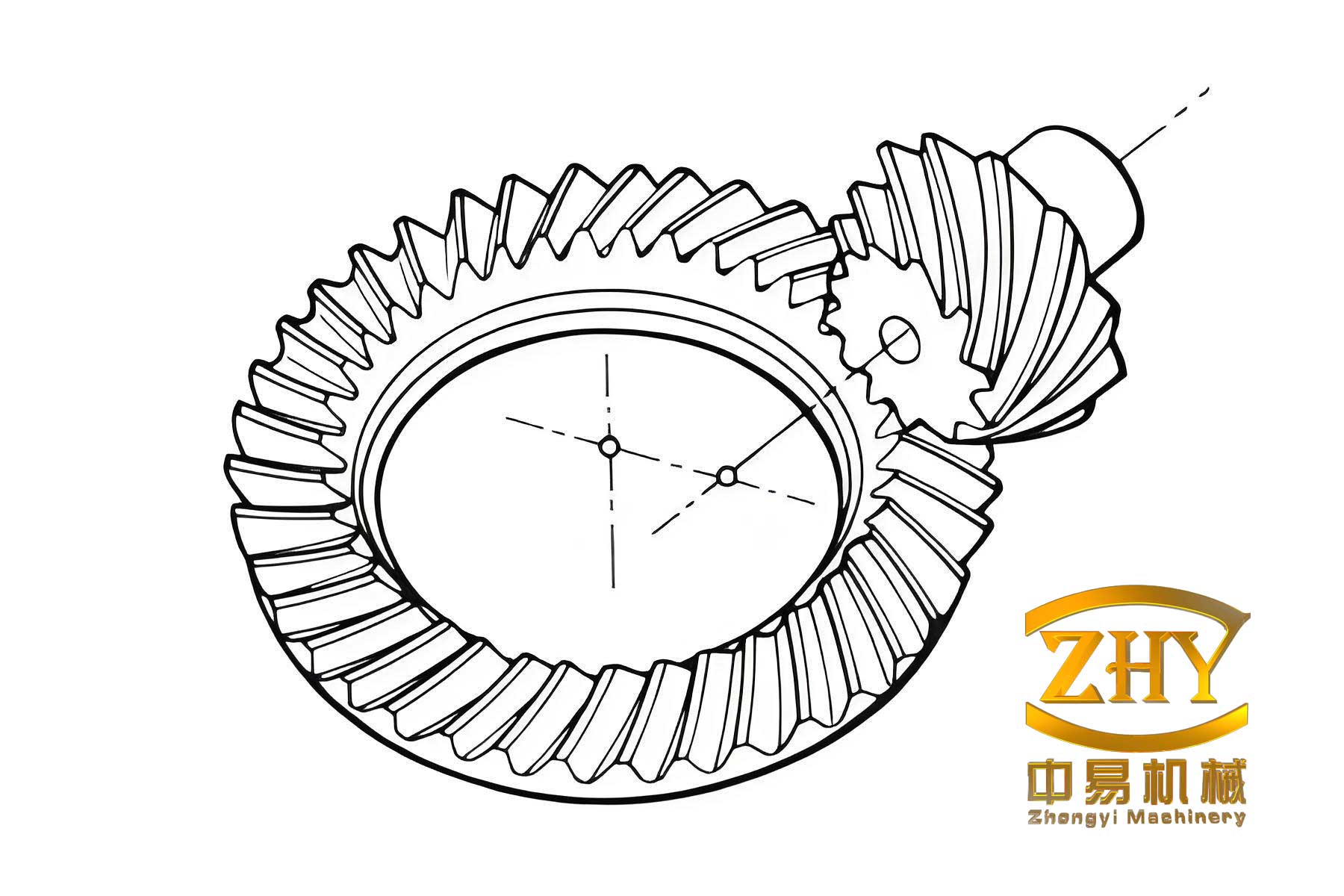
The pursuit of optimal performance in power transmission systems, particularly in automotive drivetrains, has consistently driven innovation in gear design and manufacturing. Among the various gear types, hypoid gears stand out due to their unique ability to transmit motion between non-intersecting, perpendicular axes with a significant offset. This configuration allows for lower positioning of the drive shaft in vehicle axles, contributing to a lower center of gravity and improved vehicle design. The complex, spatially curved tooth flanks of hypoid gears are generated through sophisticated manufacturing processes like face-milling or face-hobbing. However, this geometric complexity, combined with inherent machining inaccuracies and assembly misalignments, makes the precise control of their meshing behavior—specifically the contact pattern and transmission error—a significant challenge. Traditional design and analysis often rely on idealized theoretical tooth surfaces. This paper details a comprehensive methodology for modeling, analyzing, and adjusting the contact characteristics of hypoid gears based on their actual, measured tooth surfaces, providing a critical bridge between theoretical design and manufacturable, high-performance gears.
The core of this methodology lies in moving beyond the perfect theoretical model to the imperfect reality of a manufactured gear pair. The actual tooth surface of a hypoid gear inevitably deviates from its designed form due to tool wear, machine tool errors, heat treatment distortions, and other factors. These deviations, though often minute, can drastically alter the contact conditions under load, leading to suboptimal performance, elevated noise and vibration, and reduced durability. Therefore, the first and most crucial step is the accurate digital reconstruction of the real tooth flank. This is achieved by measuring the gear on a coordinate measuring machine (CMM) or a specialized gear measuring center. The standard output is a grid of points representing surface deviations from the theoretical model at specific locations along the face width and profile height.
Let the theoretical tooth surface be defined by a vector function \(\mathbf{r}(u, v)\), where \(u\) and \(v\) are the lengthwise and profilewise surface parameters, respectively. The measured deviation at a grid point \((i, j)\) is denoted as \(\delta_{ij}\). The position vector of the corresponding point on the real tooth surface, \(\mathbf{R}_{ij}\), is then obtained by superimposing this deviation along the theoretical surface normal \(\mathbf{n}_{ij}\):
$$
\mathbf{R}_{i,j} = \mathbf{r}_{i,j} + \delta_{i,j} \cdot \mathbf{n}_{i,j}
$$
To perform subsequent contact analysis, which requires continuous surface definitions for normal vector and curvature calculations, a smooth surface must be fitted through these discrete measured points. A highly effective approach is to use a bi-cubic Non-Uniform Rational B-Spline (NURBS) surface. A NURBS surface offers excellent local control and the ability to represent complex free-form shapes accurately. The reconstructed real tooth surface \(\mathbf{S}(u,v)\) is expressed as:
$$
\mathbf{S}(u, v) = \frac{\sum_{i=0}^{m} \sum_{j=0}^{n} N_{i,3}(u) N_{j,3}(v) w_{i,j} \mathbf{K}_{i,j}}{\sum_{i=0}^{m} \sum_{j=0}^{n} N_{i,3}(u) N_{j,3}(v) w_{i,j}}
$$
where \(\mathbf{K}_{i,j}\) are the control points, \(w_{i,j}\) are the corresponding weights, and \(N_{i,3}(u)\) and \(N_{j,3}(v)\) are the cubic B-spline basis functions in the \(u\) and \(v\) directions, respectively. The fitting process typically involves first calculating NURBS curve control points along the profile direction for each measured section, and then calculating the final surface control points along the lengthwise direction. Standard measurement grids (e.g., 5 points profilewise by 9 points lengthwise) are often too coarse for precise contact analysis. Therefore, the control polygon is used to generate a much denser grid of points via spline interpolation, creating a sufficiently refined digital twin of the physical hypoid gear flank for high-fidelity simulation.
The primary goal of tooth contact analysis (TCA) for hypoid gears is to predict the unloaded contact pattern (UCP) and the transmission error (TE) under specified assembly conditions. The contact pattern is the area on the tooth flank where metal-to-metal contact occurs during meshing, while transmission error is the deviation of the output gear’s position from its theoretically perfect location, often considered the primary excitation source for gear noise. For real tooth surfaces, the classical approach of solving a system of nonlinear equations derived from the condition of continuous tangency can be computationally intensive and sensitive to initial guesses due to the piecewise nature of the NURBS representation.
An efficient alternative is a discrete simulation method. The fundamental principle is that at the meshing point under unloaded conditions, the distance between the pinion and gear tooth surfaces should be zero, and the surfaces should not interfere. For a given angular position of the gear \(\phi_2\), we search for the corresponding pinion angle \(\phi_1\) and the contact point. The process can be conceptualized as finding the point of minimum separation between the two discretized flanks within the potential contact zone. Let \(\mathbf{r}^f_1\) and \(\mathbf{r}^f_2\) represent points on the pinion and gear real tooth surfaces, respectively, transformed to a fixed reference frame. The spatial distance \(D\) between any two surface points is:
$$
D_{p \times q} = | \mathbf{r}^f_{2,ij} – \mathbf{r}^f_{1,kl} |
$$
If the grid is sufficiently dense, the meshing point can be approximated by the pair of points yielding the minimum distance, \(\min(D_{p \times q})\). However, simply using the initial refined grid may not guarantee the required accuracy for the exact contact point location. To address this, a two-dimensional golden section search algorithm is employed. This optimization technique is known for its robustness and convergence properties. Starting from an initial rectangular search zone identified by the coarse contact simulation, the algorithm recursively subdivides the zone in both the lengthwise and profilewise directions by the golden ratio (0.618), evaluating the surface separation at the center of each new sub-rectangle. The sub-rectangle with the smallest separation is selected for further subdivision. This process continues until the size of the search zone is smaller than a predefined tolerance, yielding a highly accurate meshing point. This method effectively replaces the need to solve complex nonlinear equations directly.
A critical check during this search is to ensure the surfaces are not in interference. Interference occurs if the gear tooth surface penetrates the pinion tooth surface. This can be determined by checking the sign of the dot product between the pinion surface normal \(\mathbf{n}^f_1\) at a point and the vector from that pinion point to a nearby gear surface point:
$$
S_{p \times q} = \mathbf{n}^f_{1} \cdot (\mathbf{r}^f_{2} – \mathbf{r}^f_{1})
$$
If \(\min(S_{p \times q}) < 0\), local interference is detected, indicating the current assembly position is not a valid unloaded contact configuration. By iterating this process for incremental rotations of the gear, the complete path of contact (meshing trace) across the tooth flank is mapped. The transmission error curve is derived from the difference between the actual pinion rotation \(\phi_1\) required to maintain contact and its theoretical rotation based on the gear ratio.
| Step | Action in 2D Golden Section Search |
|---|---|
| 1 | Define initial search rectangle [u_min, u_max] x [v_min, v_max] based on coarse TCA result. |
| 2 | Calculate subdivision points in u and v directions using the golden ratio. |
| 3 | Evaluate the surface separation function D at the centers of the four resulting sub-rectangles. |
| 4 | Select the sub-rectangle with the smallest D value as the new search rectangle. |
| 5 | Check if the size of the new rectangle is below tolerance. If yes, proceed to Step 6; if no, go back to Step 2. |
| 6 | The center of the final sub-rectangle is the calculated meshing point with high precision. |
In practical manufacturing, the initial contact pattern from the first-cut gears often deviates from the desired location—typically aimed at the center of the tooth flank with a slight bias. For instance, the pattern may be too close to the toe or heel, or too near the top or root. The goal of adjustment calculation is to determine the necessary changes in assembly settings—namely pinion offset (\(\Delta V\)), pinion axial position (\(\Delta H\)), and gear axial position (\(\Delta J\))—to shift the contact pattern to its target. A mathematical model is established based on the condition that at the target contact point \(M_0\) on the gear tooth (with local coordinates \(s, t\) representing shifts from the actual contact point), the pinion and gear real tooth surfaces must be in perfect tangency.
The governing equations for meshing at the adjusted position include the position vector equality, surface normal collinearity, and the equation of meshing. Furthermore, to maintain a constant specified backlash, an additional constraint links the axial adjustments:
$$
\Delta J + \Delta H \tan \gamma_1 = 0
$$
where \(\gamma_1\) is the pinion pitch cone angle. The complete system of equations, involving the surface parameters \((u_1, v_1, u_2, v_2)\), the gear rotations \((\phi_1, \phi_2)\), and the three adjustment parameters \((\Delta V, \Delta H, \Delta J)\), is solved using a robust numerical method like the Newton-Raphson algorithm. The Jacobian matrix \(F'(\mathbf{X}^k)\) of the system is computed, and the solution is iteratively refined:
$$
[\mathbf{X}^{k+1}_d] = [\mathbf{X}^k_d] – F'(\mathbf{X}^k_d)^{-1} [f_d], \quad (d = 1, 2, …, 9)
$$
The iteration continues until \(||\mathbf{X}^{k+1} – \mathbf{X}^k|| < \sigma\), where \(\sigma\) is the desired precision. The calculated adjustment values \((\Delta V, \Delta H, \Delta J)\) are the direct inputs needed to correct the machine tool settings (e.g., machine center to back, sliding base, workpiece offset) for the next manufacturing cycle, either for grinding or for a corrective lapping process.
To demonstrate the efficacy of this methodology, let’s consider a case study of a automotive drive axle hypoid gear pair. The basic geometric parameters of the gear set are summarized below:
| Parameter | Pinion | Gear |
|---|---|---|
| Number of Teeth | 8 | 39 |
| Module (mm) | 4.611 | – |
| Face Width (mm) | 25 | 25 |
| Offset (mm) | 25 | |
| Pitch Cone Angle | 14°11′ | 30°41′ |
| Spiral Angle | 50° (LH) | – |
The measured deviation maps for both the pinion and gear concaved and convexed flanks were obtained. Using the described NURBS fitting and discrete TCA algorithm, the initial unloaded contact pattern and transmission error for the gear convex flank were simulated. The analysis revealed that the contact pattern was biased significantly towards the heel (large end) of the tooth. The desired correction was to move the pattern approximately 7 mm towards the toe and 1 mm towards the root. Feeding this target shift into the adjustment calculation model yielded the following machine setup corrections:
$$
\Delta V = +0.312 \text{ mm}, \quad \Delta H = -0.433 \text{ mm}, \quad \Delta J = +0.062 \text{ mm}
$$
Re-running the TCA simulation with these adjusted assembly parameters confirmed that the contact pattern was successfully relocated to a more central and favorable position on the tooth flank. The transmission error curve also showed improved characteristics. The ultimate validation came from physical rolling tests on a CNC gear rolling tester. The initial rolling test for the gear convex flank showed a contact pattern heavily biased to the heel, closely matching the initial simulation prediction. After applying the calculated corrections to the pinion’s machining settings (specifically for the concave flank, which conjugates with the gear convex flank) and manufacturing a corrected pinion, a subsequent rolling test was performed. The result showed the contact pattern centered properly, aligning excellently with the adjusted simulation results. This close correlation between the digital simulation based on real tooth surfaces and physical testing validates the entire proposed workflow.
| Stage | Contact Pattern Location | Key Calculated Adjustment | Validation Result |
|---|---|---|---|
| Initial Manufacturing | Biased to Heel | – | Matched Simulation |
| After Digital Adjustment & Machining | Centered on Flank | ΔV=+0.312mm, ΔH=-0.433mm | Matched Adjusted Simulation |
In conclusion, the control of meshing performance in hypoid gears necessitates a shift from ideal geometry to the reality of manufactured surfaces. The methodology outlined herein—encompassing accurate real tooth surface digitization via NURBS fitting, efficient discrete contact analysis empowered by a two-dimensional golden section search algorithm, and precise adjustment calculation based on a constrained nonlinear model—forms a powerful and practical engineering toolset. This integrated digital approach can significantly reduce the time and cost associated with the traditional trial-and-error process of contact pattern optimization through multiple physical rolling tests and manual machine setting adjustments. By enabling precise prediction and correction based on actual gear measurements, it paves the way for more consistent production of high-performance, quiet, and durable hypoid gear drives for demanding applications like automotive axles. Future work may integrate this with loaded tooth contact analysis (LTCA) and system dynamics models for a fully comprehensive performance prediction suite.