
The pursuit of superior vehicle refinement has elevated Noise, Vibration, and Harshness (NVH) performance to a critical design criterion. Within the automotive drivetrain, the drive axle is a significant contributor to overall NVH, with the meshing performance of its final drive hyperboloidal gears being a primary source of excitation. These gears are favored for their high load capacity, smooth operation, and ability to accommodate offset axes. However, under real-world loaded conditions, deflections in the axle system cause misalignments in the gear mesh. This misalignment can degrade the contact pattern and increase transmission error (TE) fluctuations, leading to pronounced high-speed whine, which directly impacts passenger comfort. Therefore, proactive hyperboloidal gear tooth surface modification, or topology correction, is essential not merely to compensate for errors but to design a meshing state that remains optimal under operating loads, thereby suppressing NVH at its source. This article delves into a systematic methodology for the topological modification of hyperboloidal gears and investigates the intrinsic relationship between their loaded meshing performance and the resultant drive axle NVH characteristics.
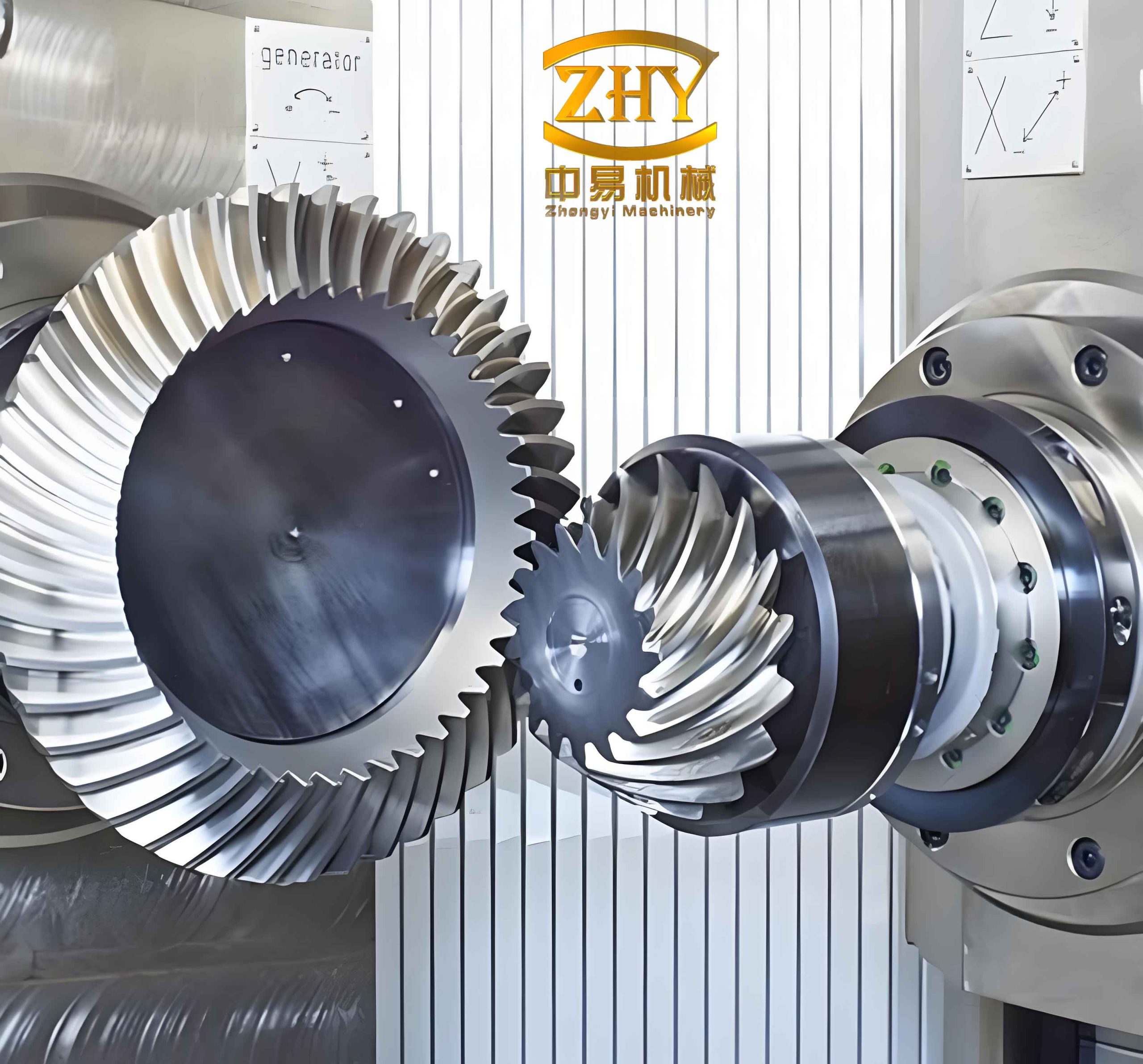
The foundation of any performance analysis is an accurate digital representation of the gear tooth surfaces. For hyperboloidal gears manufactured via the HFT (Hypoid-Formate-Tilt) method, a precise mathematical model is constructed. The pinion is generated using a tilted cutter head, while the gear is formate cut. The surface of the grinding wheel (cutter) is defined first. For a pinion, the cutter surface vector in its coordinate system \( S_t(X_t, Y_t, Z_t) \) is given by:
$$ \mathbf{r}_i^{(t)}(u_k, \theta_k) = \begin{bmatrix}
(r_k + u_k \sin \alpha_k) \cos \theta_k \\
(r_k + u_k \sin \alpha_k) \sin \theta_k \\
-u_k \cos \alpha_k \\
1
\end{bmatrix} $$
where \( k = g, p \) denotes the inner and outer blades, \( r_k \) is the point radius, \( \alpha_k \) is the blade angle (positive for inner, negative for outer), \( u_k \) is the profile parameter, and \( \theta_k \) is the surface parameter. The unit normal vector \( \mathbf{n}_i^{(t)} \) is derived from the partial derivatives of \( \mathbf{r}_i^{(t)} \). Through a series of coordinate transformations representing the machine settings—radial setting \( S_{r1} \), cradle angle \( \varphi_1 \), machine root angle \( \gamma_1 \), blank offset \( E_{m1} \), sliding base setting \( X_{b1} \), machine center to back \( X_{p1} \), tilt angle \( i \), and swivel angle \( j \)—the cutter surface is transformed into the machine coordinate system \( S_m \) and then into the pinion coordinate system \( S_1 \). The generating motion imposes the equation of meshing, which relates the parameter \( \theta_k \) to the cradle rotation angle \( \varphi \), ultimately yielding the theoretical pinion tooth surface \( \mathbf{r}_1(u_k, \theta_k) \) and its normal \( \mathbf{n}_1(u_k, \theta_k) \).
The gear tooth surface model is simpler due to the formate process. Its cutter surface equation is similar, and through transformations involving its own machine settings (\( S_{r2}, q_2, E_{m2}, X_{p2}, \gamma_2 \)), the gear tooth surface \( \mathbf{r}_2(u_w, \theta_w) \) in its coordinate system \( S_2 \) is obtained.
To construct a three-dimensional model suitable for simulation, the continuous tooth surface is discretized. The tooth flank projection is divided into a grid, for instance, 5 points along the profile (height) direction and 9 points along the lengthwise direction. The coordinates of these grid points on the projection plane are calculated based on gear geometry (face cone angle, root cone angle, outer cone distance \( R_e \), face width \( b \)). For any grid point \( P(X_P, Y_P) \) on this plane, the corresponding 3D coordinates on the actual tooth surface \( (x_P, y_P, z_P) \) are found by solving the system:
$$ \begin{cases}
x_P(u, \theta) = X_P \\
\sqrt{y_P^2(u, \theta) + z_P^2(u, \theta)} = Y_P
\end{cases} $$
Solving this for the parameters \( (u, \theta) \) and substituting back into the surface equation \( \mathbf{r}_1 \) gives the 3D point cloud. This numerical surface is then imported into CAD software (e.g., UG/NX) to generate a solid model through surface fitting operations. The geometric and machine setting parameters for an example gear pair are listed below:
| Parameter | Pinion | Gear |
|---|---|---|
| Number of Teeth | 8 | 39 |
| Hand of Spiral | Left | Right |
| Shaft Angle (°) | 90 | |
| Offset (mm) | 35 (Below) | |
| Module (mm) | 6.283 | |
| Face Width (mm) | 44.4 | 38 |
| Spiral Angle at Ref. Point (°) | 50.24 | 31.37 |
| Machine Setting (Pinion – Convex) | Value |
|---|---|
| Cutter Point Radius (mm) | 108.075 |
| Blade Angle (°) | -31 |
| Tilt Angle i (°) | 15.57 |
| Swivel Angle j (°) | 320.32 |
| Radial Setting \( S_{r1} \) (mm) | 104.4274 |
| Cradle Angle \( q_1 \) (°) | 82.25 |
| Machine Root Angle \( \gamma_1 \) (°) | 355.96 |
With accurate 3D models, the meshing performance can be simulated. Unloaded Tooth Contact Analysis (TCA) solves for the contact path and transmission error by enforcing contact and tangency conditions between the pinion and gear surfaces under specified assembly positions (including misalignments \( \Delta E \), \( \Delta H_1 \), \( \Delta H_2 \)). The governing equations in a fixed coordinate system \( S_a \) are:
$$ \mathbf{r}_a^{(1)}(u_1, \theta_1, \phi_1) = \mathbf{r}_a^{(2)}(u_2, \theta_2, \phi_2) $$
$$ \mathbf{n}_a^{(1)}(u_1, \theta_1, \phi_1) = \mathbf{n}_a^{(2)}(u_2, \theta_2, \phi_2) $$
where \( \phi_1 \) and \( \phi_2 \) are the rotation angles of the pinion and gear, respectively. Transmission error is calculated as:
$$ \Delta \phi_2 (\phi_1) = \phi_2 (\phi_1) – \frac{z_1}{z_2} \phi_1 – \left[ \phi_2^{(0)} – \frac{z_1}{z_2} \phi_1^{(0)} \right] $$
However, TCA does not account for load-induced deformations. For a true assessment of performance under operating conditions, Loaded Tooth Contact Analysis (LTCA) is performed using the Finite Element Method (FEM) in software like ABAQUS. A multi-tooth segment model is built, meshed primarily with hexahedral elements (C3D8R) with refinement in the contact zone. Material properties (Young’s modulus \( E = 210 \) GPa, Poisson’s ratio \( \nu = 0.3 \), density \( \rho = 7.85 \times 10^{-9} \) tonne/mm³) are assigned. A surface-to-surface contact definition with a friction coefficient of 0.06 (hard contact) is used. Boundary conditions apply torque to the pinion while allowing the gear to rotate freely. A dynamic implicit analysis step simulates the meshing cycle.
Post-processing extracts key performance metrics: the complete loaded contact pattern (by scripting to collect the maximum contact stress for each surface element over all time steps), the loaded transmission error (from the difference between theoretical and actual rotation angles), and tooth root bending stress. This LTCA provides a realistic picture of the stress distribution and mesh stiffness variation under load.
To evaluate the system-level NVH impact, a full drive axle model is built in MASTA software. The model includes the hyperboloidal gear pair, differential, shafts, and bearings. The housing flexibility can be incorporated via imported mass and stiffness matrices. A gear whine analysis module is used, where the transmission error from the hyperboloidal gears acts as the primary excitation to the system. The dynamic response is calculated at specified measurement points, typically on the pinion bearing cap, yielding vibration velocity and radiated sound pressure level (noise) curves in the vertical direction, which is usually the most critical. This establishes a direct link between the gear mesh excitation and the drive axle NVH output.
The core of improving NVH lies in designing the tooth surface topography. The proposed method is based on the concept of “Ease-off,” which quantifies the deviation between the actual pinion surface and a theoretical “conjugate” pinion surface that would perfectly mesh with the actual gear surface without error. First, the conjugate pinion surface \( \mathbf{r}_1^{‘(c)} \) is calculated. Starting from the gear surface \( \mathbf{r}_2(u_2, \theta_2) \), it is transformed to a fixed coordinate system considering assembly position \( \Delta E, \Delta H_2 \), and gear rotation \( \phi_2 \). The equation of meshing (conjugate condition) is applied:
$$ \mathbf{n}_a^{(2)} \cdot \mathbf{v}_a^{(21)} = 0 $$
where \( \mathbf{v}_a^{(21)} \) is the relative velocity. This yields a relation \( \phi_2 = \phi_2(u_2, \theta_2) \). Eliminating \( \phi_2 \) gives the gear surface in the fixed system \( \mathbf{r}_a^{(2)}(u_2, \theta_2) \), which is then transformed back to the pinion coordinate system \( S_1 \) considering pinion rotation \( \phi_1 = (z_2/z_1)\phi_2 \) and axial offset \( \Delta H_1 \), resulting in the conjugate pinion surface \( \mathbf{r}_1^{‘(c)}(u_2, \theta_2) \).
The Ease-off topography \( \Delta \delta \) is defined as the normal distance between the actual pinion surface \( \mathbf{r}_1^{(a)} \) and this conjugate surface \( \mathbf{r}_1^{(c)} \) at corresponding points. For a point \( \mathbf{M}_1 \) on the actual surface, we find the point \( \mathbf{M}_0 \) on the conjugate surface where the line through \( \mathbf{M}_1 \) is parallel to the conjugate surface’s normal \( \mathbf{n}_1^{(c)}(\mathbf{M}_0) \). The deviation is found by solving:
$$ \mathbf{r}_1^{(a)}(\mathbf{M}_1) – \mathbf{r}_1^{(c)}(\mathbf{M}_0) = \Delta \delta \cdot \mathbf{n}_1^{(c)}(\mathbf{M}_0) $$
This scalar field \( \Delta \delta(X, Y) \) over the tooth surface (X: lengthwise, Y: profile direction) is the Ease-off map. This topography can be approximated by a second-order polynomial, effectively decomposing it into fundamental correction components:
$$ \Delta \delta(X, Y) \approx a_0 + a_1 X + a_2 Y + a_3 X^2 + a_4 Y^2 + a_5 XY $$
The coefficients have distinct geometric meanings: \( a_1 \) controls spiral angle modification (lead slope), \( a_2 \) controls pressure angle modification (profile slope), \( a_3 \) introduces length crowning, \( a_4 \) introduces profile crowning, and \( a_5 \) controls the bias (or twist) of the contact pattern. By predefining a target Ease-off topography—for instance, one that reduces diagonal contact, enlarges the contact area, and lowers transmission error amplitude—we establish a target pinion surface \( \mathbf{r}_1^{(t)} \). This is done by adding the desired \( \Delta \delta_{target}(X, Y) \) to the conjugate surface along its normal direction:
$$ \mathbf{r}_1^{(t)} \approx \mathbf{r}_1^{(c)}(\mathbf{M}_0) + \Delta \delta_{target} \cdot \mathbf{n}_1^{(c)}(\mathbf{M}_0) $$
The final step is to determine the machine settings that will produce this target pinion surface. The sensitivity of the pinion surface coordinates to changes in machine settings \( \xi_j \) (e.g., \( S_{r1}, i, j, E_{m1}, \) etc.) is calculated. The difference between the target surface and the initial pinion surface at discrete points forms the deviation vector \( \{\Delta h_i\} \). This is related to the machine setting adjustments \( \{\Delta \xi_j\} \) through the sensitivity matrix \( [J_{ij}] \):
$$ \{\Delta h_i\} \approx [J_{ij}] \{\Delta \xi_j\} $$
Since this is an overdetermined system (more points than settings), an optimization algorithm like Sequential Quadratic Programming (SQP) is used to solve for \( \{\Delta \xi_j\} \) while respecting practical adjustment limits \( \Delta \xi_{j,min} \leq \Delta \xi_j \leq \Delta \xi_{j,max} \). The process iterates until the manufactured surface converges to the target surface within a tolerance (e.g., 10 μm).
For the example gear pair, the initial concave-side contact pattern showed a pronounced diagonal orientation. The modification aimed to reduce this diagonal, increase the contact area, and lower TE. The Ease-off coefficients were adjusted from their initial values to target values: \( a_1 \) from -1.62e-4 to 5.2e-4, \( a_2 \) from 1.1e-3 to -2.3e-4, \( a_3 \) from -2.03e-4 to 6.9e-5, \( a_4 \) from 9.03e-4 to 5.6e-5, and \( a_5 \) from -7.0e-4 to 4.0e-5. The corresponding machine setting adjustments were calculated, leading to the modified pinion settings shown below.
| Machine Setting (Pinion – Convex, Modified) | Value | Change (Δ) |
|---|---|---|
| Cutter Point Radius (mm) | 117.73 | +9.655 |
| Tilt Angle i (°) | 15.90 | +0.33 |
| Swivel Angle j (°) | 330.14 | +9.82 |
| Radial Setting \( S_{r1} \) (mm) | 107.5162 | +3.0888 |
| Cradle Angle \( q_1 \) (°) | 84.77 | +2.52 |
| Vertical Setting \( E_{m1} \) (mm) | 33.6815 | -2.18294 |
| Roll Ratio \( R_b \) | 4.6279 | -0.0654 |
TCA of the modified design confirmed the improvements: a more centralized contact pattern with less diagonal and a reduction in unloaded TE amplitude from 30 μrad to 14.8 μrad.
The true test of the modification is its performance under realistic operating conditions. For a vehicle experiencing whine during coast (engine braking), the input torque range at the pinion is negative. System deformation analysis in MASTA calculates the resulting gear mesh misalignments under these loads:
| Pinion Torque (N·m) | ΔXP (μm) | ΔXW (μm) | ΔE (μm) | ΔΣ (μrad) |
|---|---|---|---|---|
| -40 | -22.428 | 27.625 | 14.6873 | -0.0232 |
| -60 | -30.742 | 43.097 | 21.1243 | -0.0094 |
| -80 | -39.1367 | 58.9671 | 26.6865 | 0.01384 |
| -100 | -47.3308 | 74.3284 | 31.757 | 0.03851 |
FEM-based LTCA was performed for both the original and modified gear surfaces, incorporating these load-specific misalignments. The results consistently showed that the modified gears exhibited superior loaded performance: larger and better-centered contact areas, lower maximum contact stress, significantly reduced loaded TE amplitude, and reduced tooth root bending stress across all load cases. The trends are clear: as load increases, contact area grows and TE amplitude generally decreases, but at any given load, the modified gears perform better.
This improvement in mesh dynamics directly translates to enhanced NVH performance. MASTA NVH simulations for the drive axle assembly, using the respective gear geometries, show a marked reduction in vibration and sound pressure level (noise) curves for the modified design across the entire load range. Crucially, the trend of decreasing TE amplitude with increasing load correlates with the trend of decreasing NVH response, establishing a direct causal link. The reduction in mesh excitation force (related to contact stress and TE fluctuation) is the root cause of the NVH improvement.
The methodology was validated experimentally. Gears were manufactured on a CNC grinder according to both original and modified machine settings. The tooth surfaces were measured on a gear inspection center, confirming they matched the theoretical designs within microns. Rolling checks (static tests under light load) showed contact patterns that aligned well with the TCA predictions. Finally, the gears were assembled into drive axles and tested.
An End-of-Line (EOL) NVH test bench, simulating real-world torque and speed conditions, was used. The dynamic torque variation, a proxy for mesh-induced vibration, was measured. For the original gears, the response curve exceeded the acceptable threshold in the 2000-2500 rpm range, indicating a whine problem. For the modified gears, the response remained below the threshold across the entire speed range.
Ultimate validation came from vehicle road tests. Using a data acquisition system, sound pressure was measured near the driver’s ear during a 5th-gear coast condition. The results were telling: for the original gears, the gear mesh order noise (10.53rd order, derived from 8 pinion teeth divided by the 5th gear ratio of 0.76) was only 4.21 dB below the overall noise floor at its closest point. After modification, the gear mesh order noise was reduced, now lying 9.49 dB below the overall noise, a significant improvement that effectively eliminated the perceptible whine.
In conclusion, this work presents a comprehensive, closed-loop methodology for the topology modification of hyperboloidal gears aimed at optimizing drive axle NVH performance. The approach integrates precise numerical tooth modeling, advanced loaded contact simulation, and a proactive Ease-off-based surface design strategy that allows direct control over the fundamental meshing characteristics. The key findings demonstrate that targeted tooth surface modification, which reduces loaded transmission error amplitude and contact stress concentration, leads to a direct and measurable reduction in drive axle vibration and noise emission. The strong correlation between the improved meshing metrics from FEM analysis and the enhanced NVH outputs from both system simulation and physical testing validates the effectiveness of the proposed method. This provides a robust theoretical and practical framework for the NVH-driven design and development of high-performance hyperboloidal gear pairs for automotive applications.