
In recent years, our research group has been deeply engaged in the study of spiral gear drives, focusing on the combination of steel pinions or worms with polymer gears. This work stems from the growing demand for lightweight, cost-effective, and quiet transmission systems in various industries, such as automotive and household appliances. The use of spiral gear drives, particularly those employing steel/polymer material pairs, offers significant advantages, including reduced weight, damping characteristics, and lower noise emission. In high-end automobiles, for instance, there can be over a hundred auxiliary drives, many of which utilize such spiral gear configurations. As series products, these drives are often manufactured using rolled screws and die-cast spiral gears, making them economically viable. This article presents a comprehensive overview of our design methodology, experimental investigations, and optimization strategies for steel/polymer spiral gear drives, aiming to provide engineers with robust tools for initial load capacity calculations and system optimization.
The fundamental appeal of spiral gear drives lies in their ability to transmit motion between non-parallel and non-intersecting shafts efficiently. When combining steel with polymers, the design paradigm shifts, requiring careful consideration of material properties, thermal behavior, and wear mechanisms. Our approach begins with a detailed analysis of the spiral gear geometry and the interaction dynamics between steel and polymer surfaces. The spiral gear, with its helical teeth, engages in a point contact that generates complex stress distributions and sliding velocities, which are critical factors in determining the drive’s performance and lifespan. Throughout this discussion, the term ‘spiral gear’ will be frequently emphasized to underscore its central role in these transmission systems.
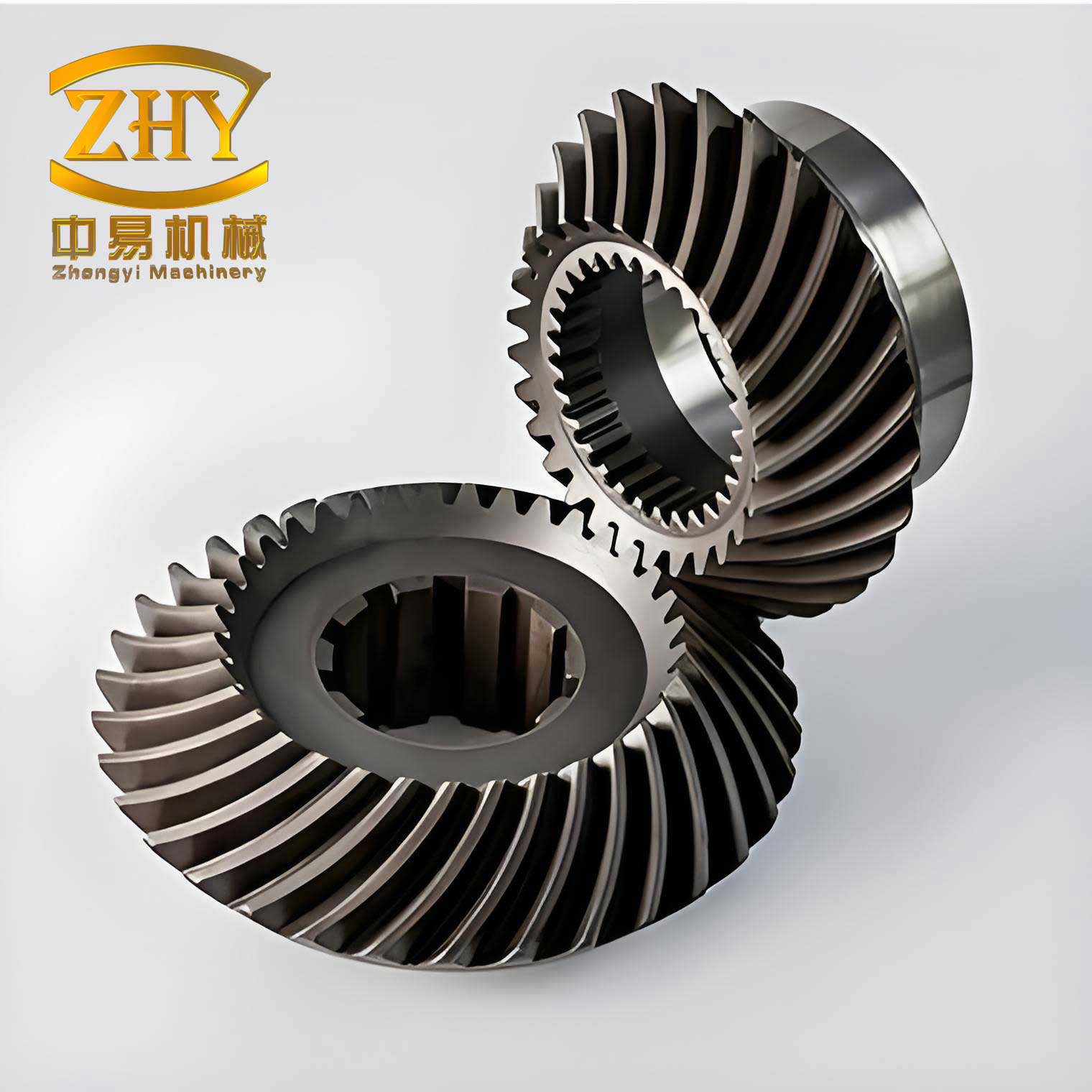
To establish a foundational understanding, we first delve into the theoretical models developed for predicting the behavior of steel/polymer spiral gear drives. A key aspect is the frictional interaction at the mesh interface, which directly influences efficiency and heat generation. We derived an approximate equation for the average coefficient of friction, $\mu_m$, which serves as a cornerstone for subsequent thermal analyses. This coefficient is expressed as a function of several operational parameters:
$$
\mu_m = k_1 \cdot \left( \frac{v_s}{v_{ref}} \right)^{k_2} \cdot \left( \frac{T}{T_{ref}} \right)^{k_3} \cdot f(\text{material}, \text{lubrication})
$$
where $v_s$ is the sliding velocity at the pitch circle, $T$ is the transmitted torque, $k_1$, $k_2$, $k_3$ are empirical constants, and $v_{ref}$, $T_{ref}$ are reference values. This equation encapsulates the nonlinear dependence of friction on sliding speed and load, which is particularly pronounced in polymer-metal contacts. The spiral gear geometry modifies the sliding velocity profile, making it essential to integrate this into the model.
Building upon the friction model, we developed equations to predict temperatures within the spiral gear drive. The thermal state is crucial as polymers have limited operational temperature ranges. We consider three key temperatures: the oil sump temperature ($\Theta_{oil}$), the hub temperature ($\Theta_{hub}$), and the mesh contact temperature ($\Theta_{mesh}$). These are approximated using power loss calculations and heat transfer principles. The mesh temperature, often the most critical, is given by:
$$
\Theta_{mesh} = \Theta_{amb} + \Delta \Theta_{loss} \cdot g\left( \frac{a}{u}, v_s, P_{loss} \right)
$$
where $\Theta_{amb}$ is the ambient temperature, $\Delta \Theta_{loss}$ is the temperature rise due to power loss, $a$ is the center distance, $u$ is the gear ratio, $v_s$ is the sliding velocity, and $P_{loss}$ is the power loss in the mesh. The function $g$ incorporates the spiral gear’s geometric influence on heat dissipation. The power loss itself is primarily due to friction and can be estimated as:
$$
P_{loss} = T \cdot \omega \cdot \mu_m \cdot h(\phi)
$$
with $\omega$ being the angular velocity and $h(\phi)$ a factor accounting for the spiral angle $\phi$ of the spiral gear teeth.
Our experimental program involved extensive bench testing of spiral gear drives with center distances ranging from 20 mm to 65 mm. We investigated various design and operational parameters to assess their impact on load capacity. The test specimens included cylindrical worms and spiral gears, as well as hourglass worms, with tooth flanks ground to precision. The polymer materials selected were PEEK (polyether ether ketone), PA4.6 (polyamide 4.6), and POM (polyoxymethylene). These materials represent a spectrum of thermal and mechanical properties relevant to spiral gear applications. We systematically varied parameters such as number of teeth, torque levels, and lubrication types (grease vs. mineral oil). The table below summarizes the key test matrix for the spiral gear drives.
| Parameter | Range/Variants | Remarks |
|---|---|---|
| Center Distance (a) | 20, 30, 40, 50, 65 mm | Fundamental size parameter |
| Polymer Material | PEEK, PA4.6, POM | Key material variable |
| Gear Type | Cylindrical Spiral Gear, Hourglass Worm Gear | Spiral gear geometry variation |
| Number of Teeth (z1/z2) | 1/20, 2/30, 3/40, etc. | Affects contact ratio and sliding |
| Torque (T) | 5 Nm to 50 Nm | Load level |
| Speed (n) | 100 rpm to 3000 rpm | Rotational speed of steel worm |
| Lubrication | Grease, Mineral Oil (ISO VG 68) | Lubrication condition |
The performance of each spiral gear set was evaluated based on several failure modes: wear, pitting, tooth fracture, and adhesive material transfer (smearing). Wear measurement was particularly challenging due to the complex contact mechanics in spiral gear meshes. We employed both gravimetric and profilometric techniques to quantify volume loss on the polymer teeth. The wear rate $W_r$ was found to correlate strongly with the frictional power intensity and temperature. An empirical relation for wear depth per unit time, $d_w$, in a spiral gear can be expressed as:
$$
d_w = C_w \cdot \mu_m \cdot p_{max} \cdot v_s \cdot \exp\left(-\frac{Q}{R \Theta_{mesh}}\right)
$$
where $C_w$ is a wear coefficient specific to the material pair, $p_{max}$ is the maximum contact pressure, $Q$ is an activation energy term, and $R$ is the gas constant. This highlights the thermally activated nature of polymer wear in spiral gear contacts.
The load capacity results revealed a strong dependency on operational parameters. For instance, at low speeds, failure was predominantly due to pitting and tooth breakage, as the lubricant film might be insufficient, leading to high-stress cycles. At high speeds, thermal limits were exceeded, causing either polymer softening or lubricant breakdown. The choice of polymer material significantly influenced performance; PEEK-based spiral gears consistently outperformed those made from PA4.6 or POM, especially under high load and speed conditions. Replacing a cylindrical spiral gear with an hourglass worm gear design increased the load capacity by improving the contact pattern and heat dissipation. Similarly, using mineral oil instead of grease enhanced cooling and load-bearing ability. The following table compiles the maximum sustainable torque (limiting torque) for a representative spiral gear drive with a center distance of 30 mm, made from PEEK, under different speeds.
| Speed (rpm) | Limiting Torque with Grease (Nm) | Limiting Torque with Oil (Nm) | Dominant Failure Mode |
|---|---|---|---|
| 500 | 18 | 22 | Tooth fracture |
| 1000 | 15 | 20 | Pitting |
| 1500 | 12 | 18 | Wear/Thermal |
| 2000 | 8 | 15 | Thermal overload |
| 2500 | 5 | 12 | Polymer softening |
These results underscore the need for a holistic design tool that can predict these interrelated failure modes. To address this, we developed a simulation program named “Schraubrad.de”. This software enables designers to model steel/polymer spiral gear drives comprehensively, accounting for geometry, materials, lubrication, and operational conditions. The core of the program is a multi-physics model that integrates mechanical load distribution, thermal analysis, and wear progression. The algorithm calculates the limiting torque for a given spiral gear drive by iteratively checking against all potential failure criteria: bending strength, contact stress (pitting risk), wear depth limit, and temperature thresholds. The optimization module then suggests geometric adjustments—such as module, number of teeth, spiral angle, or material choice—to maximize load capacity or efficiency for specific constraints.
The simulation process begins with the definition of the spiral gear pair geometry. Key input parameters include the normal module $m_n$, number of teeth $z_1$ and $z_2$, spiral angle $\beta$, pressure angle $\alpha_n$, and center distance $a$. The program calculates the tooth contact analysis (TCA) to determine the instantaneous contact ellipses and sliding velocities. The contact pressure $p_{H}$ is computed using Hertzian theory modified for polymer viscoelasticity:
$$
p_{H} = \sqrt[3]{\frac{2 \cdot F_n \cdot E^*}{\pi^2 \cdot \rho_{rel}}}
$$
where $F_n$ is the normal load, $E^*$ is the equivalent modulus of elasticity (considering steel and polymer), and $\rho_{rel}$ is the relative curvature radius at the contact point specific to the spiral gear tooth profile. The equivalent modulus for a steel-polymer pair is given by:
$$
\frac{1}{E^*} = \frac{1-\nu_1^2}{E_1} + \frac{1-\nu_2^2}{E_2}
$$
with subscripts 1 and 2 for steel and polymer, respectively, and $\nu$ being Poisson’s ratio. For polymers, $E_2$ is often temperature-dependent, adding complexity to the thermal-structural coupling.
Thermal modeling in the simulation uses a lumped-parameter network. The heat generation $Q_{gen}$ at the spiral gear mesh is computed from the friction power loss. This heat is then dissipated via conduction through the gears and shafts, and convection to the environment and lubricant. The governing equation for the temperature node representing the polymer gear tooth is:
$$
C_p \frac{d\Theta}{dt} = Q_{gen} – h_c A (\Theta – \Theta_{oil}) – \frac{k A}{L} (\Theta – \Theta_{hub})
$$
where $C_p$ is the thermal capacitance, $h_c$ is the convective heat transfer coefficient, $A$ is the surface area, $k$ is the thermal conductivity, and $L$ is a characteristic length. The program solves these equations iteratively until steady-state temperatures are reached, which are then checked against the polymer’s maximum service temperature.
Wear prediction is implemented using an Archard-type model, but adapted for spiral gear geometries and polymer-specific behavior. The incremental wear volume $\Delta V$ per cycle is calculated as:
$$
\Delta V = K_w \cdot \frac{F_n \cdot s}{H}
$$
where $K_w$ is a dimensionless wear coefficient (dependent on material, lubrication, and temperature), $s$ is the sliding distance per engagement cycle, and $H$ is the hardness of the polymer (temperature-sensitive). For a spiral gear, the sliding distance $s$ varies along the tooth flank and is integrated over the path of contact. The program accumulates wear over the desired service life, allowing prediction of backlash increase and potential tooth shape degradation.
To illustrate the optimization capability, consider the task of designing a spiral gear drive for an automotive seat adjuster. Constraints include a center distance of 28 mm, input speed up to 2000 rpm, and required torque of 10 Nm. The goal is to minimize weight (favoring polymer) while ensuring 10,000 cycles of life. The simulation program can automate the variation of parameters like module, number of teeth, and spiral angle. For instance, increasing the spiral angle $\beta$ generally improves smoothness and load sharing but also increases axial forces and sliding. The optimizer might converge to a design with $m_n=1.25$ mm, $z_1=2$, $z_2=30$, $\beta=20^\circ$, using PEEK lubricated with oil. The program would output the predicted limiting torque curve versus speed, similar to the one derived experimentally but tailored to the exact geometry.
The validation of our models against experimental data showed good agreement. For example, the predicted mesh temperature for a PEEK spiral gear operating at 1500 rpm and 15 Nm torque was within 5°C of the measured value using infrared thermography. The wear depth prediction after 100 hours of testing had an error margin of less than 15%. These accuracies are deemed sufficient for preliminary design and optimization purposes. However, we acknowledge the challenges in modeling the time-dependent behavior of polymers, such as creep and fatigue, which are areas for future refinement.
In practical applications, the design of steel/polymer spiral gear drives requires careful attention to manufacturing tolerances. The injection molding of polymer gears can induce shrinkage and warpage, affecting the tooth profile accuracy. Our simulation program includes a tolerance analysis module that estimates the impact of manufacturing variations on load distribution and stress concentrations. For critical applications, we recommend using ground steel worms paired with molded polymer gears, as this combination provides good consistency. The table below lists typical tolerance classes for such spiral gear components.
| Component | Tolerance Parameter | Typical Value (ISO Standard) | Influence on Spiral Gear Performance |
|---|---|---|---|
| Steel Worm | Profile deviation (fp) | Grade 6 | Affects noise and contact pattern |
| Polymer Gear | Tooth thickness deviation (Es) | Grade 8 | Influences backlash and load sharing |
| Housing | Center distance tolerance | ±0.05 mm | Critical for proper mesh alignment |
Furthermore, lubrication selection is paramount. While grease offers simplicity and minimal leakage, oil lubrication provides better cooling and can extend the life of a spiral gear drive under demanding conditions. We developed guidelines for lubricant viscosity selection based on the sliding speed and contact pressure. The optimal kinematic viscosity $\nu_{opt}$ at operating temperature can be estimated using:
$$
\nu_{opt} = \nu_0 \cdot \left( \frac{v_s}{v_0} \right)^{\alpha} \cdot \left( \frac{p_{H}}{p_0} \right)^{\beta}
$$
where $\nu_0$, $v_0$, $p_0$ are reference values, and $\alpha$, $\beta$ are exponents derived from our tests. For spiral gear drives with high sliding speeds, a higher viscosity is generally beneficial to maintain an elastohydrodynamic (EHL) film, albeit partial.
Looking ahead, the potential for steel/polymer spiral gear drives is vast, especially with the advent of new high-performance polymers and composites. Materials like carbon-fiber reinforced PEEK or polyimides could push the operational boundaries further. Our ongoing research explores the integration of fiber orientation from molding into the wear and strength models. Additionally, we are investigating the use of surface treatments on steel worms, such as diamond-like carbon (DLC) coatings, to reduce friction and wear in spiral gear meshes.
In conclusion, the design and optimization of steel/polymer spiral gear drives necessitate a multidisciplinary approach that combines tribology, heat transfer, polymer science, and mechanical design. Our developed methodology and simulation tool provide a robust framework for engineers to tackle this challenge. By accurately modeling the complex interactions in a spiral gear mesh, we can predict failure modes and optimize the system for specific applications, ensuring reliable performance, weight savings, and cost efficiency. The repeated focus on spiral gear throughout this discussion highlights its critical function in these innovative transmission systems. As industries continue to seek lightweight and quiet solutions, the role of optimized steel/polymer spiral gear drives will undoubtedly expand, driven by continuous improvement in materials and design technologies.
To further aid designers, we have encapsulated key design equations into a set of guidelines. For a quick estimation of the center distance $a$ for a spiral gear drive based on torque $T$ and material, one can use the empirical relation:
$$
a \approx k_a \cdot \sqrt[3]{T \cdot \frac{K_H}{[\sigma]_H^2}}
$$
where $k_a$ is a layout factor, $K_H$ is the load concentration factor, and $[\sigma]_H$ is the allowable contact stress for the polymer. For common polymers in spiral gears, $[\sigma]_H$ ranges from 30 MPa for POM to 80 MPa for reinforced PEEK at moderate temperatures. The spiral gear’s helix angle also plays a role; a typical range for $\beta$ is 10° to 25° to balance axial thrust and smoothness.
Finally, it is worth reiterating that the success of a steel/polymer spiral gear drive hinges on a holistic view—considering not just static strength but dynamic thermal and wear behavior. Our simulation program, by integrating these aspects, enables a virtual prototyping approach that reduces development time and cost. As we continue to refine our models with more data and advanced computational techniques, the accuracy and scope of such tools will only improve, paving the way for even more widespread adoption of efficient spiral gear drives in modern machinery.