
In the realm of culinary appliances, the hot pot stands as a popular centerpiece for communal dining. However, traditional and even some modern automated hot pots often grapple with significant drawbacks, including complex mechanisms, high maintenance costs, and substantial safety hazards. Conventional lifting systems frequently rely on hydraulic or pneumatic actuators, or gear-rack assemblies, which can be prone to leaks, failures, and require intricate upkeep. Furthermore, manual intervention for lifting and lowering the food basket exposes users to risks of scalding from splashing broth, and precise control over cooking time remains elusive, leading to inconsistent food quality. To address these challenges, I have developed an innovative automatic lifting hot pot design centered around a robust and reliable worm gear drive system. This design prioritizes operational simplicity, safety, cost-effectiveness, and precise electronic control. The core innovation lies in the application of a worm gear and worm screw mechanism to achieve smooth, self-locking, and controlled vertical motion, eliminating the need for hazardous fluid power systems. Throughout this exposition, the critical role of worm gears will be emphasized, as they form the mechanical heart of the lifting apparatus.
The overall system architecture comprises three integrated modules: the pot assembly, the lifting mechanism, and the control unit. The pot assembly rests atop the lifting mechanism, which is securely mounted beneath the dining table, while the control interface is positioned on the table surface for user accessibility. The synergy between these modules enables fully automated operation. The lifting mechanism, empowered by worm gears, translates rotary input from a motor into precise linear displacement of the food basket. This mechanical configuration is not only compact but also inherently resistant to back-driving, a crucial safety feature that prevents the basket from descending unexpectedly under load. The following sections delve into the detailed design of each component, supplemented with analytical formulations and summary tables to elucidate the engineering principles.
The pot assembly is designed for functionality and user convenience. It consists of an outer pot body, flavor partition plates, a lead screw sleeve, and a compartmentalized lifting basket. The flavor partition plates are fixed radially inside the outer pot, creating distinct sections for different soup bases or ingredients. These plates are attached to the central lead screw sleeve. The lifting basket itself is a composite structure featuring a perforated plate (to allow broth circulation), vertical fixation rods that engage with the lead screw, and slots that align with the fixed flavor partition plates. This design allows the basket to be lowered and raised through the partitions, keeping different food items separated according to flavor zones during cooking. The key dimensions and materials for the pot assembly are summarized in Table 1.
| Component | Material | Primary Function | Key Dimension/Feature |
|---|---|---|---|
| Outer Pot Body | Food-grade Stainless Steel 304 | Holds the broth and provides structural enclosure | Diameter: 300 mm, Height: 150 mm |
| Flavor Partition Plates | Food-grade Stainless Steel 304 | Divides the pot into separate cooking zones | Thickness: 2 mm, Height: 120 mm |
| Lifting Basket (Perforated Plate) | Food-grade Stainless Steel 316 | Holds food and allows liquid flow | Perforation diameter: 8 mm, Open area: ~40% |
| Lead Screw Sleeve | Bronze (for low friction) | Guides the vertical motion of the central screw | Internal thread matched to lead screw pitch |
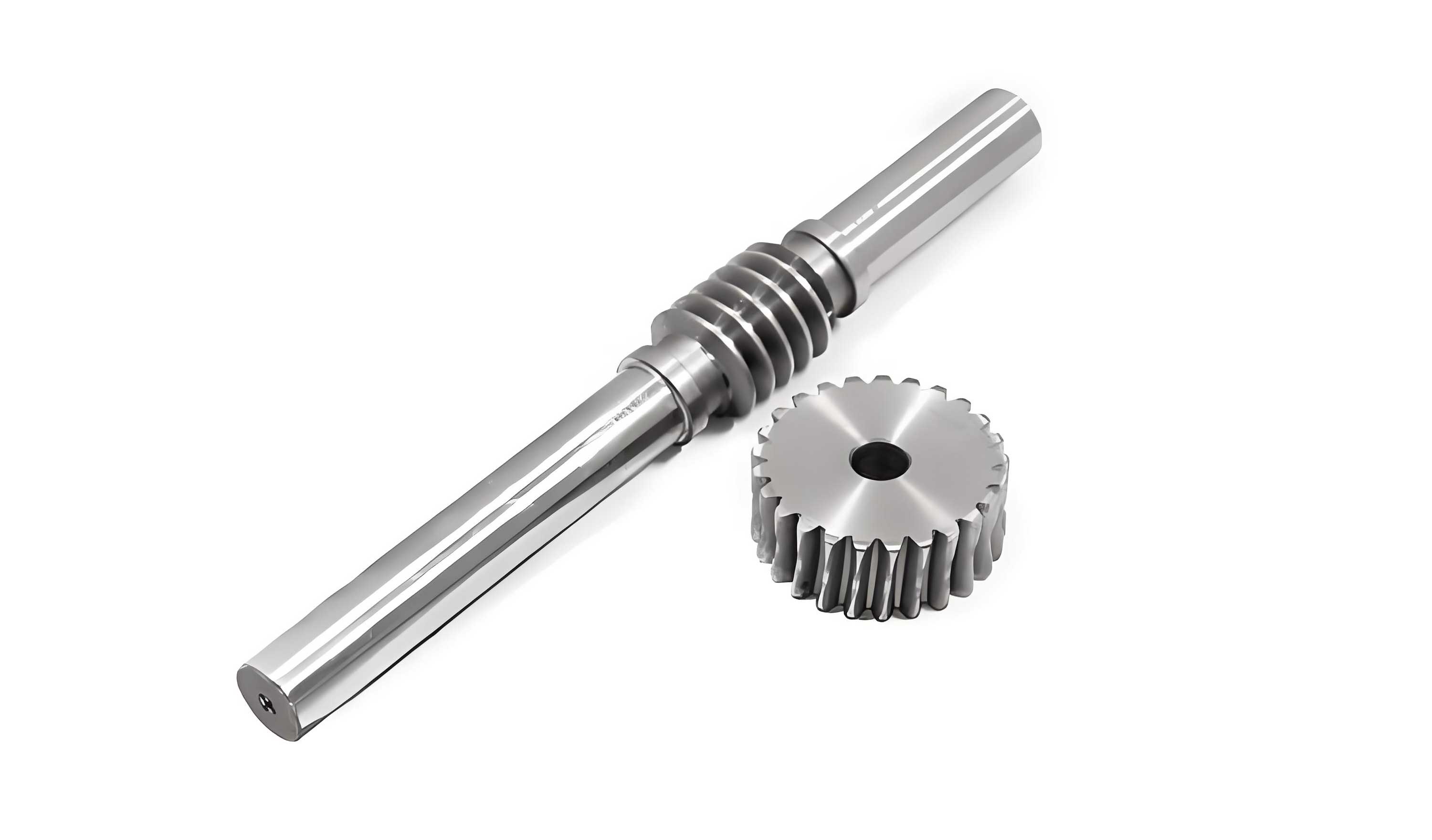
The centerpiece of the innovation is the lifting mechanism, which is fundamentally a worm gear actuator. This mechanism converts the high-speed, low-torque rotation of an electric motor into low-speed, high-torque linear motion with a high reduction ratio and self-locking capability. The assembly includes a vertical lead screw (also called a translating screw), a worm gear (the driven gear), a worm screw (the driving element), a compact housing, bearings, a drive motor, and a height limit device. The lead screw is directly engaged with the internal threads of the worm gear. As the worm gear rotates, it causes the lead screw to translate vertically without rotating itself, thanks to a keyway or spline constraint. The rotation of the worm gear is driven by the worm screw, which is mounted on the motor shaft via a key. The housing encloses the worm gear and worm assembly, providing support via bearings and end covers. A height limit switch or mechanical stopper is integrated to prevent over-travel.
The kinematics and mechanics of the worm gear drive are paramount. The velocity ratio (or reduction ratio) \( i \) is given by:
$$ i = \frac{\omega_{worm}}{\omega_{gear}} = \frac{N_{gear}}{N_{worm}} $$
where \( \omega_{worm} \) is the angular velocity of the worm screw (input), \( \omega_{gear} \) is the angular velocity of the worm gear (output), \( N_{gear} \) is the number of teeth on the worm gear, and \( N_{worm} \) is the number of starts (threads) on the worm screw. For a single-start worm, \( N_{worm} = 1 \), leading to a high reduction ratio equal to \( N_{gear} \). The linear velocity \( v \) of the lifting basket (attached to the lead screw) is related to the motor speed:
$$ v = p \cdot \omega_{gear} = p \cdot \frac{\omega_{motor}}{i} $$
where \( p \) is the pitch of the lead screw (linear travel per revolution of the worm gear), and \( \omega_{motor} = \omega_{worm} \) assuming a direct coupling. The torque relationship highlights the mechanical advantage. The output torque on the worm gear \( T_{gear} \) is:
$$ T_{gear} = T_{motor} \cdot i \cdot \eta $$
where \( T_{motor} \) is the input torque from the motor and \( \eta \) is the efficiency of the worm gear pair, typically between 0.5 and 0.9 for a single-start design depending on lubrication and materials. The thrust force \( F \) generated to lift the basket is:
$$ F = \frac{2 \pi \cdot \eta \cdot T_{gear}}{p} = \frac{2 \pi \cdot \eta \cdot (T_{motor} \cdot i)}{p} $$
This force must exceed the total weight of the basket, food, and any frictional losses. The self-locking condition, a vital safety feature, occurs when the lead angle \( \lambda \) of the worm is less than the arctangent of the coefficient of friction \( \mu \):
$$ \lambda < \tan^{-1}(\mu) $$
This ensures the load cannot back-drive the system, holding the basket securely in any position without power. A summary of typical design parameters for the worm gear lifting mechanism is provided in Table 2.
| Parameter | Symbol | Typical Value/Range | Remarks |
|---|---|---|---|
| Worm Gear Teeth | \( N_{gear} \) | 30 – 60 teeth | Determines reduction ratio |
| Worm Starts | \( N_{worm} \) | 1 (Single-start) | Ensures high reduction and self-locking |
| Reduction Ratio | \( i \) | 30:1 to 60:1 | \( i = N_{gear} / N_{worm} \) |
| Lead Screw Pitch | \( p \) | 3 – 6 mm/rev | Affects lifting speed and force |
| Gear Efficiency | \( \eta \) | ~0.7 | For bronze gear and steel worm, lubricated |
| Motor Power | \( P_{motor} \) | 15 – 25 W | DC geared motor suitable |
| Max Lifting Force | \( F_{max} \) | 50 – 100 N | Designed for typical food load |
| Lifting Speed | \( v \) | 1 – 3 mm/s | Calculated from \( v = p \cdot \omega_{motor} / i \) |
The control system orchestrates the entire cooking process with precision and simplicity. It consists of a programmable timer/controller unit and a tactile keypad interface. The user sets the desired cooking duration via the timer. Upon initiation, the controller activates the motor to lower the basket into the broth. The motor runs for a predetermined time calculated to achieve the full descent stroke. After the set cooking time elapses, the controller automatically reverses the motor polarity (or engages a relay in the opposite direction) to raise the basket, lifting the cooked food clear of the liquid. This process minimizes user interaction to a single button press. The control logic can be modeled using simple state equations. Let \( S(t) \) represent the system state (0: idle, 1: lowering, 2: cooking/heating, 3: raising). The transition is triggered by user input \( U \) (start signal) and timer variable \( \tau \). The timer counts down from the set value \( T_{set} \). The dynamics can be described as:
$$ \text{If } S(t) = 0 \text{ and } U = 1, \text{ then } S(t+\Delta t) = 1, \tau = T_{set} $$
$$ \text{If } S(t) = 1 \text{ and basket reaches lower limit, then } S(t+\Delta t) = 2 $$
$$ \text{If } S(t) = 2 \text{ and } \tau \leq 0, \text{ then } S(t+\Delta t) = 3 $$
$$ \text{If } S(t) = 3 \text{ and basket reaches upper limit, then } S(t+\Delta t) = 0 $$
This automated sequence ensures repeatable and accurate cooking results. The integration of the worm gear mechanism is crucial here, as its inherent stability and predictable motion profile allow the controller to accurately position the basket without the need for complex feedback sensors, though limit switches can be added for redundancy.
The technical workflow of the hot pot operation is sequential and user-friendly. First, the apparatus is installed: the pot assembly is fixed on the table, the lifting mechanism underneath, and the control panel within easy reach. The compartmentalized lifting basket is placed inside the pot, with its slots engaging the fixed flavor partitions. Food items are placed into the respective compartments on the basket. The user then selects the desired cooking time via the control panel and presses the start button. This action engages the motor, which drives the worm screw. The worm screw meshes with and rotates the worm gear. The rotating worm gear, through its internal threading, causes the vertical lead screw to descend, lowering the entire basket smoothly into the simmering broth. The descent continues until the basket reaches a predefined lower position, either mechanically determined or sensed. The heating element (typically integrated into the pot base) continues to cook the food. The controller monitors the timer. Upon expiration, it automatically commands the motor to reverse. The worm gear now rotates in the opposite direction, retracting the lead screw and raising the basket completely out of the broth, presenting the perfectly timed food for serving. The use of worm gears in this cycle ensures that the basket remains stable at any height during pauses and that the lifting action is slow and controlled, preventing spillage.
The advantages of this worm gear-based automatic lifting hot pot are multifaceted, spanning mechanical, safety, operational, and economic domains. Compared to conventional lifting methods, the benefits are substantial and are systematically compared in Table 3.
| Aspect | Hydraulic/Pneumatic Systems | Gear-Rack Systems | Proposed Worm Gear System |
|---|---|---|---|
| Mechanical Complexity | High (pumps, valves, seals, fluid reservoirs) | Moderate (gears, racks, guides) | Low (compact worm gear set, few moving parts) |
| Inherent Safety | Low (risk of fluid leaks, pressure loss) | Moderate (can back-drive if not braked) | High (self-locking property of worm gears prevents accidental drop) |
| Noise & Vibration | Moderate (pump noise, fluid flow) | High (gear meshing impact, potential chatter) | Low (continuous, sliding contact in worm gears dampens noise) |
| Transmission Precision & Backlash | Good (but can drift with temperature/leaks) | Low (significant backlash typical) | High (worm gears offer minimal backlash and smooth motion) |
| Maintenance Cost & Needs | High (fluid changes, seal replacement, pressure checks) | Moderate (lubrication, wear on teeth) | Low (sealed, lubricated-for-life worm gear units possible) |
| Operational Simplicity | Requires manual valve control or complex electronics | Often manual or requires additional braking | High (fully automated via single-button electronic control) |
| Cost of Manufacturing | High | Moderate | Low to Moderate (standardized worm gear components widely available) |
| Lifting Speed Control | Adjustable but complex | Fixed by motor/gear ratio | Easily Controllable (speed determined by motor PWM and fixed worm gear ratio) |
Specifically, the merits of employing worm gears are profound. Firstly, the worm gear transmission provides a compact and high-ratio speed reduction in a single stage, allowing the use of a small, standard electric motor. The self-locking characteristic, derived from the geometry of the worm gears, is a paramount safety benefit; it ensures the food basket remains stationary even if power is lost, eliminating the risk of sudden drops. Secondly, the meshing action between the worm and the worm gear is a sliding contact, which operates more quietly than the impacting teeth of spur gears, contributing to a pleasant dining ambiance. Thirdly, the precision afforded by worm gears results in minimal backlash, allowing for accurate and repeatable positioning of the basket. This precision complements the electronic control system, which uses a simple timer to achieve exact cooking durations. The automation enabled by this synergy means the user interacts only once with the device, drastically reducing the opportunity for accidental contact with hot surfaces or splashing broth. From an economic perspective, worm gear assemblies are mature, mass-produced components, making them cost-effective and reliable. Their long service life and low maintenance requirements further enhance the value proposition of the overall appliance.
To further illustrate the design robustness, let’s consider a sample calculation for the worm gear system. Assume we select a worm gear with \( N_{gear} = 40 \) teeth driven by a single-start worm (\( N_{worm}=1 \)). The reduction ratio is \( i = 40 \). A small DC geared motor with a no-load speed of 100 RPM and an output torque of 0.05 Nm is chosen. The lead screw has a pitch \( p = 4 \) mm/rev. The worm gear efficiency is estimated at \( \eta = 0.7 \). The output speed of the worm gear (and thus the lead screw’s rotational speed) is:
$$ \omega_{gear} = \frac{\omega_{motor}}{i} = \frac{100 \, \text{RPM}}{40} = 2.5 \, \text{RPM} = 0.2618 \, \text{rad/s} $$
The linear lifting/lowering speed is:
$$ v = p \cdot \omega_{gear} = (0.004 \, \text{m/rev}) \times (2.5 \, \text{rev/min} / 60 \, \text{s/min}) \approx 1.67 \times 10^{-4} \, \text{m/s} = 0.167 \, \text{mm/s} $$
This is a slow, controlled speed. The output torque on the worm gear is:
$$ T_{gear} = T_{motor} \cdot i \cdot \eta = (0.05 \, \text{Nm}) \times 40 \times 0.7 = 1.4 \, \text{Nm} $$
The theoretical maximum thrust force is:
$$ F = \frac{2 \pi \cdot T_{gear}}{p} = \frac{2 \pi \times 1.4 \, \text{Nm}}{0.004 \, \text{m}} \approx 2200 \, \text{N} $$
This is far greater than the required force (likely under 100 N for a loaded basket), indicating a substantial safety factor and the ability to overcome static friction easily. The actual lifting force accounting for efficiency in converting rotary to linear motion is slightly lower but still ample. These calculations underscore how a modest motor coupled with a worm gear can generate significant lifting force at a safe, controlled speed.
The application of worm gears extends beyond mere force transmission; it influences the thermal and material design considerations. The housing for the worm gear assembly must be designed to prevent heat ingress from the hot pot above, which could affect lubrication viscosity and material dimensions. Thermal insulation or a simple air gap can mitigate this. Material selection for the worm gear pair typically involves a hardened steel worm and a bronze worm gear. Bronze offers excellent wear resistance against steel and good conformability, which is ideal for the sliding contact in worm gears. This material combination also has a relatively low coefficient of friction, which aids efficiency. For the lead screw, a stainless steel with a bronze or polymer nut (within the worm gear) can be used to minimize friction and corrosion from the cooking environment. The durability of worm gears under intermittent, low-speed service—typical for a hot pot—is exceptionally high, promising years of reliable operation.
In conclusion, the design of this automatic lifting hot pot represents a significant advancement in culinary appliance technology by effectively merging robust mechanical engineering with user-centric electronic control. The pivotal component, the worm gear drive, is the linchpin that enables a safe, quiet, precise, and economical lifting solution. Its inherent self-locking property directly addresses critical safety concerns prevalent in fluid-based systems. The simplicity of the worm gear mechanism reduces part count, assembly complexity, and long-term maintenance needs. When integrated with a programmable timer controller, the system delivers a fully automated cooking experience that ensures consistent food quality while keeping the user at a safe distance from potential hazards. Compared to existing market alternatives, this worm gear-based design offers superior operational and economic benefits. It stands as a testament to how classical mechanical elements like worm gears can be innovatively applied to solve modern-day design challenges, creating products that are not only functional but also enhance safety and convenience in everyday life. The potential for scalability and adaptation of this worm gear lifting principle to other food service or industrial applications where controlled vertical motion is required is also considerable, further amplifying the impact of this design philosophy.