
As a power transmission component with an exceptionally wide range of applications, gears are subjected to complex and demanding stress states during operation. These stresses primarily include cyclic bending stress at the root of the teeth and significant Hertzian contact stress on the tooth flanks. Furthermore, the meshing action introduces sliding friction and absorbs a degree of impact loading. Common failure modes arising from these conditions encompass excessive wear, pitting (fatigue spalling), and catastrophic tooth breakage. The judicious selection of gear materials, coupled with precise heat treatment, is therefore paramount to enhancing surface hardness, wear resistance, bending fatigue strength, and contact fatigue strength, while ensuring the core retains sufficient toughness and strength to withstand shock loads.
The choice of material—be it forged steel, cast steel, cast iron, non-ferrous metals, or polymers—directly dictates the feasible heat treatment routes and the final mechanical properties. Common heat treatment processes for gears include normalizing, annealing, quenching and tempering, surface hardening (induction or flame hardening), and various thermochemical treatments like carburizing, carbonitriding, and nitriding. Each process aims to optimize the microstructure for specific performance requirements but inherently carries the risk of introducing heat treatment defects if not meticulously controlled. This article provides a comprehensive analysis of gear material systems, their associated thermal processing routes, and the critical relationship between process parameters and the mitigation of detrimental heat treatment defects.
1. Gear Materials and Corresponding Heat Treatment Routes
1.1 Forged Steels: The Predominant Choice
Forged steels constitute the majority of high-performance gear materials due to their superior homogeneity, strength, and toughness compared to cast counterparts. They are broadly categorized based on surface hardness: soft-face (≤ 350 HB) and hard-face (> 350 HB).
1.1.1 Soft-Face Gears
These gears undergo heat treatment prior to the final cutting operation. The standard process chain is: Forging → Normalizing → Rough Machining → Quenching and Tempering (QT) → Finish Machining. The tempering temperature is relatively high, resulting in a tempered sorbitic or troostitic structure with good machinability and a uniform hardness typically between 250-350 HB.
Common Materials: Medium carbon steels like AISI 1045, and low-alloy steels like 35SiMn, 4140 (40Cr), 4340 (40CrNi), 40MnB.
Advantages: Excellent core toughness, good overall strength, relatively simple and economical manufacturing with achievable AGMA/ISO quality level of 8. Suitable for medium-duty, stable load applications.
Key Considerations: The final hardness is limited, restricting load capacity. Care must be taken during quenching to avoid distortion, a common heat treatment defect in softer, machined components.
1.1.2 Hard-Face Gears
Hard-face gears are finish-machined in a soft state and subsequently surface hardened. Two primary material and process routes exist:
Route A: Through-Hardening or Surface Hardening of Medium Carbon Steels
Process Chain: Forging → Normalizing → Rough Machining → Quenching and Tempering → Finish Machining → Surface Hardening (Induction/Flame) → Low-Temperature Tempering → Grinding/Honing.
Common Materials: AISI 1045, 4140 (40Cr).
Characteristics: Achieves a hard case (HRC 48-55) for high wear and contact fatigue resistance, combined with a tough, ductile core (typically HRC 30-40). This yields a high load capacity. However, distortion is a significant concern, and precision grinding is often required post-heat treatment to correct geometric inaccuracies—a direct consequence of managing heat treatment defects like warpage.
Route B: Case Hardening of Low Carbon (Carburizing) Steels
Process Chain: Forging → Normalizing → Rough Machining → Carburizing → Direct Quenching or Reheat Quenching → Cryogenic Treatment (optional) → Low-Temperature Tempering → Precision Grinding.
Common Materials: Low-carbon alloy steels like 20CrMo, 20MnCr5, SAE 8620, and notably 20CrMnTi (a Chinese grade with excellent hardenability and fine grain structure).
Characteristics: This process produces the most demanding gear microstructure: a high-carbon martensitic case with exceptional hardness (HRC 58-63) and a low-carbon, tough martensitic or bainitic core. It is the benchmark for high-speed, heavy-load, and shock-loaded applications (e.g., automotive transmissions, aerospace). The long, high-temperature carburizing cycle, however, exacerbates risks like grain growth, excessive intergranular oxidation, and distortion, making the control of heat treatment defects critically important.
| Material Category | Typical Grades | Core Process | Surface Hardness | Core Hardness/Toughness | Typical Applications & Notes |
|---|---|---|---|---|---|
| Soft-Face Forged Steel | 1045, 4140 | Quench & Temper (bulk) | 250-350 HB | Good toughness | Medium duty, general industrial gears. |
| Hard-Face (Through-Hardened) | 1045, 4140 | QT + Surface Harden | 48-55 HRC | 30-40 HRC, Good toughness | Automotive, machine tool gears. Distortion control key. |
| Hard-Face (Case Carburized) | 8620, 20CrMnTi | Carburize & Quench | 58-63 HRC | 35-45 HRC, High toughness | Heavy-duty, high-contact stress, shock-loaded gears (e.g., drivetrain). |
1.2 Cast Irons
Cast irons, particularly gray iron (e.g., ASTM Class 30, 35, 40) and ductile (nodular) iron (e.g., Grade 60-40-18, 80-55-06), offer advantages in manufacturing complex shapes economically. The graphite flakes in gray iron provide inherent lubricity and damping capacity but reduce strength and impact resistance. Ductile iron, with its spheroidal graphite, offers much better strength and ductility, bridging the gap between gray iron and steel.
Heat Treatment: Cast gears are often stress-relief annealed or normalized after casting to eliminate foundry stresses and improve machinability. For increased wear resistance, surface hardening (flame or induction) is applied. A critical heat treatment defect specific to cast irons is the risk of cracking during rapid quenching due to the notch effect of graphite and internal stresses; therefore, processes must be carefully designed, often using austempering for ductile iron to achieve high strength with good ductility.
1.3 Cast Steels
Used for very large gears where forging is impractical. Common grades include ASTM A27 Grade 70-36 (ZG270-500) and Grade 55-30 (ZG310-570). The as-cast structure is coarse and segregated, necessitating a homogenizing normalizing or annealing treatment. Subsequently, they can be quenched and tempered or surface hardened. The key challenge is achieving uniform properties throughout the large section, avoiding soft spots—a type of heat treatment defect caused by inadequate quenching intensity or section size effects.
1.4 Non-Ferrous Metals
Bronzes (tin, aluminum, silicon) are predominantly used for worm wheels due to their excellent anti-galling properties against hardened steel worms. They also find use in corrosive environments or where non-magnetic properties are needed. Heat treatments are generally limited to stress relieving. Aluminum alloys (e.g., 7075, 2024) are used in aerospace for weight-critical applications, typically in the solution-treated and artificially aged (T6) condition.
1.5 Non-Metallic Materials
Materials like polyamide (nylon), acetal, and laminated phenolics are used for very high-speed, light-load, and low-noise applications (e.g., printers, consumer appliances). They require no traditional heat treatment but are sensitive to temperature-related dimensional changes and creep.
2. The Critical Link: Heat Treatment Processes and Associated Defects
Heat treatment is a transformative step that defines gear performance. However, deviations from optimal parameters invariably lead to heat treatment defects that compromise integrity. The figure below illustrates a classic example of such a defect.
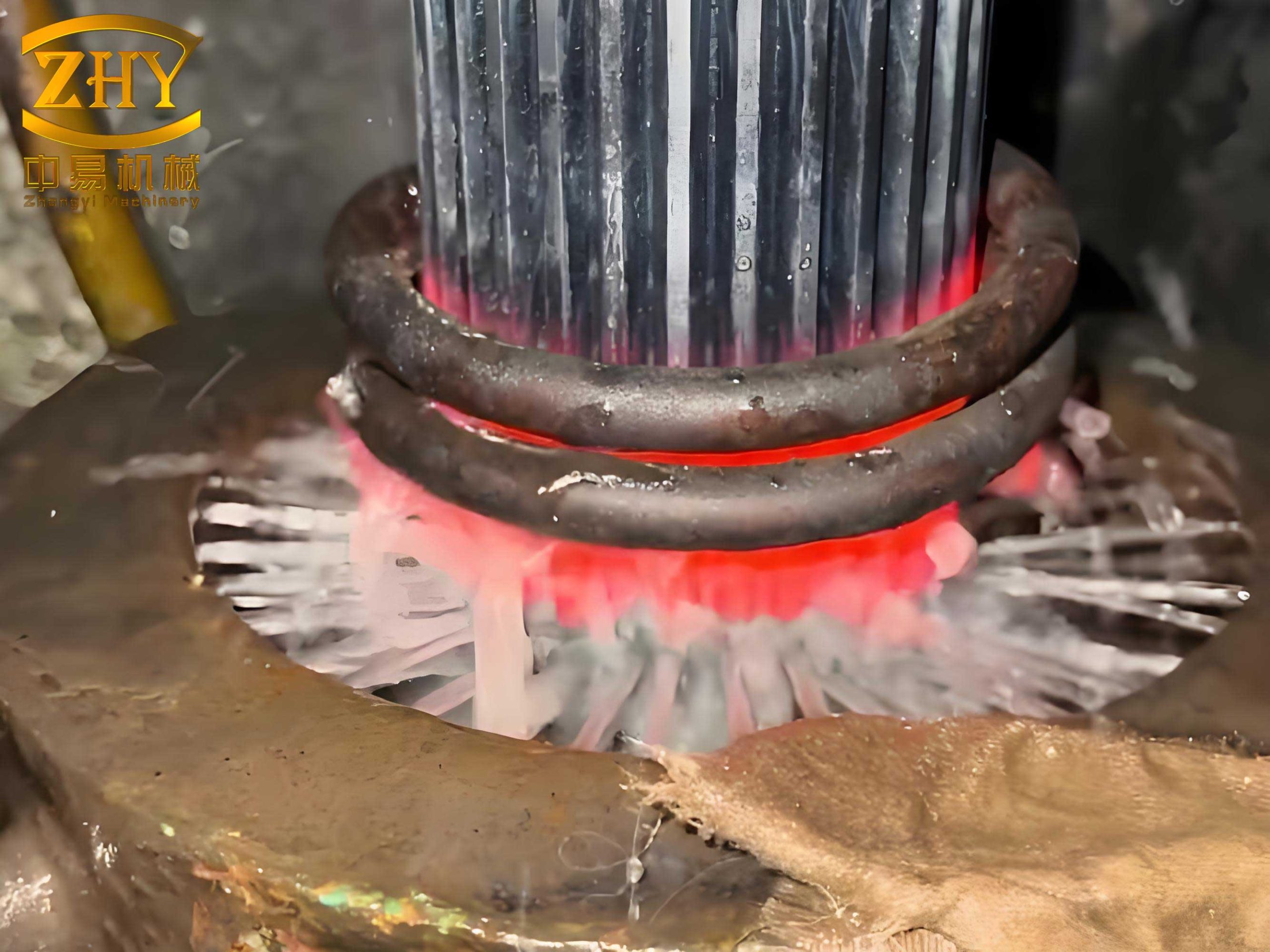
Let’s analyze major processes and their potential pitfalls.
2.1 Quenching & Tempering (Q&T)
The objective is to form martensite (via quenching) and then relieve stresses/improve toughness (via tempering). Key defect risks include:
Quench Cracking: Caused by excessive thermal and transformational stresses during rapid cooling. Factors include inappropriate quenchant (too severe), part geometry (sharp corners), high carbon content, and non-uniform cooling. The stress intensity factor ($K_I$) must be kept below the material’s fracture toughness ($K_{IC}$):
$$ K_I = Y \sigma \sqrt{\pi a} < K_{IC} $$
where $Y$ is a geometric factor, $\sigma$ is stress, and $a$ is flaw size.
Distortion and Warpage: Non-uniform cooling or heating, residual stresses from prior machining, and non-symmetrical part design lead to shape changes. This is a pervasive heat treatment defect requiring subsequent corrective machining.
Insufficient Hardness (Soft Spots): Results from inadequate quenchant agitation, vapor blanket formation, or low hardenability of the steel. The depth of hardening ($D_h$) can be estimated using ideal critical diameter ($D_I$) concepts.
2.2 Carburizing and Case Hardening
This involves diffusing carbon into the surface at high temperatures (900-950°C) followed by quenching.
Excessive Intergranular Oxidation (IGO): At high temperatures, oxygen from the furnace atmosphere penetrates grain boundaries, forming oxides of alloying elements (Cr, Mn, Si). This depletes the matrix of these elements, reducing hardenability and creating potential initiation sites for fatigue cracks—a severe heat treatment defect. Depth of IGO ($d_{IGO}$) is a critical quality metric.
Abnormal Case Microstructure: Excessive carbon content can lead to retained austenite (reducing hardness) or brittle carbide networks at the surface. The carbon concentration profile $C(x,t)$ is governed by Fick’s second law:
$$ \frac{\partial C}{\partial t} = D \frac{\partial^2 C}{\partial x^2} $$
where $D$ is the diffusion coefficient, highly temperature-dependent via an Arrhenius relationship: $D = D_0 \exp(-Q/RT)$.
Distortion: More severe than in Q&T due to higher process temperatures, steep carbon gradients, and complex phase transformations. Finite Element Analysis (FEA) is often used to model and predict this heat treatment defect.
2.3 Induction Hardening
A localized, rapid heating and quenching process.
Insufficient or Excessive Case Depth: Incorrect power, frequency, or scan speed. The standard depth of penetration (δ) of the eddy current is inversely proportional to the square root of frequency (f):
$$ \delta = \sqrt{\frac{\rho}{\pi \mu f}} $$
where $\rho$ is resistivity and $\mu$ is permeability. This guides frequency selection for a desired case depth.
Overheating/Burning: Excessive power density can cause localized melting or austenite grain coarsening, leading to quench cracking or poor toughness.
Tempering Issues: The “soft” heat-affected zone (HAZ) between the hardened case and core must be managed to avoid a sharp hardness drop, a heat treatment defect that can act as a stress concentrator.
2.4 Nitriding
A low-temperature (500-570°C) process diffusing nitrogen to form hard compounds. Defects are different:
Brittle White Layer: Formation of excessively thick, brittle iron nitrides (Fe2-3N) at the surface, prone to spalling. Control via gas composition and time is critical.
Distortion: Lower than carburizing but can occur due to relief of prior machining stresses or non-uniform case growth.
Reduced Core Properties: Prolonged exposure to nitriding temperatures can over-temper the core of medium-carbon steels, reducing its yield strength.
| Heat Treatment Process | Primary Goal | Key Process Parameters | Potential Defects | Mitigation Strategies |
|---|---|---|---|---|
| Quench & Temper | High Strength/Toughness Core | Austenitizing T, Quenchant, Tempering T | Cracking, Distortion, Soft Spots | Proper quenchant selection, pre-heating, stress-relief anneal before hardening, controlled agitation. |
| Carburizing | Hard Case, Tough Core | Temperature, Time, Carbon Potential | IGO, Retained Austenite, Carbide Networks, Distortion | Use low-oxygen potential atmospheres (vacuum, plasma), post-carburizing thermal cycles (reheating), slow cooling before quenching, FEA-based distortion compensation. |
| Induction Hardening | Localized Hard Case | Frequency, Power, Scan Speed | Overheating, Shallow/Deep Case, Soft Zones | Precise control of scanning parameters, proper coil design, pre-and post-heat tempering. |
| Nitriding | Hard, Wear-Resistant Case with Low Distortion | Temperature, Time, N Potential | Brittle White Layer, Porosity | Control of nitriding potential (Kn), two-stage processes, mechanical removal (honing) of white layer. |
3. Material Selection Principles and Failure Mode Avoidance
The guiding principle is to match the material and its heat treatment to the dominant failure mode and operating conditions, while proactively designing to minimize heat treatment defects.
- For High Impact/Shock Loading: Select materials with high core toughness. Low-carbon alloy steels for carburizing are ideal, as they provide a hard case over a very ductile, low-carbon martensitic core. The primary heat treatment defect to avoid here is inadequate core toughness, which can arise from improper tempering.
- For High-Speed, High-Contact Stress (Resistance to Pitting): Select materials capable of achieving very high surface hardness. Case-hardened steels (carburized or nitrided) are preferred. The focus is on achieving a defect-free, high-integrity case. Subsurface origin pitting often initiates at inclusions or zones of heat treatment defects like non-martensitic transformation products (bainite, pearlite) due to inadequate hardenability.
- For Low/Medium Speed with Wear, Pitting, and Bending Fatigue Risks: Select materials with good overall mechanical properties. Through-hardened medium-carbon steels (e.g., 4140) or high-quality ductile irons are suitable. The main heat treatment defect to control is distortion, ensuring proper tooth geometry post-heat treatment.
- For Large Size and Complex Geometry: Cast steels or ductile irons are logical choices. The major challenge is achieving uniformity in properties. Normalizing is critical to homogenize the as-cast structure and prevent localized soft or hard areas—a common heat treatment defect in castings.
- General Rules: Standardize materials to simplify supply chains and process knowledge. Consider machinability and hardenability. For high-precision, high-stress gears, alloy steels are almost always necessary.
4. Quantitative Analysis of Heat Treatment Effects
The performance of a heat-treated gear can be modeled quantitatively. For instance, the bending fatigue strength ($\sigma_{f}$) is strongly influenced by surface hardness ($H$) and residual stress ($\sigma_{res}$). A simplified model might be:
$$ \sigma_{f} = A \cdot H^{n} + B \cdot \sigma_{res} $$
where $A$, $B$, and $n$ are material constants. Compressive residual stress ($\sigma_{res} < 0$) significantly enhances fatigue life. Conversely, tensile residual stress, a dangerous heat treatment defect often from improper quenching or grinding, drastically reduces it.
The contact fatigue (pitting) life is related to the shear stress amplitude below the surface. A hardened case of sufficient depth ($E_{case}$) must be present to support the subsurface shear stress ($\tau_{max}$) induced by contact loading. An insufficient case depth is a critical design and processing heat treatment defect:
$$ E_{case} > k \cdot b $$
where $b$ is the half-width of the contact patch and $k$ is a safety factor (often > 3). The core hardness must also be sufficient to prevent “case crushing.”
The risk of quench cracking is associated with the thermal stress ($\sigma_{th}$) and transformational stress ($\sigma_{tr}$). The total stress must not exceed the fracture strength ($\sigma_{fr}$) at temperature:
$$ \sigma_{total} = \sigma_{th} + \sigma_{tr} = \alpha E \Delta T + \Delta V \cdot \frac{E}{3(1-\nu)} < \sigma_{fr}(T) $$
where $\alpha$ is thermal expansion, $E$ is Young’s modulus, $\Delta T$ is thermal gradient, $\Delta V$ is volumetric change from transformation, and $\nu$ is Poisson’s ratio. This equation highlights why slow heating, preheating, and less severe quenchants mitigate this catastrophic heat treatment defect.
5. Integrated Selection Guide and Process Control
A holistic approach is required. The following matrix summarizes the decision logic, incorporating defect risk assessment.
| Operating Condition / Failure Mode Concern | Recommended Material Class | Primary Heat Treatment | Target Surface Hardness | High-Risk Heat Treatment Defects to Actively Manage |
|---|---|---|---|---|
| Heavy Shock Loads, High Impact | Low-Carbon Alloy Steel (e.g., 20CrMnTi, 8620) | Carburize & Quench | 58-63 HRC | Distortion, Intergranular Oxidation, Retained Austenite |
| High-Speed, High Contact Stress (Pitting) | Low-Carbon Alloy Steel or Nitriding Steel (e.g., 34CrAlNi7) | Carburizing or Nitriding | 58-63 HRC (Carb) 65-72 HRC (Nit) | Case Depth Uniformity, White Layer (Nitriding), Spalling |
| Medium Speed/ Load, General Purpose | Medium-Carbon Steel (e.g., 4140) | Through-Harden & Temper or Induction Harden | 45-55 HRC | Distortion, Quench Cracking, Soft Spots |
| Large Size, Complex Shape, Medium Duty | Ductile Iron (e.g., 80-55-06) or Cast Steel | Normalize + (Surface Harden if needed) | 250-350 HB (Bulk) 50-55 HRC (Case) | Property Uniformity, Cracking during hardening of castings |
| Corrosion, Non-Magnetic, Worm Wheels | Bronze (e.g., CuSn12, CuAl10Fe3) | Stress Relieve (Cast) | 80-200 HB | Porosity (casting defect), Stress Corrosion Cracking |
Process control is the final barrier against heat treatment defects. This involves:
Atmosphere Control: Precise monitoring of carbon potential in carburizing or nitriding potential in nitriding using oxygen probes or hydrogen analyzers.
Temperature Uniformity: Ensuring furnace hot zones are within tight tolerances (±5°C for nitriding, ±10°C for carburizing).
Quenchant Management: Regular monitoring of quenchant temperature, agitation, and cooling curve performance to ensure consistent and repeatable heat extraction.
Post-Process Validation: Using techniques like microhardness traverses, microstructure analysis, X-ray diffraction for residual stress/retained austenite, and non-destructive testing (e.g., magnetic particle inspection for cracks) to verify the absence of critical heat treatment defects.
6. Conclusion
The journey from a gear blank to a high-performance power transmission component is defined by the synergistic choice of material and heat treatment. While processes like carburizing, induction hardening, and nitriding offer pathways to exceptional surface properties and core toughness, they each introduce specific risks of heat treatment defects. These defects—ranging from distortion and cracking to microstructural anomalies like intergranular oxidation or retained austenite—can severely degrade fatigue life, wear resistance, and operational reliability. Successful gear manufacturing, therefore, rests not only on selecting the optimal material class (forged steel, cast iron, etc.) for the application but also on a deep understanding of the associated thermal processing windows. This knowledge must be coupled with rigorous process design and control to mitigate defect formation. Ultimately, the theoretical principles governing diffusion, phase transformation, stress development, and hardenability must be diligently applied in practice to consistently produce gears that meet their demanding service requirements, ensuring high load capacity and extended operational life.