
The development of high-ratio hyperboloid gear drives represents a significant advancement in power transmission technology, offering superior performance in applications demanding high reduction ratios within compact spaces. Traditional solutions like worm gears or planetary gear sets often face limitations in terms of efficiency, load capacity, or spatial requirements. Hyperboloid gear drives, with their crossed axes and offset configuration, provide a compelling alternative, characterized by smooth operation, high torque density, and excellent durability. The design of such gears, particularly with very high ratios where the pinion tooth count can be as low as one, requires a specialized approach distinct from standard hypoid or spiral bevel gear design. This article delves into the core methodology for designing Gleason-type hyperboloid gears with a parallel tooth depth system, focusing on the determination of fundamental pitch cone geometry, the establishment of critical geometric constraints, and the computation of all necessary gear parameters for manufacturing.
The fundamental kinematic structure of a hyperboloid gear pair is defined by its crossed axes. The pitch surfaces are two hyperboloids of revolution, which can be approximated by pitch cones for design and manufacturing purposes. At the heart of defining the gear pair’s spatial relationship are the pitch cones. Establishing their precise geometry is the first critical step in hyperboloid gear design.
Consider two non-intersecting, non-parallel axes representing the pinion and gear rotations. A unique point P, the pitch point, is chosen where the two conceptual pitch cones are tangent. The line through P perpendicular to the pinion axis defines the pinion pitch radius, \(r_1\). Similarly, the line through P perpendicular to the gear axis defines the gear pitch radius, \(r_2\). The distance between the two axes is the offset, \(E\). The angle between the axes is the shaft angle, \(\Sigma\), often 90 degrees. From these, key angles are derived: the pinion pitch cone angle \(\delta_1\), the gear pitch cone angle \(\delta_2\), and the spiral angles \(\beta_1\) and \(\beta_2\) at the pitch point. The spatial relationship also defines the pitch cone distances \(R_1\) and \(R_2\), and the offset angle \(\varepsilon’\). The complete set of interrelated parameters forms the foundation for all subsequent calculations. A thorough understanding of this 3D geometry, often involving coordinate transformations between the pinion and gear axis systems, is essential. The governing equations relating these parameters are typically solved iteratively, as direct closed-form solutions are complex due to the non-linear relationships introduced by the offset.
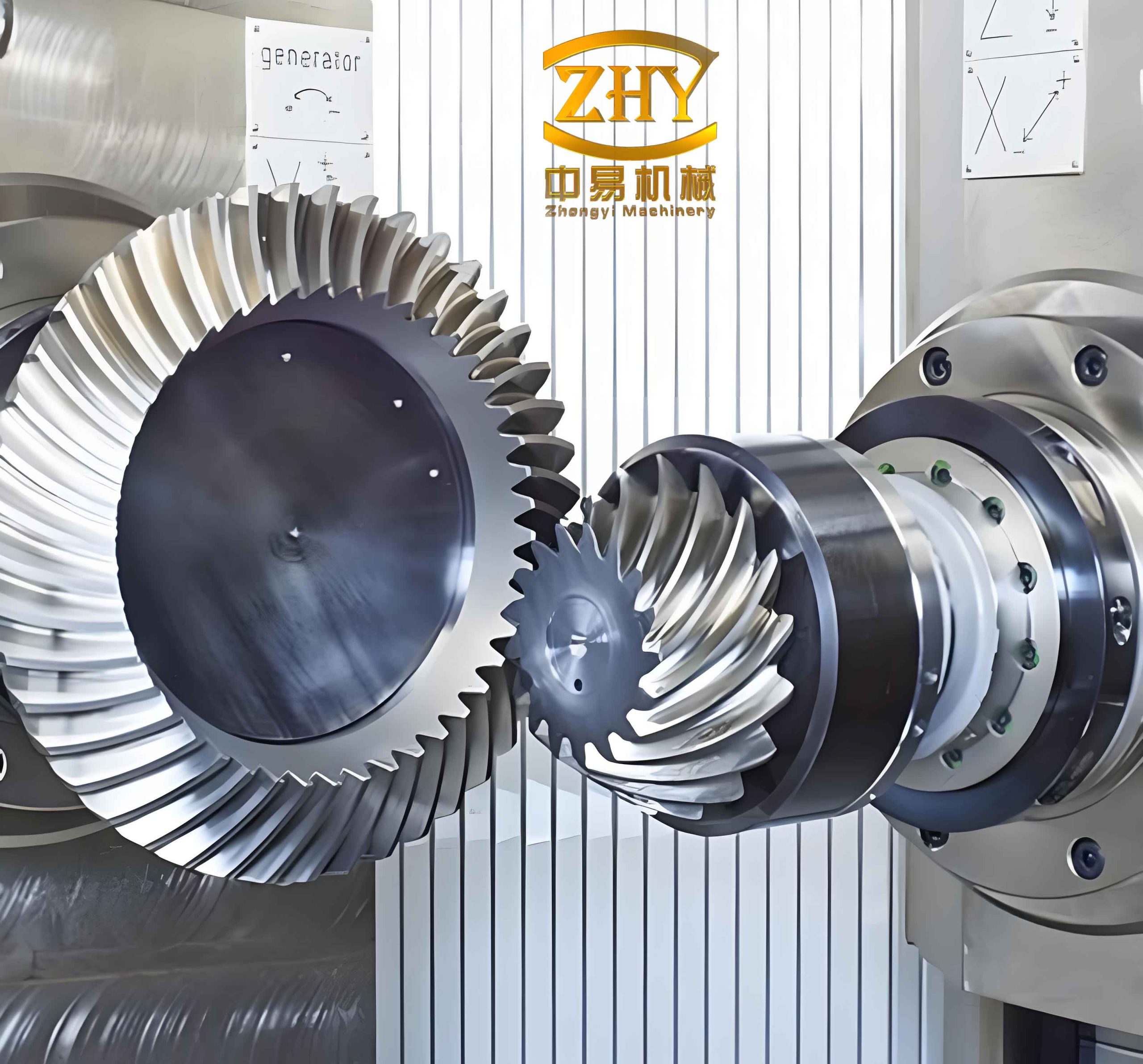
The design of a functional and robust hyperboloid gear pair extends far beyond defining the pitch cones. A set of stringent geometric constraints must be applied to ensure proper meshing, avoid interference, achieve acceptable contact patterns, and provide sufficient strength. These constraints guide the selection of key parameters during the iterative design process for the hyperboloid gear.
Offset Ratio: The offset \(E\) significantly influences the sliding action and the overall size of the hyperboloid gear set. It is commonly expressed as a ratio relative to the gear outer diameter \(d_{e2}\). An excessively small offset reduces the benefits of the hyperboloid design, while an excessively large one can lead to high sliding velocities and potential lubrication challenges. A typical practical range is:
$$0.2 \le \frac{E}{d_{e2}} \le 0.33$$
Spiral Angle and Contact Ratio: The spiral angle, particularly at the mean point \(\beta_{m2}\), is crucial for smooth operation. A larger spiral angle increases the overlap ratio (contact ratio), promoting quieter meshing. However, it also increases axial thrust loads on the bearings. The total contact ratio \(\varepsilon_{\gamma}\) must be greater than 1.0 for continuous action and is preferably higher for high-quality drives. It can be estimated via the virtual gear pair at the mean point. The normal module \(m_n\) is:
$$m_n = \frac{2 r_{m2} \cos \beta_{m2}}{z_2}$$
The face contact ratio (overlap) \(\varepsilon_{\beta}\) and the transverse contact ratio \(\varepsilon_{\alpha}\) contribute to the total:
$$\varepsilon_{\beta} = \frac{b_2 \sin \beta_{m2}}{\pi m_n}$$
$$\varepsilon_{\alpha} = \frac{g_{van} \cos^2 \beta_{vb}}{ \pi m_n \cos \alpha_n}$$
where \(g_{van}\) is the length of action for the virtual gears and \(\beta_{vb}\) is the base helix angle. The total contact ratio is then:
$$\varepsilon_{\gamma} = \sqrt{\varepsilon_{\alpha}^2 + \varepsilon_{\beta}^2}$$
For high-ratio hyperboloid gears, ensuring \(\varepsilon_{\gamma} > 1.2\) is often a target, while keeping \(\beta_{m2}\) typically below 40° to manage thrust loads.
Addendum Coefficient and Undercutting: In high-ratio hyperboloid gear sets, the pinion has very few teeth and is highly vulnerable to undercutting at its inner end. Undercutting severely weakens the tooth root. To prevent this, the gear addendum is often minimized. A common and effective practice is to set the gear addendum coefficient \(f_{a2} = 0\), meaning the gear addendum \(h_{a2} = 0\). This increases the pinion addendum correspondingly, moving its critical root section away from the interfering region and ensuring a full involute profile is generated.
Face Width and Tooth Taper: The face width \(b_2\) cannot be chosen arbitrarily. For a parallel depth tooth system, the tool radius \(r_c\) is ideally selected to produce zero gear root angle and avoid abnormal tooth taper. This condition is approximately given by:
$$r_c \approx R_2 \sin \beta_2$$
where \(R_2\) is the gear pitch cone distance. Using a tool with this radius helps maintain a nearly constant normal chordal thickness from the inner to the outer end of the tooth. The face width itself is limited by the resulting change in normal tooth top land width \(S_{n2x}\). This width at any point along the face can be calculated. A practical constraint is to ensure the top land width at the inner end is not less than half of that at the outer end. Violating this can lead to pointed teeth or weak edges. Mathematical modeling of \(S_{n2x}\) as a function of cone distance \(R_{x2}\) and spiral angle \(\beta_{x2}\) allows determining the maximum usable face width \(b_{2_{max}}\) for a given tool and blank geometry.
The complete design process for a high-ratio hyperboloid gear is an iterative optimization that satisfies all constraints. It begins with fixed inputs: shaft angle \(\Sigma\), pinion tooth count \(z_1\) (which can be 1), gear tooth count \(z_2\), desired offset \(E\), gear outer diameter \(d_{e2}\), and hand of spiral.
Initial Estimation: An initial guess for the gear pitch angle \(\delta_{2}^{init}\) is made, often based on experience or empirical relations for the given ratio \(\mu = z_2/z_1\). The mean gear pitch radius is estimated from the outer diameter and an assumed face width. The initial offset angle \(\varepsilon^{0}\) is found from the geometry:
$$\sin \varepsilon^{0} = \frac{E \sin \delta_{2}^{init}}{r_2}$$
A diameter factor \(K\) is introduced to account for the enlarged pinion diameter characteristic of hyperboloid gears compared to bevel gears. Its initial value relates to the desired pinion spiral angle \(\beta_{1}^{des}\):
$$K^{0} = \tan \beta_{1}^{des} \sin \varepsilon^{0} + \cos \varepsilon^{0}$$
The initial pinion mean radius \(r_{m1}^{0}\) and the angle \(\eta\) between the pinion axis and the common perpendicular plane are then calculated.
Iterative Solution: Using these initial values, approximations for the final angles \(\varepsilon\), \(\varepsilon’\), \(\delta_1\), and \(\delta_2\) are computed. The calculated pinion spiral angle \(\beta_{1}^{calc}\) is compared to the desired \(\beta_{1}^{des}\). The difference drives a correction to the diameter factor \(K\) and the pinion radius:
$$\Delta K = \sin \varepsilon’ (\tan \beta_{1}^{des} – \tan \beta_{1}^{calc})$$
$$\Delta r_{m1} = \frac{\Delta K \cdot r_2 \cdot z_1}{z_2}$$
The parameters are updated (\(K = K^{0} + \Delta K\), \(r_{m1} = r_{m1}^{0} + \Delta r_{m1}\)) and the geometric quantities are recalculated precisely:
$$\sin \varepsilon = \sin \varepsilon^{0} – \frac{\Delta r_{m1}}{r_2} \sin \eta$$
$$\tan \delta_1 = \frac{\sin \eta}{\tan \varepsilon \sin \Sigma} + \frac{\cos \eta}{\tan \Sigma}$$
$$\sin \varepsilon’ = \frac{\sin \varepsilon \sin \Sigma}{\cos \delta_1}$$
$$\tan \beta_{m1} = \frac{K – \cos \varepsilon’}{\sin \varepsilon’}$$
$$\beta_{m2} = \beta_{m1} – \varepsilon’$$
$$\tan \delta_2 = \frac{\sin \varepsilon}{\tan \eta \sin \Sigma} + \frac{\cos \varepsilon}{\tan \Sigma}$$
$$R_1 = \frac{r_{m1}}{\sin \delta_1}, \quad R_2 = \frac{r_2}{\sin \delta_2}$$
The resulting offset \(E’ = \sin \varepsilon (r_1 \cos \delta_2 + r_2 \cos \delta_1)\) is checked against the target \(E\). If the error is unacceptable, the value of \(\eta\) is adjusted, and the iteration loop repeats until convergence on both spiral angle and offset is achieved.
Tooth Proportions and Blank Dimensions: Once the pitch cone geometry is finalized, the remaining gear and pinion blank dimensions are calculated. For a parallel depth system, the root and face cone angles equal the pitch cone angles (\(\delta_f = \delta_a = \delta\)). The working depth \(h_k\) is typically \(1.700 m_n\) or similar, and with a gear addendum of zero (\(h_{a2}=0\)), the pinion addendum becomes \(h_{a1} = h_k\). The whole depth \(h\) is slightly larger to provide clearance. The distances from the crossing point to the pinion and gear apexes (\(G, Z\)), and to the face cone and root cone apexes (\(G_a, Z_a, G_f, Z_f\)) are derived from trigonometric relationships within the defined cone geometry. The pinion face width \(b_1\) is often determined by the gear face width \(b_2\) and the shaft offset.
To demonstrate the application of this design methodology, a high-ratio hyperboloid gear pair with a dramatic reduction ratio of 1:120 was developed. The primary design inputs and the final calculated geometric parameters are summarized in the table below. This example highlights the extreme nature of such a hyperboloid gear design, featuring a single-tooth pinion.
| Parameter | Pinion | Gear |
|---|---|---|
| Number of Teeth, \(z\) | 1 | 120 |
| Normal Module, \(m_n\) (mm) | 2.25 | |
| Normal Pressure Angle, \(\alpha_n\) (deg) | 20.0 | |
| Shaft Angle, \(\Sigma\) (deg) | 90.0 | |
| Offset, \(E\) (mm) | 81.0 | |
| Face Width, \(b\) (mm) | 51.52 | 27.00 |
| Mean Spiral Angle, \(\beta_m\) (deg) | 80.73 | 39.00 |
| Pitch Cone Angle, \(\delta\) (deg) | 3.58 | 85.10 |
| Face Cone Angle, \(\delta_a\) (deg) | 3.58 | 85.10 |
| Root Cone Angle, \(\delta_f\) (deg) | 3.58 | 85.10 |
| Outer Diameter, \(d_e\) (mm) | 19.37 | 270.00 |
| Addendum, \(h_a\) (mm) | 3.15 | 0.00 |
| Whole Depth, \(h\) (mm) | 3.83 | |
| Pitch Apex to Crossing Pt., \(G, Z\) (mm) | 13.22 | 5.37 |
| Face Apex to Crossing Pt., \(G_a, Z_a\) (mm) | 36.88 | 5.37 |
| Root Apex to Crossing Pt., \(G_f, Z_f\) (mm) | 24.05 | 1.53 |
The successful design of a hyperboloid gear is validated through its manufacture and testing. For high-ratio gears, especially those with large gear pitch angles approaching 90 degrees, standard machine settings can cause tool interference with the gear blank, leading to a destructive “second cut.” To prevent this, the gear is often cut using a modified roll method with a tilted tool axis (cutter tilt). The minimum required tilt angle to avoid interference is calculated based on the tool diameter and the gear blank’s root cone geometry. Once the tilt is applied, the corresponding machine settings (cradle angle, ratio of roll, etc.) are recalculated. The pinion is typically cut using a completing or duplex method based on the predetermined gear geometry.
Manufacturing trials for the designed 1:120 hyperboloid gear pair on a modern CNC hypoid gear grinder confirm the practicality of the design. The grinding process, using a vitrified cup wheel with a radius close to the theoretical \(r_c\), successfully generated the tooth surfaces for both members. Subsequent roll testing of the matched pair showed a stable and correctly located contact pattern under light load, along with acceptable meshing noise characteristics. This physical verification underscores the correctness of the geometric design principles, constraint definitions, and iterative calculation methodology for high-ratio hyperboloid gears.
In conclusion, the design of high-ratio hyperboloid gears, particularly those employing a parallel tooth depth system, is a sophisticated engineering task that balances complex spatial geometry with stringent performance constraints. The process hinges on the accurate determination of the pitch cone relationship through iterative solving of non-linear equations. Critical to success is the rigorous application of constraints on offset ratio, spiral angle (ensuring adequate contact ratio), addendum (preventing undercut), and face width (maintaining tooth strength). The outlined methodology, from initial estimation through iterative refinement to final blank dimensioning, provides a structured framework for developing these specialized power transmission components. The successful design and manufacture of a functional 1:120 ratio hyperboloid gear pair serve as a definitive proof of concept, demonstrating that robust and efficient ultra-high-ratio drives are achievable through meticulous application of hyperboloid gear design principles. As demand grows for compact, high-torque reducers in robotics, aerospace, and precision machinery, the role of advanced hyperboloid gear technology will continue to expand.