
The relentless pursuit of efficiency and performance in modern powertrains, particularly for New Energy Vehicles (NEVs), has placed unprecedented demands on transmission components. Among these, gear shafts are critical elements, directly influencing noise, vibration, and harshness (NVH) characteristics as well as power transmission efficiency. For high-speed applications, such as NEV transmissions where input speeds can exceed 9000 RPM, achieving precision levels of ISO 4-6 for gears is paramount. This precision is not solely a function of the grinding process itself; it is fundamentally anchored in the quality of the primary locating datum: the central holes at both ends of the shaft. This article, drawn from extensive manufacturing experience, analyzes the challenges in machining central holes for hollow gear shafts and details a comprehensive optimization strategy encompassing process planning, structural design, and post-heat treatment correction.
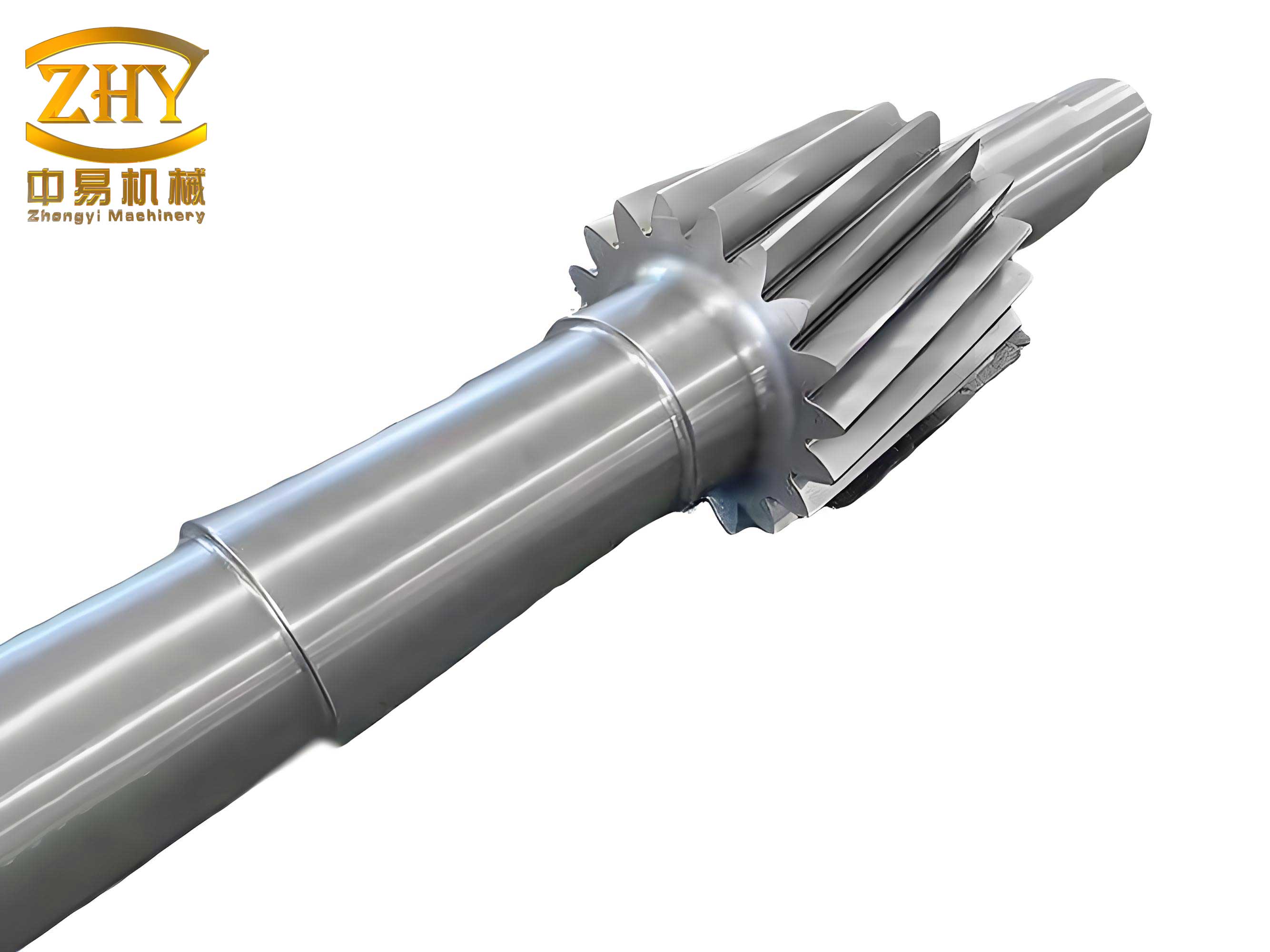
The challenge is particularly acute for hollow gear shafts. Their thin-walled, asymmetrical cross-sections make them prone to significant and unpredictable distortion during carburizing and quenching heat treatment. This distortion manifests as out-of-roundness (ovality), bending, and enlargement of the central hole’s conical angle. Even minor imperfections in these central holes—whether in concentricity, roundness, surface finish, or conical angle accuracy—are magnified in subsequent grinding operations (for bearing journals, gear teeth, etc.), leading to radial runout errors and ultimately compromising the functional performance of the assembly. The core problem is ensuring that the axis defined by the two finished central holes accurately represents the desired functional axis of the gear shaft after all manufacturing and thermal processing steps.
The initial machining of central holes typically involves CNC turning. A critical success factor is the selection and consistency of the machining datum. A two-step turning process is often employed: First, one end and its central hole are machined using a rough-turned outer diameter as a secondary datum. Then, the shaft is reversed, and the second end is machined using the finished outer diameter from the first operation as the primary datum. This inherent inconsistency in datum quality can introduce a coaxiality error between the two central holes from the very beginning. Furthermore, the clamping force from a standard three-jaw chuck can induce elastic deformation in the hollow shaft, which springs back after machining, creating a form error not detectable during in-situ inspection. The initial errors can be summarized as follows, where $E_{coax}$ represents the coaxiality error between the two central hole axes, $D_{rough}$ is the runout of the rough datum, and $D_{finished}$ is the runout of the finished datum:
$$E_{coax} \propto | D_{rough} – D_{finished} | + \delta_{clamp}$$
Here, $\delta_{clamp}$ is the error induced by clamping deformation. Measurements from initial processing confirm these issues.
| Process Stage | Location | Central Hole Roundness (µm) | Conical Angle | Adjacent OD Runout (µm) |
|---|---|---|---|---|
| After CNC Turning | End A (Rough Datum) | 5.44 – 6.66 | 62°16’48” | 5.22 |
| After CNC Turning | End B (Finished Datum) | 12.80 – 14.29 | 59°57’54” | 9.07 |
The subsequent carburizing and quenching process acts as an agent of significant change. The non-uniform mass distribution and rapid cooling cause complex stresses, leading to predictable and unpredictable distortions. A consistent trend observed in hollow gear shafts is the enlargement of the central hole’s 60° conical angle and a severe degradation of its roundness. The post-heat treatment state starkly illustrates the problem.
| Process Stage | Location | Central Hole Roundness (µm) | Conical Angle | Adjacent OD Runout (µm) |
|---|---|---|---|---|
| After Heat Treatment | End A | 11.48 – 12.42 | 62°54’49” | 14.68 |
| After Heat Treatment | End B | 14.80 – 20.29 | 60°18’55” | 11.07 |
The angular error ($\Delta \alpha$) and roundness error ($\Delta R$) increase dramatically, invalidating the previously machined central holes as precision datums. The relationship can be conceptually modeled as a function of material (M), geometry (G), and heat treatment parameters (H):
$$[\Delta \alpha, \Delta R] = f(M, G, H)$$
Where for thin-walled, asymmetric hollow gear shafts, the geometrical factor $G$ dominates, leading to $\Delta \alpha > 0$ (angle increase) and $\Delta R \gg$ pre-heat treatment values.
The optimization strategy is multi-faceted, targeting each stage of the process. First, the CNC turning process is refined. To minimize datum-induced error, the goal is to machine both central holes from as similar a datum condition as possible. This is achieved by performing a unified “finish turning” operation for each end on the same machine setup. The shaft is gripped on a stable, central portion of its pre-machined blank. The machine then performs all operations on that exposed end—facing, outer diameter (OD) turning, and central hole drilling—in one continuous sequence before the part is released from the chuck. This ensures the central hole and the adjacent functional OD are perfectly coaxial at that moment. The process is then repeated for the other end. To counteract the predictable thermal expansion of the conical angle, a compensatory pre-correction is applied during CNC programming. Knowing from historical data that the angle increases by approximately $20’$ to $40’$, the angle is machined slightly smaller, for instance, to $59°45’$. The nominal material removal ($\delta_{comp}$) for this compensation is estimated based on prior data:
$$\delta_{comp} = k \cdot \Delta \alpha_{avg}$$
where $k$ is an empirical coefficient derived for the specific shaft geometry and heat treatment cycle. Furthermore, rigorous machine and fixture maintenance is essential. Chuck jaw runout and face runout must be certified to be less than 0.01 mm, and cleaning of all locating surfaces before part loading is mandated to eliminate particulate-induced tilt.
Second, the design of the central hole itself is optimized. Instead of a simple 60° cone (A-type), a B-type center hole with a protective $120°$ countersink is specified. This design offers multiple advantages for precision gear shafts: 1) The $120°$ recess protects the critical $60°$ sealing surface from handling damage during inter-process logistics. 2) More importantly, it reduces the effective contact area of the $60°$ cone. A shorter contact length is less susceptible to the averaging effects of form errors and thermal distortion, allowing the subsequent grinding process to establish a true axis more effectively. 3) It localizes the wear on grinding tools, reducing the effective surface to be regenerated and improving process consistency.
The third and most critical pillar of optimization is the implementation of a post-heat treatment central hole grinding operation. This process is dedicated to re-establishing a geometrically perfect datum on the hardened gear shaft, effectively “resetting” the axis by removing the thermally induced errors. The operation uses a dedicated center hole grinder. The principle involves a rotating grinding wheel (typically a fine-grain, such as F100 chromium oxide or F60 white aluminum oxide for required finishes of Ra ≤ 0.4 µm or Ra ≤ 0.8 µm, respectively) that spins on its own axis (high-speed rotation for cutting) while simultaneously revolving around the theoretical part axis (planetary motion). This compound motion, combined with a precise oscillatory feed along the 60° cone, ensures the entire conical surface is ground uniformly relative to the machine’s intrinsic axis.
A pivotal aspect of this setup is the workpiece location method. Simply supporting the shaft between the machine’s live headstock and tailstock centers would only replicate any pre-existing coaxiality error. Therefore, a kinematic location system is used. The shaft is placed in a V-block or a specialized fixture that locates on the pitch circle diameter of the gear teeth—a major functional datum. This fixture is itself centered on the machine axis. The tailstock center then only provides light axial support. This method ensures that the newly ground central holes are concentric with the functional gear tooth axis, not necessarily the pre-heat treatment shaft axis. This is a profound shift in philosophy: the central holes are created to be true to the gear, rather than expecting the gear to be true to pre-existing holes. The grinding parameters are tightly controlled: an infeed rate ($v_f$) of 0.005–0.010 mm/s (the component normal to the cone surface) and a cutting speed ($v_c$) of approximately 30 m/s, with total stock removal ($a_p$) limited to 0.05 mm to prevent thermal damage.
The tooling for this operation is also optimized. The grinding wheel arbor is precision-machined in one setup to ensure the threaded mounting end and the wheel-mounting spigot are perfectly coaxial, with total indicated runout (TIR) held below 0.015 mm. This minimizes vibration and ensures the grinding wheel’s cutting path is true to the machine’s rotational axis.
The results from implementing this optimized process chain are conclusive. The following table compares the central hole quality and the resulting functional runout after the final OD grinding operation, which now uses the post-heat-treatment-ground central holes as its datum.
| Sample & Process | Central Hole Roundness (µm) | Conical Angle | Surface Finish (Ra µm) | Resulting Ground OD Runout (µm) |
|---|---|---|---|---|
| Sample 1 (Standard) | 2.50 – 5.40 | 59°45′ – 59°46′ | ≤ 0.4 | 1.41 – 1.49 |
| Sample 2 (Standard) | 1.97 – 6.67 | 59°43′ – 59°51′ | ≤ 0.4 | 2.60 – 3.33 |
| Sample 3 (Fully Optimized) | 1.67 – 2.87 | 59°59′ – 60°03′ | ≤ 0.4 | 2.03 – 2.62 |
The data demonstrates that the optimized process delivers central holes with roundness consistently below 3 µm, conical angle within a tight tolerance of $60° \pm 4’$, and excellent surface finish. Most importantly, when these superior datums are used for final grinding, the radial runout of critical functional diameters—such as bearing seats—is consistently controlled within 3 µm. This level of precision is a prerequisite for achieving the quiet, efficient, and reliable operation required in high-performance NEV transmissions. The coaxiality error ($E’_{coax}$) between the final functional axis (defined by ground ODs/teeth) and the central hole datum axis is minimized:
$$E’_{coax} \approx \Delta R_{hole} + \epsilon_{grinder}$$
where $\Delta R_{hole}$ is the now very small roundness error from the ground center hole (≤ 3 µm), and $\epsilon_{grinder}$ is the inherent error of the external grinder, which is now the dominant but manageable term.
In conclusion, achieving ultra-high precision in hollow gear shafts is a systems engineering challenge centered on datum management. The key to success lies in a holistic approach: 1) Refining soft machining processes to produce the best possible initial condition with thermal compensation, 2) Intelligently designing the central hole geometry to mitigate damage and localize error, and 3) Most crucially, implementing a post-heat treatment center hole grinding operation that uses the part’s functional features (gear teeth) to re-establish a true and precise datum axis. This integrated methodology ensures that the final ground geometries of the gear shafts are concentric and accurate, directly contributing to the performance and quality targets demanded by next-generation automotive powertrains. The control of the central hole is, fundamentally, the control of the gear shaft’s functional soul.