
In my practical engineering experience, I encountered a challenging design case constrained by strict spatial limitations, specific transmission ratio requirements, and available manufacturing equipment. The original design specification called for spiral bevel gears. However, due to these constraints, it became necessary to design a pair of low-tooth-count straight bevel gears. The initial parameters were a module of m=5 mm, pinion tooth count Z1=9, gear tooth count Z2=30, and a shaft angle Σ=90°. The gear set was to be fully enclosed within a casting, with a critical internal wall width limiting the gear’s maximum size. The application did not require exceptionally high operational smoothness. After several iterations involving careful adjustment and rational selection of radial and tangential displacement coefficients, addendum modification factors, and face width, I successfully addressed the typical problems associated with low-tooth-count straight bevel gears, namely severe undercutting and tooth tip sharpening. The gears were manufactured, inspected, and have performed reliably for years. This article details the design methodology and calculations.
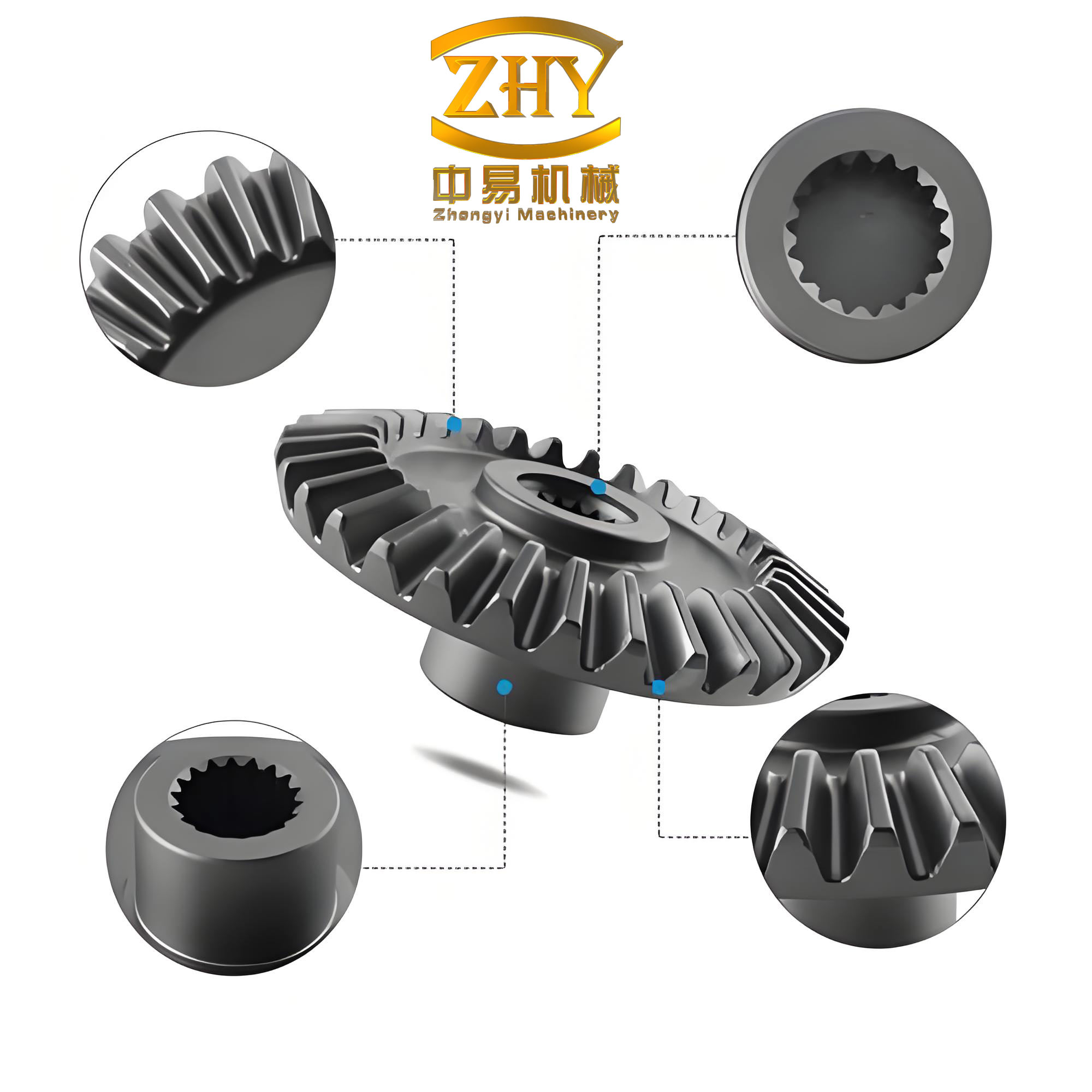
The core of designing such straight bevel gears lies in the judicious selection of modification coefficients. The initial choice of radial displacement coefficient \(x\) and tangential displacement coefficient \(x_t\) was made based on standard manual tables, considering the transmission ratio \(i = Z_2/Z_1 \approx 3.33\) and a pinion tooth count close to Z1=9. This initial selection was then refined through a comprehensive analysis of its impact on undercutting, tip sharpness, interference at the fillet, and contact ratio. The final values, along with the addendum coefficient, had to satisfy multiple criteria: ensuring sufficient bending strength (calculation omitted here), preventing undercut on the pinion with only 9 teeth and its mating gear, avoiding critically thin tooth tips, and eliminating fillet interference. The selected key parameters are summarized in the table below.
| Item | Symbol | Value & Remarks |
|---|---|---|
| Module | m | 5 mm |
| Addendum Coefficient | \(h_a^*\) | 0.8 (Short-Addendum System) |
| Dedendum Coefficient | \(c^*\) | 0.25 |
| Number of Teeth | \(Z_1 / Z_2\) | 9 / 30 |
| Face Width | b | 30 mm |
| Pressure Angle | \(\alpha\) | 20° |
| Tooth Form System | – | Straight Tooth, E-nims Tooth Form |
| Radial Displacement Coefficient | \(x_1 / x_2\) | +0.55 / -0.55 |
| Tangential Displacement Coefficient | \(x_{t1} / x_{t2}\) | +0.08 / -0.08 |
Undercut (Root Interference) Check
For standard straight bevel gears without profile shift, the minimum number of teeth to avoid undercutting is given by:
$$Z_{\text{min}} = \frac{2h_a^*}{\sin^2 \alpha}$$
For our parameters (\(h_a^*=0.8, \alpha=20°\)):
$$Z_{\text{min}} = \frac{2 \times 0.8}{\sin^2 20°} \approx \frac{1.6}{0.117} \approx 13.68$$
This confirms that undercut would occur on a standard 9-tooth pinion. With profile shift, the condition to avoid undercutting for a gear is:
$$x \geq h_a^* – \frac{Z \sin^2 \alpha}{2}$$
Applying this to our pinion (Gear 1, Z1=9):
$$x_1 = 0.55 \geq 0.8 – \frac{9 \times \sin^2 20°}{2} = 0.8 – \frac{9 \times 0.117}{2} = 0.8 – 0.5265 = 0.2735$$
The condition is satisfied. For the gear (Gear 2, Z2=30):
$$x_2 = -0.55 \geq 0.8 – \frac{30 \times 0.117}{2} = 0.8 – 1.755 = -0.955$$
This condition is also satisfied. Therefore, neither gear in this pair of straight bevel gears will experience undercutting.
Tooth Tip Thickness Evaluation
Excessively thin tooth tips are prone to chipping and reduce tooth strength. We must check the chordal thickness at the tip, both at the large end and the small end of the tooth.
Large End Tip Thickness: First, calculate the addendum angle \(\theta_a\) for the pinion. The formula derived from geometry is:
$$\theta_{a1} = \arctan\left(\frac{h_{a1}}{R_e – 0.5b}\right)$$
Where \(R_e\) is the outer cone distance and \(h_{a1}\) is the pinion’s addendum. The large-end tip circular tooth thickness \(s_{a1}\) is calculated from the circular tooth thickness at the large-end pitch circle \(s_1\), the addendum \(h_{a1}\), and the pressure angle \(\alpha\):
$$s_{a1} \approx s_1 + 2h_{a1} \tan \alpha – \Delta s$$
Where \(\Delta s\) accounts for the change due to the conical shape. After calculation (detailed geometry omitted for brevity), the tip thickness was found to be significantly greater than the critical value of \(0.25m = 1.25\) mm, thus it is safe.
Small End Tip Thickness: This is often more critical. For meshing without backlash, the tip thickness of one gear should equal the space width at the tip of its mate. The gear’s large-end space width \(e_{2}\) can be found from its large-end circular tooth thickness \(s_2\) and the pitch:
$$e_{2} = p – s_2 = \pi m – s_2$$
At the small end, dimensions are scaled by the ratio of the inner cone distance \(R_i\) to the outer cone distance \(R_e\). The small-end space width of the gear \(e_{2i}\) is:
$$e_{2i} \approx e_{2} \times \frac{R_i}{R_e}$$
The small-end tip thickness of the pinion \(s_{a1i}\) must be compared to this value. Calculations showed that \(s_{a1i} > e_{2i}\) and was well above \(0.2m = 1.0\) mm. Therefore, the tooth tips of these straight bevel gears are sufficiently thick at both ends.
Fillet Interference (Undercut Interference) Check
When designing modified gear pairs, it is crucial to avoid fillet interference, where the tip of one gear digs into the transition curve (fillet) of the other. For two meshing gears, the condition for no interference on Gear 1 is:
$$\tan\alpha_{w} – \frac{Z_2}{Z_1}(\tan\alpha_{a2} – \tan\alpha_{w}) \geq \tan\alpha – \frac{4(h_a^* – x_1)}{Z_1 \sin 2\alpha}$$
And the condition for no interference on Gear 2 is:
$$\tan\alpha_{w} – \frac{Z_1}{Z_2}(\tan\alpha_{a1} – \tan\alpha_{w}) \geq \tan\alpha – \frac{4(h_a^* – x_2)}{Z_2 \sin 2\alpha}$$
Where \(\alpha_w\) is the operating pressure angle, and \(\alpha_a\) is the pressure angle at the tip circle of the gear. For our pair, because the sum of the radial displacement coefficients is zero (\(x_1 + x_2 = 0\)), the operating pressure angle equals the standard pressure angle (\(\alpha_w = \alpha = 20°\)). Calculating the tip pressure angles and substituting all values into the inequalities confirmed that both conditions are satisfied. Thus, this pair of modified straight bevel gears will not suffer from fillet interference.
Calculation of Key Geometric Parameters
Based on the chosen design parameters, the primary geometric dimensions of the straight bevel gears are calculated as follows. Note: Subscript 1 refers to the pinion, subscript 2 to the gear.
| Item | Symbol | Formula & Calculated Result |
|---|---|---|
| Large-End Pitch Diameter | \(d_{e1} / d_{e2}\) | \(d_e = mZ\) → \(45.0\) mm / \(150.0\) mm |
| Pitch Cone Angle | \(\delta_1 / \delta_2\) | \(\delta_1 = \arctan(Z_1/Z_2) \approx 16.70°\), \(\delta_2 = 90° – \delta_1 = 73.30°\) |
| Cone Distance | \(R_e\) | \(R_e = \frac{d_{e1}}{2 \sin \delta_1} = \frac{45}{2 \times \sin 16.70°} \approx 78.25\) mm |
| Addendum | \(h_{a1} / h_{a2}\) | \(h_a = m(h_a^* + x)\) → \(h_{a1}=5(0.8+0.55)=6.75\) mm, \(h_{a2}=5(0.8-0.55)=1.25\) mm |
| Tip Diameter | \(d_{a1} / d_{a2}\) | \(d_a = d_e + 2h_a \cos \delta\) → \(d_{a1} \approx 57.93\) mm, \(d_{a2} \approx 150.72\) mm |
| Large-End Circular Tooth Thickness | \(s_1 / s_2\) | \(s = m(\frac{\pi}{2} + 2x \tan \alpha + x_t)\) → \(s_1 \approx 9.45\) mm, \(s_2 \approx 6.22\) mm |
| Chordal Tooth Thickness at Large End | \(\bar{s}_1 / \bar{s}_2\) | \(\bar{s} \approx s – \frac{s^3}{6d_e^2}\) → \(\bar{s}_1 \approx 9.44\) mm, \(\bar{s}_2 \approx 6.22\) mm |
| Chordal Addendum at Large End | \(\bar{h}_{a1} / \bar{h}_{a2}\) | \(\bar{h}_a \approx h_a + \frac{s^2 \cos \delta}{4d_e}\) → \(\bar{h}_{a1} \approx 6.84\) mm, \(\bar{h}_{a2} \approx 1.25\) mm |
| Virtual Number of Teeth | \(Z_{v1} / Z_{v2}\) | \(Z_v = Z / \cos \delta\) → \(Z_{v1} \approx 9.41\), \(Z_{v2} \approx 104.72\) |
Discussion and Design Rationale
The design of these low-tooth-count straight bevel gears involved several key decisions:
1. Use of a Short-Addendum System (\(h_a^*=0.8\)): Analysis of the tip thickness formula shows that increasing \(h_a^*\) increases the addendum angle \(\theta_a\) and the tip diameter, which in turn reduces the tip thickness \(s_a\), making the tip prone to sharpening. Furthermore, from the undercut formula, using a standard addendum (\(h_a^*=1.0\)) would require the pinion’s radial displacement coefficient \(x_1\) to be greater than approximately 0.4, potentially introducing other difficulties in balancing design constraints for this specific case. Therefore, adopting a short-addendum system was fundamental to resolving the tip-sharpness challenge.
2. Selection of Displacement Coefficients (\(x\) and \(x_t\)): The formula for circular tooth thickness, \(s = m(\pi/2 + 2x \tan \alpha + x_t)\), reveals that increasing \(x_t\) directly increases the tooth thickness of one gear while decreasing that of its mate. A positive tangential shift for the pinion (\(x_{t1}=+0.08\)) was used to strengthen its critically thin tooth. The radial shift \(x_1=+0.55\) was chosen primarily to avoid undercut while working in conjunction with the reduced \(h_a^*\).
3. Determination of Face Width (b=30 mm): The face width directly affects the strength and the taper of the tooth. While a wider face increases load capacity, it also amplifies the difference in dimensions between the large and small ends. The small-end tooth thickness diminishes with increasing face width. A general rule for straight bevel gears is to limit the face width to approximately one-third of the cone distance (\(b \leq R_e/3\)). Our cone distance \(R_e\) is about 78.25 mm, making b=30 mm a suitable and common choice, balancing strength and manufacturing feasibility.
Conclusion
The successful design of low-tooth-count straight bevel gears under stringent spatial and ratio constraints demonstrates that critical issues like undercutting, tip sharpening, and fillet interference can be effectively mitigated. The solution hinges on the rational and integrated selection of the radial displacement coefficient \(x\), the tangential displacement coefficient \(x_t\), and the addendum coefficient \(h_a^*\). This approach not only solves the geometric problems but also enhances the bending strength of the weaker pinion. It is important to note that while effective, this design for straight bevel gears typically results in a lower contact ratio. In applications where a high degree of smoothness and multiple tooth-pair contact are paramount, non-straight tooth forms (e.g., spiral or zerol bevel gears) would be more appropriate. The methodology and calculations presented provide a validated framework for the engineering design of such specialized straight bevel gears.