
In the realm of high-performance mechanical systems, gear shafts serve as critical components, transmitting torque and motion under demanding conditions. The integrity of these gear shafts is paramount, and any failure, particularly during manufacturing processes like heat treatment, warrants rigorous investigation. This article delves into a detailed analysis of longitudinal cracking observed in gear shafts fabricated from 18CrNiMo7-6 steel. Drawing from firsthand analytical experience, I will systematically explore the failure mechanisms, employing metallurgical examination techniques and theoretical frameworks to elucidate the root cause. The focus remains steadfast on gear shafts, their material behavior, and the processing parameters that govern their performance.
The incident involved gear shafts that developed severe axial cracks during or immediately after a standard heat treatment cycle. These gear shafts were intended for heavy-duty applications, where reliability is non-negotiable. The primary objective was to determine whether the failure originated from inherent material defects or was induced by the thermo-mechanical processing sequence. As an analyst involved in the failure investigation, I oversaw the sectioning of the failed gear shafts and coordinated a multi-faceted analytical campaign.
The material under scrutiny is 18CrNiMo7-6, a case-hardening steel renowned for its high core strength and good toughness, making it a preferred choice for critical gear shafts in automotive and industrial applications. The standard production route for these gear shafts involved electric arc furnace (EAF) melting, followed by ladle furnace (LF) refining, vacuum degassing (VD), and ingot casting. The forged product was then machined into the final gear shaft geometry. The specified heat treatment for these gear shafts consisted of carburizing at 960 °C, followed by quenching from 840 °C in oil, and subsequent tempering at 170 °C.
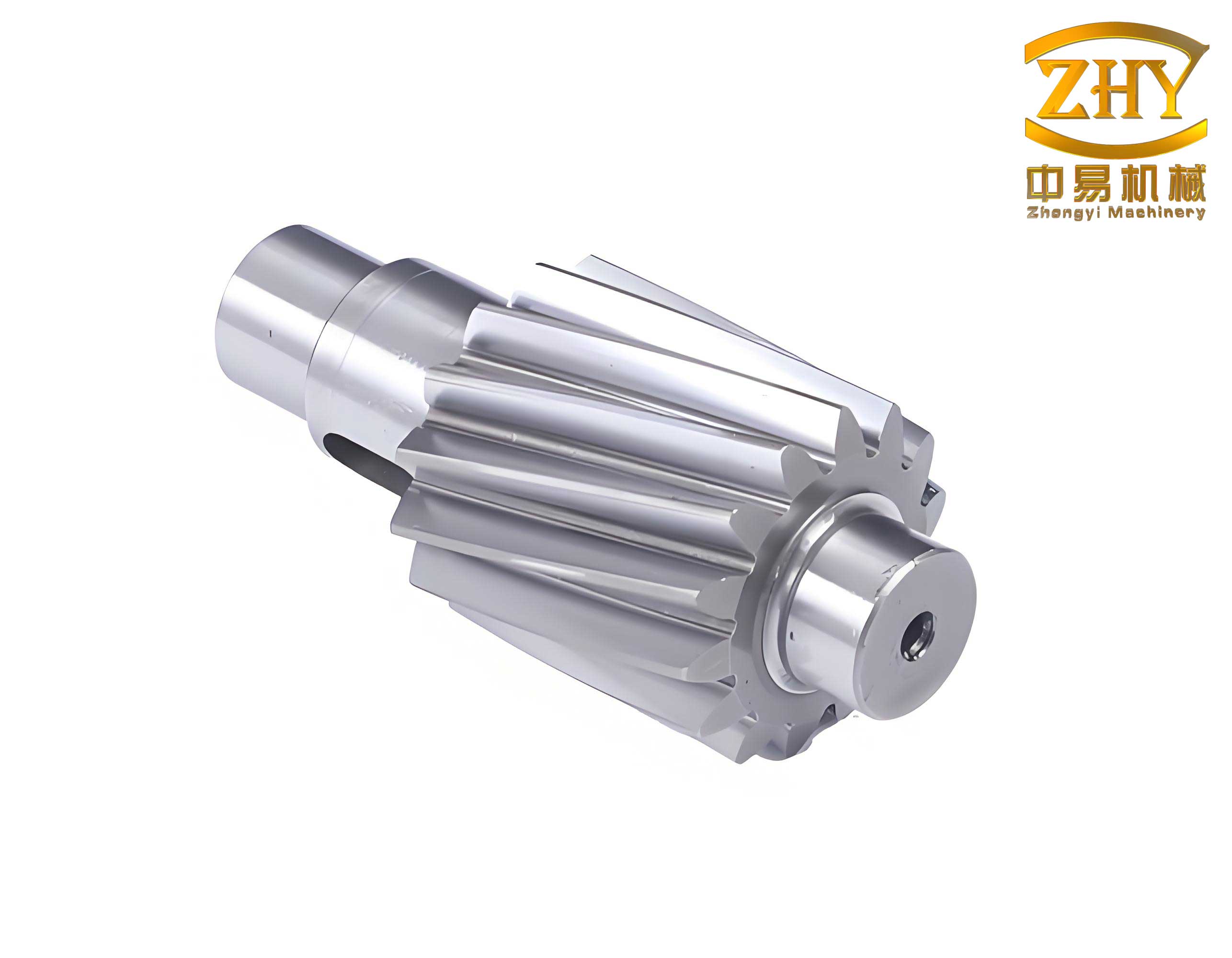
Macroscopic examination of the cracked gear shafts revealed a classic signature of quench cracking. The cracks were longitudinal, propagating along the axis of the gear shafts. In multiple specimens, the cracks originated near the tooth root fillet region, approximately 3 mm from the root, and propagated radially inwards, reaching depths of up to 89 mm, effectively severing the gear shafts. The crack opening was widest at the tooth root area, tapering towards the interior. This morphology immediately pointed towards high tensile stresses generated during the martensitic transformation upon quenching. The visual evidence was consistent across several failed gear shafts, indicating a systemic issue rather than an isolated flaw.
To rule out compositional inhomogeneity as a contributing factor, samples were extracted from various locations of the gear shafts: the surface (near a tooth), the mid-radius region, and the core. Chemical analysis was performed, and the results are consolidated in the table below. The composition was uniformly within specification for 18CrNiMo7-6 steel, with no significant segregation of carbon or alloying elements that could predispose the gear shafts to cracking. Carbon content, a key driver of martensite hardness and transformation stress, showed minimal gradient.
| Sampling Location | C | Mn | Si | S | P | Ni | Cr | Mo | Al |
|---|---|---|---|---|---|---|---|---|---|
| Gear Shaft A (Surface) | 0.180 | 0.59 | 0.25 | 0.009 | 0.017 | 1.63 | 1.73 | 0.28 | 0.039 |
| Gear Shaft A (Mid-Radius) | 0.185 | 0.60 | 0.25 | 0.011 | 0.016 | 1.64 | 1.75 | 0.29 | 0.038 |
| Gear Shaft A (Core) | 0.190 | 0.60 | 0.26 | 0.010 | 0.017 | 1.64 | 1.73 | 0.29 | 0.039 |
| Gear Shaft B (Surface) | 0.190 | 0.59 | 0.25 | 0.008 | 0.019 | 1.59 | 1.70 | 0.28 | 0.039 |
| Gear Shaft B (Mid-Radius) | 0.185 | 0.61 | 0.27 | 0.012 | 0.018 | 1.58 | 1.72 | 0.29 | 0.037 |
| Gear Shaft B (Core) | 0.190 | 0.61 | 0.28 | 0.010 | 0.019 | 1.58 | 1.72 | 0.28 | 0.038 |
The fracture surfaces of the sectioned gear shafts were examined to locate the crack initiation sites. In all cases, the origin was confirmed to be at the subsurface region near the tooth root, a stress concentrator. Scanning electron microscopy (SEM) of the fracture origins revealed predominantly intergranular fracture morphology, with some areas showing quasi-cleavage. This is characteristic of brittle fracture induced by high stress. Notably, one gear shaft’s origin contained a manganese sulfide (MnS) inclusion approximately 270 µm in length. However, its severity was rated as level 1.5 according to standard inclusion rating charts, which is considered acceptable and not atypical for gear shafts of this grade. The other gear shaft’s origin showed no such agglomeration of non-metallic inclusions. Energy dispersive spectroscopy (EDS) confirmed the inclusion’s composition. Critically, the crack faces and their adjacent material showed no evidence of oxidation or decarburization. This absence is a key indicator that the cracking occurred at a low temperature, post-quench, and not during the high-temperature carburizing stage. The formula for the volume change during martensitic transformation, a primary source of stress, can be expressed as:
$$\Delta V \approx \beta \cdot (c – c_0)$$
where $\Delta V$ is the volumetric strain, $\beta$ is a constant dependent on the steel, $c$ is the carbon content in martensite, and $c_0$ is a reference carbon content. For gear shafts with a carburized case, the high surface carbon leads to a larger $\Delta V$ in the case, generating tensile stresses in the core.
Microstructural analysis was performed on transverse sections of the gear shafts. The microstructure at the tooth tip (carburized zone) consisted of tempered acicular martensite and retained austenite. The core microstructure comprised tempered lath martensite and bainite. The prior austenite grain size was evaluated as ASTM 7-8, which is fine and desirable for toughness in gear shafts. No abnormal grain growth or microstructural anomalies were observed. The cracks themselves, when viewed under the microscope, were transgranular and showed no branching or secondary cracking indicative of fatigue. The crack path was straight and continuous from the surface to the interior. A critical observation was the lack of any decarburized layer along the crack flanks, reinforcing the conclusion that the crack formed after the final quench.
The discussion now centers on the mechanism of quench cracking in these gear shafts. Quench cracks are a form of thermal stress cracking resulting from the interplay of thermal gradients and phase transformation stresses. When a component like a gear shaft is quenched, the surface cools rapidly and transforms to martensite first. Martensite formation is accompanied by a volumetric expansion. The cooler, hardened surface layer constrains the hotter, still-austentic core. As the core subsequently transforms, its expansion is resisted by the already rigid surface layer, setting up complex stress states. The maximum tensile stress often develops at the subsurface region, which aligns perfectly with the crack origins observed in these gear shafts. The stress state can be approximated by considering the thermal stress ($\sigma_{th}$) and transformation stress ($\sigma_{tr}$). The total stress ($\sigma_{total}$) during quenching is:
$$\sigma_{total} = \sigma_{th} + \sigma_{tr}$$
where $\sigma_{th} \propto E \cdot \alpha \cdot \Delta T$, with $E$ being Young’s modulus, $\alpha$ the coefficient of thermal expansion, and $\Delta T$ the temperature gradient. The transformation stress $\sigma_{tr}$ is related to the volume change and transformation plasticity. For gear shafts with non-uniform sections like teeth, stress concentrations at fillets significantly amplify these stresses.
The pivotal finding from correlating the metallurgical data with production records was the time interval between quenching and tempering. A statistical review of the cracking incidents revealed a strong correlation with extended waiting times post-quench before the tempering operation. For instance, one batch of gear shafts that exhibited a high frequency of cracks had an average waiting time of over 12 hours after oil quenching before being loaded into the tempering furnace. Another cracked gear shaft had a delay of about 6.5 hours. In contrast, gear shafts from batches tempered within 3-4 hours of quenching showed no cracking. This delay is catastrophic for high-hardenability steels like 18CrNiMo7-6 used for these gear shafts. Immediately after quenching, the microstructure is meta-stable, consisting of martensite (supersaturated with carbon) and retained austenite. At room temperature, especially if the ambient temperature is low (as it was during winter when these failures clustered), the martensite finish temperature ($M_f$) may not have been reached for all regions, or retained austenite may continue to transform to martensite over time. This is known as delayed martensite formation or “autotempering” in a negative sense, which can be modeled by a kinetic equation for isothermal martensite formation:
$$f = 1 – \exp[-\alpha(M_s – T)^n]$$
where $f$ is the fraction of martensite, $\alpha$ and $n$ are constants, $M_s$ is the martensite start temperature, and $T$ is the holding temperature (room temperature). A lower $T$ promotes further transformation. Each increment of martensite formation adds new transformation stresses to the already high residual stress field in the gear shaft. If the combined stress exceeds the fracture strength of the material at that temperature, a crack initiates and propagates catastrophically. Tempering, performed promptly, relieves these stresses by allowing carbon diffusion from the martensite, forming carbides, and reducing lattice strain. The tempering process also stabilizes the retained austenite, preventing its deleterious later transformation.
| Contributing Factor | Effect on Gear Shafts | Mitigation Strategy |
|---|---|---|
| High Carbon Content in Case | Increases martensite hardness and transformation strain, raising stress. | Optimize carburizing profile; consider carbon gradient control. |
| Severe Quenching (Oil) | Creates high thermal gradients and high cooling rates. | Use interrupted quenching or milder quenchant if feasible for gear shaft design. |
| Geometric Stress Concentrators (Tooth Root) | Amplifies tensile stresses at critical locations. | Optimize fillet radius design in gear shafts; use shot peening. |
| Delayed Tempering | Allows stress accumulation from delayed phase transformation. | Implement strict process control: temper gear shafts immediately after quench (within 1-2 hours max). |
| Low Ambient Temperature | Lowers $M_f$, promoting more martensite formation at room temperature. | Control workshop temperature or use warm tempering for gear shafts immediately after quench. |
To further generalize the analysis for gear shafts, we can consider the role of alloying elements. The 18CrNiMo7-6 composition provides high hardenability, ensuring martensite formation even in the core of large section gear shafts. While this is beneficial for strength, it also means the entire cross-section undergoes martensitic transformation, generating significant stress. The nickel content improves toughness but does not eliminate the cracking risk if processing is faulty. The molybdenum addition helps reduce temper embrittlement but is irrelevant to quench cracking. The primary defense for such gear shafts is meticulous process control.
The investigation conclusively ruled out classical metallurgical defects as the root cause. The chemical homogeneity, acceptable inclusion rating, fine grain size, and absence of oxidation on crack faces collectively indicated that the material quality of the gear shafts was to specification. The solitary MnS inclusion found was within normative limits and is ubiquitous in conventionally melted steels for gear shafts; it likely acted as a minor stress raiser but was not the fundamental cause. The problem was purely process-induced.
In conclusion, the longitudinal cracking of the 18CrNiMo7-6 gear shafts was unequivocally identified as quench cracking. The failure was not due to inherent material deficiencies but was a direct consequence of delayed tempering after the oil quenching operation. The delay allowed for the progressive development of internal stresses from continued phase transformations at room temperature, ultimately exceeding the fracture strength of the material at stress concentration points like the tooth root. This case study underscores a critical, often-overlooked aspect of heat treatment protocol for high-strength gear shafts: the indispensability of immediate tempering. For gear shafts manufactured from steels with high hardenability and significant alloy content, the window between quenching and tempering must be minimized, ideally to less than two hours, and controlled environmental conditions are necessary to prevent such costly failures. This principle is paramount for ensuring the reliability and longevity of gear shafts in service. Future work could involve finite element modeling of the temperature and stress profiles in gear shafts during quenching and the subsequent holding period to quantitatively define safe waiting times for different geometries and steel grades.
Expanding on the theoretical aspects, the susceptibility to quench cracking can be parameterized. One approach is to use a cracking susceptibility coefficient ($K$), which for gear shafts might incorporate geometry (G), carbon content (C), and cooling rate (Q):
$$K_{shaft} = f(G, C_{eq}, Q)$$
where $C_{eq}$ is the carbon equivalent accounting for hardenability. For the gear shafts in question, a high $C_{eq}$ and a severe quench (oil) combined with a stress-raising geometry (gear tooth root) resulted in a high $K_{shaft}$. The final trigger was the time-dependent stress increase post-quench, $\Delta \sigma(t)$, which can be conceptualized as:
$$\Delta \sigma(t) = \int_{t_{quench}}^{t_{temper}} S \cdot \frac{df_m}{dt} dt$$
where $S$ is a stress factor per unit martensite formed and $df_m/dt$ is the rate of delayed martensite formation. If $ \sigma_{residual} + \Delta \sigma(t) > \sigma_{fracture}$, cracking occurs. This framework helps in designing safer heat treatment schedules for critical gear shafts.
In practice, for manufacturing facilities producing such gear shafts, the recommendations are clear. First, establish and enforce a standard operating procedure that mandates tempering within a specified short period after the quench for all gear shafts. Second, consider the use of elevated-temperature tempering or “automatic tempering” systems that receive gear shafts directly from the quench tank. Third, monitor ambient temperature in the quenching area, as seasonal variations can have a pronounced effect. Finally, non-destructive testing like magnetic particle inspection should be conducted on gear shafts immediately after quenching and before tempering to detect any incipient cracks early. By integrating these measures, the production of reliable, crack-free gear shafts can be consistently achieved.