
In the realm of precision machining, ultrasonic gear honing stands out as a sophisticated technique that enhances surface finish, dimensional accuracy, and the overall performance of gears. This process relies critically on the effective implementation of ultrasonic vibrations directly onto the gear being processed. The design and analysis of the vibration system that delivers these oscillations are paramount. In this work, I delve into the application of the mechanical four-terminal network method to model, analyze, and design a composite vibration system tailored for ultrasonic gear honing. The approach offers a systematic framework for handling complex assemblies of vibrating elements, allowing for the derivation of key performance parameters such as resonance frequency and displacement amplification factor. The core innovation lies in integrating a compound conical horn with the workpiece gear, the latter simplified as a cylindrical rod, and treating the entire assembly as a cascade of four-terminal networks. This methodology not only simplifies the mathematical treatment but also provides clear design equations, facilitating the optimization of ultrasonic gear honing systems for industrial applications.
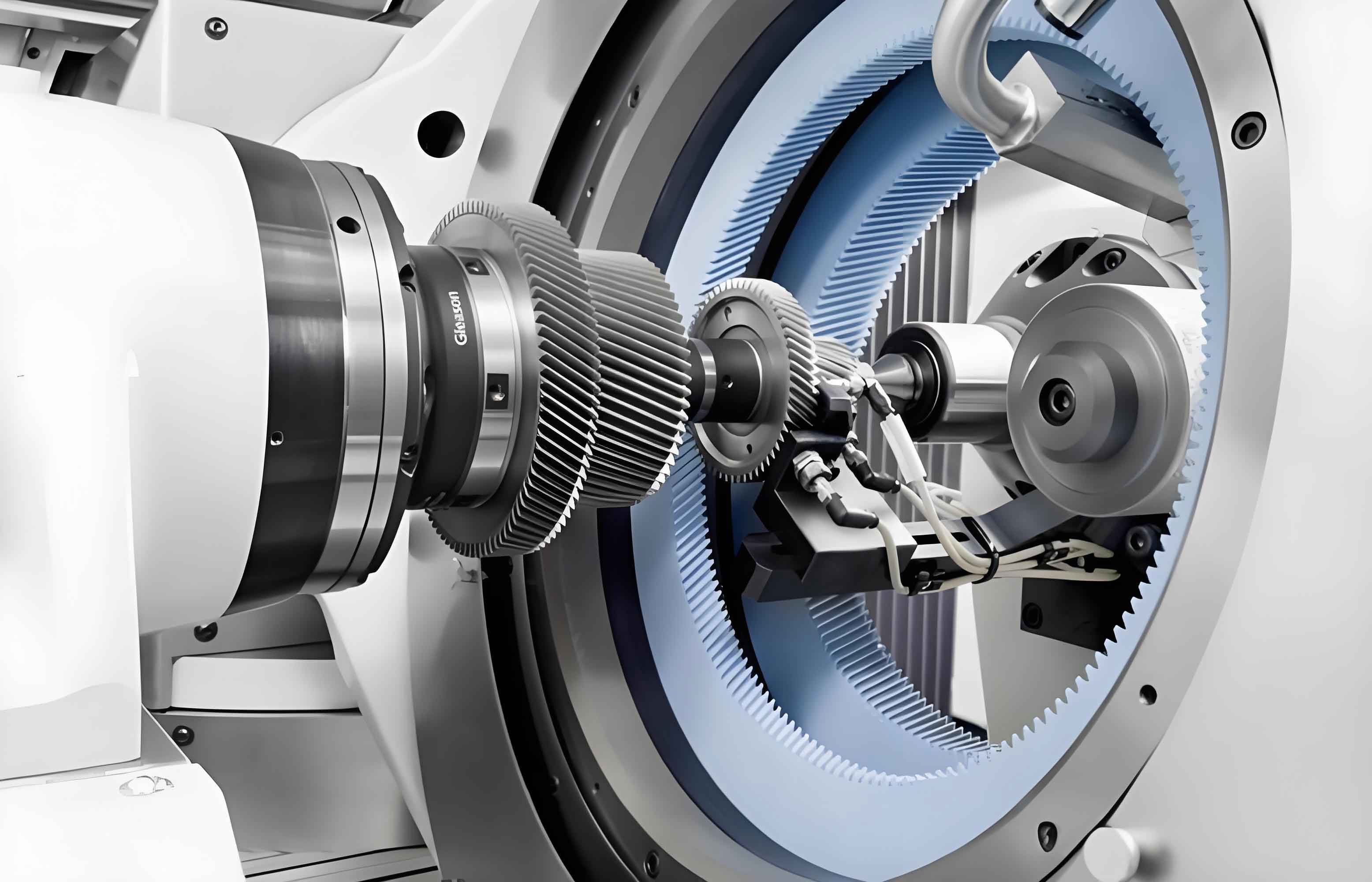
The success of ultrasonic gear honing is inherently tied to the efficient transmission and amplification of ultrasonic vibrations from the transducer to the gear teeth interface. Traditional design methods often struggle with the composite nature of these systems, which typically consist of multiple segments with varying cross-sections. The four-terminal network analogy, borrowed from electrical engineering, proves to be a powerful tool here. It treats each mechanical segment as a two-port network characterized by a transfer matrix relating the state variables—force and velocity—at its input and output ports. By cascading these matrices, the behavior of the entire vibration system can be captured elegantly. In this article, I will elaborate on the foundational theory, derive the governing equations, and present the design formulas essential for realizing an effective ultrasonic gear honing system. Throughout, the focus remains on the practical implications for gear honing, emphasizing how this method enhances control over the vibrational dynamics crucial for material removal and surface modification in gear manufacturing.
Fundamental Theory of Longitudinal Vibration in Variable Cross-Section Bars
The starting point for modeling the vibration system is the one-dimensional longitudinal vibration of a slender bar with a variable cross-section. Consider a bar of length \( l \), with a cross-sectional area function \( S(x) \), mass density \( \rho \), and Young’s modulus \( E \). Assuming the lateral dimensions are much smaller than the acoustic wavelength, the bar can be treated as undergoing pure longitudinal motion along the x-axis. The longitudinal displacement \( u \) is a function of position \( x \) and time \( t \): \( u = u(x, t) \). For harmonic excitation at angular frequency \( \omega \), the time-harmonic displacement can be expressed as \( u(x,t) = \Re\{ \bar{u}(x) e^{j\omega t} \} \), where \( \bar{u}(x) \) is the complex amplitude. The governing wave equation for the longitudinal vibration is derived from Newton’s second law and the stress-strain relationship:
$$ \frac{\partial^2 \bar{u}}{\partial x^2} + \frac{1}{S(x)} \frac{\partial S(x)}{\partial x} \frac{\partial \bar{u}}{\partial x} + k^2 \bar{u} = 0 $$
Here, \( k = \omega / v \) is the wave number, and \( v = \sqrt{E/\rho} \) is the longitudinal wave speed in the material. This differential equation describes how the displacement field adapts to changes in cross-section. For a general solution, boundary conditions involving force and velocity at the ends must be applied. The force \( F \) at any section is related to the displacement gradient: \( F = -ES(x) \frac{\partial \bar{u}}{\partial x} \). The harmonic velocity \( \dot{u} \) is \( j\omega \bar{u} \). By defining the state vector at a port as comprising the velocity \( \dot{u} \) and force \( F \) (with sign conventions appropriate for mechanical systems), we can transform the continuous system into a discrete two-port representation. This forms the basis of the mechanical four-terminal network.
Mechanical Four-Terminal Network Model and Transfer Matrix
The core idea is to represent a segment of the vibration system as a linear two-port network. For a segment between \( x=0 \) and \( x=l \), the input state vector \( Z_1 = [\dot{u}_1, F_1]^T \) and output state vector \( Z_2 = [\dot{u}_2, F_2]^T \) are related by a 2×2 transfer matrix \( D \):
$$ Z_2 = D Z_1 \quad \text{or} \quad \begin{bmatrix} \dot{u}_2 \\ F_2 \end{bmatrix} = \begin{bmatrix} a_{11} & a_{12} \\ a_{21} & a_{22} \end{bmatrix} \begin{bmatrix} \dot{u}_1 \\ F_1 \end{bmatrix} $$
The elements \( a_{ij} \) of the transfer matrix depend on the geometry and material of the segment. For a segment with a variable cross-section described by \( S(x) \), these coefficients can be derived by solving the wave equation with appropriate boundary conditions. The general expressions, as derived from the motion equation, are:
$$ a_{11} = \frac{ \frac{\partial S_1}{\partial x} \sin(k l) + 2k S_1 \cos(k l) }{ 2k \sqrt{S_1 S_2} } $$
$$ a_{12} = – \frac{ j k \sin(k l) }{ \rho v k_1 \sqrt{S_1 S_2} } $$
$$ a_{21} = \frac{ \rho v k_1 \sqrt{S_1 S_2} }{ j k \sin(k l) } – a_{11} \left( \frac{ \rho v k_1 S_2 }{ j k \tan(k l) } – \frac{ \rho v }{ j 2k } \frac{\partial S_2}{\partial x} \right) $$
$$ a_{22} = – a_{12} \left( \frac{ \rho v k_1 S_2 }{ j k \tan(k l) } – \frac{ \rho v }{ j 2k } \frac{\partial S_2}{\partial x} \right) $$
In these formulas, \( S_1 = S(0) \) and \( S_2 = S(l) \) are the cross-sectional areas at the input and output ends, respectively, and \( k_1 \) is a wave number parameter that may simplify for specific profiles. For common geometries like uniform cylinders or cones, these expressions simplify considerably. The power of this representation becomes evident when dealing with composite systems. For ultrasonic gear honing, the vibration system is typically an assembly of multiple segments: a transducer, a horn (often stepped or conical), a coupling section, and the gear itself. Each can be modeled as an individual four-terminal network. The overall transfer matrix \( A \) of the composite system is obtained by multiplying the individual matrices in the order of energy flow:
$$ A = D_n \cdot D_{n-1} \cdots D_2 \cdot D_1 = \begin{bmatrix} A_{11} & A_{12} \\ A_{21} & A_{22} \end{bmatrix} $$
Consequently, the relationship between the state vectors at the very input and the very output of the system is:
$$ Z_{n+1} = A Z_1 $$
This compact formulation allows us to analyze the global behavior of the ultrasonic gear honing vibration system. Key design aspects such as resonance conditions and amplification ratios can be extracted directly from the elements of \( A \). For instance, under free-free boundary conditions (zero force at both ends), resonance occurs when \( A_{21} = 0 \), yielding the frequency equation. The displacement amplification factor \( M_p \), defined as the ratio of output to input velocity amplitudes under resonance, is given by \( M_p = A_{11} \). These principles guide the design process to achieve desired vibrational characteristics for effective gear honing.
Composite Vibration System for Ultrasonic Gear Honing
In the specific context of ultrasonic gear honing, the vibration system must be carefully designed to ensure that the gear receives sufficient ultrasonic amplitude while maintaining structural integrity and resonance at the operating frequency. A common configuration involves a compound conical horn attached to a cylindrical rod that represents the gear. The horn serves to amplify the displacement provided by the transducer, and the gear, being the load, is integrated into the system as a vibrating element. To simplify the analysis for the gear honing application, the complex geometry of a gear is approximated as an equivalent cylindrical rod. This simplification is justified because the primary vibrational mode of interest is longitudinal, and the gear’s effective mass and stiffness can be represented by a rod with a diameter equal to the gear’s pitch diameter and a length equal to its face width. This approximation allows the application of the one-dimensional wave theory and the four-terminal network method.
The composite system studied here comprises four distinct segments in series:
- Segment 1: A compound conical horn (tapered section) with its larger end connected to the transducer and smaller end connected to a cylindrical extension.
- Segment 2: A uniform cylindrical rod (part of the horn assembly or a coupling piece).
- Segment 3: Another uniform cylindrical rod representing an intermediate section.
- Segment 4: The cylindrical rod representing the gear workpiece.
All segments are assumed to be made of the same material (e.g., titanium or steel) with density \( \rho \), wave speed \( c = v = \sqrt{E/\rho} \), and wave number \( k = \omega/c \). The lengths are denoted \( l_1, l_2, l_3, l_4 \), and the cross-sectional areas are \( S_1, S_2, S_3, S_4 \), respectively. For the compound conical segment (Segment 1), the area varies linearly: \( S(x) = S_1 (1 – \alpha x) \), where \( \alpha = (N-1)/(N l_1) \) and \( N = S_1 / S_2 \) is the area ratio. The other segments have constant cross-sections.
The following table summarizes the geometric parameters and their roles in the ultrasonic gear honing vibration system:
| Segment | Description | Length | Cross-Sectional Area | Function in Gear Honing |
|---|---|---|---|---|
| 1 | Compound Conical Horn | \( l_1 \) | \( S(x) = S_1 (1 – \alpha x) \) | Amplifies displacement from transducer |
| 2 | Cylindrical Rod 1 | \( l_2 \) | Constant \( S_2 \) | Transmits and possibly further tunes vibration |
| 3 | Cylindrical Rod 2 | \( l_3 \) | Constant \( S_3 \) | Provides structural connection |
| 4 | Gear Workpiece (simplified) | \( l_4 \) | Constant \( S_4 \) | Receives ultrasonic energy for honing process |
The design objective is to determine these dimensions such that the system resonates at a specific ultrasonic frequency (typically 20 kHz or higher) and provides an adequate displacement amplification factor to enable effective gear honing. The four-terminal network method streamlines this task by providing explicit formulas for the overall transfer matrix elements.
Derivation of Transfer Matrices and System Equations
For each segment, the transfer matrix is derived by substituting its geometry into the general formulas or using known solutions for standard shapes. For the uniform cylindrical segments (Segments 2, 3, and 4), the transfer matrix is that of a uniform rod undergoing longitudinal vibration:
$$ D_{\text{uniform}} = \begin{bmatrix} \cos(k l) & -\frac{j \sin(k l)}{\rho c S} \\ -j \rho c S \sin(k l) & \cos(k l) \end{bmatrix} $$
Thus, for Segments 2, 3, and 4:
$$ A_2 = \begin{bmatrix} \cos(k l_2) & -\frac{j \sin(k l_2)}{\rho c S_2} \\ -j \rho c S_2 \sin(k l_2) & \cos(k l_2) \end{bmatrix} $$
$$ A_3 = \begin{bmatrix} \cos(k l_3) & -\frac{j \sin(k l_3)}{\rho c S_3} \\ -j \rho c S_3 \sin(k l_3) & \cos(k l_3) \end{bmatrix} $$
$$ A_4 = \begin{bmatrix} \cos(k l_4) & -\frac{j \sin(k l_4)}{\rho c S_4} \\ -j \rho c S_4 \sin(k l_4) & \cos(k l_4) \end{bmatrix} $$
For the compound conical segment (Segment 1), with area varying as \( S(x) = S_1 (1 – \alpha x) \), the transfer matrix elements are:
$$ A_1 = \begin{bmatrix} a^1_{11} & a^1_{12} \\ a^1_{21} & a^1_{22} \end{bmatrix} = \begin{bmatrix} -\frac{\alpha}{k} \sin(k l_1) + \cos(k l_1) & -\frac{j \sin(k l_1)}{\rho c S_1 (1 – \alpha l_1)} \\ \frac{\rho c S_1}{j k} \left( k (1 – \alpha l_1) + \frac{\alpha^2}{k} \sin(k l_1) – \alpha^2 l_1 \cos(k l_1) \right) & (1 – \alpha l_1) \cos(k l_1) + \frac{\alpha}{k} \sin(k l_1) \end{bmatrix} $$
The overall transfer matrix \( A \) for the four-segment composite system is then:
$$ A = A_4 \cdot A_3 \cdot A_2 \cdot A_1 = \begin{bmatrix} A_{11} & A_{12} \\ A_{21} & A_{22} \end{bmatrix} $$
Performing this matrix multiplication yields explicit expressions for \( A_{11}, A_{12}, A_{21}, A_{22} \) in terms of \( k, l_i, S_i, \rho, c, \alpha, \) and \( N \). These expressions are algebraic but lengthy. However, they are essential for deriving the design equations. For the ultrasonic gear honing system operating under free-free conditions (the ends are stress-free, corresponding to maximum displacement), the resonance frequency equation is obtained by setting \( A_{21} = 0 \). After carrying out the matrix multiplication and simplification, the frequency equation is found to be:
$$ \tan(k l_2) = \frac{ N \left(1 – \frac{\alpha}{k} \tan(k l_1)\right) (S_4 \tan(k l_4) + S_3 \tan(k l_3)) + \frac{ k(1 – \alpha l_1) + \frac{\alpha^2}{k} \tan(k l_1) – \alpha^2 l_1 }{ S_1 k } \left(1 – \frac{S_4}{S_3} \tan(k l_3) \tan(k l_4)\right) }{ \frac{ k(1 – \alpha l_1) + \frac{\alpha^2}{k} \tan(k l_1) – \alpha^2 l_1 }{ S_1 k S_2 } (S_4 \tan(k l_4) + S_3 \tan(k l_3)) – N S_2 \left(1 – \frac{\alpha}{k} \tan(k l_1)\right) \left(1 – \frac{S_4}{S_3} \tan(k l_3) \tan(k l_4)\right) } $$
This transcendental equation in \( k \) (and hence angular frequency \( \omega = k c \)) determines the resonant frequencies of the composite system. For design purposes, given the material properties and geometric parameters of the horn and gear workpiece, one can solve this equation numerically for \( k \) to find the operating frequency. Conversely, for a desired frequency, the equation can guide the selection of dimensions.
The displacement amplification factor \( M_p \), which is crucial for ensuring sufficient vibration amplitude at the gear for effective honing, is given by \( M_p = A_{11} \) evaluated at resonance. The explicit formula, after derivation, is:
$$ M_p = \left( \cos(k l_4) \cos(k l_3) – N_2 \sin(k l_4) \sin(k l_3) \right) \left[ N \cos(k l_2) \left( -\frac{\alpha}{k} \sin(k l_1) + \cos(k l_1) \right) – \frac{N_2}{k} \sin(k l_2) \cdot H \right] + \left( \cos(k l_4) \sin(k l_3) + N_2 \sin(k l_4) \cos(k l_3) \right) \left[ -\frac{1}{N} \sin(k l_2) \left( -\frac{\alpha}{k} \sin(k l_1) + \cos(k l_1) \right) – \cos(k l_2) \cdot H \right] $$
where \( N_2 = S_4 / S_3 \) and \( H \) is a term encapsulating effects from the conical segment: \( H = \frac{\rho c S_1}{j k} \left( k (1 – \alpha l_1) + \frac{\alpha^2}{k} \sin(k l_1) – \alpha^2 l_1 \cos(k l_1) \right) \). In practice, for resonance, \( k \) satisfies the frequency equation, and \( M_p \) becomes a real number representing the ratio of output to input velocity amplitudes. A higher \( M_p \) indicates better amplification, which is desirable in ultrasonic gear honing to transmit sufficient vibrational energy to the gear-workpiece interface.
Design Considerations and Practical Application in Gear Honing
The derived frequency equation and amplification factor formula provide a direct pathway for designing the ultrasonic vibration system tailored for gear honing. The process involves several steps. First, the material properties (\( \rho, E, c \)) are selected based on factors like acoustic impedance, strength, and fatigue resistance. Titanium alloys and certain steels are common. Second, the operating ultrasonic frequency is chosen, typically in the range of 20-40 kHz for gear honing applications, balancing between resolution and power penetration. Third, the gear workpiece dimensions (pitch diameter and face width) are used to determine \( S_4 \) and \( l_4 \) for the equivalent cylindrical rod. Fourth, the designer selects initial values for the horn parameters (\( S_1, S_2, l_1, N \)) and the connecting rod dimensions (\( S_3, l_3, l_2 \)) based on spatial constraints and desired amplification. The frequency equation is then solved iteratively to adjust these dimensions until the system resonates at the desired frequency. Finally, the amplification factor \( M_p \) is computed to ensure it meets the requirements for effective gear honing.
To illustrate the relationships among key parameters, the following table presents a summary of the design variables and their influence on system performance for ultrasonic gear honing:
| Design Parameter | Symbol | Typical Range/Value | Effect on Resonance Frequency | Effect on Amplification Factor \( M_p \) |
|---|---|---|---|---|
| Horn Large-End Area | \( S_1 \) | 100-500 mm² | Inverse relationship; larger area lowers frequency | Generally decreases with larger \( S_1 \) |
| Horn Area Ratio | \( N = S_1/S_2 \) | 2-10 | Complex, affects wave propagation | Primary determinant; higher N often increases \( M_p \) |
| Horn Length | \( l_1 \) | 50-150 mm | Inverse relationship; longer horn lowers frequency | Non-linear; optimal length exists |
| Cylindrical Rod Lengths | \( l_2, l_3 \) | 20-80 mm each | Direct influence; longer rods lower frequency | Moderate influence; can tune phase |
| Gear Workpiece Length (Face Width) | \( l_4 \) | 10-50 mm | Significant; longer gear lowers frequency | Can reduce \( M_p \) if too long |
| Gear Workpiece Area (Pitch Diameter) | \( S_4 \) | 50-200 mm² | Moderate; larger area lowers frequency | Lower \( S_4 \) relative to \( S_3 \) can increase \( M_p \) |
| Wave Number at Resonance | \( k \) | \( \omega/c \), ~50-200 rad/m | Determined by solution of frequency equation | Evaluated at resonance for \( M_p \) |
In practical ultrasonic gear honing, the vibration system must be integrated with a honing tool that carries abrasives and a mechanism for relative motion between the tool and gear. The ultrasonic vibrations induce high-frequency micro-impacts that assist in material removal, improve surface finish, and reduce honing forces. The design ensures that the gear itself becomes part of the resonant structure, which maximizes energy transfer and avoids losses at interfaces. The four-terminal network method provides a systematic approach to achieve this integration efficiently. By modeling each component as a network, designers can quickly evaluate the impact of changing one component (e.g., using a different gear size) on the overall system behavior. This is particularly valuable in gear honing where workpiece geometries vary.
Advantages of the Four-Terminal Network Method for Gear Honing Systems
The adoption of the four-terminal network method for designing ultrasonic vibration systems offers several distinct advantages, especially in the context of gear honing. First, it provides a modular framework. Each segment of the system—whether it’s a horn, connector, or the gear workpiece—is treated as a black box with a known transfer matrix. This modularity simplifies the analysis of complex assemblies and facilitates iterative design changes. For instance, if a different gear for honing is to be processed, only the matrix for segment 4 needs to be updated, and the overall performance can be recalculated swiftly. Second, the method yields closed-form analytical expressions for critical design criteria like resonance frequency and amplification factor. These formulas, though sometimes lengthy, are exact within the assumptions of one-dimensional theory and provide deep insight into parameter sensitivities. Third, the approach is computationally efficient compared to full finite-element simulations during preliminary design stages. It allows rapid prototyping of vibration system geometries before committing to detailed and costly numerical analyses or experimental trials.
Moreover, for ultrasonic gear honing, where precision and consistency are paramount, the ability to predict the vibrational behavior accurately is crucial. The four-terminal network method enables designers to ensure that the system resonates at the intended frequency, avoiding detuning that could reduce honing efficiency. It also helps in maximizing the displacement amplification to achieve the necessary vibration amplitudes at the gear teeth without overloading the transducer. This leads to energy-efficient operation and prolonged equipment life. Additionally, the method can be extended to include loss mechanisms by introducing complex wave numbers or adding dissipative elements in the network matrices, though for simplicity, the ideal lossless case is often considered initially.
Conclusion
In this comprehensive exploration, I have detailed the design of an ultrasonic gear honing vibration system using the mechanical four-terminal network method. Starting from the fundamental wave equation for longitudinal vibration in variable cross-section bars, I established the theoretical foundation for representing mechanical segments as two-port networks. The composite system for gear honing, comprising a compound conical horn and a gear simplified as a cylindrical rod, was analyzed by cascading the individual transfer matrices. This led to the derivation of the resonance frequency equation and the displacement amplification factor formula—key tools for system design. The methodology underscores a structured approach to tailoring vibration systems for ultrasonic gear honing, ensuring optimal energy transfer and performance. By leveraging the four-terminal network analogy, designers can efficiently navigate the parameter space to achieve desired resonant characteristics and amplification, ultimately enhancing the effectiveness and reliability of the gear honing process. The integration of analytical formulas, as presented here, with practical considerations paves the way for advanced ultrasonic gear honing systems that meet the stringent demands of modern precision engineering.