
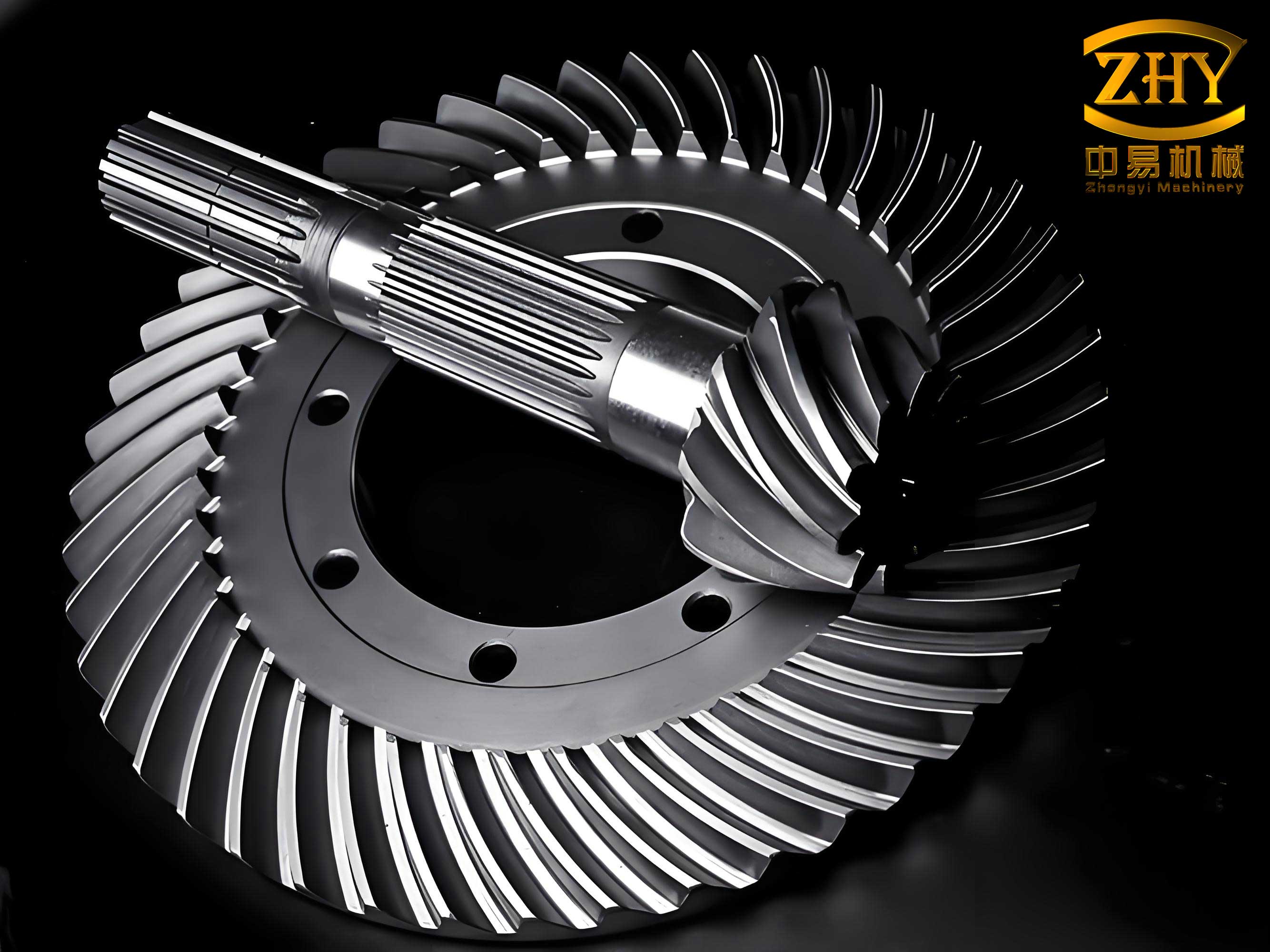
The precision manufacturing of spiral bevel gears is a cornerstone of modern power transmission systems, especially in demanding applications such as aerospace, automotive differentials, and heavy machinery where high speed, low noise, and high load capacity are paramount. The complex spatial geometry of their conjugated tooth surfaces makes their machining a significant technological challenge. The core of this process lies in accurately controlling the relative motion between the imaginary generating gear (crown gear) and the workpiece gear on a dedicated machine tool. A critical aspect of this control is the precise determination of the cutter-head’s spatial trajectory during the generation roll. Defining the exact starting and ending positions of the cutter-head center is not merely an academic exercise; it has direct practical implications for machining efficiency, tool life, and gear quality. An inaccurate starting point can lead to tool collisions (“crashes”) with the gear blank, while an undefined or overly conservative ending point increases non-cutting idle time, reducing productivity. Therefore, establishing a rigorous mathematical foundation to calculate these critical positions is essential for developing advanced, efficient, and reliable CNC machining strategies for spiral bevel gears.
Fundamental Principles and Mathematical Modeling
The machining of spiral bevel gears is fundamentally based on the principle of simulating the meshing between an imaginary crown gear (the generating gear) and the final workpiece gear. To mathematically describe this process, a series of coordinate systems must be established. Let us define a fixed machine coordinate system \( S_c (O_c – x_c, y_c, z_c) \) attached to the generating gear. Its origin \( O_c \) coincides with the theoretical center of the generating gear. The \( z_c \)-axis aligns with the rotation axis of the generating gear. Correspondingly, a fixed coordinate system \( S_g (O_g – x_g, y_g, z_g) \) is attached to the workpiece gear, with its \( z_g \)-axis aligned with the gear’s rotation axis. The angle between these two axes is the machine root angle \( \varepsilon \), and the shortest distance between them is the horizontal offset \( \Delta E \). Additional coordinate systems \( S (O – x, y, z) \) and \( S_6 (O_6 – x_6, y_6, z_6) \) are rigidly attached to the generating gear and workpiece gear, respectively, and coincide with \( S_c \) and \( S_g \) at the initial position. During machining, the generating gear rotates by an angle \( \theta_c \) with angular velocity \( \vec{\omega}_c \), and the workpiece rotates by an angle \( \theta_g \) with angular velocity \( \vec{\omega}_g \).
The condition for proper tooth surface generation is governed by the conjugate meshing theory, which requires that the relative velocity vector at the contact point between the two surfaces is orthogonal to the common normal vector. This is expressed by the equation of meshing:
$$ \vec{v}^{(cg)} \cdot \vec{n} = 0 \tag{1} $$
Here, \( \vec{n} \) is the unit normal vector to the generating gear surface at the contact point. The relative velocity \( \vec{v}^{(cg)} \) is given by:
$$ \vec{v}^{(cg)} = \vec{v}^{(c)} – \vec{v}^{(g)} = \vec{\omega}_c \times \vec{r}_c – \vec{\omega}_g \times \vec{r}_g \tag{2} $$
Where \( \vec{r}_c \) and \( \vec{r}_g \) are the position vectors of the contact point in the \( S_c \) and \( S_g \) systems, respectively. Through coordinate transformation, these vectors can be related. The geometry of the cutter-head defines the generating gear surface. For a face-milling cutter with a defined pressure angle \( \alpha_0 \), cutter point radius \( r_w \) (outer blade) or \( r_n \) (inner blade), and a radial setting \( S \) at an angular offset \( q \), the surface equation of the generating gear in the basic coordinate system can be derived. Using parameters \( l \) and \( \theta \), the coordinates \( (x_0, y_0, z_0) \) of a point on the generating tooth surface are:
$$
\begin{aligned}
x_0 &= l \sin\alpha_0 \cos(q + \theta_c – \theta) + S_1 \\
y_0 &= l \sin\alpha_0 \sin(q + \theta_c – \theta) + S_2 \\
z_0 &= \pm (r_w \cot\alpha_0 – l \cos\alpha_0)
\end{aligned} \tag{3}
$$
The sign in the \( z_0 \) equation is positive for the surface generated by the outer blade and negative for the inner blade. The unit normal vector \( \vec{e}_c \) at this point is:
$$ \vec{e}_c = \pm \cos\alpha_0 \cos(q+\theta_c-\theta) \vec{i}_c \pm \cos\alpha_0 \sin(q+\theta_c-\theta) \vec{j}_c + \sin\alpha_0 \vec{k}_c \tag{4} $$
By substituting the expressions for \( \vec{v}^{(cg)} \) (derived from Eq.(2) and coordinate transforms) and \( \vec{n} \) (Eq.(4)) into the meshing equation (Eq.(1)), and further substituting the surface coordinates from Eq.(3), a comprehensive meshing equation for spiral bevel gear generation is obtained. This equation functionally relates the machine motion parameters \( (\theta_c, \theta_g) \), the cutter geometry parameters \( (\alpha_0, r_w, r_n) \), the machine setup parameters \( (\Delta A, \Delta E, q, S, \varphi_f) \), and the generating surface parameters \( (l, \theta) \). It serves as the foundational constraint for all subsequent calculations of cutter paths and contact points in the machining of spiral bevel gears.
Determination of Machine Setup Parameters
Before calculating the cutter-head trajectory, the basic machine adjustment parameters for cutting both the gear (typically the larger wheel) and the pinion (the smaller wheel) must be established. These parameters position the workpiece relative to the theoretical generating gear and define the basic cutter orientation.
Gear (Wheel) Cutting Parameters
For the gear, which is often cut using a completing or duplex spread-blade method, the generating gear’s pitch cone coincides with that of the finished gear. Key parameters include the mean spiral angle \( \beta_m \), the mean cone distance \( L \), and the nominal cutter radius \( r_u \). The calculation proceeds as follows:
$$
\tan j = \frac{r_u – L \sin\beta_m}{L \cos\beta_m} \tag{5}
$$
$$
S = \frac{L \cos\beta_m}{\cos j} \tag{6}
$$
$$
q = \beta_m + j \tag{7}
$$
The initial cutter center location coordinates \( (l_1, l_2) \) in the machine plane are then:
$$
l_1 = S \cos q, \quad l_2 = S \sin q \tag{8}
$$
The machine center position, accounting for the sliding base feed \( \Delta A \) and the root angle \( \varphi_f \), and the ratio of roll \( i_{cg} \) are given by:
$$
x_0 = -\Delta A \cos\varphi_f, \quad y_0 = \Delta E \tag{9}
$$
$$
i_{cg} = – \frac{\sin \varphi}{\cos \gamma} \tag{10}
$$
Where \( \varphi \) is the pitch angle and \( \gamma \) is the face angle of the gear.
Pinion Cutting Parameters
The calculation for the pinion follows a similar logic but often involves different settings to obtain the localized conjugate contact with the gear. The formulae for the basic cutter location are analogous but with a sign change for the angular component due to the opposite hand of spiral or method of generation:
$$
l_1 = S \cos q, \quad l_2 = -S \sin q \tag{11}
$$
The machine center position and ratio of roll are calculated similarly using the pinion’s own root angle \( \varphi_f \) and pitch angle \( \varphi \).
The following table summarizes typical adjustment parameters for a pair of spiral bevel gears.
| Parameter | Gear (Wheel) | Pinion | Description |
|---|---|---|---|
| Radial Setting \( S \) (mm) | 16.246 | 16.246 | Basic distance from machine center to cutter center. |
| Angular Offset \( q \) (deg) | 62.5° | -62.5° | Orientation of cutter axis relative to machine centerline. |
| Cutter Tilt \( j \) (deg) | 7.5° | 7.5° | Initial tilt angle of the cutter. |
| Ratio of Roll \( i_{cg} \) | 0.845 | 0.537 | Generating gear to workpiece angular velocity ratio. |
| Machine Center \( x_0 \) (mm) | 2.954 | -4.334 | X-coordinate of machine center relative to reference. |
| Machine Center \( y_0 \) (mm) | 0 | 0 | Y-coordinate (horizontal offset \( \Delta E \)). |
Solving for Cutter-Head Start and End Positions
The generation process for spiral bevel gears is not a full 360-degree rotation but a specific roll segment corresponding to the tooth depth from toe to heel. The start and end of cut are defined by the entry and exit of contact between the generating gear surface and the extreme points of the workpiece tooth slot.
Gear (Wheel) Generation
Assuming generation proceeds from the heel (large end) to the toe (small end) of the gear tooth, the starting contact point \( A \) is typically at the heel, where the root of the generating gear touches the tip of the gear tooth. The corresponding parameters \( \theta_A \) and \( l_A \) on the generating surface are calculated from the gear’s outer cone distance \( L_e \), the inner blade radius \( r_n \), and the whole depth \( h \):
$$
\tau_A = \arccos\left( \frac{S^2 + r_n^2 – L_e^2}{2 S r_n} \right), \quad \theta_A = 180^\circ – \tau_A \tag{12}
$$
$$
l_A = \frac{r_n}{\sin \alpha_n} – \frac{h}{\sin \alpha_n} \tag{13}
$$
The ending contact point \( B \) is at the toe, where the tip of the generating gear touches the root of the gear tooth. Its parameters are calculated using the outer blade radius \( r_w \) and the inner cone distance \( L_i \):
$$
\tau_B = \arccos\left( \frac{S^2 + r_w^2 – L_i^2}{2 S r_w} \right), \quad \theta_B = 180^\circ – \tau_B \tag{14}
$$
$$
l_B = \frac{r_w}{\sin \alpha_w} \tag{15}
$$
Substituting the pair \( (\theta_A, l_A) \) and \( (\theta_B, l_B) \) into the master meshing equation (a specific form of Eq.(1) incorporating all setup parameters) yields the corresponding generating gear rotation angles \( \theta_{cA} \) (start) and \( \theta_{cB} \) (end). The actual cutter-head center coordinates \( (S_{1A}, S_{2A}) \) and \( (S_{1B}, S_{2B}) \) in the machine coordinate system at these instants are then:
$$
\begin{aligned}
\text{Start:} \quad & S_{1A} = -\Delta A \cos\varphi_f + S \cos(\beta_m + j + \theta_{cA}) \\
& S_{2A} = S \sin(\beta_m + j + \theta_{cA}) \\[6pt]
\text{End:} \quad & S_{1B} = -\Delta A \cos\varphi_f + S \cos(\beta_m + j + \theta_{cB}) \\
& S_{2B} = S \sin(\beta_m + j + \theta_{cB})
\end{aligned} \tag{16}
$$
Pinion Generation
For the pinion, the generation direction is often reversed (toe to heel). The calculation logic is similar but with adjusted signs and contact conditions. The parameters for the start point \( A \) (toe) and end point \( B \) (heel) become:
$$
\tau_A = \arccos\left( \frac{S^2 + r_w^2 – L_i^2}{2 S r_w} \right), \quad \theta_A = 180^\circ + \tau_A \tag{17}
$$
$$
l_A = \frac{r_w}{\sin \alpha_w} + \frac{h}{\sin \alpha_w} \tag{18}
$$
$$
\tau_B = \arccos\left( \frac{S^2 + r_n^2 – L_e^2}{2 S r_n} \right), \quad \theta_B = 180^\circ + \tau_B \tag{19}
$$
$$
l_B = \frac{r_n}{\sin \alpha_n} \tag{20}
$$
Substituting these into the meshing equation (with \( q \) replaced by \( -q \) for pinion setup) gives \( \theta_{cA} \) and \( \theta_{cB} \). The final cutter-head center positions for the pinion are:
$$
\begin{aligned}
\text{Start:} \quad & S_{1A} = -\Delta A \cos\varphi_f + S \cos(\beta_m + j – \theta_{cA}) \\
& S_{2A} = -S \sin(\beta_m + j – \theta_{cA}) \\[6pt]
\text{End:} \quad & S_{1B} = -\Delta A \cos\varphi_f + S \cos(\beta_m + j – \theta_{cB}) \\
& S_{2B} = -S \sin(\beta_m + j – \theta_{cB})
\end{aligned} \tag{21}
$$
Numerical Example and Validation
To demonstrate the practical application of this methodology, consider a spiral bevel gear pair designed for a power transmission system. The primary geometric parameters of the gear set are listed below.
| Parameter | Pinion | Gear (Wheel) |
|---|---|---|
| Number of Teeth \( Z \) | 11 | 33 |
| Module (mm) | 5.398 | 5.398 |
| Pressure Angle \( \alpha \) (deg) | 20 | 20 |
| Shaft Angle \( \Sigma \) (deg) | 90 | |
| Mean Spiral Angle \( \beta_m \) (deg) | 35 | 35 |
| Hand of Spiral | Left | Right |
| Face Width \( b \) (mm) | 39 | 39 |
| Outer Cone Distance \( L_e \) (mm) | 53.785 | 53.785 |
| Pitch Angle \( \varphi \) (deg) | 18.43 | 71.57 |
| Root Angle \( \varphi_f \) (deg) | 16.195 | 69.085 |
| Whole Depth \( h \) (mm) | 10.796 | 10.796 |
| Cutter Radius \( r_u \) (mm) | 114.3 | |
Applying the formulas for machine setup (Eqs. 5-11) and then solving the meshing equation for the calculated start and end contact points (Eqs. 12-21) yields the precise cutter-head center locations. The results are consolidated in the following table.
| Item | Pinion Machining | Gear (Wheel) Machining |
|---|---|---|
| Start Roll Angle \( \theta_{cA} \) (deg) | -21.32 | -15.41 |
| End Roll Angle \( \theta_{cB} \) (deg) | 15.36 | 14.82 |
| Start Position \( S_{1A} \) (mm) | 8.006 | 8.375 |
| Start Position \( S_{2A} \) (mm) | -10.697 | 15.886 |
| End Position \( S_{1B} \) (mm) | 0.800 | 0.880 |
| End Position \( S_{2B} \) (mm) | -15.883 | -15.850 |
| Required Roll Range (deg) | -21.32 to 15.36 | -15.41 to 14.82 |
The significance of these calculated ranges is evident when compared to a conventional, conservative approach. In practice, without precise calculation, machine operators often set a much larger, symmetrical swing range for the cutter-head (e.g., -30° to 30°) to absolutely ensure complete tooth generation and avoid crashes. As the table shows, the actual required roll for the pinion is only from -21.32° to 15.36°, and for the gear from -15.41° to 14.82°. Using the calculated ranges directly in CNC programming eliminates significant idle motion, reducing the non-cutting air-cut time by nearly 30% in this example. This directly translates to higher machine tool productivity and lower cost per part for spiral bevel gears. Furthermore, it guarantees the integrity of the tooth surfaces by ensuring the cut starts and ends exactly at the theoretical boundaries.
Conclusion
The analysis and precise determination of the cutter-head center location constitute a fundamental step in optimizing the CNC machining process for spiral bevel gears. By establishing a rigorous mathematical model based on spatial gearing theory and the equation of meshing, it is possible to move beyond empirical trial-and-error methods or overly conservative safety margins. The methodology detailed herein allows for the exact calculation of the generating gear’s rotation angles and the corresponding cutter-head coordinates at the start and end of the generation roll. Implementing these calculated parameters into CNC programs offers substantial benefits: it minimizes non-productive machine motions, thereby increasing throughput and reducing manufacturing costs for spiral bevel gears. Simultaneously, it ensures geometric accuracy by defining the exact limits of the cutting cycle, preventing under-generation (incomplete teeth) or the risk of tool collision. This approach provides a solid theoretical and practical foundation for the development of advanced, efficient, and intelligent CNC systems dedicated to the high-precision manufacturing of spiral bevel gears.