
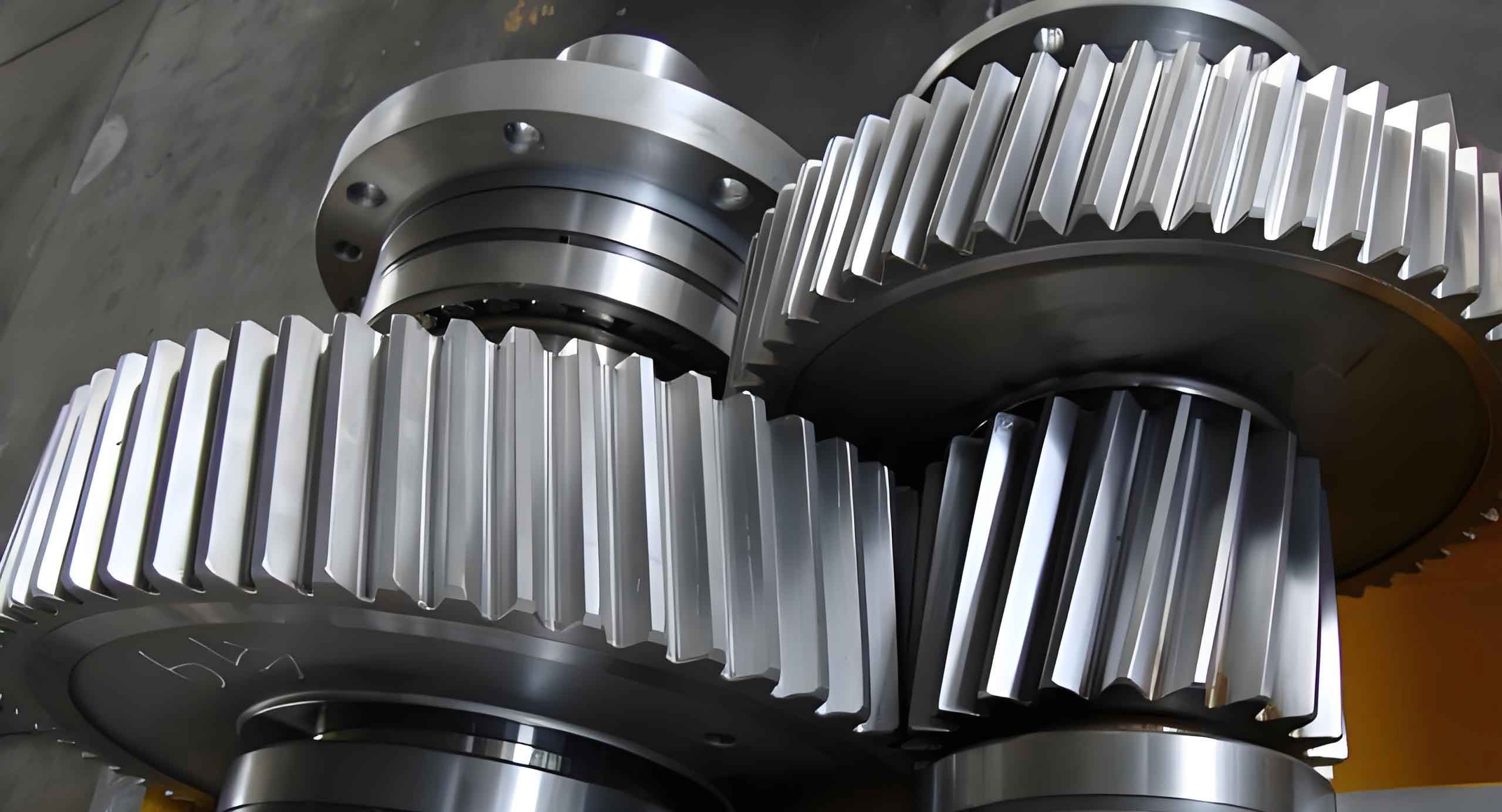
In the design, manufacturing, and inspection processes of a helical gear, controlling tooth thickness is paramount. While measurement of the normal base tangent length and measurement over pins (or balls) are commonly employed, there are frequent instances where measuring the base tangent length directly on the transverse (face) plane of the helical gear is advantageous. This method is particularly useful for narrow-face-width helical gears where measurement in the normal plane is impractical. Its key advantages include not relying on the tip diameter as a datum, resulting in high measurement accuracy, simple gauging tools (often a standard vernier caliper suffices), and ease of mastering the measurement technique. The primary drawback, however, has traditionally been the reliance on complex and cumbersome analytical calculation methods.
This article details a methodology based on the CAXA 2011 electronic drawing board (hereafter CAXA) for the rapid graphical determination of both the transverse base tangent length and the corresponding span number for a helical gear. CAXA software possesses powerful drawing and precise dimensioning capabilities. Specifically, its integrated “Gear” generation tool can be utilized to create accurate involute tooth profiles. Through a systematic graphical construction process, the relevant thickness dimensions can be obtained directly via annotation. The procedure begins with six fundamental formulas required to derive the transverse parameters of the helical gear. These parameters are then used within CAXA to construct the transverse view of the helical gear and the ideal position for the base tangent line. Finally, the length is measured graphically, and the span number is counted directly from the drawing.
A practical example will be used throughout to illustrate each step of the method.
Fundamental Formulas for Helical Gear Transverse Parameters
To graphically obtain the transverse base tangent length and span number, the transverse parameters of the helical gear must first be calculated. The following formulas, found in standard textbooks and design manuals, are essential.
Formulas for Drawing the Transverse Tooth Profile and Base Circle
The transverse plane parameters are derived from the standard normal plane inputs. The key relationships are governed by the helix angle $\beta$ at the reference diameter.
The transverse pressure angle $\alpha_t$ is calculated from the normal pressure angle $\alpha_n$:
$$ \tan\alpha_t = \frac{\tan\alpha_n}{\cos\beta} \quad (1) $$
The transverse module $m_t$ is related to the normal module $m_n$:
$$ m_t = \frac{m_n}{\cos\beta} \quad (2) $$
The transverse profile shift coefficient $x_t$ is derived from the normal coefficient $x_n$:
$$ x_t = x_n \cos\beta \quad (3) $$
The transverse addendum coefficient $h_{at}^*$ and tip clearance coefficient $c_t^*$ are similarly modified:
$$ h_{at}^* = h_{an}^* \cos\beta \quad (4) $$
$$ c_t^* = c_n^* \cos\beta \quad (5) $$
Finally, the diameter of the base circle $d_b$ in the transverse plane is:
$$ d_b = m_t z \cos\alpha_t \quad (6) $$
Where $z$ is the number of teeth. Therefore, drawing the transverse tooth profile of the helical gear requires the six basic parameters: $m_t$, $\alpha_t$, $x_t$, $h_{at}^*$, $c_t^*$, and $d_b$, all obtained from Equations (1) to (6).
| Symbol | Description | Source Formula |
|---|---|---|
| $\alpha_t$ | Transverse pressure angle | Eq. (1) |
| $m_t$ | Transverse module | Eq. (2) |
| $x_t$ | Transverse profile shift coefficient | Eq. (3) |
| $h_{at}^*$ | Transverse addendum coefficient | Eq. (4) |
| $c_t^*$ | Transverse tip clearance coefficient | Eq. (5) |
| $d_b$ | Base circle diameter | Eq. (6) |
Example: Calculation of Transverse Parameters
Consider an external cylindrical helical gear with the following given data:
- Number of teeth, $z = 23$
- Normal module, $m_n = 4 \text{ mm}$
- Normal pressure angle, $\alpha_n = 20^\circ$
- Helix angle (at reference diameter), $\beta = 30^\circ$
- Normal profile shift coefficient, $x_n = 1$
- Normal addendum coefficient, $h_{an}^* = 1$
- Normal tip clearance coefficient, $c_n^* = 0.25$
The objective is to find the transverse base tangent length $W_{kt}$ and the span number $k$.
Applying Equations (1) through (6):
$$
\begin{aligned}
\alpha_t &= \arctan\left(\frac{\tan 20^\circ}{\cos 30^\circ}\right) \approx 22.79587726^\circ \\
m_t &= \frac{4}{\cos 30^\circ} \approx 4.618802154 \text{ mm} \\
x_t &= 1 \times \cos 30^\circ = 0.8660254 \\
h_{at}^* &= 1 \times \cos 30^\circ = 0.8660254 \\
c_t^* &= 0.25 \times \cos 30^\circ \approx 0.21650635 \\
d_b &= 4.618802154 \times 23 \times \cos(22.79587726^\circ) \approx 97.93474 \text{ mm}
\end{aligned}
$$
These calculated parameters fully define the equivalent spur gear in the transverse plane of the original helical gear.
Graphical Construction Procedure in CAXA
With the transverse parameters computed, the graphical solution can be executed within the CAXA software environment.
Step 1: Generating the Transverse Tooth Profile
- Launch the CAXA software.
- Locate and click the “Gear” tool button in the interface.
- A parameter input dialog box will appear. Enter the calculated transverse basic parameters ($z$, $m_t$, $\alpha_t$, $x_t$, $h_{at}^*$, $c_t^*$) into this dialog.
- Click “Next” to proceed to a preview dialog. Here, relevant settings for the drawing (e.g., precision) can be adjusted. After confirming the settings and clicking “Finish,” a precise drawing of the transverse tooth profile for the specified helical gear is generated on the screen.
This generated profile represents the exact involute shape as it appears on the transverse section of the helical gear.
Step 2: Drawing Essential Auxiliary Circles
Two critical circles must be added to the generated tooth profile drawing:
1. The Base Circle ($d_b$): Using the “Circle” tool, draw a circle centered on the gear axis with a diameter equal to the calculated $d_b$ (approximately 97.93474 mm for our example). This circle is the locus from which the involute tooth flanks are developed.
2. The Ideal Measurement Point Circle ($d_{Lk}$): When measuring the transverse base tangent length, the two parallel measuring jaws contact the involute profiles. For optimal measurement consistency and to avoid areas near the tip or root, it is ideal for these contact points to lie near the midpoint of the active involute profile. We define the circle passing through these ideal midpoints on the transverse involutes as $d_{Lk}$.
To draw it:
- Select the “Circle” tool.
- Specify the gear center point (O) as the circle’s center.
- Move the cursor to visually locate the midpoint of any involute curve on the generated profile (typically between the start of active profile and the tip circle).
- Click to create the circle. This circle $d_{Lk}$ will intersect all tooth flank involutes near their midpoints.
Step 3: Constructing the Position of the Transverse Base Tangent Line
The base tangent line must be tangent to two corresponding involutes on opposite sides of the gear. Its position depends on whether the span number $k$ is odd or even. Since $k$ is not yet known, construction lines for both possibilities are created.
For an Even $k$ Value:
- Select any tooth space. Identify the two points (B and C) where the involute flanks of this space meet the tip circle.
- Draw the line segment BC connecting these two points.
- Find the midpoint of BC. Draw a line (OA) from the gear center O through this midpoint. This line OA will intersect the base circle at point A.
- Now, draw a line (DE) that is parallel to BC and passes through point A. This line DE represents the potential position of the transverse base tangent line for an even span number. It will be perpendicular to the line OA and tangent to the base circle at A.
For an Odd $k$ Value:
- Select any tooth (instead of a space). Identify the midpoint of its tip width or visually approximate the symmetry line of the tooth.
- Draw a radial line (OF) from the gear center O through this tooth’s approximate symmetry point.
- Following a similar logic as above, construct a line (TS) perpendicular to OF that is also tangent to the base circle. Line TS represents the potential base tangent line position for an odd span number.
At this stage, both lines DE and TS are visible on the drawing, representing the two candidate base tangent lines.
Step 4: Graphical Determination of Length ($W_{kt}$) and Span Number ($k$)
This is the final and decisive step. The objective is to find which of the two candidate lines (DE or TS) correctly engages with the involute flanks and to measure its length between points of contact.
- Identify Engagement Points: Observe where the candidate lines DE and TS intersect or pass near the involute profiles. The correct base tangent line will be tangential to two involutes that are several teeth apart. Label the intersections of line DE with the ideal measurement circle $d_{Lk}$ as Q and P. Label the intersections of line TS with $d_{Lk}$ as G and H.
- Evaluate Engagement: For each candidate line, examine the distance between points Q (or G) and the nearest involute profiles on either side. Visually, one will notice that for one of the lines, points Q and P (or G and H) lie very close to—or can be connected across—two specific involutes that are symmetrically positioned. The line for which the contact points (the tangency points on the involutes, which may need to be found by projecting Q/P or G/H onto the nearest involute) are most symmetrically located on opposing flanks is the correct one.
- Determine Span Number $k$: Once the correct base tangent line (e.g., TS in our example) is identified, simply count the number of tooth spaces (for even k) or the number of teeth (for odd k) that are spanned between the two engaging involute flanks. This count, done directly on the screen, is the transverse span number $k$. In our example, this count is 5.
- Measure the Length $W_{kt}$: Using CAXA’s precise dimensioning tool (e.g., the “Distance” or “Linear” dimension command), measure the distance between the two tangency points on the identified involutes. If the tangency points are not exactly at Q/P or G/H, draw perpendiculars from these points to the respective involutes to find the true contact points (U and V). The measured distance UV is the graphical solution for the transverse base tangent length $W_{kt}$. For the example, this measurement yields $W_{kt} \approx 65.4912$ mm.
Accuracy and Validation of the Graphical Method
To validate the accuracy of this graphical method for the helical gear example, the result can be compared against the value obtained from established analytical formulas for transverse base tangent length. The analytical formula for a spur gear (which is what the transverse section represents) with profile shift is:
$$
W_{kt} = m_t \cos\alpha_t [ \pi (k – 0.5) + z \, \text{inv}(\alpha_t) + 2 x_t \tan\alpha_t ]
$$
Where $\text{inv}(\alpha_t) = \tan\alpha_t – \alpha_t$ (in radians).
For our example with $k=5$:
$$
\begin{aligned}
\text{inv}(\alpha_t) &= \tan(22.79587726^\circ) – (22.79587726^\circ \times \frac{\pi}{180}) \approx 0.023299 \\
W_{kt} &\approx 4.618802154 \times \cos(22.79587726^\circ) [ \pi (5 – 0.5) + 23 \times 0.023299 + 2 \times 0.8660254 \times \tan(22.79587726^\circ) ] \\
W_{kt} &\approx 4.255 \times [14.137 + 0.5359 + 0.7307] \\
W_{kt} &\approx 4.255 \times 15.4036 \approx 65.4911 \text{ mm}
\end{aligned}
$$
| Method | Transverse Base Tangent Length $W_{kt}$ (mm) | Span Number $k$ |
|---|---|---|
| CAXA Graphical Determination | 65.4912 | 5 |
| Analytical Calculation | 65.4911 | 5 (assumed for calculation) |
| Difference | 0.0001 mm | 0 |
The discrepancy of 0.0001 mm is exceptionally small and falls far within the tolerances acceptable for most practical engineering applications, including quality control. This high degree of accuracy stems from the precision of CAXA’s geometric kernel and dimensioning engine.
Critical Advantage Regarding Span Number ($k$): A significant benefit of this graphical method is the reliable determination of the span number $k$. Traditional simplified formulas for estimating $k$ often fail to account accurately for the effects of large profile shift coefficients ($x_n$ or $x_t$). An incorrect $k$ can lead to measurement errors or even make the measurement impossible if the caliper jaws contact the tooth tip or root. The graphical method inherently and visually determines the correct $k$ by considering the exact geometry of the profile-shifted helical gear in its transverse plane.
Discussion and Conclusions
The graphical method utilizing CAXA software, as detailed for a helical gear, provides a robust and intuitive alternative to purely analytical calculations for determining transverse base tangent length and span number. The procedure systematically transforms the three-dimensional helical gear problem into a two-dimensional transverse spur gear problem via precise formulas, and then leverages software-assisted drafting to find the solution geometrically.
The primary characteristics and advantages of this method are:
- Conceptual Clarity: The process is visually intuitive. One can directly see the relationship between the base circle, the involute flanks, and the positioning of the measuring line, demystifying the underlying gear geometry.
- Comprehensiveness: It fully incorporates the influence of both the helix angle $\beta$ and the profile shift coefficient $x_n$, ensuring accuracy for both standard and modified helical gear designs.
- Accuracy: As demonstrated, the results exhibit negligible error compared to theoretical calculations, making the method suitable for practical engineering use.
- Efficiency and Reliability: It reduces dependency on complex manual calculations or iterative guesses for span number. The graphical determination of $k$ is direct and reliable, minimizing the risk of selection errors.
This method is universally applicable to external spur and helical gears. The core principle—using precise software to generate the gear profile and then solving the measurement problem graphically—can also be extended to other gear measurement challenges, such as determining the best pin size for measurement over pins or visualizing contact patterns. In summary, for engineers, designers, and technicians working with helical gears, mastering this CAXA-based graphical technique offers a powerful, accurate, and visually informative tool for gear analysis and inspection planning.