
In modern industrial applications, large cylindrical gears, particularly spur and pinion gears, play a pivotal role in heavy machinery such as power generation systems, mining equipment, marine propulsion, and aerospace launch platforms. These gears, typically defined as those with diameters exceeding 0.8 meters, directly influence the economic and technical performance of entire mechanical systems. However, the precise measurement of large spur and pinion gears remains a significant challenge due to their size and the difficulty in locating their geometric centers during in-situ inspections. Accurate determination of the gear’s geometric center is fundamental for calculating tooth profile deviations, which are critical for assessing gear quality, performance, and longevity. In this article, I will present a comprehensive method for establishing the geometric center of large spur and pinion gears based on a discrete data model of involute profiles, develop corresponding mathematical frameworks, and demonstrate through simulations the efficacy of this approach in computing tooth profile errors.
The foundation of our method lies in the discrete modeling of involute tooth profiles. For a standard spur gear, the parametric equations in Cartesian coordinates for points on the involute curve are given by:
$$
\begin{bmatrix} x_k \\ y_k \end{bmatrix} = \begin{bmatrix} r_b (\cos \varphi_k + \varphi_k \sin \varphi_k) \\ r_b (\sin \varphi_k – \varphi_k \cos \varphi_k) \end{bmatrix}
$$
where \( x_k \) and \( y_k \) are the coordinates of points on the tooth profile, \( r_b \) is the base circle radius, and \( \varphi_k \) is the unfolding angle corresponding to each point. The range of \( \varphi_k \) is typically between \( \varphi_f \) and \( \varphi_a \), representing the limits at the root and tip circles, respectively, calculated as:
$$
\varphi_f = \tan \alpha_f = \tan \left( \arccos \frac{r_b}{r_f} \right), \quad \varphi_a = \tan \alpha_a = \tan \left( \arccos \frac{r_b}{r_a} \right)
$$
Here, \( r_f \) and \( r_a \) denote the root and tip circle radii, while \( \alpha_f \) and \( \alpha_a \) are the pressure angles at these circles. To construct full tooth profiles for a spur and pinion gear, these involute curves are rotated to account for tooth symmetry and spacing. For the \( i \)-th tooth, the coordinates for the \( j \)-th face (left or right) and \( k \)-th sampling point are derived through rotational transformations:
$$
\begin{bmatrix} x_{ijk} \\ y_{ijk} \end{bmatrix} = \begin{bmatrix} \cos \omega_i & -\sin \omega_i \\ \sin \omega_i & \cos \omega_i \end{bmatrix} \begin{bmatrix} \cos \theta_j & -\sin \theta_j \\ \sin \theta_j & \cos \theta_j \end{bmatrix} \begin{bmatrix} r_b (\cos \varphi_k + \varphi_k \sin \varphi_k) \\ r_b (\sin \varphi_k – \varphi_k \cos \varphi_k) \end{bmatrix}
$$
with \( \omega_i = i \times 2\pi / z \) (where \( z \) is the number of teeth) and \( \theta_j \) as the rotation angle for left or right faces. This model generates a complete set of discrete data points for the gear’s tooth profiles, serving as the basis for subsequent geometric center determination.
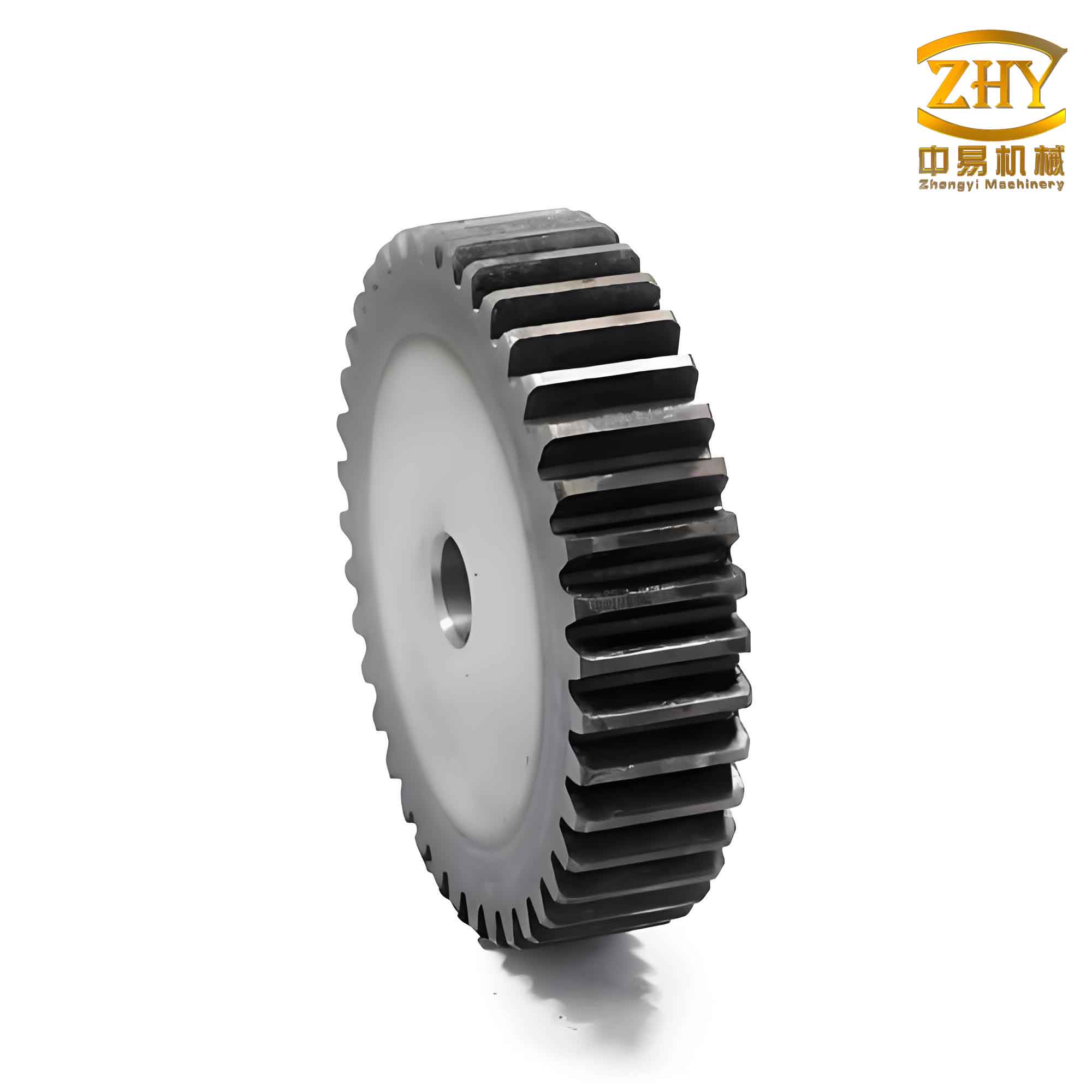
Determining the geometric center of a large spur and pinion gear is crucial for accurate measurement, especially in online inspection systems. Our proposed method involves selecting specific tooth pairs from the gear. For gears with an even number of teeth, we choose two symmetric tooth pairs (e.g., A and A’, B and B’), while for odd-numbered teeth, we select any two teeth and their symmetric slots. Let the measured coordinates for these teeth, including added random noise to simulate real-world imperfections, be denoted as \( (x_{Alk}, y_{Alk}) \), \( (x_{Ark}, y_{Ark}) \), etc., for \( k = 1, 2, \dots, n \). The initial estimate for the gear’s geometric center, \( C_0(x_0, y_0) \), is computed by summing all coordinate values from the eight tooth profiles:
$$
x_0 = \sum_{k=1}^n (x_{Alk} + x_{Ark} + x_{A’lk} + x_{A’rk} + x_{Blk} + x_{Brk} + x_{B’lk} + x_{B’rk}), \quad y_0 = \sum_{k=1}^n (y_{Alk} + y_{Ark} + y_{A’lk} + y_{A’rk} + y_{Blk} + y_{Brk} + y_{B’lk} + y_{B’rk})
$$
We then employ an iterative approximation algorithm to refine this center. Starting from \( C_0 \), we define four neighboring points with a step size \( p = 1 \): \( C_1(x_0+1, y_0+1) \), \( C_2(x_0-1, y_0+1) \), \( C_3(x_0-1, y_0-1) \), and \( C_4(x_0+1, y_0-1) \). For each candidate center \( C_l \) (where \( l = 0, 1, \dots, 4 \)), we generate theoretical involute curves with base radius \( r_b \) for the same tooth profiles. By translating these curves to align with the measurement coordinate system, we calculate the squared distances between corresponding points on the measured and theoretical profiles across multiple cross-sectional circles. The total squared distance for all eight profiles is given by:
$$
W_{l} = \sum_{k=1}^{8} \sum_{i=1}^{N} \left[ (x_{k,i} – x’_{k,i})^2 + (y_{k,i} – y’_{k,i})^2 \right]
$$
where \( (x_{k,i}, y_{k,i}) \) are measured points and \( (x’_{k,i}, y’_{k,i}) \) are theoretical points for the \( k \)-th tooth profile under center \( C_l \). The center \( C_l \) yielding the minimum \( W_{l} \) is selected as the updated geometric center. This process is repeated with adjusted step sizes (e.g., \( p \) reduced to 0.1 times the coordinate magnitude) over multiple iterations \( m \) until convergence. The final \( C_l \) provides the accurate geometric center of the spur and pinion gear, essential for subsequent deviation analyses.
Once the geometric center is established, we proceed to compute the tooth profile total deviation, a key parameter in gear quality assessment according to standards such as GB/T 10095.1-2008. The tooth profile total deviation, denoted \( \Delta f \), represents the distance between two design profile traces that envelop the actual profile trace within the evaluation range. For a spur and pinion gear, this involves constructing theoretical involutes from the determined center and comparing them with the measured profiles. Consider an arbitrary point \( K(x_k, y_k) \) on the actual tooth profile. We first determine the corresponding point \( P'(x_{P’}, y_{P’}) \) on the base circle by projecting \( K \) radially:
$$
x_{P’} = \frac{r_b}{\sqrt{(x_k – x_0)^2 + (y_k – y_0)^2}} x_k, \quad y_{P’} = \frac{r_b}{\sqrt{(x_k – x_0)^2 + (y_k – y_0)^2}} y_k
$$
where \( (x_0, y_0) \) is the gear’s geometric center. The pressure angle \( \alpha_k \) and unfolding angle \( \varphi_k \) at point \( K \) are calculated as:
$$
\alpha_k = \arctan \left( \frac{\sqrt{(x_k – x_0)^2 + (y_k – y_0)^2 – r_b^2}}{r_b} \right), \quad \varphi_k = \frac{\sqrt{(x_k – x_0)^2 + (y_k – y_0)^2 – r_b^2}}{r_b}
$$
The rotation angle \( \beta \) from \( P’ \) to the theoretical involute start point \( P \) is then:
$$
\beta = \varphi_k – \alpha_k
$$
Using a rotation matrix \( A \), which depends on whether \( K \) is on the left or right flank, we compute the coordinates of \( P \):
$$
\begin{bmatrix} x_P \\ y_P \end{bmatrix} = A \begin{bmatrix} x_{P’} \\ y_{P’} \end{bmatrix}, \quad \text{where } A = \begin{bmatrix} \cos \beta & -\sin \beta \\ \sin \beta & \cos \beta \end{bmatrix} \text{ for left flank, or } A = \begin{bmatrix} -\cos \beta & -\sin \beta \\ \sin \beta & -\cos \beta \end{bmatrix} \text{ for right flank}
$$
By repeating this for all points on the tooth profile, we obtain a set of start points \( P_i(x_i, y_i) \) for theoretical involutes. The angular differences \( \theta_i \) between these points, relative to a reference point \( P_k \), are computed using:
$$
\theta_i = \arcsin \left( \frac{y_i \cdot x_k – x_i \cdot y_k}{x_k^2 + y_k^2} \right), \quad \theta_i \in \left( -\frac{\pi}{2}, \frac{\pi}{2} \right)
$$
The tooth profile total deviation \( \Delta f \) for each flank is then:
$$
\Delta f = r_b \times | \theta_{\text{min}} – \theta_{\text{max}} |
$$
where \( \theta_{\text{min}} \) and \( \theta_{\text{max}} \) are the minimum and maximum values among all \( \theta_i \). This method ensures precise evaluation of profile errors for large spur and pinion gears.
To validate our approach, we conducted simulation studies using a large spur and pinion gear with parameters: module \( m = 40 \, \text{mm} \), number of teeth \( z = 100 \), pressure angle \( \alpha = 20^\circ \), and helix angle \( \beta = 0^\circ \). The discrete involute model was generated, and random noise with amplitudes ranging from 0 to 318 μm (simulating Grade 8 gear tolerances) was added to the profile data to mimic measurement inaccuracies. The geometric center was calculated iteratively, and tooth profile deviations were computed using both the theoretical center \( O(0,0) \) and the estimated center \( C_l(x_l, y_l) \). The results are summarized in the table below, showcasing the robustness of our method.
| Noise Amplitude δ (μm) | Calculated Center \( x_l \) (mm) | Calculated Center \( y_l \) (mm) | Tooth Profile Deviation \( F_\alpha \) (μm) with Theoretical Center | Tooth Profile Deviation \( F’_\alpha \) (μm) with Calculated Center | Difference \( F_\alpha – F’_\alpha \) (μm) |
|---|---|---|---|---|---|
| 0 | -3.832 × 10^{-2} | 3.205 × 10^{-2} | 0 | 0 | 0 |
| 10 | -4.564 × 10^{-2} | 5.861 × 10^{-2} | 10 | 10 | 0 |
| 50 | -3.017 × 10^{-2} | 7.407 × 10^{-2} | 50 | 59.9 | -9.9 |
| 100 | -2.894 × 10^{-2} | 7.531 × 10^{-2} | 99.8 | 102.2 | -2.4 |
| 150 | -3.248 × 10^{-2} | 7.177 × 10^{-2} | 149.5 | 159.1 | -9.6 |
| 200 | -5.645 × 10^{-2} | 4.779 × 10^{-2} | 199.4 | 208.6 | -9.2 |
| 250 | -5.783 × 10^{-2} | 4.642 × 10^{-2} | 249.6 | 258.6 | -9.0 |
| 300 | -6.488 × 10^{-2} | 3.936 × 10^{-2} | 299.5 | 306.8 | -7.3 |
| 318 | -5.199 × 10^{-2} | 5.225 × 10^{-2} | 317.2 | 318.5 | -1.3 |
The simulation outcomes demonstrate that our method for determining the geometric center of large spur and pinion gears is highly effective. Even with substantial random noise up to 318 μm, the maximum error in the calculated center coordinates is within 1 μm, while the tooth profile deviations computed using the estimated center differ from those using the theoretical center by no more than 10 μm. This level of accuracy is acceptable for practical applications, indicating that the algorithm can reliably support the in-situ measurement of large spur and pinion gears. The iterative approximation process ensures convergence to a stable geometric center, which is critical for subsequent gear quality assessments.
In the context of spur and pinion gear measurement, our method addresses a key challenge in large gear metrology. Traditional systems like coordinate measuring machines or laser trackers often struggle with gears exceeding several meters in diameter. By leveraging discrete involute models and robust center-finding algorithms, we enable precise evaluations without requiring extensive hardware setups. The mathematical frameworks presented here, including the discrete point generation and deviation calculations, are adaptable to various gear sizes and types, though we focus on spur and pinion gears due to their widespread use in heavy industries. Furthermore, the integration of this method into online inspection systems could revolutionize quality control for large gear manufacturing, reducing downtime and enhancing performance.
To elaborate on the geometric center determination, the algorithm’s efficiency stems from its use of multiple tooth profiles to average out measurement errors. For a spur and pinion gear, the selection of symmetric tooth pairs minimizes biases caused by localized imperfections. The stepwise refinement with decreasing step sizes ensures that the center estimate converges rapidly, typically within a few iterations. In our simulations, we set the iteration count \( m = 10 \), but this can be adjusted based on the desired precision. The computational complexity is manageable, making it suitable for real-time applications in industrial settings where large spur and pinion gears are common.
Regarding tooth profile deviation calculation, the method aligns with international standards by focusing on the enveloping principle. The use of angular differences on the base circle simplifies the computation and avoids direct curve fitting, which can be error-prone for noisy data. For spur and pinion gears, the pressure angle and unfolding angle relationships are straightforward, but the same approach can be extended to helical or bevel gears with appropriate modifications. The key insight is that accurate center determination reduces systematic errors in deviation assessments, as shown in our simulation results where differences remained within 10 μm even under high noise levels.
In practical applications, this method can be integrated with measurement devices such as laser scanners or tactile probes to capture tooth profile data. The added noise in our simulations mimics real-world factors like surface roughness or sensor inaccuracies. By validating against known standards, we ensure that the computed deviations reflect true gear quality. For large spur and pinion gears, this is particularly important because even small errors can lead to significant operational issues like increased wear or vibration. Our approach provides a reliable means to detect such errors early in the manufacturing or maintenance process.
Looking forward, there are opportunities to enhance this method. For instance, incorporating advanced optimization techniques could further speed up center determination. Additionally, adapting it to gears with modified tooth profiles or non-standard geometries would broaden its applicability. The core principles, however, remain rooted in the involute theory that underpins spur and pinion gear design. As industries continue to demand larger and more precise gears, tools like ours will be essential for ensuring their reliability and efficiency.
In conclusion, we have developed and validated a comprehensive method for determining the geometric center and calculating tooth profile deviations of large spur and pinion gears. Through discrete involute modeling, iterative center approximation, and angular-based deviation analysis, we achieve high accuracy even in noisy conditions. The simulation results confirm that our approach is robust and practical, making it a valuable asset for the measurement and quality control of large cylindrical gears. This work lays a foundation for future advancements in gear metrology, particularly for applications involving massive spur and pinion gears in critical machinery.