
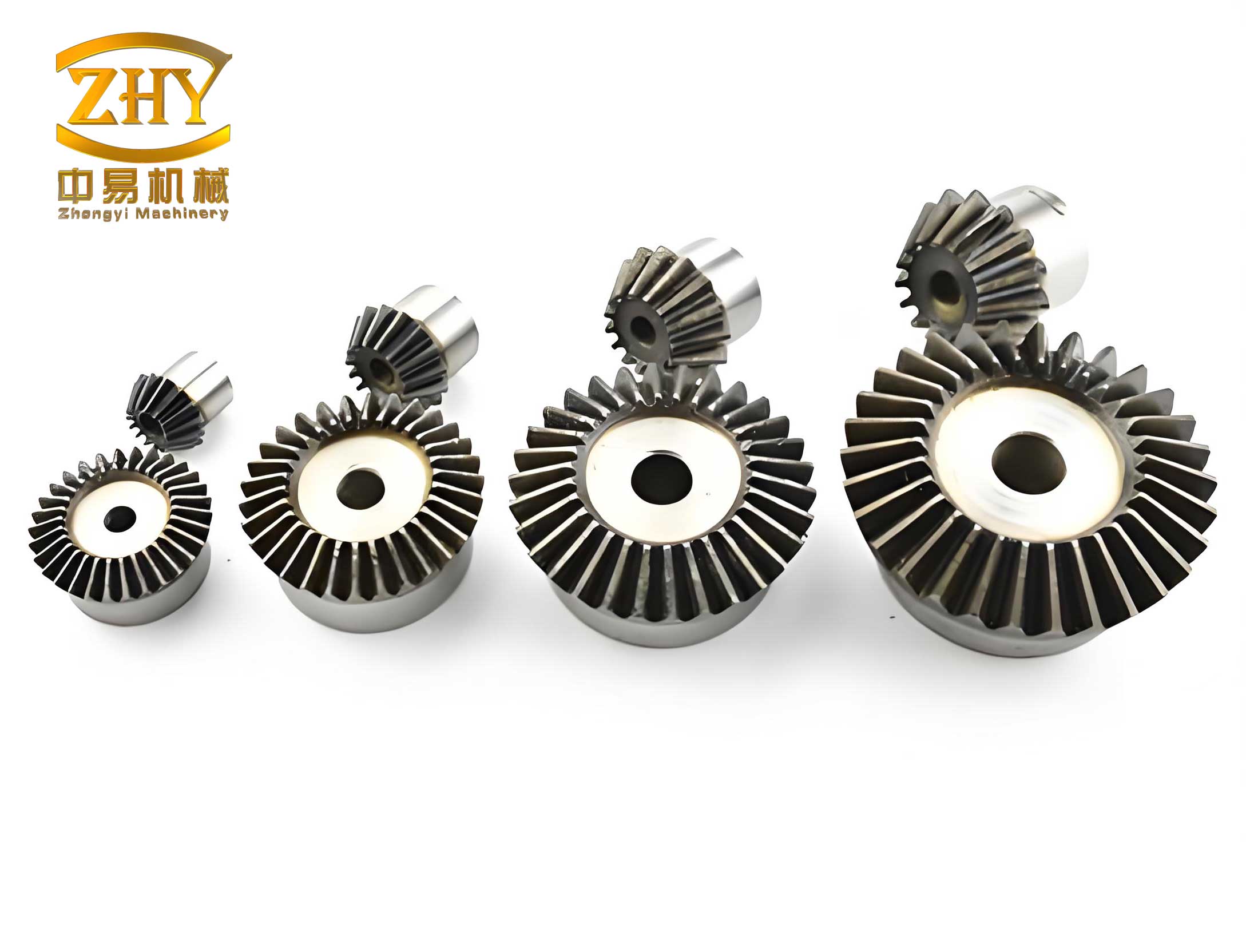
In the field of automotive transmission systems, bevel gears play a critical role in transferring power between intersecting shafts, especially in heavy-duty vehicles like trucks and buses. Historically, gear steels in many regions, including China, relied heavily on materials such as 20CrMnTi, which was adopted from earlier Soviet designs. This steel offered advantages like low cost and mature processing techniques, allowing it to dominate the gear steel market for decades. However, with advancing automotive technology, the demands on bevel gears have escalated significantly. Modern applications require enhanced fatigue life, minimal heat treatment deformation, and high strength to withstand rigorous operating conditions. Consequently, there has been a shift towards more advanced steel grades, including Cr-Mo, Cr-Ni-Mo, Mn-B, and Cr-Mn-Mo series. These materials provide superior performance but also present challenges in manufacturing and quality control. In response to this industry trend, our team embarked on developing a specialized steel grade, 22CrMoH2, tailored for bevel gears used in heavy vehicles. The primary objectives were to achieve high hardenability with a narrow hardenability band, reduce deformation during carburizing heat treatment (with circumferential deformation not exceeding 0.1 mm), and extend fatigue life. This article details our first-person perspective on the design, production, and validation of 22CrMoH2 steel, emphasizing key innovations and results.
The development of 22CrMoH2 steel was driven by specific technical requirements from a leading gear manufacturer, who needed it for producing drive and driven bevel gears in heavy trucks. Bevel gears are subjected to high torque and cyclic stresses, making material properties crucial for reliability. Our approach involved a comprehensive analysis of the factors influencing heat treatment deformation and fatigue life. We recognized that these two aspects are interconnected; for instance, fine grain structure not only reduces deformation but also improves fatigue resistance by inhibiting crack initiation. Thus, our process design integrated metallurgical principles, process optimization, and rigorous quality checks. Below, I will elaborate on the product design,工艺流程, and quality assessments that led to the successful production of 22CrMoH2 steel for bevel gears.
To address heat treatment deformation in bevel gears, we focused on grain refinement and segregation control. Fine-grained steels exhibit lower deformation tendencies because the increased grain boundary energy and紧密 intergranular connections resist slip during thermal cycles. The key challenge was maintaining fine austenite grain size at the carburizing temperature of 930°C. Aluminum nitride (AlN) offers some grain refinement, but its solubility at high temperatures limits its effectiveness during prolonged carburizing. Therefore, we introduced niobium (Nb) as a microalloying element. Nb forms stable carbonitrides, Nb(C,N), which pin grain boundaries and inhibit grain growth even at elevated temperatures. According to research, the optimal Nb content for this purpose is around 0.04%; higher levels (e.g., 0.08%) can lead to coarse, sparse precipitates that are less effective. We formulated this into our composition design, as shown later. The pinning effect can be described by the Zener drag equation:
$$ P = \frac{3 \gamma f}{2r} $$
where \( P \) is the pinning pressure, \( \gamma \) is the grain boundary energy, \( f \) is the volume fraction of precipitates, and \( r \) is the precipitate radius. For Nb(C,N), small, dispersed particles maximize \( P \), ensuring fine grains. Additionally, we considered ingot segregation patterns, known as “锭形偏析” in Chinese, which refers to the dendritic segregation in continuous cast billets. This segregation can cause asymmetric deformation during heat treatment. To mitigate this, we selected Φ600 mm round billets for rolling. Round billets promote uniform cooling during casting, resulting in more symmetrical segregation patterns. We also optimized electromagnetic stirring (EMS) parameters in the mold: setting the intensity to 150 A/2 Hz balanced the reduction of centerline segregation with minimizing white band formation. Furthermore, a high compression ratio during rolling helped alleviate center porosity and segregation. The relationship between reduction ratio and segregation improvement can be expressed as:
$$ S_f = S_i \cdot e^{-k \varepsilon} $$
where \( S_f \) is the final segregation index, \( S_i \) is the initial segregation index, \( k \) is a material constant, and \( \varepsilon \) is the true strain from rolling. By increasing the first-pass reduction, we transferred segregation zones inward, reducing their impact on bevel gear performance.
For enhancing the fatigue life of bevel gears, we prioritized material purity and microstructure control. Fatigue failure often initiates at non-metallic inclusions or microstructural defects, so minimizing these is critical. We adopted a composition strategy with molybdenum (Mo) at the mid-to-upper limit and chromium (Cr) at the mid-to-lower limit. Mo improves hardenability, refines grains, and enhances carburizing layer quality by forming spherical carbides, whereas Cr can lead to needle-like or network carbides that are detrimental. The beneficial effects of Mo on fatigue strength are well-documented, as it increases the resistance to overload and fatigue crack propagation. We also strictly controlled titanium (Ti) content, as excessive Ti forms coarse TiN inclusions that act as stress raisers. Instead, we relied on Nb for grain refinement without the Ti-related risks. The composition specifications are summarized in Table 1, showing both protocol requirements and our internal controls.
| Element | Protocol Range | Internal Control |
|---|---|---|
| C | 0.19–0.25 | 0.20–0.24 |
| Si | 0.17–0.37 | 0.23–0.27 |
| Mn | 0.60–1.00 | 0.80–0.98 |
| P | ≤0.020 | ≤0.018 |
| S | ≤0.025 | ≤0.008 |
| Cr | 0.90–1.25 | 0.92–1.00 |
| Mo | 0.35–0.45 | 0.40–0.42 |
| Als | 0.012–0.020 | 0.012–0.020 |
| Cu | ≤0.25 | ≤0.10 |
| O (×10-6) | ≤12 | ≤10 |
| N, Ti (×10-6) | ≤60 | ≤60 (Ti controlled separately) |
| Nb | Not specified | 0.04 (added for microalloying) |
To achieve high purity, we targeted low total oxygen (T.O) and sulfur contents. Studies show that fatigue life improves dramatically with reduced inclusion counts; for example, in bearing steels, lowering T.O from 8 ppm to 4.5 ppm increased L10 life by 4.2 times. We implemented several process measures: using high-quality refractories to minimize exogenous inclusions, controlling ladle furnace (LF) and vacuum degassing (VD) operations to reduce脱氧 pressure, and optimizing soft blowing to promote inclusion flotation. The kinetics of inclusion removal can be modeled using Stokes’ law:
$$ v = \frac{2 g (\rho_m – \rho_i) r^2}{9 \eta} $$
where \( v \) is the rising velocity, \( g \) is gravity, \( \rho_m \) and \( \rho_i \) are densities of molten steel and inclusions, \( r \) is inclusion radius, and \( \eta \) is viscosity. By maintaining stable ladle and tundish levels, we prevented slag entrapment. Additionally, we emphasized the importance of fine austenite grain size for fatigue resistance. The Hall-Petch relationship relates grain size \( d \) to yield strength \( \sigma_y \):
$$ \sigma_y = \sigma_0 + \frac{k_y}{\sqrt{d}} $$
where \( \sigma_0 \) and \( k_y \) are constants. Finer grains enhance strength and fatigue limit, which is crucial for bevel gears under cyclic loading.
The production流程 for 22CrMoH2 steel involved a integrated route from ironmaking to rolling. We started with hot metal from blast furnaces, which was charged into an 80-ton top-bottom combined blowing converter. After decarburization, the steel underwent refining in a 70-ton LF station, followed by VD treatment to achieve vacuum levels below 100 Pa for over 15 minutes. This ensured effective degassing and inclusion control. Continuous casting was performed on a R17m three-strand machine to produce Φ600 mm round billets. The billets were then hot- or cold-charged into a double-regenerative walking beam furnace for heating. After descaling with high-pressure water, the billets were rolled on a Φ1350 two-high reversible blooming mill and further finished on a Φ950 mill to produce 120 mm round bars. The bars were cut, cooled on a冷床, annealed, inspected for surface and internal defects via ultrasonic testing, and finally packaged. Key process parameters included superheat control at 20–28°C during casting, increased secondary cooling to reduce segregation, and optimized rolling reductions to eliminate ingot pattern segregation. The entire流程 was monitored to ensure consistency for bevel gear applications.
Quality assessment of the produced 22CrMoH2 steel involved extensive testing. Chemical composition uniformity was verified by sampling multiple points across the cross-section of bars from six heats. Results showed that all elements met internal controls, with oxygen content ranging from 6.1 to 8.6 ppm, nitrogen from 52 to 63 ppm, sulfur from 0.013% to 0.015%, and titanium from 35 to 43 ppm. The carbon variation within a single heat was minimal, with a range of 0.02% to 0.04%, indicating excellent homogeneity—a vital factor for consistent bevel gear performance. Hardenability was evaluated using the Jominy end-quench test after normalizing at 925°C and quenching at 925°C. The results, presented in Table 2, demonstrate compliance with protocol requirements for bevel gears, ensuring adequate depth of hardening after carburizing.
| Heat Number | J9 (HRC) | J15 (HRC) | Remarks |
|---|---|---|---|
| 7307126M | 45, 46 | 40, 39 | Meets protocol: J9 43–48, J15 36–41 |
| 7307127M | 46, 46 | 39, 39 | All values within specified ranges |
| 7307128M | 45, 46 | 39, 40 | Consistent hardenability across heats |
| 7307129M | 45, 46 | 41, 40 | Narrow band suitable for bevel gears |
| 7307130M | 45, 44 | 41, 39 | Ensures uniform carburized layer |
| 7307131M | 46, 45 | 41, 40 | Supports fatigue life requirements |
Macroetch testing revealed sound low-magnification structures: general porosity rated at 0.5–1.0级, center porosity at 1.0–1.5级, and ingot pattern segregation at 0–1.0级. These ratings indicate a dense, uniform material, which is essential for minimizing heat treatment distortion in bevel gears. Austenite grain size was assessed after carburizing simulations, showing fine grains of 7.5–8.5级 according to ASTM standards. This refinement directly contributes to reduced deformation and enhanced fatigue properties. Non-metallic inclusion ratings were determined using microscopic examination, as summarized in Table 3. The low levels of oxides, sulfides, and other inclusions confirm high cleanliness, critical for preventing fatigue crack initiation in bevel gears under cyclic loads.
| Inclusion Type | Thick (级) | Thin (级) | Comments |
|---|---|---|---|
| A (Sulfides) | 0.5–1.0 | 1.0–1.5 | Controlled S content minimizes these |
| B (Aluminates) | 0–0.5 | 0–1.0 | Low levels due to effective deoxidation |
| C (Silicates) | 0–0.5 | 0–1.0 | Rare, thanks to slag system optimization |
| D (Oxides) | 0–0.5 | 0.5–1.0 | Fine, dispersed oxides |
| Ds (Single particle) | 0.5 | Indicates absence of large inclusions | |
The performance of 22CrMoH2 steel in actual bevel gears was validated through user trials. Approximately 500 tons of the steel were delivered for manufacturing drive and driven bevel gears. After carburizing heat treatment, the deformation was measured, showing a comprehensive pass rate of 92.55% for circumferential deformation within 0.1 mm. This meets the stringent requirements for heavy vehicle applications, where precise gear geometry is vital for noise reduction and efficiency. Fatigue testing indicated that the bevel gears achieved the desired life cycles, with failures primarily occurring beyond the target thresholds. The success can be attributed to the synergistic effects of grain refinement, inclusion control, and optimized composition. For instance, the addition of Nb contributed to both fine grains and reduced segregation, while Mo enhanced hardenability and carbide morphology. These factors collectively improve the load-bearing capacity and durability of bevel gears.
In conclusion, the development of 22CrMoH2 steel represents a significant advancement in gear steel technology, specifically for bevel gears used in demanding environments. Our first-person experience in this project highlighted the importance of a holistic approach, integrating metallurgical design with process precision. By focusing on grain refinement through Nb microalloying, controlling segregation via round billet casting and rolling optimization, and ensuring high purity through advanced refining, we produced a material that excels in heat treatment stability and fatigue resistance. The bevel gears manufactured from this steel have demonstrated reliable performance in heavy trucks, earning customer approval. This achievement not only provides a robust solution for current gear applications but also sets a foundation for future innovations in high-performance steel grades. As the automotive industry continues to evolve, materials like 22CrMoH2 will play a pivotal role in enabling more efficient and durable transmission systems, particularly for bevel gears that are integral to power transfer in complex drivetrains.
Looking ahead, further research could explore additional microalloying elements or advanced heat treatment cycles to push the boundaries of bevel gear performance. However, the current results validate our strategies and underscore the value of tailored material development for specific engineering challenges. The lessons learned from this project will inform future endeavors in gear steel production, contributing to the broader goal of enhancing vehicle reliability and sustainability.