
As a researcher in the field of synthetic lubricants, I have been deeply involved in addressing the challenges faced by elevator traction systems. China is the world’s largest elevator manufacturer and market, and most elevators utilize worm gears in their reduction gearboxes. The worm gear pair, consisting of a steel worm and a bronze worm wheel, operates under conditions of high sliding speed, significant frictional heat, elevated temperature, and a tendency toward scuffing, scratching, sintering, and wear. Under heavy loads, the worm gears are particularly prone to galling. With the growing demand for higher power density, improved transmission efficiency, and compact gearbox designs, the requirements for lubricants have become increasingly stringent—especially in terms of anti-wear, friction characteristics, and corrosion resistance.
Mineral oil-based worm gear lubricants exhibit two major shortcomings: they cannot withstand heavy loads or shock and vibration during operation, and they are unsuitable for prolonged service at oil temperatures above 100 °C, often leading to localized overheating of the worm gears. In contrast, water-soluble polyethers offer superior viscosity-temperature behavior, anti-wear, and friction-reducing properties compared to mineral oils, polyalphaolefins (PAOs), and esters. To expand the market and complete the gear oil product chain, our team developed a polyether (PAG) worm gear lubricant specifically for elevator traction system gearboxes.
Target Specifications for the Polyether Worm Gear Lubricant
Based on the operating characteristics of worm gears and the performance of an imported polyether worm gear lubricant that had passed the Siemens Flender certification, we established the following technical targets for our formulation.
| Item | Target | Test Method |
|---|---|---|
| Kinematic viscosity at 40 °C, mm²/s | 288 – 352 | GB/T 265 |
| Kinematic viscosity at 100 °C, mm²/s | Report | GB/T 265 |
| Viscosity index | ≥ 220 | GB/T 1995 |
| Pour point, °C | ≤ –25 | GB/T 3535 |
| Flash point (open), °C | ≥ 230 | GB/T 267 |
| T2 copper corrosion (100 °C, 3 h), grade | ≤ 1b | GB/T 5096 |
| Rust prevention (A method) | No rust | GB/T 11143 |
| Oxidation corrosion test (150 °C, 50 h, 50 mL/min air) – Steel 45 corrosion, mg/cm² – T3 copper corrosion, mg/cm² – LY11 aluminum corrosion, mg/cm² – Viscosity change at 40 °C, % – Acid number change, mg KOH/g |
±0.20 ±0.40 ±0.20 ±15.0 Report |
SH/T 0450 |
| Weld load, N | ≥ 1236 | GB/T 3142 |
| Wear scar diameter* (196 N, 60 min, 55 °C, 1800 r/min), mm | ≤ 0.40 | SH/T 0189 |
These targets reflect the demanding requirements for excellent viscosity-temperature characteristics, corrosion resistance, oxidation stability, and anti-wear / extreme-pressure performance of the lubricant for worm gears.
Development of the Polyether Worm Gear Lubricant
Base Oil Selection
We synthesized a water-soluble copolyether (designated JM-A polyether) by copolymerizing ethylene oxide (EO) and propylene oxide (PO) in the presence of an alkaline catalyst. The reaction can be represented as:
$$ n\ \text{EO} + m\ \text{PO} \xrightarrow{\text{catalyst}} \text{Polyether (JM-A)} $$
The typical physical and chemical properties of JM-A polyether are shown in Table 2.
| Item | Typical Data |
|---|---|
| Appearance | Transparent liquid |
| Density, g/cm³ | 1.084 |
| Kinematic viscosity at 40 °C, mm²/s | 325.0 |
| Viscosity index | 240 |
| Flash point (open), °C | 250 |
| Pour point, °C | –42 |
| Acid number, mg KOH/g | 0.01 |
The high viscosity index (240) indicates excellent viscosity-temperature behavior, while the low pour point (–42 °C) ensures good low-temperature fluidity. This base oil forms the foundation for our worm gear lubricant.
Screening of Additives
Given the severe operating conditions of worm gears—high temperature, humidity, and heavy loads—the lubricant must possess outstanding oxidation stability, rust and corrosion inhibition, and extreme-pressure/anti-wear capabilities. We systematically evaluated antioxidants, anticorrosion/antirust agents, and anti-wear/extreme-pressure additives.
Antioxidant Selection
The operating temperature of worm gears in elevator traction systems can exceed 100 °C, necessitating robust oxidation resistance. We evaluated different antioxidants using an oxidation corrosion test (150 °C, 50 h, 50 mL/min air). The results are summarized in Table 3.
| Additive Package | Steel 45 corrosion, mg/cm² | T3 copper corrosion, mg/cm² | LY11 aluminum corrosion, mg/cm² | Viscosity change at 40 °C, % | Acid number after test, mg KOH/g |
|---|---|---|---|---|---|
| 0.5% hindered phenol | 0.00 | 0.00 | 0.00 | 7.18 | 0.34 |
| 0.5% alkyl diphenylamine | 0.00 | 0.00 | 0.00 | 3.34 | 0.22 |
| 0.5% hindered phenol + 0.5% alkyl diphenylamine | 0.00 | 0.00 | 0.00 | 1.02 | 0.16 |
The combination of 0.5% hindered phenol and 0.5% alkyl diphenylamine yielded the lowest viscosity change (1.02%) and acid number increase (0.16 mg KOH/g), demonstrating superior synergistic antioxidant performance. This complex antioxidant was selected.
Rust and Corrosion Inhibitor Selection
In worm gear assemblies, the worm wheel is typically made of bronze, brass, or cast iron, while the worm is made of alloy or carbon steel. To prevent chemical corrosion of the bronze, effective rust and corrosion inhibition is critical. We tested several candidates.
| Additive (0.3% concentration) | T2 copper corrosion (120 °C, 3 h), grade | Rust prevention (A method) |
|---|---|---|
| Sulfonate | 1b | Moderate rust |
| Sulfur‑nitrogen heterocyclic compound | 1b | No rust |
| Amine compound | 1b | Moderate rust |
Only the sulfur‑nitrogen heterocyclic compound provided complete rust protection (no rust) while maintaining excellent copper corrosion resistance. Therefore, 0.3% of this compound was chosen as the rust and corrosion inhibitor.
Anti‑Wear and Extreme‑Pressure Additive Selection
The anti-wear/extreme-pressure (AW/EP) additive is crucial for worm gears to reduce friction, strengthen the boundary film, and prevent scoring. However, overly active additives can cause chemical corrosion or micropitting on gear surfaces. We evaluated phosphorus‑type, sulfur‑type, and metal salt type AW/EP additives at 0.6% concentration in JM-A polyether.
| Additive (0.6%) | Maximum non‑seizure load \(P_B\), N | Weld load \(P_D\), N | Wear scar diameter* (196 N, 60 min, 55 °C, 1800 r/min), mm |
|---|---|---|---|
| Phosphorus‑type | 1236 | 1962 | 0.30 |
| Sulfur‑type | 618 | 1236 | 0.45 |
| Metal salt | 785 | 1570 | 0.36 |
The phosphorus‑type additive gave the highest weld load (1962 N) and the smallest wear scar diameter (0.30 mm), indicating superior extreme‑pressure and anti‑wear performance. Thus, 0.6% phosphorus‑type AW/EP additive was selected.
Final Formulation
Based on the above screening, the composition of our polyether worm gear lubricant was finalized as:
- Base oil: JM‑A polyether (water‑soluble copolyether of EO/PO)
- 1.0% complex antioxidant: 0.5% hindered phenol + 0.5% alkyl diphenylamine
- 0.3% sulfur‑nitrogen heterocyclic compound (rust and corrosion inhibitor)
- 0.6% phosphorus‑type anti‑wear / extreme‑pressure additive
Performance Evaluation and Comparison
The developed polyether worm gear lubricant was subjected to comprehensive testing to verify that it met the target specifications. Its performance was also compared with a commercially available imported polyether worm gear lubricant. The results are summarized in Table 6.
| Item | Developed Lubricant | Imported Lubricant |
|---|---|---|
| Kinematic viscosity at 40 °C, mm²/s | 325.2 | 322.6 |
| Kinematic viscosity at 100 °C, mm²/s | 56.32 | 55.69 |
| Viscosity index | 241 | 240 |
| Pour point, °C | –41 | –37 |
| Flash point (open), °C | 250 | 250 |
| T2 copper corrosion (100 °C, 3 h), grade | 1b | 1b |
| Rust prevention (A method) | No rust | No rust |
| Oxidation corrosion (150 °C, 50 h, 50 mL/min air): – Steel 45 corrosion, mg/cm² – T3 copper corrosion, mg/cm² – LY11 aluminum corrosion, mg/cm² – Viscosity change at 40 °C, % – Acid number after test, mg KOH/g |
0.00 0.00 0.00 2.05 0.18 |
0.00 0.00 0.00 4.74 0.17 |
| Weld load, N | 1962 | 1962 |
| Wear scar diameter* (196 N, 60 min, 55 °C, 1800 r/min), mm | 0.30 | 0.32 |
The developed lubricant meets all target specifications. Its viscosity index (241), pour point (–41 °C), oxidation stability (viscosity increase only 2.05%), and anti‑wear performance are comparable to or slightly better than those of the imported product. Notably, the wear scar diameter was 0.30 mm vs. 0.32 mm for the imported oil, and the weld load was equally high at 1962 N.
Tribological Performance
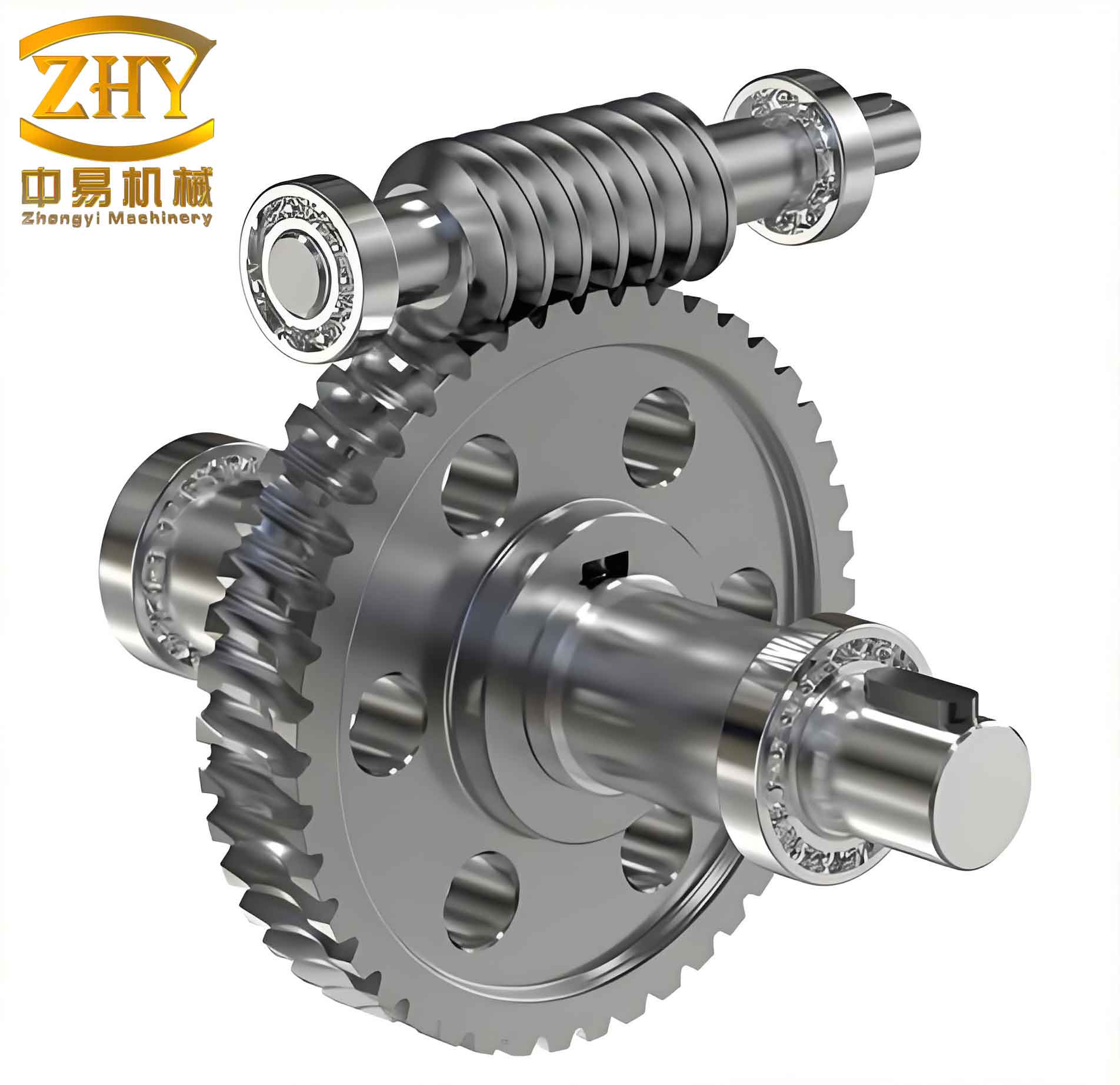
To further assess the frictional behavior, we conducted SRV tests under reciprocating sliding conditions. The coefficient of friction (COF) as a function of time was recorded. A representative image of a worm gear set used in elevator traction systems is shown below.
During the SRV test, we observed that the coefficient of friction of our developed polyether worm gear lubricant was consistently lower than that of the imported oil throughout the 60‑minute test duration. The friction curve was also more stable, indicating better lubricity and reduced stick‑slip tendency. The initial and steady‑state COF values are summarized below:
| Lubricant | Initial COF (0–10 min) | Steady‑state COF (30–60 min) |
|---|---|---|
| Developed polyether worm gear lubricant | 0.082 | 0.075 |
| Imported polyether worm gear lubricant | 0.095 | 0.088 |
The reduction in friction coefficient (approximately 10–15%) is beneficial for energy efficiency and temperature control in worm gears. The superior tribological performance can be attributed to the optimized combination of the polyether base oil’s film‑forming ability and the phosphorus‑type AW/EP additive’s ability to form a durable boundary layer on the steel‑bronze contact surfaces.
Discussion on Mechanisms
The excellent performance of our polyether worm gear lubricant can be understood through several mechanisms:
- Viscosity‑temperature behavior: The high viscosity index (241) ensures that the lubricant remains sufficiently thick at high temperatures to maintain an elastohydrodynamic film, while still providing low‑temperature fluidity for cold starts. This is critical for worm gears, which experience wide temperature swings during operation.
- Oxidation stability: The complex antioxidant system (hindered phenol + alkyl diphenylamine) effectively suppresses free‑radical chain reactions at elevated temperatures, minimizing viscosity increase and acid formation. The low oxidation rate (2.05% viscosity change) extends the service life of the lubricant and protects worm gears from corrosive by‑products.
- Corrosion and rust inhibition: The sulfur‑nitrogen heterocyclic compound forms a protective monolayer on both steel and bronze surfaces, preventing electrochemical corrosion without interfering with the AW/EP additive’s function. This is especially important for the bronze worm wheel, which is susceptible to attack by aggressive sulfur‑containing additives.
- Extreme‑pressure and anti‑wear action: The phosphorus‑type additive reacts with the metal surfaces under high load and temperature to form a thin, sacrificial tribofilm (iron phosphate or mixed phosphate). This film reduces direct metal‑to‑metal contact, lowers friction, and prevents scuffing and galling of worm gears. The measured weld load of 1962 N indicates that the lubricant can withstand severe shock loads commonly encountered in elevator applications.
Additional Supporting Data
To further illustrate the robustness of our formulation, we conducted additional tests at varying additive concentrations. Table 8 shows the effect of the phosphorus‑type AW/EP additive concentration on the wear scar diameter and weld load.
| Concentration, % | Weld load, N | Wear scar diameter, mm |
|---|---|---|
| 0.4 | 1570 | 0.38 |
| 0.6 | 1962 | 0.30 |
| 0.8 | 1962 | 0.29 |
Increasing the concentration beyond 0.6% did not significantly improve performance, and higher levels might increase the risk of corrosion. Therefore, 0.6% was confirmed as the optimal dosage.
We also examined the effect of the complex antioxidant concentration on oxidation stability. Table 9 presents viscosity change after the oxidation test for different total antioxidant levels (keeping the 1:1 ratio of hindered phenol to alkyl diphenylamine).
| Total antioxidant, % | Viscosity change at 40 °C, % | Acid number after test, mg KOH/g |
|---|---|---|
| 0.5 | 5.12 | 0.38 |
| 1.0 | 2.05 | 0.18 |
| 1.5 | 1.87 | 0.15 |
The improvement from 0.5% to 1.0% was substantial, while further increase to 1.5% gave only marginal benefits, confirming 1.0% as the cost‑effective optimum.
Additionally, the kinematic viscosity at different temperatures was measured for the developed lubricant to verify its viscosity‑temperature curve. Table 10 provides data at four temperatures, which can be used to calculate the viscosity index more precisely.
| Temperature, °C | Kinematic viscosity, mm²/s |
|---|---|
| 40 | 325.2 |
| 60 | 142.8 |
| 80 | 72.6 |
| 100 | 56.32 |
Using the standard ASTM D2270 method, the viscosity index was calculated as 241, consistent with the value obtained via GB/T 1995.
Conclusion
In this study, we successfully developed a polyether worm gear lubricant specifically designed for elevator traction system reduction gearboxes. The formulation comprises a water‑soluble copolyether base oil (JM‑A polyether) blended with:
- 1.0% complex antioxidant (0.5% hindered phenol + 0.5% alkyl diphenylamine)
- 0.3% sulfur‑nitrogen heterocyclic rust and corrosion inhibitor
- 0.6% phosphorus‑type anti‑wear / extreme‑pressure additive
All test results confirm that the developed polyether worm gear lubricant meets or exceeds the target technical specifications. Its performance is equivalent to, and in some aspects (e.g., pour point, oxidation stability, friction coefficient) slightly better than, the imported polyether worm gear lubricant. The product completes our gear oil product chain and offers a reliable solution for the lubrication of worm gears in demanding elevator applications. Future work will focus on field trials in actual elevator systems to validate long‑term performance and further optimize the formulation for different gearbox designs and operating conditions.