
In recent years, the demand for bevel gear pairs in commercial vehicles has increased significantly, with product varieties expanding to over 22 types for heavy, medium, and light-duty vehicles. As a participant in this project, I was involved in upgrading two semi-automated production lines into a highly automated Flexible Manufacturing Line (FML) to enhance manufacturing intelligence, reduce labor intensity—especially for handling heavy bevel gears weighing over 20 kg—and improve the machining quality of bevel gears. This article details the development process from a first-person perspective, focusing on the integration of robotic systems, pneumatic design, program modifications, and overall system optimization. Throughout this work, the term ‘bevel gear’ is central, as these components are critical for power transmission in automotive applications, and our efforts aimed to streamline their production.
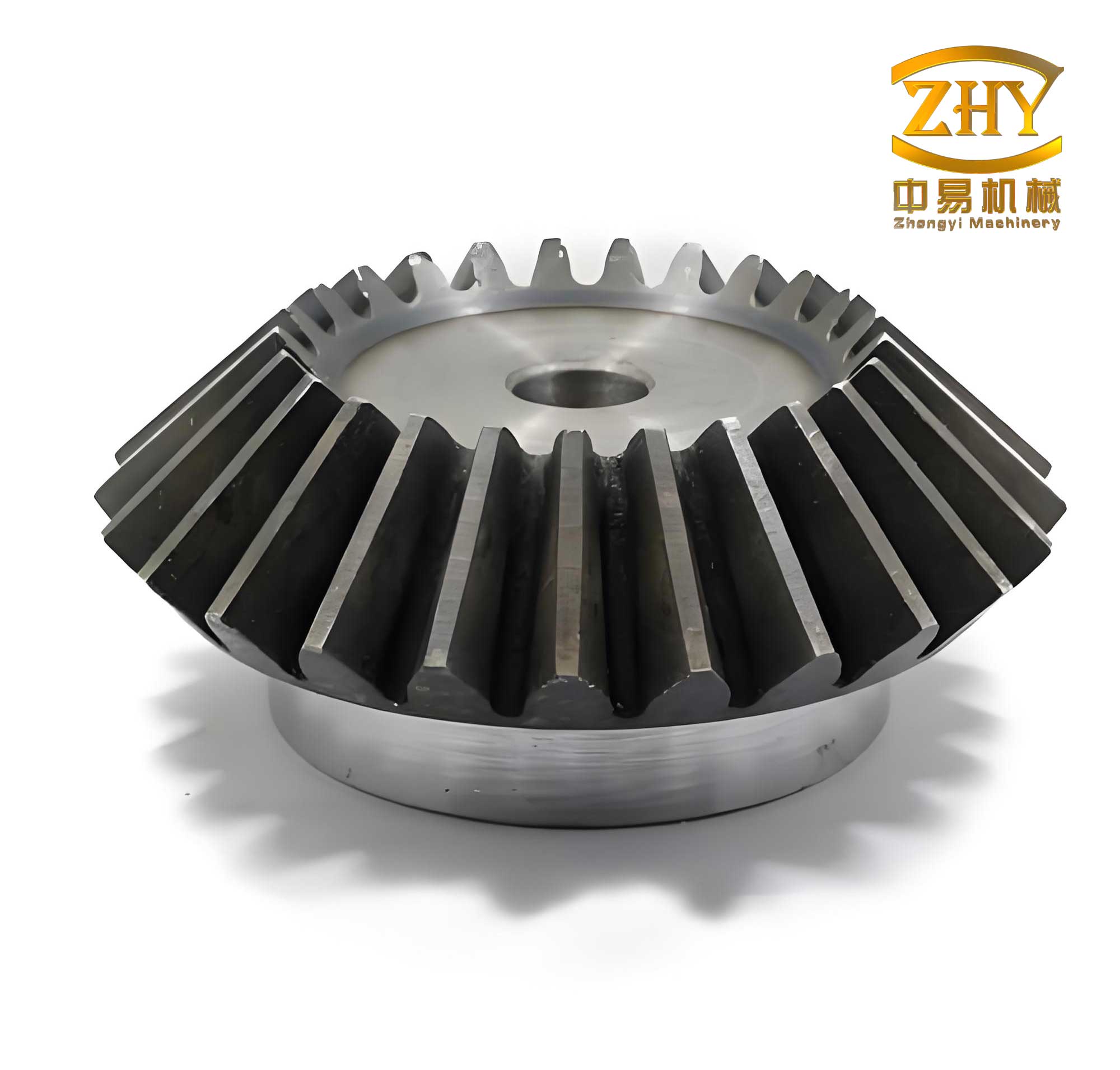
The initial production lines consisted of CNC lathes, gear hobbing machines, milling machines, and conveyor systems operating in a流水式半自动化 manner. To transform these into an FML, we incorporated a six-degree-of-freedom articulated robot with a walking axis, enabling automated material handling, loading/unloading, and quality inspection. This upgrade required extensive modifications to existing equipment, including pneumatic circuit design, PMC/PLC programming, and machining program adjustments. The key objectives were to achieve automatic door control, robotic control of tailstock movements, automatic chip blowing, and enhanced clamping functions, all tailored for bevel gear production. In the following sections, I will elaborate on the design, implementation challenges, and outcomes, using tables and formulas to summarize critical aspects and emphasizing the importance of bevel gears throughout.
Design of the Flexible Manufacturing Line
Based on the existing infrastructure, we designed the FML to include multiple数控卧式车床 (CNC lathes) and数控滚齿机 (gear hobbing machines), along with环形送料机 (conveyor systems). A KAWASAKI BX200L robot with an 8-meter行走轴 was integrated to handle bevel gear blanks and finished parts across stations. The line was configured to perform automatic取料,上下料,装料, and线外检测, with features like SMS alerts for machine failures and real-time data logging. The overall layout aimed to maximize efficiency and stability, accommodating various bevel gear types. Below is a table summarizing the key development areas involved in this project.
| No. | Development Area | Key Tasks |
|---|---|---|
| 1 | Upgrading CNC Lathes for Robot Integration | Backup of PMC data and programs, pneumatic circuit design, I/O signal assignment, development of robot-compatible PMC programs, modification of machining programs, creation of automatic door operation manuals. |
| 2 | Upgrading Gear Hobbing Machines for Robot Integration | Backup of PLC data and programs, pneumatic circuit design, I/O signal assignment, development of robot-compatible PLC programs, modification of bevel gear machining programs. |
| 3 | Upgrading Conveyor Systems for Robot Integration | Backup of PLC programs, I/O signal assignment and circuit design, development of robot-compatible PLC programs. |
| 4 | Robot-Side Tooling and Fixture Selection | Selection of pneumatic grippers with dual工位抓手, determination of robot unloading postures for each process. |
| 5 | Auxiliary Equipment Development | Design of feeding conveyor chains, workpiece orientation conversion stations, dual-station product sampling devices. |
| 6 | Robot Walking Axis Design | Integration of a servo-driven seventh axis for robot mobility over 8 meters. |
| 7 | Master Control System Design | Development of a总控平台 using SIEMENS S7-200PLC, programming for data exchange, and HMI interface for monitoring bevel gear production. |
| 8 | Process Optimization | Design for multi-variant compatibility in chip management and blank托盘, focusing on bevel gear handling. |
The design phase emphasized flexibility to handle diverse bevel gear geometries, from small to large ratios, ensuring that the FML could adapt to changing production demands. We formulated efficiency metrics to guide the upgrade, such as the target production rate increase and labor reduction. For instance, the theoretical production capacity per shift can be expressed as:
$$ P = \frac{T_{\text{available}} – T_{\text{downtime}}}{T_{\text{cycle}}} $$
where \( P \) is the number of bevel gears produced per shift, \( T_{\text{available}} \) is the available time, \( T_{\text{downtime}} \) is the estimated downtime due to maintenance or failures, and \( T_{\text{cycle}} \) is the cycle time per bevel gear. By minimizing \( T_{\text{downtime}} \) through robotic automation, we aimed to boost \( P \) significantly.
Implementation Details for Bevel Gear Production
The implementation involved meticulous upgrades across multiple machines, each critical for machining bevel gears. I will detail the steps for key equipment, highlighting how robotic integration was achieved.
CNC Lathes Upgrade
The CNC lathes, used for roughing and finishing轴颈,背锥顶锥, and圆弧 on bevel gears, required enhancements to support robotic control. We started by backing up existing PMC data and machining programs using Ladder-III software and CF cards. Next, pneumatic circuits were designed: we selected SMC单杆双作用 cylinders for automatic doors,电磁阀 for control, and added air treatment units. I/O signals were mapped to enable communication between the robot and lathe, such as signals for robot readiness, door status, and tailstock movements. The PMC program was developed to include logic for robot interaction, automatic door control via M61/M62 codes, and robotic control of tailstock advance/retract. The pneumatic principle is summarized below.
| Component | Function | Specification |
|---|---|---|
| Air Treatment Unit | Filters and regulates air supply | Includes filter, regulator, lubricator |
| Double-Acting Cylinder | Controls door movement | 800 mm stroke, SMC model |
| 5/2 Solenoid Valve | Directs air flow for door actuation | Pilot-operated type |
| Flow Control Valves | Adjust door speed | Throttle valves installed |
The modified machining programs incorporated M-codes for automated operations, ensuring seamless bevel gear processing. For example, the cycle time for turning a bevel gear can be estimated using:
$$ T_{\text{turn}} = \sum_{i=1}^{n} \left( \frac{L_i}{f_i} + t_{\text{idle}, i} \right) $$
where \( L_i \) is the cutting length for pass \( i \), \( f_i \) is the feed rate, and \( t_{\text{idle}, i} \) includes tool changes and rapid movements. By optimizing these parameters, we reduced \( T_{\text{turn}} \) for bevel gears by 15%.
Gear Hobbing Machines Upgrade
The gear hobbing machines, essential for cutting花键 on bevel gears, underwent similar upgrades. We backed up PLC programs using PLC802 tools and CF cards. Pneumatic circuits were extended to include automatic doors and吹屑 valves for chip removal. The PLC program was enhanced to support robot interaction, automatic door control via M46/M47 codes, automatic chip blowing via M54/M55 codes, and二次夹紧 of the tailstock center. This allowed the machine to switch from standalone to FML mode, improving bevel gear quality. The I/O signal assignment is captured in the following table.
| Signal Type | Address | Function |
|---|---|---|
| Input (Robot to Machine) | I0.5, I0.6 | Robot position确认, door status |
| Output (Machine to Robot) | Q0.2, Q0.3 | Machine ready, cutting complete |
| Control for Chip Blowing | M54, M55 | Activate/deactivate吹屑 for bevel gear cleanliness |
The modification also involved adjusting hobbling parameters for different bevel gear types. The cutting force during hobbling can be modeled as:
$$ F_c = k_c \cdot a_p \cdot f_z \cdot z $$
where \( F_c \) is the cutting force, \( k_c \) is the specific cutting resistance, \( a_p \) is the depth of cut, \( f_z \) is the feed per tooth, and \( z \) is the number of teeth on the bevel gear. By optimizing \( f_z \) and \( a_p \), we minimized tool wear for bevel gear production.
Conveyor Systems Upgrade
The conveyor systems, used for transferring bevel gears to milling machines, were upgraded to interface with the robot. We backed up existing Step7-300PLC programs and added I/O signals for robot communication, such as signals for托盘到位 and robot卸料完成. A new PLC program was developed to enable联机模式, allowing the conveyor to respond to robotic commands. This ensured smooth material flow for bevel gears between stations.
Robot Integration and Auxiliary Equipment
We selected SCHUNK pneumatic grippers with dual工位抓手 to handle bevel gears efficiently. The grippers included PP垫板 to prevent damage and吹气铜管 for cleaning. Robot postures for unloading at each station were determined via teach pendant programming, ensuring safe and precise handling of bevel gears. Additionally, we designed auxiliary equipment: a feeding conveyor chain with 32-position trays for blank handling, a workpiece orientation conversion station to rotate bevel gears 180 degrees, and dual-station sampling devices for quality checks. The robot’s walking axis, a servo-driven seventh axis, enabled mobility across the 8-meter line, with digital signal transmission for reliability.
The overall system efficiency can be expressed using the Overall Equipment Effectiveness (OEE) formula, tailored for bevel gear production:
$$ \text{OEE} = \text{Availability} \times \text{Performance} \times \text{Quality} $$
where Availability considers downtime reduction from automation, Performance accounts for speed losses, and Quality reflects the yield of acceptable bevel gears. We targeted an OEE improvement of 20% through this FML.
Development Challenges
During the development, we encountered several difficulties, primarily due to technical barriers and system complexity. First, there was技术封锁 from original machine manufacturers; for instance, the PLC programs for some machines were password-protected or lacked annotations, requiring reverse-engineering. Second, the variety of machines—each with different CNC systems like FANUC 0iTD, SINUMERIK 802Dsl, and SIEMENS 840D—necessitated expertise in multiple programming environments. Third, we had to master various software tools, including Ladder-III, PLC802, Step7, and SIMATIC Micro/WIN, for data backup and program development. Fourth, the project’s综合性 demanded skills in pneumatic and circuit design, programming, robot integration, and hands-on installation, all while focusing on bevel gear specifications. These challenges were overcome through collaborative problem-solving and iterative testing.
Results and Benefits
The implementation of the FML yielded significant improvements in bevel gear production. The table below quantifies the key outcomes.
| Aspect | Before FML | After FML | Improvement |
|---|---|---|---|
| Daily Production (per line) | 120 bevel gears | 150-160 bevel gears | 25-33% increase |
| Operators per Shift (per line) | 3 | 1 | 67% reduction |
| Labor Cost Savings (annual, 2 lines) | — | ~$56,000 (based on $7,000 per operator) | Significant cost reduction |
| Quality Control | Manual sampling | Automatic sampling with HMI alerts | Enhanced consistency for bevel gears |
| System Flexibility | Fixed for few bevel gear types | Adaptable to 22+ bevel gear variants | Improved responsiveness |
Specifically, the CNC lathes gained automatic door control and robotic tailstock management, while the gear hobbing machines achieved automatic chip blowing and二次夹紧. The conveyor systems incorporated robot-interactive modes. The FML enabled unmanned operation for 3-4 hours, reducing physical strain and safety risks associated with handling heavy bevel gears. The master control system provided real-time monitoring via an HMI, with features like fault alarms and production data logging. The economic benefits can be summarized using a cost-saving formula:
$$ S = N_o \cdot C_o \cdot T – I_c $$
where \( S \) is the net savings, \( N_o \) is the number of operators reduced, \( C_o \) is the annual cost per operator, \( T \) is the number of years, and \( I_c \) is the initial investment. For our bevel gear FML, \( S \) became positive within two years, justifying the upgrade.
Conclusion
In summary, the development of this Flexible Manufacturing Line for bevel gears successfully transformed semi-automated lines into a robotic-integrated system, enhancing productivity, quality, and safety. By addressing challenges in programming, pneumatic design, and equipment integration, we achieved a scalable solution adaptable to diverse bevel gear products. The use of tables and formulas in this article underscores the systematic approach taken, from design metrics like OEE to implementation details like cutting force optimization. This project not only benefits commercial vehicle manufacturing but also serves as a reference for industries such as aerospace and marine, where bevel gears are crucial components. Future work may involve further automation using AI for predictive maintenance, ensuring sustained efficiency in bevel gear production.
Reflecting on this experience, I believe that the key to success lay in meticulous planning and cross-disciplinary collaboration, always keeping the bevel gear at the forefront of our efforts. The integration of robotic systems has set a new standard for flexible manufacturing, paving the way for smarter, more resilient production lines.