
The development of robotics and integrated mechatronic systems places stringent demands on the power density of transmission devices, creating significant opportunities for hyperboloid gears with few pinion teeth and high reduction ratios. Characterized by high contact ratio, smooth operation, exceptional load-carrying capacity, and flexible spatial configuration, hyperboloid gears maintain high transmission efficiency even under high reduction ratios. Under comparable conditions, their efficiency can exceed that of standard worm drives by over 15%. Furthermore, their superior manufacturability allows for hard finishing processes like grinding on both the pinion and gear, ensuring long-term meshing accuracy. Consequently, in precision indexing, CNC machine tool servos, and integrated mechatronic equipment, few-teeth, high-ratio hyperboloid gears are increasingly being adopted as replacements for worm or planetary gear drives. The core of designing such hyperboloid gears lies in the determination of the pitch cone geometry and the selection of appropriate tooth geometry coefficients.
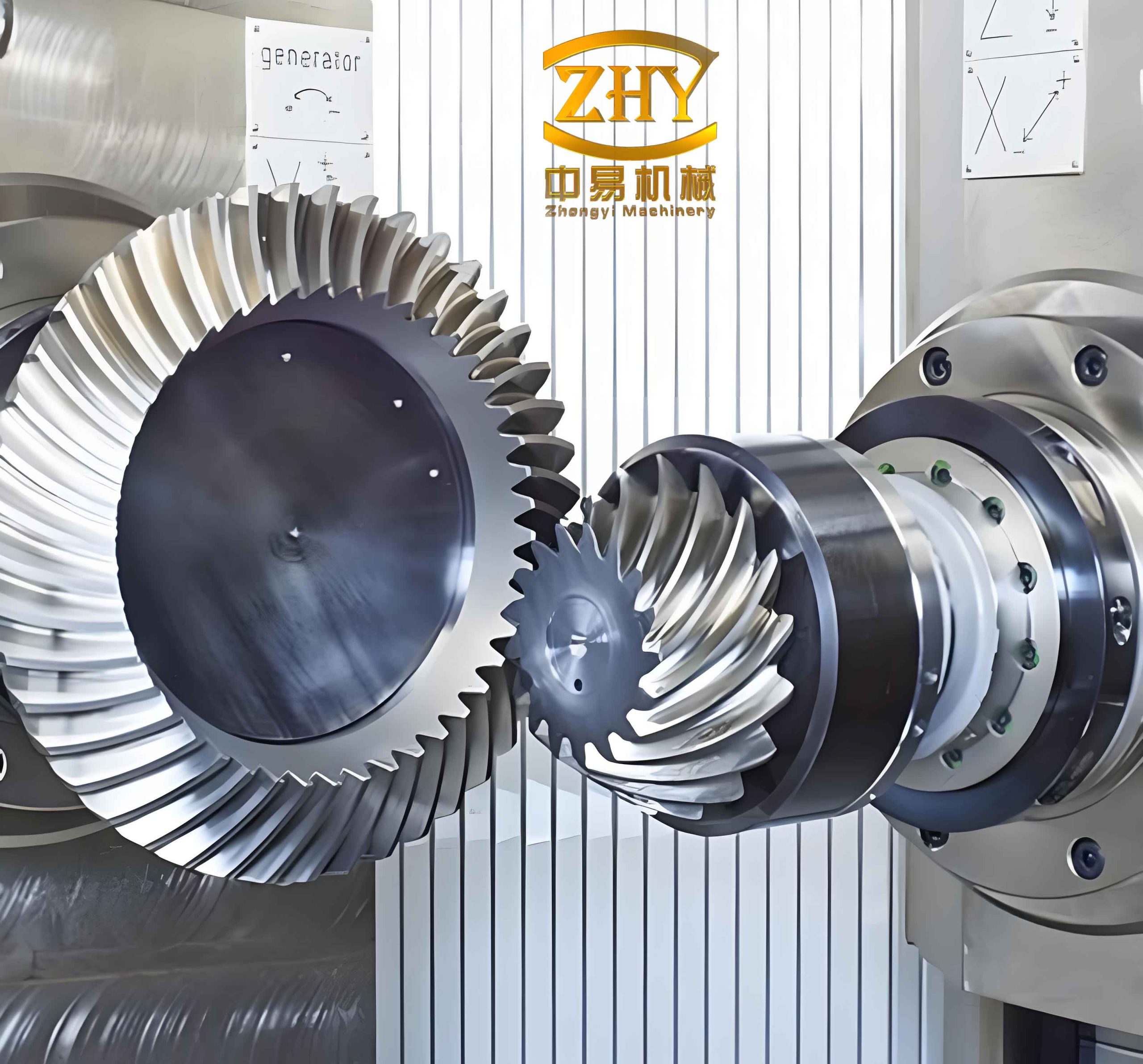
The American Gear Manufacturers Association (AGMA) standards typically constrain the pinion tooth count to no fewer than 5 and the sum of pinion and gear teeth to no less than 40. When designing a hyperboloid gear with a pinion tooth count below 5, several critical factors must be considered: meshing limitations, cutting feasibility, and strength balance conditions. These translate into specific geometric constraints that govern the permissible design space.
I. Pitch Cone Determination and Geometric Constraints
The design of the pitch cone for a high-ratio hyperboloid gear is not unique for a given ratio. While classical methods imposed numerous restrictive conditions to find a single solution, modern computational optimization allows for a more flexible approach, focusing on achieving key performance targets within defined boundaries.
A. Key Geometric Design Constraints
Several fundamental constraints must be enforced to ensure a functional and manufacturable hyperboloid gear pair.
1. Limiting Pressure Angle (Second-Order Contact Boundary): To prevent the occurrence of detrimental second-order contact boundaries on the tooth surface, the limiting pressure angle must be controlled. It is calculated by:
$$ \tan \alpha_{\text{lim}} = \frac{R_2 \sin \beta_2 – R_1 \sin \beta_1}{R_2 \tan \delta_2 + R_1 \tan \delta_1} \cdot \frac{\cos \epsilon’}{\tan \delta_1 \tan \delta_2} $$
where $R_1$, $R_2$ are the pitch cone distances; $\beta_1$, $\beta_2$ are the mean spiral angles; $\delta_1$, $\delta_2$ are the pitch angles; and $\epsilon’$ is the offset angle. A practical constraint such as $\alpha_{\text{lim}} < 8^\circ$ is typically applied.
2. Limiting Curvature Radius vs. Cutter Radius: Classical symmetrical design aimed for equal meshing characteristics on both tooth flanks by making the limiting curvature radius $r_{\text{lim}}$ equal to the cutter radius $r_c$. The formula is:
$$ r_{\text{lim}} = \frac{\tan \beta_1 – \tan \beta_2}{ \frac{1}{R_1 \cos \beta_1} – \frac{1}{R_2 \cos \beta_2} – \tan \alpha_{\text{lim}} \left( \frac{\tan \beta_1}{R_1 \tan \delta_1} + \frac{\tan \beta_2}{R_2 \tan \delta_2} \right) } $$
Modern designs, especially for high-ratio hyperboloid gears, often employ asymmetric profiles to favor the drive side strength. Therefore, this condition is relaxed to a constraint, ensuring the values are close but not necessarily identical: $\left| \frac{r_{\text{lim}}}{r_c} – 1 \right| \leq 0.01$.
3. Manufacturing (Cutting) Constraint: As the ratio increases, the gear pitch angle $\delta_2$ approaches $90^\circ$, which risks interference between the gear face cone and the cutter head. Thus, a limit is imposed: $\delta_2 \leq 85^\circ$.
4. Pinion Undercutting and Strength Constraint: With a very low tooth count, the pinion is prone to undercutting. To avoid this and ensure balanced strength relative to the gear, the pinion’s virtual number of teeth $z_{v1}$ is constrained to a minimum value (e.g., 50). It is calculated as:
$$ z_{v1} = \frac{z_1}{\cos \delta_1 \cdot \cos^3 \beta_1} $$
5. Offset and Spiral Angle Constraints: The offset $E$ should be within a practical range relative to the gear pitch radius $r_2$: $0.3 \leq \frac{E}{r_2} \leq 0.6$. To prevent excessive axial thrust, the gear spiral angle is limited: $\beta_2 \leq 40^\circ$.
B. A New Convergence Condition for Optimal Pinion Volume
To uniquely determine a pitch cone configuration that prioritizes pinion strength, we propose an optimization objective: maximizing the pinion volume factor $k_1$. This factor is given by:
$$ k_1 = \tan \beta_2 \sin \epsilon’ + \cos \epsilon’ $$
Analysis shows that $k_1$ reaches its maximum when the derivative with respect to $\epsilon’$ is zero, leading to the condition $\epsilon’ = \beta_2$. Since the relationship between spiral angles is $\epsilon’ = \beta_1 – \beta_2$, the optimal condition becomes:
$$ \beta_1 = 2\beta_2 $$
This equation indicates that for a given gear spiral angle $\beta_2$, the pinion volume is maximized when its spiral angle is twice that of the gear. This condition serves as the primary convergence target in the pitch cone optimization process.
The pitch cone parameters—spiral angles $\beta_1$, $\beta_2$, pitch angles $\delta_1$, $\delta_2$, and distances from the crossing point to the cone apexes—are determined by solving an optimization problem. The objective is to satisfy $\beta_1 = 2\beta_2$ while adhering to all the geometric constraints listed in Section I.A.
II. Tooth Geometry Design and Parameter Selection
Following pitch cone determination, the tooth geometry is defined based on parameters at the mean point of the gear. Key decisions involve selecting appropriate addendum and dedendum coefficients and applying profile shift to prevent tooth pointing and to intentionally increase the pinion’s outer diameter for enhanced strength.
A. Pinion Tip Thickness Constraint
The pinion’s tip thickness at the outer end is critical and is influenced by radial and tangential profile shift. Since the gear is often cut by a forming (non-generating) method, its cutter point width $W_2$ can be adjusted to control the pinion’s tip thickness.
$$ W_2 = s_{n1} – h_{f2} (\tan \alpha_u – \tan \alpha_v) $$
where $s_{n1}$ is the pinion normal circular tooth thickness at the mean point, $h_{f2}$ is the gear dedendum, and $\alpha_u$, $\alpha_v$ are the working pressure angles on the concave and convex sides. The mean normal tooth thickness for the pinion is:
$$ s_{n1} = p_n \cos \beta_2 – s_{n2} $$
$$ s_{n2} = 0.5 p_n \cos \beta_2 – (h_{a1} – h_{a2}) \tan \alpha – k_t m_n $$
Here, $p_n = \pi m_n$ is the normal circular pitch, $m_n$ is the mean normal module, $h_{a1}$, $h_{a2}$ are the addendum of pinion and gear, $\alpha$ is the mean pressure angle, and $k_t$ is the tooth thickness factor.
The pinion tip thickness $S^*_{an}$ is then calculated and must satisfy: $S^*_{an} \geq 0.4 m_n$.
$$ S^*_{an} = r_{a1} \left[ \frac{s_{n1}}{r_1} – (\text{inv} \alpha_{au} – \text{inv} \alpha_u) – (\text{inv} \alpha_{av} – \text{inv} \alpha_v) \right] $$
B. Minimum Slot Width Constraint
To ensure good cutting conditions and tool life, the minimum slot width at the pinion’s inner end must be constrained, typically to no less than $0.4 m_n$. The formula is:
$$ W_{L1} = p_{in} – (h_{fi1} + h_{fi2})(\tan \alpha_u – \tan \alpha_v) + j_{\text{min}} $$
where $p_{in}$ is the normal circular pitch at the inner end, $h_{fi1}+h_{fi2}$ is the sum of dedendum at the inner end, and $j_{\text{min}}$ is the minimum normal backlash.
III. Computational Procedure for Geometric Parameters
The design process is algorithmic and can be implemented computationally.
Step 1: Input Basic Parameters. The designer specifies: number of teeth ($z_1$, $z_2$), gear pitch radius ($r_2$), shaft angle ($\Sigma$), offset ($E$), and cutter radius ($r_c$). These are often determined based on application requirements, structural limits, experience, or preliminary optimization.
Step 2: Determine Pitch Cone via Optimization. Using the constraints from Section I.A and the objective $\beta_1 = 2\beta_2$ from Section I.B, an optimization solver determines the final pitch cone parameters ($\delta_1$, $\beta_1$, $t_{z1}$, $\delta_2$, $\beta_2$, $t_{z2}$).
Step 3: Calculate Detailed Tooth Geometry. Subject to the constraints in Section II, suitable addendum coefficients, dedendum coefficients, and the tooth thickness factor $k_t$ are selected. The complete set of tooth geometry parameters—including addendum, dedendum, working depth, face angles, root angles, and outer diameters—are calculated using standard hyperboloid gear geometry formulas.
Following this procedure for a 3:60 ratio hyperboloid gear pair, the following geometric parameters were computed and are summarized in Table 1.
| Item | Gear (Wheel) | Pinion |
|---|---|---|
| Number of Teeth | 60 | 3 |
| Face Width (mm) | 20.000 | 27.397 |
| Pressure Angle (°) | +18.635 / -26.365 | +18.635 / -26.365 |
| Mean Spiral Angle (°) | 36.552 | 73.000 |
| Pitch Angle (°) | 84.945 | 4.070 |
| Face Angle (°) | 84.486 | 6.307 |
| Root Angle (°) | 82.191 | 4.443 |
| Outer Whole Depth (mm) | 3.070 | 3.114 |
| Outer Diameter (mm) | 119.906 | 22.198 |
| Pinion Mean Tip Thickness (mm) | – | 0.975 |
| Contact Ratio | 5.854 | 5.854 |
IV. Three-Dimensional Simulation and Cutting Experiment
A. 3D Tooth Modeling and Simulation
For a hyperboloid gear with a gear pitch angle exceeding approximately $75^\circ$, a forming (non-generating) method is typically used for manufacturing. The theoretical tooth profile of such a gear closely approximates a straight line. For the 60-tooth gear with a pitch angle of $84.945^\circ$, three-dimensional coordinate points of the tooth surface were calculated via a dedicated algorithm implemented in MATLAB. These point clouds were then imported into UG NX software to construct a solid model, as shown in Figure 1 (representative image).
Subsequently, the pinion’s conjugate tooth surface was simulated by enveloping the gear model. It is noted that the actual machined pinion surface will have slight modifications (on the order of micrometers) compared to this fully conjugate model for contact pattern control, but this does not affect the evaluation of the tooth’s macro-geometry and topological integrity. The solid model of the 3-tooth pinion is presented in Figure 2. The modeling process did not account for backlash, which is inconsequential for assessing tooth form, tip sharpness, and root undercutting. The model confirms that the pinion tooth form remains well-proportioned and free of abnormal geometry, validating the suitability of the chosen spiral angles and profile shift coefficients for a ratio of 20:1.
B. Gear Cutting Experiment and Validation
To physically validate the design of the 3:60 hyperboloid gear pair, a cutting experiment was conducted on a GH-35 hypoid gear milling machine. The gear was successfully manufactured using the forming method, with no interference observed between the gear face cone and the cutter head, confirming the $\delta_2 \leq 85^\circ$ constraint as a practical limit.
Due to the small module, the pinion was cut using a conventional two-tool (duplex) completing method without generation. The physically manufactured gear and pinion are shown in Figure 3. Their visual appearance and tooth forms are consistent with the 3D solid models generated in the simulation phase (Figures 1 & 2). This experiment successfully demonstrates the feasibility of the proposed design methodology for few-teeth, high-reduction-ratio hyperboloid gears from a geometrical and manufacturing standpoint.
It is important to note that the primary focus of this experimental study was on validating the tooth form geometry for extreme ratios. Given the small size of the test gears, a rolling test for contact pattern analysis was not performed. Future work will concentrate on the precise control and optimization of the contact pattern and transmission error for such high-ratio hyperboloid gear pairs.
V. Conclusions
1. The design of high reduction ratio hyperboloid gears hinges critically on the optimal determination of pitch cone geometry and the careful selection of tooth geometry coefficients. Appropriate pitch cone parameters and tooth design parameters can effectively prevent blank interference and abnormal pinion tooth forms.
2. For small-module, high-ratio hyperboloid gears where ultra-high contact quality is not the paramount requirement, the duplex completion method presents a viable and practical manufacturing approach for the pinion.
3. The theoretical development, 3D simulation, and physical cutting experiment collectively confirm the feasibility of designing and manufacturing hyperboloid gear pairs with a reduction ratio as high as 20:1, utilizing a pinion with only 3 teeth. The proposed method, featuring a new convergence condition targeting pinion volume maximization and operating within well-defined geometric constraints, provides a robust framework for such advanced hyperboloid gear designs.