
In the automotive industry, hyperboloid gears are widely used in final drive assemblies due to their superior load-bearing capacity and excellent NVH (Noise, Vibration, and Harshness) performance. As a key component in power transmission, the meshing of hyperboloid gears must be carefully designed to ensure efficiency and longevity. One critical parameter in this design is the tooth side clearance, which refers to the gap between the non-working tooth surfaces of mating gears. This clearance is essential for forming a lubricant film to prevent overheating and failure, as well as to accommodate thermal expansion during operation. However, excessive clearance can lead to meshing impact and increased noise, negatively affecting NVH. Therefore, selecting an appropriate tooth side clearance is crucial. In this article, we explore a comprehensive design method for tooth side clearance in hyperboloid gears, combining theoretical forward design, reverse design based on manufacturing processes, physical quality test data, and considerations of gear loading and thermal expansion deformation. We aim to establish a scientific and rational approach to determine optimal clearance values, ensuring both performance and reliability in hyperboloid gears applications.
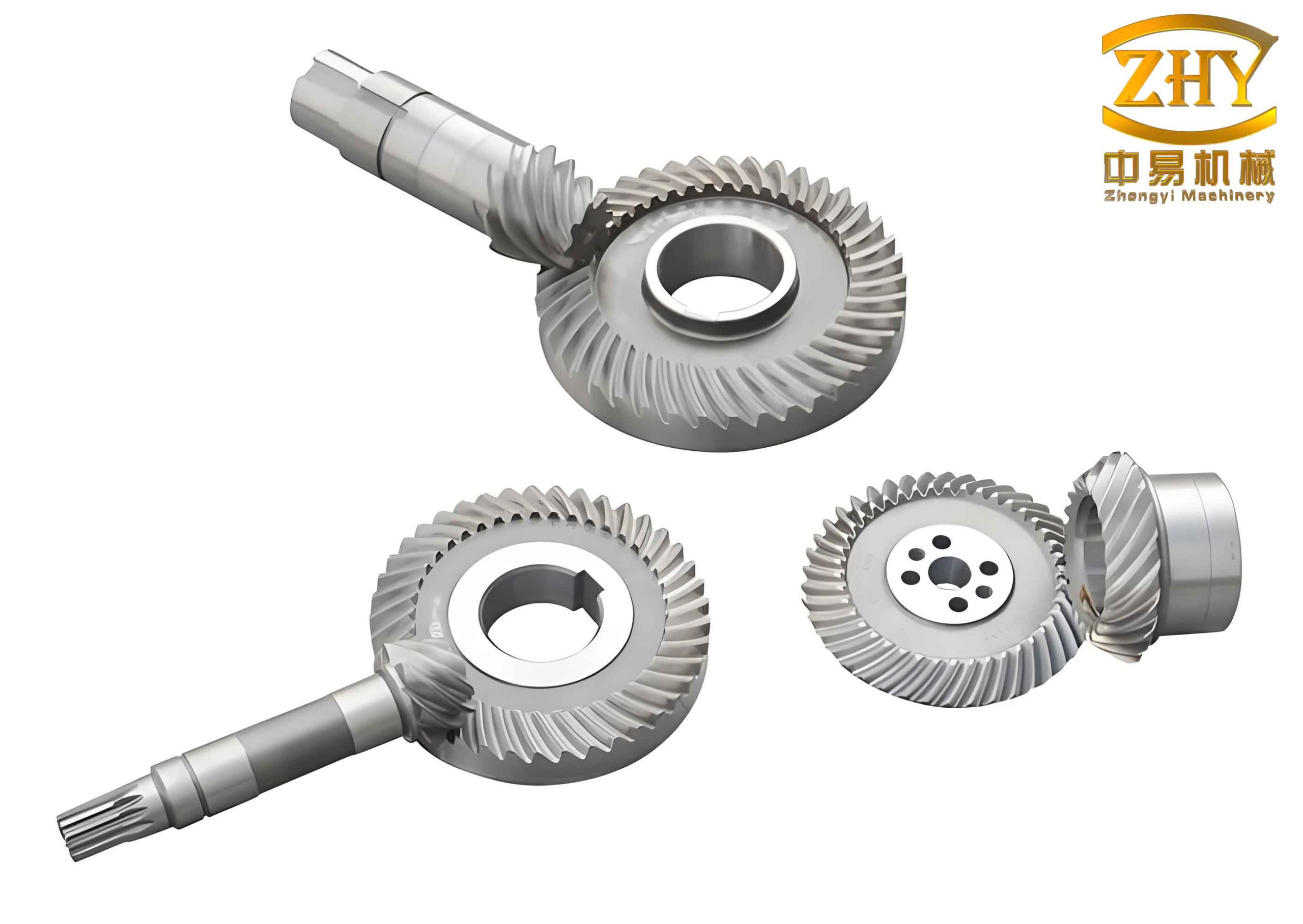
Tooth side clearance in hyperboloid gears is defined as the intentional gap between the tooth flanks of the pinion and ring gear when they are in a stationary meshed position. This clearance serves multiple purposes: it allows for the formation of a lubricating oil film to reduce friction and heat generation, prevents jamming due to thermal expansion, and compensates for manufacturing tolerances. In hyperboloid gears, the complex curved tooth surfaces require precise clearance control to maintain smooth meshing and minimize transmission errors. From our perspective, the design of tooth side clearance involves balancing these factors to avoid negative effects such as backlash-induced noise or insufficient lubrication. We begin by examining theoretical design methods, where we use advanced software tools like Gleason’s C-AGE to calculate initial clearance values based on gear geometry and operating conditions.
In theoretical forward design for hyperboloid gears, we rely on established standards and software simulations. For instance, using Gleason’s C-AGE software, we can derive the designed tooth side clearance range. Typically, for hyperboloid gears with specific parameters, the software outputs a clearance range of 0.127 mm to 0.1778 mm. This range is based on ideal conditions, assuming perfect manufacturing and assembly. To generalize, we can refer to standard tables for tooth side clearance selection based on pitch diameter. Below is a table summarizing recommended clearance values for hyperboloid gears of different sizes:
| Pitch Diameter (mm) | Minimum Clearance (mm) | Maximum Clearance (mm) |
|---|---|---|
| 25.4 to 31.749 | 0.51 | 0.76 |
| 31.75 to 38.097 | 0.46 | 0.66 |
| 38.1 to 44.449 | 0.41 | 0.56 |
| 44.45 to 50.797 | 0.36 | 0.46 |
| 50.8 to 63.497 | 0.30 | 0.41 |
| 63.5 to 76.197 | 0.25 | 0.33 |
| 76.2 to 88.897 | 0.20 | 0.28 |
| 88.9 to 101.597 | 0.18 | 0.23 |
| 101.6 to 126.997 | 0.15 | 0.20 |
| 127 to 152.397 | 0.13 | 0.18 |
| 152.4 to 203.197 | 0.10 | 0.15 |
| 203.2 to 253.997 | 0.08 | 0.13 |
| 254 to 507.997 | 0.05 | 0.10 |
| 508 to 1016 | 0.00 | 0.05 |
| 1041.4 to 2032 | 0.00 | 0.03 |
| 2057.4 to 3048 | 0.00 | 0.02 |
For our specific hyperboloid gears design, with a pitch diameter falling within the 127 mm to 152.397 mm range, the theoretical clearance is 0.13 mm to 0.18 mm. This serves as a baseline for further adjustments. However, in practice, manufacturing imperfections significantly impact the actual clearance. Thus, we must consider reverse design based on manufacturing processes. Hyperboloid gears are typically manufactured to a specified accuracy grade, such as Grade 7 according to GB11365-89 standard. The gear accuracy directly influences tooth spacing errors, which are critical for clearance variation. We can express the cumulative effect of pitch errors on clearance using the following formula:
$$ \Delta C = F_{p,\text{pinion}} + F_{p,\text{ring}} $$
where $\Delta C$ is the total clearance variation due to pitch errors, $F_{p,\text{pinion}}$ is the pitch error of the pinion gear, and $F_{p,\text{ring}}$ is the pitch error of the ring gear. For Grade 7 accuracy, the standard pitch errors are 45 μm for the pinion and 63 μm for the ring gear. Therefore, the cumulative variation is:
$$ \Delta C = 45 \, \mu\text{m} + 63 \, \mu\text{m} = 108 \, \mu\text{m} = 0.108 \, \text{mm} $$
Assuming all other components are at theoretical dimensions, we can calculate the possible clearance range around the designed mean value. If we take the mean clearance as 0.155 mm (the midpoint of 0.13 mm to 0.18 mm), the clearance range due to pitch errors becomes:
$$ C_{\text{min}} = 0.155 – 0.108 = 0.047 \, \text{mm} $$
$$ C_{\text{max}} = 0.155 + 0.108 = 0.263 \, \text{mm} $$
Thus, considering only manufacturing errors in hyperboloid gears, the tooth side clearance could vary from 0.047 mm to 0.263 mm. This highlights the importance of accounting for tolerances in design. To better understand this, we present a table linking gear accuracy grades to pitch errors for hyperboloid gears:
| Accuracy Grade | Pinion Pitch Error (μm) | Ring Gear Pitch Error (μm) |
|---|---|---|
| 4 | 12 | 18 |
| 5 | 20 | 28 |
| 6 | 32 | 45 |
| 7 | 45 | 63 |
| 8 | 63 | 90 |
| 9 | 90 | 125 |
| 10 | 125 | 180 |
| 11 | 180 | 250 |
| 12 | 250 | 355 |
In real-world applications, hyperboloid gears are assembled into final drive units, and the clearance is measured after assembly. We conducted tests on 50 final drive assemblies, measuring tooth side clearance at four circumferential points per assembly before and after meshing tests. The results showed variations due to gear meshing relationships and manufacturing tolerances. For hyperboloid gears with a specific ratio, the meshing pattern causes different tooth pairs to engage over rotations, leading to clearance variations. The measured clearance ranged from 0.07 mm to 0.21 mm, which aligns with our calculated tolerance range but indicates additional factors at play. Below is a excerpt from our test data table:
| Sample ID | State | Position 1 (mm) | Position 2 (mm) | Position 3 (mm) | Position 4 (mm) |
|---|---|---|---|---|---|
| 1 | Before Test | 0.14 | 0.15 | 0.13 | 0.14 |
| 1 | After Test | 0.16 | 0.16 | 0.15 | 0.17 |
| 2 | Before Test | 0.12 | 0.12 | 0.11 | 0.13 |
| 2 | After Test | 0.15 | 0.13 | 0.13 | 0.16 |
| 3 | Before Test | 0.13 | 0.14 | 0.18 | 0.17 |
| 3 | After Test | 0.17 | 0.16 | 0.20 | 0.18 |
| 4 | Before Test | 0.15 | 0.16 | 0.15 | 0.16 |
| 4 | After Test | 0.18 | 0.17 | 0.17 | 0.18 |
Beyond manufacturing, hyperboloid gears experience deformation under load and thermal expansion during operation. This deformation affects tooth side clearance and must be considered in design. According to Gleason recommendations, the meshing separation coefficient for hyperboloid gears is typically 0.00635 mm. Additionally, operating temperatures in rear drive axles range from 70°C to 150°C, causing thermal expansion. The linear expansion of steel can be estimated using the coefficient of thermal expansion, approximately $11 \times 10^{-6} \, \text{°C}^{-1}$. For a temperature rise of $\Delta T = 100°C$, the expansion per unit length is:
$$ \delta_{\text{thermal}} = \alpha \cdot L \cdot \Delta T $$
where $\alpha$ is the coefficient of thermal expansion, and $L$ is a characteristic length, such as the gear tooth height. For hyperboloid gears, empirical data suggests deformation of 0.02 mm to 0.03 mm at 100°C. Combining load-induced separation and thermal expansion, the total deformation on working and non-working surfaces can be calculated. For the working surface, deformation includes separation and expansion:
$$ \delta_{\text{work}} = \delta_{\text{separation}} + \delta_{\text{thermal, work}} $$
For non-working surfaces, only thermal expansion applies. Assuming symmetrical effects, the total clearance reduction due to deformation is:
$$ \Delta C_{\text{deform}} = 2 \times (\delta_{\text{separation}} + \delta_{\text{thermal}}) $$
Using values: $\delta_{\text{separation}} = 0.00635 \, \text{mm}$, $\delta_{\text{thermal}} = 0.02 \, \text{mm}$ to $0.03 \, \text{mm}$, we get:
$$ \Delta C_{\text{deform, min}} = 2 \times (0.00635 + 0.02) = 0.0527 \, \text{mm} $$
$$ \Delta C_{\text{deform, max}} = 2 \times (0.00635 + 0.03) = 0.0727 \, \text{mm} $$
However, for safety, we consider a broader range based on experience: 0.01365 mm to 0.02365 mm for working surface expansion, leading to total deformation of 0.0673 mm to 0.1073 mm. This means the tooth side clearance must be at least 0.1073 mm to avoid negative clearance (interference) during operation. Negative clearance in hyperboloid gears can cause jamming, increased wear, and noise.
Integrating all factors, we determine the optimal tooth side clearance for hyperboloid gears. The theoretical design suggests 0.127 mm to 0.1778 mm; manufacturing tolerances allow 0.047 mm to 0.263 mm;实测 data shows 0.07 mm to 0.21 mm; and deformation analysis requires at least 0.1073 mm. Combining these, we propose a final clearance range of 0.11 mm to 0.20 mm for our hyperboloid gears assembly. This range accommodates manufacturing variances, prevents negative clearance, and ensures proper lubrication and NVH performance. To summarize, we use the following decision formula:
$$ C_{\text{final}} = \max(C_{\text{theory, min}}, C_{\text{deform, min}}) \text{ to } \min(C_{\text{theory, max}}, C_{\text{tolerance, max}}) $$
Substituting values: $C_{\text{theory, min}} = 0.127 \, \text{mm}$, $C_{\text{theory, max}} = 0.1778 \, \text{mm}$, $C_{\text{deform, min}} = 0.1073 \, \text{mm}$, $C_{\text{tolerance, max}} = 0.263 \, \text{mm}$, but based on实测 data, we tighten to 0.20 mm. Thus, $C_{\text{final}} = 0.11 \, \text{mm}$ to $0.20 \, \text{mm}$.
Tooth side clearance directly impacts the NVH characteristics of hyperboloid gears. Meshing noise arises from transmission errors, which are deviations from ideal motion due to manufacturing inaccuracies and clearance. In hyperboloid gears, localized conjugate contact is used to allow some mismatch for adjustability, but excessive clearance increases backlash and impact noise. The relationship between clearance and noise can be modeled through transmission error analysis. The transmission error $\Delta \theta$ for hyperboloid gears can be expressed as:
$$ \Delta \theta = \frac{C}{r} + \epsilon $$
where $C$ is the tooth side clearance, $r$ is the pitch radius, and $\epsilon$ represents other errors like tooth profile deviations. Minimizing $\Delta \theta$ reduces noise, but requires tight clearance control. For hyperboloid gears, we balance clearance to ensure lubrication without compromising NVH. Experimental studies show that clearance values within 0.1 mm to 0.2 mm generally yield acceptable noise levels for automotive applications.
In conclusion, designing tooth side clearance for hyperboloid gears is a multidisciplinary task that involves theoretical calculations, manufacturing insights, empirical testing, and operational considerations. We have demonstrated a method that integrates forward design using software tools like Gleason’s C-AGE, reverse design based on gear accuracy grades, analysis of实测 data from final drive assemblies, and calculations for load and thermal deformation. By synthesizing these aspects, we recommend a clearance range of 0.11 mm to 0.20 mm for hyperboloid gears in our specific application, ensuring reliability, performance, and NVH quality. This approach not only addresses functional requirements but also optimizes manufacturing processes by avoiding overly stringent tolerances that could lead to waste. Future work will focus on refining these methods through continuous data collection and improvement of hyperboloid gears design protocols.
Throughout this research, we emphasize the importance of hyperboloid gears in automotive systems and the critical role of tooth side clearance. Hyperboloid gears, with their unique geometry, require meticulous clearance design to harness their advantages. By applying the methodologies described, engineers can achieve robust designs that enhance the durability and efficiency of hyperboloid gears in final drive assemblies. We hope this contribution aids in advancing the understanding and application of hyperboloid gears technology.