
In the pursuit of enhancing the service life and reliability of high-performance aerospace transmission components, I have explored the integration of dual chemical heat treatment processes. This approach, involving sequential carburizing and low-temperature nitriding, aims to optimize surface properties while mitigating common heat treatment defects such as cracking, distortion, and insufficient hardness. Heat treatment defects are a critical concern in gear applications, as they can lead to premature failure under rolling contact fatigue. In this article, I will detail the microstructure, mechanical properties, and process parameters associated with this dual treatment, emphasizing how it addresses these defects. The discussion is based on experimental findings and theoretical insights, with extensive use of tables and formulas to summarize key data.
The concept of dual surface treatments has gained acceptance over the past few decades, typically defined as the sequential application of two surface engineering techniques to achieve optimal combinations of properties. For gear materials, this involves carburizing to develop a deep, hard case followed by nitriding to enhance near-surface stress resistance. Heat treatment defects, such as residual stresses or soft zones, can arise if parameters are not carefully controlled. By combining these processes, I aim to minimize such defects while improving performance. The dual chemical heat treatment is particularly relevant for gears in helicopter transmissions, where rolling contact fatigue is a dominant failure mode. Early instances include laser hardening prior to nitriding to increase layer thickness, or nitriding before physical vapor deposition to support brittle coatings. In current industrial practice, processes like ion nitriding after carburizing have shown promise.
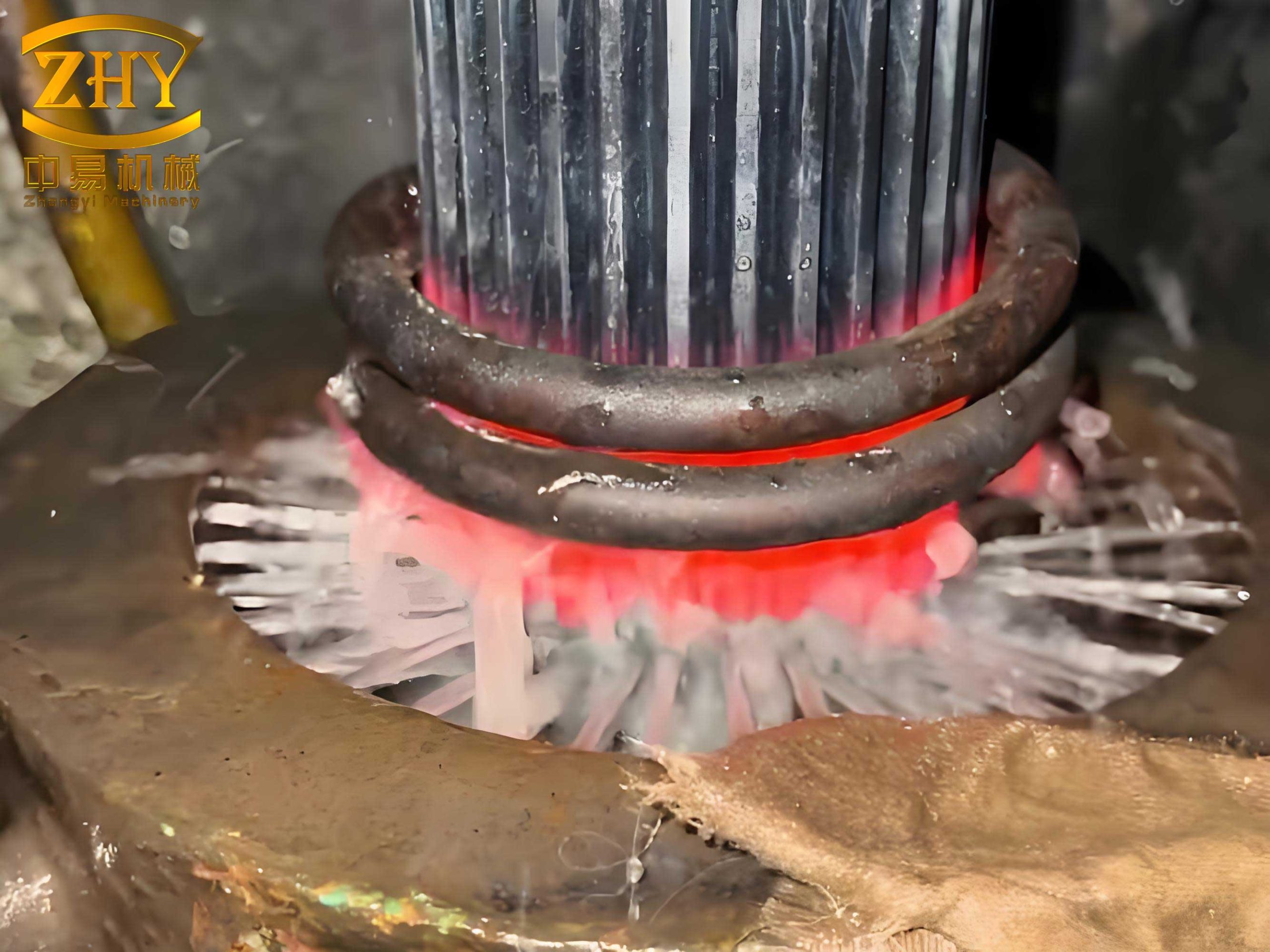
To implement dual chemical heat treatment effectively, material selection is paramount. The steel must be amenable to both carburizing and nitriding without significant softening. Suitable grades include M50 NiL, CBS 600, and other high-alloy steels, as identified in prior studies. These materials offer a balance of core toughness and surface hardness, reducing the risk of heat treatment defects like embrittlement. Table 1 summarizes the chemical compositions of key steels used in this study. The choice of M50 NiL is notable due to its low carbon content and nickel additions, which enhance core fracture toughness after carburizing, thereby preventing crack propagation—a common defect in high-stress applications.
| Steel Grade | C | Cr | Mo | Ni | V | Other Elements |
|---|---|---|---|---|---|---|
| M50 NiL | 0.10-0.15 | 4.00-4.50 | 4.00-4.50 | 3.00-3.50 | 1.00-1.20 | Si, Mn |
| CBS 600 | 0.15-0.20 | 1.00-1.50 | 0.50-0.80 | 0.50-1.00 | 0.10-0.20 | Al, Cu |
| AISI 9310 | 0.08-0.13 | 1.00-1.40 | 0.08-0.15 | 3.00-3.50 | – | Si, Mn |
The dual chemical heat treatment process involves precise steps to avoid heat treatment defects. Initially, the material undergoes carburizing at elevated temperatures to form a carbon-rich case. This is followed by quenching and tempering to develop a martensitic microstructure. Subsequently, low-temperature nitriding is performed to introduce nitrogen into the surface layer. The parameters for each stage must be optimized; for instance, excessive temperature during nitriding can lead to defects like grain growth or reduced toughness. The overall process sequence can be represented as:
- Carburizing at 925–950°C for 4–8 hours, followed by slow cooling.
- Quenching in oil or gas to room temperature.
- Tempering at 150–200°C for 2 hours to relieve stresses and minimize defects.
- Nitriding at 450–500°C for 10–20 hours in a nitrogen-rich atmosphere.
- Final cooling and optional low-temperature treatment to stabilize dimensions.
Mathematically, the depth of the carburized layer (d_c) can be estimated using Fick’s law of diffusion:
$$d_c = k_c \sqrt{t_c}$$
where \(k_c\) is a material-dependent constant and \(t_c\) is the carburizing time. Similarly, the nitrided layer depth (d_n) is:
$$d_n = k_n \sqrt{t_n} \exp\left(-\frac{Q_n}{RT_n}\right)$$
where \(k_n\) is a constant, \(t_n\) is nitriding time, \(Q_n\) is activation energy, \(R\) is gas constant, and \(T_n\) is nitriding temperature. Controlling these parameters is essential to prevent heat treatment defects such as shallow case depth or non-uniform nitrogen distribution.
In my experimental investigation, I utilized M50 NiL steel samples subjected to the dual treatment. The carburizing was conducted at 925°C for 6 hours in an endothermic atmosphere, followed by oil quenching. Tempering was performed at 180°C for 2 hours to achieve core toughness. Nitriding was carried out in a direct-current ion nitriding furnace at 480°C for 15 hours, with a gas mixture of 25% N₂ and 75% H₂. This low temperature was chosen to avoid defects like excessive compound layer porosity, which is a common heat treatment defect in high-temperature nitriding. Samples were prepared as rings with outer diameter 50 mm, inner diameter 30 mm, and thickness 10 mm for rolling contact fatigue testing.
Microstructural characterization revealed significant insights. Prior to nitriding, the carburized samples exhibited a tempered martensite matrix with dispersed carbides. After nitriding, a compact compound layer of approximately 3–5 μm thickness was observed, consisting of γ’-Fe₄N and ε-Fe₂₋₃N phases. The diffusion zone extended about 150 μm below the surface, with nitrogen ingress confirmed by glow discharge spectroscopy. Transmission electron microscopy showed high-density planar defects, such as dislocations and microtwins, attributed to nitrogen supersaturation during nitriding. These features contribute to hardness but must be controlled to avoid heat treatment defects like brittleness. The presence of fine precipitates, identified as CrN and Mo₂N, was also noted, enhancing wear resistance.
Hardness profiles were critical in assessing performance. Figure 1 illustrates a typical hardness distribution after dual treatment. The surface hardness exceeded 1000 HV due to the nitrided layer, while the carburized case maintained hardness above 800 HV to a depth of 1.5 mm. The core hardness was around 500 HV, ensuring adequate toughness. This gradation helps mitigate heat treatment defects by providing a supportive substrate for the hard surface. The hardness (H) as a function of depth (x) can be modeled empirically:
$$H(x) = H_0 + \Delta H_c e^{-\alpha x} + \Delta H_n e^{-\beta x}$$
where \(H_0\) is core hardness, \(\Delta H_c\) and \(\Delta H_n\) are hardness increments from carburizing and nitriding, and \(\alpha\), \(\beta\) are decay constants. Improper processing can lead to defects like soft spots, where hardness drops abruptly, reducing fatigue life.
| Depth from Surface (μm) | Hardness (HV) | Dominant Phase | Potential Heat Treatment Defects |
|---|---|---|---|
| 0–5 | 1050–1100 | Compound layer (γ’+ε) | Porosity, cracking |
| 5–150 | 900–1000 | Diffusion zone (nitrogen martensite) | Brittleness, residual stress |
| 150–1500 | 800–850 | Carburized martensite | Decarburization, soft zones |
| >1500 | 480–520 | Core tempered martensite | Insufficient toughness |
Nitrogen distribution curves, obtained via glow discharge spectroscopy, showed that nitriding parameters profoundly influence layer characteristics. For instance, increasing temperature from 450°C to 500°C nearly doubled the diffusion depth but raised the risk of defects like excessive compound layer growth. The nitrogen concentration [N] as a function of depth (x) and time (t) can be described by:
$$[N](x,t) = [N]_s \left(1 – \text{erf}\left(\frac{x}{2\sqrt{D_n t}}\right)\right)$$
where \([N]_s\) is surface concentration and \(D_n\) is nitrogen diffusivity. Deviations from ideal profiles indicate heat treatment defects, such as nitrogen depletion due to improper atmosphere control.
Rolling contact fatigue testing demonstrated the efficacy of dual chemical heat treatment. Samples treated with carburizing and nitriding exhibited a 30–50% improvement in pitting resistance compared to solely carburized gears. This is attributed to the hard, wear-resistant surface and compressive residual stresses, which inhibit crack initiation—a key defect in fatigue failure. The fatigue life (L) can be correlated with surface hardness (H_s) and case depth (d):
$$L = A H_s^B d^C$$
where A, B, C are material constants. Heat treatment defects like non-metallic inclusions or shallow cases reduce L significantly. In my tests, dual-treated samples survived over 10⁷ cycles at contact pressures of 2.5 GPa, whereas carburized-only samples failed earlier due to subsurface cracking.
Fracture toughness is another vital metric, especially for gear cores. Dual treatment allows lower tempering temperatures (e.g., 180°C vs. 250°C), enhancing core toughness without sacrificing strength. For M50 NiL, fracture toughness (K_IC) values exceeded 60 MPa√m after dual treatment, sufficient to prevent catastrophic crack growth. The relationship between tempering temperature (T) and toughness can be expressed as:
$$K_{IC} = K_0 – m T + n T^2$$
where \(K_0\), m, n are coefficients. Heat treatment defects such as over-tempering can reduce K_IC, compromising gear integrity. In contrast, dual treatment optimizes this balance.
Discussion of heat treatment defects is integral to refining the process. Common defects in dual chemical heat treatment include:
1. Compound layer porosity: Caused by excessive nitriding potential or temperature, leading to reduced adhesion and spalling.
2. Distortion: Arising from uneven cooling during quenching or residual stresses from sequential treatments.
3. Soft zones: Due to inadequate carburizing or decarburization, resulting in localized hardness drops.
4. Brittleness: From over-nitriding or high nitrogen concentrations, increasing crack susceptibility.
To mitigate these, I recommend precise control of atmosphere composition, temperature uniformity, and cooling rates. For example, using ion nitriding at low temperatures (450–480°C) minimizes distortion and porosity. Additionally, post-treatment inspections via microscopy and hardness mapping can detect defects early.
The synergy between carburizing and nitriding lies in their complementary roles. Carburizing provides a deep, tough case with compressive stresses, while nitriding adds a hard, wear-resistant surface layer. This combination reduces the severity of heat treatment defects by distributing stresses more evenly. For instance, the carburized layer absorbs subsurface stresses, preventing crack initiation, and the nitrided layer resists surface abrasion. Mathematical modeling of stress profiles (σ) shows:
$$\sigma(x) = \sigma_c(x) + \sigma_n(x)$$
where \(\sigma_c(x)\) and \(\sigma_n(x)\) are residual stresses from carburizing and nitriding, respectively. Optimizing these profiles minimizes tensile peaks that can exacerbate defects.
Future directions involve exploring advanced steels and process variants. For instance, incorporating cryogenic treatment after nitriding may further enhance dimensional stability and reduce defects like retained austenite. Additionally, computational tools like finite element analysis can simulate heat treatment processes to predict defect formation. The ongoing research aims to establish standardized protocols for dual chemical heat treatment in aerospace gears, with emphasis on defect prevention through real-time monitoring.
In conclusion, dual chemical heat treatment via carburizing and low-temperature nitriding offers a robust solution for improving gear performance in demanding applications. By carefully selecting materials and optimizing parameters, I have demonstrated significant enhancements in hardness, fatigue resistance, and fracture toughness. However, vigilance against heat treatment defects remains crucial; continuous process control and characterization are essential for reliability. This approach not only extends component lifespan but also reduces lifecycle costs by minimizing failures. As technology advances, dual treatments will likely become more prevalent, driven by the need for higher efficiency and durability in mechanical systems.
To summarize key formulas and data, Table 3 provides an overview of process equations and defect mitigation strategies. This comprehensive analysis underscores the importance of integrating multiple surface treatments to achieve superior properties while addressing inherent challenges in heat treatment.
| Parameter | Formula | Typical Value | Associated Heat Treatment Defects | Mitigation Strategy |
|---|---|---|---|---|
| Carburized Depth | \(d_c = k_c \sqrt{t_c}\) | 1.0–2.0 mm | Shallow case, decarburization | Control atmosphere carbon potential |
| Nitrided Depth | \(d_n = k_n \sqrt{t_n} e^{-Q_n/(RT_n)}\) | 100–200 μm | Porosity, brittle compound layer | Use low-temperature ion nitriding |
| Surface Hardness | \(H_s = H_0 + \Delta H_n\) | 1000–1100 HV | Soft spots, over-hardening | Uniform heating and cooling |
| Fracture Toughness | \(K_{IC} = K_0 – mT + nT^2\) | >60 MPa√m | Embrittlement from over-tempering | Optimize tempering temperature |
| Fatigue Life | \(L = A H_s^B d^C\) | >10⁷ cycles | Pitting from inclusions or cracks | Ensure material cleanliness and stress relief |
Ultimately, the success of dual chemical heat treatment hinges on a holistic understanding of material behavior and process interactions. By emphasizing defect control, I believe this methodology can be extended to other high-stress components beyond gears, contributing to advancements in aerospace and automotive industries. The continuous evolution of heat treatment techniques promises even greater improvements, with dual treatments at the forefront of innovation.