
In this article, I will delve into the intricate dynamics and acoustic behavior of spiral bevel gearboxes, which are pivotal in synchronization systems like ship lifts. The primary objective is to model internal dynamic excitations inherent to spiral bevel gears, predict vibration responses, and estimate radiation noise. I will employ finite element methods for structural dynamics and boundary element techniques for acoustics, ensuring a holistic approach. Throughout, the关键词 ‘spiral bevel gears’ will be frequently emphasized to highlight their central role in gearbox performance.
Spiral bevel gears are widely used in power transmission systems due to their high load capacity and efficiency. However, their operation induces dynamic excitations that lead to vibrations and noise, impacting system reliability and environmental comfort. In applications such as ship lift synchronization, stringent requirements on vibration and noise levels necessitate thorough analysis. Here, I focus on a spiral bevel gearbox with specific geometric parameters, as detailed in the following table.
| Parameter | Pinion | Gear |
|---|---|---|
| Module at large end (mm) | 10 | 10 |
| Number of teeth | 14 | 56 |
| Face width (mm) | 90 | 90 |
| Mean spiral angle (degrees) | 35 | -35 |
| Material elastic modulus (Pa) | 2.06 × 10¹¹ | |
| Material density (kg/m3) | 7.8 × 10³ | |
| Poisson’s ratio | 0.3 | |
| Tooth surface friction coefficient | 0.1 | |
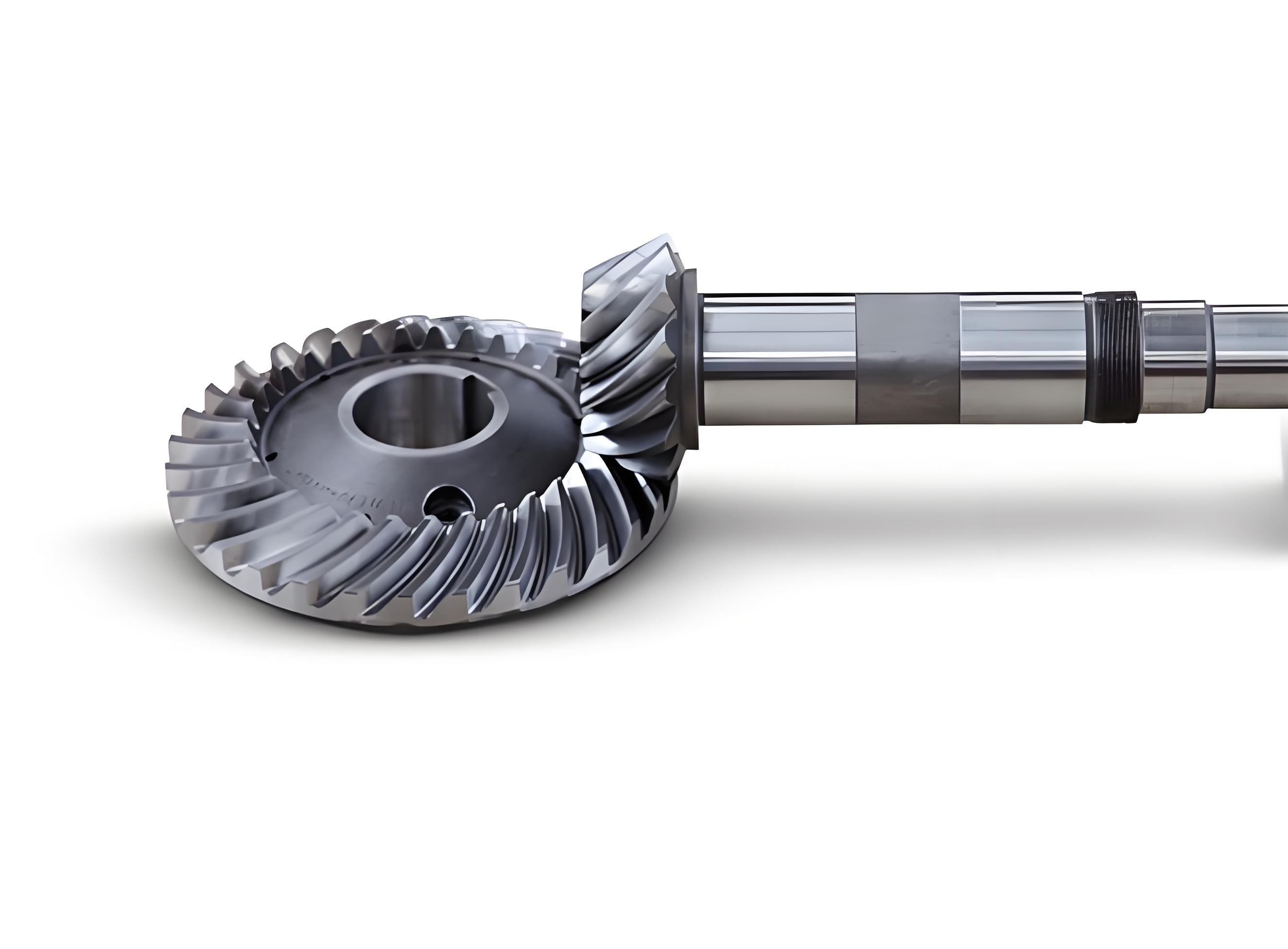
The operational conditions include an input speed of 1000 rpm and an input torque of 1.05 kN·m. To visualize the geometry of spiral bevel gears, I include an image below, which illustrates the complex tooth profile essential for smooth power transmission.
Internal dynamic excitations in spiral bevel gears stem from three primary sources: time-varying mesh stiffness, transmission errors, and meshing impacts. I will model each component separately before synthesizing them for the overall excitation. The mesh stiffness for a single tooth pair is calculated using the formula:
$$k = \frac{F_c}{\delta_p + \delta_g}$$
where \( F_c \) is the contact force per tooth pair, and \( \delta_p \) and \( \delta_g \) are the tooth deformations of the pinion and gear, respectively. Through parametric finite element analysis in ANSYS, I obtain the mesh stiffness curve over one engagement cycle, as shown in subsequent results. The stiffness varies periodically, reflecting the changing contact conditions as spiral bevel gears rotate.
Transmission errors arise from manufacturing inaccuracies and are modeled as a sinusoidal function. For spiral bevel gears with a 5-grade accuracy, the error is expressed as:
$$e(t) = e_r \sin\left(\frac{\pi t}{T_z} + \phi\right)$$
Here, \( e_r \) is the error amplitude, \( t \) is time, \( T_z \) is the single-tooth engagement time, and \( \phi \) is the phase angle, set to zero. This error induces fluctuations in the mesh, contributing to dynamic loads.
Meshing impact forces are simulated using explicit dynamics in LS-DYNA. The equation of motion for the contact problem is discretized as:
$$M\ddot{u} = P – F + R + H – C\dot{u}$$
where \( M \) is the mass matrix, \( C \) is the damping matrix, \( P \) is the external load vector, \( F \) is the stress divergence vector, \( R \) is the contact force vector, \( H \) is the hourglass viscous force vector, and \( \dot{u} \) and \( \ddot{u} \) are velocity and acceleration vectors, respectively. I use SOLID164 elements for the gears and SHELL163 rigid elements for applying boundary conditions. The resulting dynamic mesh force for a single tooth exhibits transient peaks during engagement.
The total internal dynamic excitation \( F(t) \) is synthesized by combining stiffness variation, error, and mesh force changes:
$$F(t) = \Delta k(t) e(t) + \Delta R(t)$$
where \( \Delta k(t) \) is the varying part of mesh stiffness, and \( \Delta R(t) \) is the fluctuating component of the mesh force. I compute this excitation over multiple cycles to ensure periodicity, which serves as input for the gearbox dynamic analysis.
To analyze the dynamic response of the spiral bevel gearbox, I construct a comprehensive finite element model that includes the spiral bevel gears, shafts, bearings, and housing. The model uses SOLID45 elements for structural components and COMBIN14 spring elements to simulate bearing supports and gear mesh interactions. The housing is constrained at bolt holes on the bottom surface. The mesh comprises 274,204 elements and 98,443 nodes, ensuring adequate resolution for dynamic simulations.
Modal analysis is performed using the block Lanczos method to extract natural frequencies and mode shapes. The first ten modes are listed below, highlighting the dynamic characteristics of the spiral bevel gearbox.
| Mode | Frequency (Hz) | Mode Shape Description |
|---|---|---|
| 1 | 178.5 | Input shaft bending in Z-direction combined with output shaft axial extension |
| 2 | 193.4 | Torsional vibration of both input and output shafts |
| 3 | 202.9 | Input shaft bending in Y-direction coupled with housing swing around Z-axis |
| 4 | 294.7 | Input shaft bending in Z-direction with housing swing around X-axis |
| 5 | 305.2 | Output shaft axial extension plus housing swing around Z-axis |
| 6 | 318.2 | Output shaft bending in X-direction with housing swing around Z-axis |
| 7 | 439.4 | Housing torsional swing around Y-axis |
| 8 | 500.0 | Input shaft torsion around X-axis |
| 9 | 532.1 | Input shaft bending in Y-direction |
| 10 | 548.2 | Output gear swing around Y-axis |
The input shaft rotational frequency is 16.67 Hz, the output shaft frequency is 4.17 Hz, and the mesh frequency of the spiral bevel gears is 233.33 Hz. Since none of the natural frequencies coincide with these operational frequencies, resonance is avoided, ensuring stable operation of the spiral bevel gearbox.
For transient dynamic response, I apply the synthesized internal excitation along the line of action of the spiral bevel gears. Using the full method in ANSYS, I solve over a time span of 120 ms with a step size of 0.195 ms. The vibration responses—displacement, velocity, and acceleration—are extracted at key nodes on the housing surface. The root mean square (RMS) values for selected nodes are summarized in the following tables.
| Node ID | X-direction (μm) | Y-direction (μm) | Z-direction (μm) |
|---|---|---|---|
| 97371 | 1.96 | 1.13 | 0.94 |
| 88176 | 1.99 | 0.31 | 2.06 |
| 86052 | 1.71 | 0.20 | 2.06 |
| 84222 | 2.15 | 2.60 | 1.10 |
| Node ID | X-direction (mm/s) | Y-direction (mm/s) | Z-direction (mm/s) |
|---|---|---|---|
| 97371 | 3.53 | 2.42 | 2.66 |
| 88176 | 3.27 | 1.53 | 5.48 |
| 86052 | 3.28 | 1.07 | 5.29 |
| 84222 | 3.58 | 12.16 | 7.39 |
| Node ID | X-direction (mm/s2) | Y-direction (mm/s2) | Z-direction (mm/s2) |
|---|---|---|---|
| 97371 | 12.15 | 4.00 | 12.60 |
| 88176 | 12.91 | 8.01 | 30.68 |
| 86052 | 15.54 | 6.45 | 28.48 |
| 84222 | 11.16 | 52.55 | 48.85 |
Nodes near bearing supports, such as 88176 and 86052, show higher Z-direction responses due to axial dynamic loads from the spiral bevel gears. Node 84222 on the housing top exhibits significant vibrations in all directions. The frequency-domain responses reveal peaks at the mesh frequency \( f_m = 233.33 \) Hz and its harmonics, indicating that mesh dynamics dominate the vibration behavior of spiral bevel gearboxes.
To predict radiation noise, I use the direct boundary element method in SYSNOISE. The acoustic model is built from the housing surface mesh, comprising 20,383 nodes and 40,786 elements. The vibration displacements from the dynamic analysis serve as boundary conditions for the acoustic simulation. The governing equation for surface acoustic pressure is:
$$A(\omega) p = B(\omega) v_n$$
where \( p \) is the surface pressure vector, \( v_n \) is the normal velocity vector, and \( A \) and \( B \) are influence matrices dependent on angular frequency \( \omega \). The sound pressure at any field point \( N \) is computed via:
$$P_N = \int_\Omega \left( p \frac{\partial G}{\partial n} + i\rho_0 \omega v_n G \right) d\Omega$$
Here, \( \Omega \) is the housing surface, \( G \) is the Green’s function, \( n \) is the surface normal, and \( \rho_0 = 1.225 \, \text{kg/m}^3 \) is air density. I set the reference sound pressure to \( 2 \times 10^{-5} \) Pa and analyze frequencies from 62.5 Hz to 8 kHz in octave bands.
The results show that the maximum surface sound pressure occurs in the 1 kHz band, reaching 123.8 dB at locations near ribbed areas on the bearing seats. This highlights the acoustic hotspots in spiral bevel gearboxes. For field points placed 1 meter from the housing at input and output sides, the A-weighted sound pressure levels are calculated. The following table summarizes the octave band levels for both points.
| Frequency Band (Hz) | Field Point 1 (Input Side) | Field Point 2 (Output Side) |
|---|---|---|
| 62.5 | 45.2 | 43.8 |
| 125 | 52.7 | 51.3 |
| 250 | 68.9 | 67.5 |
| 500 | 82.4 | 80.9 |
| 1000 | 96.9 | 95.4 |
| 2000 | 89.3 | 87.8 |
| 4000 | 75.6 | 74.1 |
| 8000 | 61.2 | 59.7 |
Field point 1, near the input side, exhibits slightly higher noise levels due to proximity to active vibration sources. Both points peak at 1 kHz, corresponding to the mesh frequency harmonics, reaffirming that spiral bevel gears are the primary noise generators. The overall A-weighted sound pressure level reaches 96.9 dB(A), which may require mitigation measures for noise-sensitive applications.
In discussion, I emphasize that the dynamic response and radiation noise of spiral bevel gearboxes are intrinsically linked to mesh frequency excitations. The time-varying stiffness of spiral bevel gears, coupled with errors and impacts, creates broadband vibrations that propagate through the structure and radiate as noise. The finite element and boundary element models provide a robust framework for predicting these phenomena. However, uncertainties in material properties, damping, and manufacturing tolerances can affect accuracy. Future work could incorporate nonlinear bearing models, thermal effects, and experimental validation to refine predictions for spiral bevel gearboxes.
In conclusion, I have presented a detailed analysis of dynamic characteristics and radiation noise for a spiral bevel gearbox. By modeling internal excitations specific to spiral bevel gears, I simulated vibrations and acoustic radiation, showing that peak responses occur at mesh frequency and its multiples. This study underscores the importance of considering dynamic interactions in spiral bevel gear design to minimize vibration and noise. The methodologies applied here—finite element analysis for dynamics and boundary element methods for acoustics—offer valuable tools for engineers working with spiral bevel gears in demanding applications like ship lift synchronization systems.