
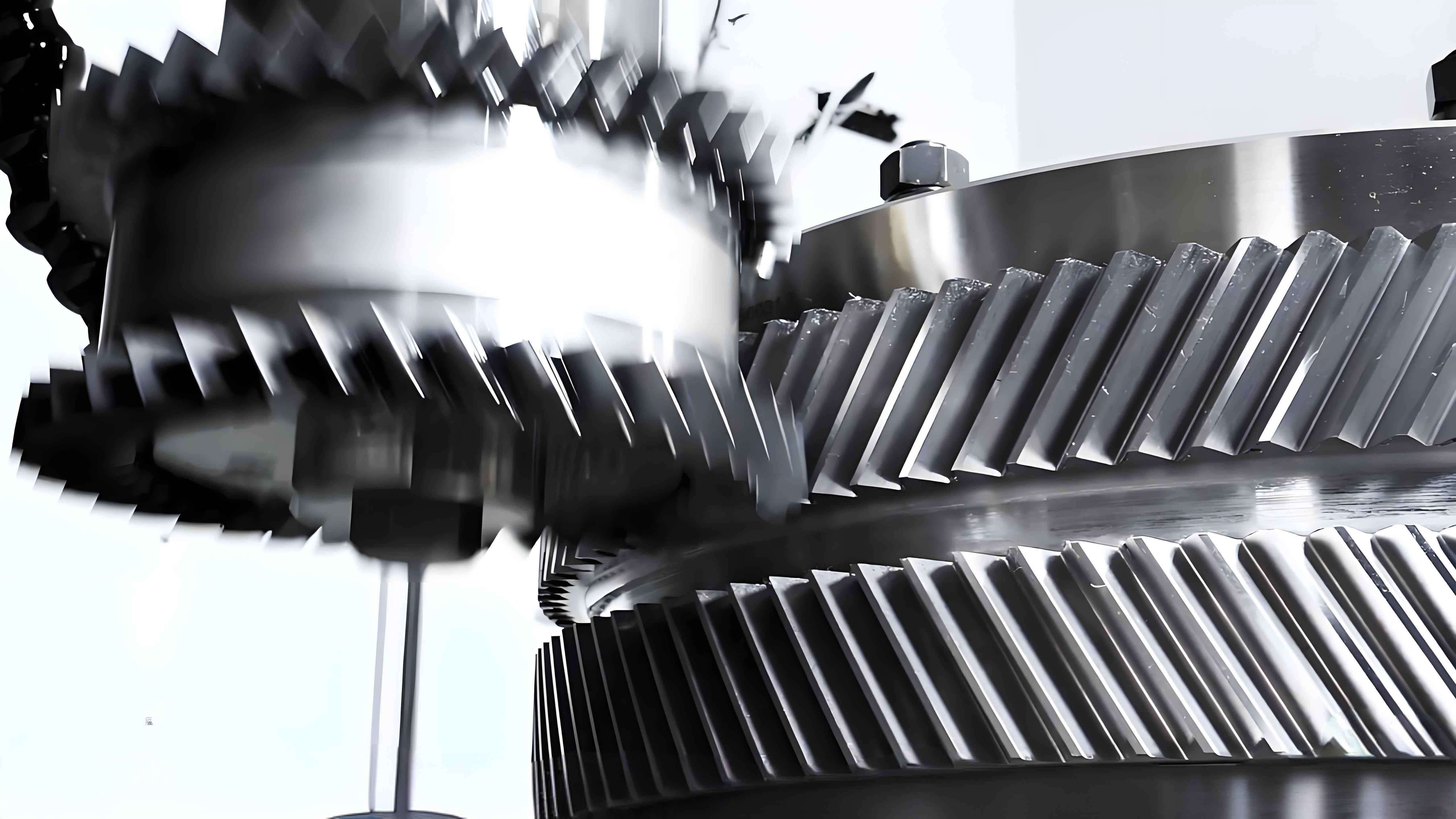
The quest for higher power density, efficiency, and quieter operation in modern marine and industrial propulsion systems has driven the widespread adoption of herringbone gear transmissions. These gears, characterized by their unique double-helical geometry, offer significant advantages over single helical gears, primarily the inherent cancellation of net axial thrust under ideal conditions. This theoretical balance eliminates the need for massive thrust bearings, allowing for more compact and efficient gearbox designs. The herringbone gear configuration is therefore a cornerstone in high-speed, high-power applications where reliability and low vibration are paramount.
However, this ideal of perfect axial force cancellation is rarely achieved in practice. Manufacturing imperfections, assembly tolerances, and the dynamic nature of the meshing process introduce excitations that disrupt this balance. The resulting axial vibration, though often considered secondary to transverse and torsional vibrations, poses significant risks. Unchecked axial oscillation can lead to fluctuating axial loads on thrust bearings, potentially exceeding their design limits and leading to premature failure. It can also induce unwanted casing vibrations, contribute to overall system noise, and, in extreme cases, cause misalignment and altered contact patterns that accelerate wear and reduce the fatigue life of the gear teeth. Consequently, a thorough understanding of the excitation mechanisms and dynamic response governing axial vibration in herringbone gears is not merely an academic exercise but a critical necessity for robust and silent transmission design.
The primary challenge in modeling herringbone gear dynamics lies in accurately representing the interaction between the two opposing helical strands. A common and effective approach is the lumped-parameter method. In this framework, the complex, continuous system is discretized into a set of concentrated masses and inertias interconnected by massless springs and dampers representing the stiffness and damping properties of the shafts, bearings, and gear meshes.
For a pair of herringbone gears, each gear body can be conceptually split into two independent helical gear segments with opposite hand. Thus, a single herringbone gear pair is modeled as two independent helical gear pairs operating in parallel. A four-degree-of-freedom model—translational displacements in the x (horizontal), y (vertical), and z (axial) directions, plus torsional rotation about the gear axis—is typically assigned to each gear segment. For a simple pair, this results in a 16-degree-of-freedom system. The governing equations of motion for each mass are derived from Newton’s second law, considering forces from shaft bending, torsion, axial deformation, bearing supports, and gear meshing. The meshing force between any two mating helical segments is the cornerstone of the excitation. It acts along the line of action and can be expressed as:
$$ F_m = k_m(t) \lambda_n + c_m \dot{\lambda}_n $$
where \( k_m(t) \) is the time-varying mesh stiffness, \( c_m \) is the mesh damping, and \( \lambda_n \) is the relative displacement along the line of action. This relative displacement is a function of the translational and rotational displacements of the two mating gears, the gear geometry (pressure angle \( \alpha \), helix angle \( \beta \)), and any transmission error \( e(t) \). The projections of this meshing force onto the coordinate axes generate the excitations in the transverse and axial directions. For a helical gear, the axial component is given by \( F_z = F_m \sin \beta \). In a perfect herringbone gear, the axial forces from the left-hand and right-hand segments are equal and opposite (\( \beta_{LH} = -\beta_{RH} \)), leading to \( F_{z,\text{net}} = 0 \).
The axial vibration of a herringbone gear system is predominantly driven by internal excitations that disrupt the perfect symmetry of the double-helical structure. The primary culprits are helix angle errors, time-varying mesh stiffness, and transmission errors (e.g., profile deviations).
1. Helix Angle Error Excitation: This is often the most significant source of axial vibration in herringbone gears. In reality, the two helical halves of a herringbone gear may have slight deviations from their nominal helix angles due to manufacturing or assembly. Let \( \beta_1 = \beta + \Delta\beta_1 \) and \( \beta_2 = \beta + \Delta\beta_2 \) be the actual helix angles for the two segments of a gear, where \( \Delta\beta_1 \) and \( \Delta\beta_2 \) are the errors. The net axial force imbalance on a gear becomes:
$$ \Delta F_z = F_{m1} \sin\beta_1 – F_{m2} \sin\beta_2 $$
Assuming the mesh forces are approximately equal (\( F_{m1} \approx F_{m2} \approx F_m \)) and the errors are small, this simplifies to:
$$ \Delta F_z \approx F_m (\Delta\beta_2 – \Delta\beta_1) \cos \beta = F_m \cdot \Delta\beta_{rel} \cdot \cos \beta $$
where \( \Delta\beta_{rel} \) is the relative helix angle error between the two sides. This error is typically periodic with gear rotation, modeled as \( \Delta\beta_{rel} = A_\beta \sin(\omega t + \phi) \), where \( \omega \) is the rotational frequency. This direct force imbalance acts as a powerful excitation at the rotational frequency and its harmonics.
2. Time-Varying Mesh Stiffness (TVMS) Excitation: The number of tooth pairs in contact varies as gears rotate, causing the mesh stiffness \( k_m(t) \) to fluctuate periodically with the gear mesh frequency \( \omega_m = N \cdot \omega \), where N is the number of teeth. This variation can be represented by a Fourier series:
$$ k_m(t) = k_{m0} + \sum_{n=1}^{\infty} \left[ a_n \cos(n\omega_m t) + b_n \sin(n\omega_m t) \right] $$
Here, \( k_{m0} \) is the average mesh stiffness, and the coefficients \( a_n, b_n \) depend on the contact ratio and load sharing. Even with perfectly matched helix angles, if the TVMS waveforms for the two sides are not perfectly in phase (due to micro-geometry or load variations), the instantaneous axial forces \( F_{z1}(t)=k_{m1}(t)\lambda_{n1}\sin\beta \) and \( F_{z2}(t)=k_{m2}(t)\lambda_{n2}\sin(-\beta) \) will not cancel perfectly at every instant. This results in a residual axial excitation primarily at the mesh frequency and its harmonics.
3. Transmission Error (TE) Excitation: Transmission error, defined as the deviation of the output gear’s position from its theoretical location, is a major source of dynamic load. It arises from tooth profile errors, pitch errors, and deflections. It is commonly modeled as a displacement excitation along the line of action:
$$ e(t) = \sum_{n} E_n \sin(n\omega_m t + \phi_n) $$
While TE primarily excites vibrations in the torsional and transverse directions, it also influences the axial vibration indirectly. TE affects the dynamic mesh force \( F_m(t) \), which in turn modulates the axial force components. Its impact on axial vibration is generally less direct than that of helix angle error, but it can be significant, especially when interacting with other nonlinearities like backlash.
The table below summarizes these key internal excitations for a herringbone gear:
| Excitation Type | Physical Cause | Primary Frequency | Effect on Axial Force |
|---|---|---|---|
| Helix Angle Error | Manufacturing/Assembly tolerance mismatch between left/right helices. | Rotational frequency (ω) and harmonics | Direct imbalance: \( \Delta F_z \propto F_m \cdot \Delta\beta_{rel} \) |
| Time-Varying Mesh Stiffness | Periodic change in number of contacting tooth pairs. | Mesh frequency (ω_m) and harmonics | Indirect imbalance via phase/amplitude differences in \( k_m(t) \) between sides. |
| Transmission Error | Tooth profile deviations, pitch errors, deflections. | Mesh frequency (ω_m) and harmonics | Indirect modulation of dynamic mesh force \( F_m(t) \). |
To analyze the axial vibration response, the system of differential equations derived from the lumped-parameter model must be solved numerically. This involves integrating the equations of motion in the time domain, often using methods like the Runge-Kutta algorithm. The dynamic response, particularly the axial displacement \( z(t) \) of the gear bodies, is obtained. A typical analysis might involve the following steps for a given herringbone gear set (example parameters in table below):
| Parameter | Pinion | Gear |
|---|---|---|
| Number of Teeth, \( z \) | 25 | 76 |
| Normal Module, \( m_n \) (mm) | 3.5 | |
| Normal Pressure Angle, \( \alpha_n \) (°) | 20 | |
| Helix Angle, \( \beta \) (°) | 25 | |
| Face Width per Helix (mm) | 52 | |
| Average Mesh Stiffness, \( k_{m0} \) (N/m) | 1.68 × 10⁸ | |
| Axial Bearing Stiffness, \( k_z \) (N/m) | 5.0 × 10⁶ | |
| Input Speed, \( n_r \) (rpm) | 4000 | |
| Input Torque, \( T_d \) (Nm) | 119.4 | |
Case 1: Response to Helix Angle Error. Introducing a relative helix angle error \( \Delta\beta_{rel} = 0.1^\circ \) (≈1.75 mrad) between the two sides of the driving herringbone gear produces a pronounced axial vibration. The floating member (often the driven gear assembly) exhibits the largest response. The axial displacement time history for the driven gear segments shows a dominant synchronous vibration at the rotational frequency. The amplitude can reach several micrometers. For instance, with the parameters above, peak-to-peak axial displacements on the order of 8-10 μm are plausible. The relationship between error magnitude and response amplitude is roughly linear for small errors: \( z_{amp} \propto \Delta\beta_{rel} \).
Case 2: Response to Time-Varying Mesh Stiffness. Even with zero helix angle error, the TVMS excitation alone can cause axial vibration. The simulated axial displacement in this case is typically an order of magnitude smaller than that caused by a significant helix angle error. The response is rich in harmonics of the mesh frequency. The axial vibration of the two segments of a single herringbone gear will be nearly anti-phase, as expected. The maximum axial displacement might be on the order of 0.5 to 2 μm. The following equation conceptually links the stiffness variation to axial force fluctuation, assuming a constant static load \( F_s \):
$$ \Delta F_z^{TVMS}(t) \approx \frac{F_s}{k_{m0}} \Delta k_m(t) \sin \beta $$
where \( \Delta k_m(t) \) is the fluctuating part of the mesh stiffness. This explains why increasing the average mesh stiffness \( k_{m0} \) generally helps reduce axial vibration from this source.
Case 3: Response to Transmission Error. With a composite transmission error of amplitude \( e_0 = 10 \mu m \), the resulting axial vibration is generally the smallest among the three primary excitations. The energy couples into the axial direction through the modulation of the dynamic mesh force. The response spectrum is dominated by the mesh frequency. Axial displacements are often sub-micron in scale for this level of TE.
The table below qualitatively compares the axial vibration response from these individual excitations for the example herringbone gear system:
| Analysis Case | Excitation Amplitude | Dominant Frequency | Estimated Axial Displacement Amplitude | Relative Severity |
|---|---|---|---|---|
| Helix Angle Error | Δβ_rel = 0.1° | Rotational (ω) | 4 – 5 μm | Highest |
| Time-Varying Mesh Stiffness | Inherent from contact ratio | Mesh (ω_m) & harmonics | 0.5 – 2 μm | Medium |
| Transmission Error | e₀ = 10 μm | Mesh (ω_m) | < 1 μm | Lowest |
In a real herringbone gear transmission, all these excitations coexist and interact, often in a nonlinear manner due to factors like backlash and bearing clearance. The combined response is not a simple superposition. For example, a helix angle error can modulate the effective phase of the TVMS excitation between the two sides, potentially amplifying the vibration at combination frequencies. Therefore, a comprehensive nonlinear dynamic analysis is required for accurate prediction in high-load or high-precision applications.
The insights gained from this dynamic analysis lead directly to practical design and manufacturing guidelines for controlling axial vibration in herringbone gears:
1. Tight Control of Helical Symmetry: The analysis unequivocally identifies helix angle error as the most potent exciter of axial vibration. Therefore, the highest priority in manufacturing and inspection must be placed on ensuring the symmetry of the two helical strands. This involves precision grinding/hobbing processes and stringent metrology to minimize \( \Delta\beta_{rel} \). A design specification limiting the relative helix angle error is crucial.
2. Optimization of Mesh Stiffness and Contact Ratio: To mitigate TVMS excitation, design choices that increase the average mesh stiffness and reduce the amplitude of its fluctuation are beneficial. This can be achieved through careful selection of module, pressure angle, and profile modifications. A high contact ratio (ideally an integer or near-integer) can minimize the stiffness variation, thereby reducing the associated axial vibration component. The contact ratio \( \epsilon_\gamma \) is given by:
$$ \epsilon_\gamma = \epsilon_\alpha + \frac{b \sin\beta}{\pi m_n} $$
where \( \epsilon_\alpha \) is the transverse contact ratio and \( b \) is the face width. Optimizing \( \epsilon_\gamma \) is a key design lever.
3. Rational Design of Axial Restraint Stiffness: The axial support, usually provided by a thrust bearing, plays a critical role. Its stiffness \( k_z \) must be chosen carefully. An excessively high stiffness will transmit large dynamic forces to the bearing and housing, potentially causing high-frequency noise and bearing fatigue. An excessively low stiffness will allow large axial displacements, risking loss of proper tooth contact and impact. The optimal axial support stiffness is a compromise, often tuned based on the predicted axial force spectrum to avoid resonances within the operating speed range. The natural frequency of the axial mode can be approximated by:
$$ f_{z} \approx \frac{1}{2\pi} \sqrt{\frac{2k_z}{m_{eff}}} $$
where \( m_{eff} \) is the effective mass of the axially floating component. This frequency should be kept away from major excitation frequencies (rotational and mesh).
4. Application of Profile and Lead Modifications: Strategic tooth modifications are essential to compensate for deflections and manufacturing errors, thereby reducing transmission error and its contribution to dynamic loading. Lead crowning or end relief on the helical teeth can help accommodate small misalignments and axial shifts without inducing edge loading, which would otherwise exacerbate axial force imbalances.
In conclusion, the axial vibration of a high-speed herringbone gear transmission is a critical dynamic phenomenon stemming from the breakdown of perfect geometric symmetry under operational conditions. Through a lumped-parameter dynamic modeling approach, it is established that the primary drivers are helix angle errors and time-varying mesh stiffness, with transmission error playing a secondary role. Helix angle error produces a direct, synchronous force imbalance and is typically the most dominant factor. The dynamic analysis provides a quantitative framework for predicting axial vibration levels and forms the indispensable foundation for making informed design decisions. These include specifying tighter manufacturing tolerances for helix symmetry, optimizing tooth geometry for favorable mesh stiffness characteristics, and rationally designing the axial support system stiffness. By addressing these factors, engineers can significantly enhance the performance, reliability, and acoustic behavior of high-power herringbone gear drives, ensuring they meet the demanding requirements of modern marine and industrial applications.