
Spiral gears, also known as crossed helical gears, offer distinct advantages in modern engineering applications due to their relative ease of manufacture and lower cost compared to other gear types like hypoid or bevel gears. Their ability to connect non-parallel and non-intersecting shafts with a simple cylindrical gear form makes them attractive for various light to moderate load power transmission systems. However, a significant barrier to their wider and more reliable application has been the absence of universally accepted and mature design formulas for their load-carrying capacity, particularly for contact fatigue strength. This gap in design methodology often forces engineers to rely on empirical rules or over-conservative estimates, limiting the potential of spiral gears. In this analysis, I will delve into the fundamental geometric characteristics of the contact point between mating spiral gears, derive a practical engineering formula for calculating contact (Hertzian) stress, and comprehensively examine the key factors influencing their contact fatigue strength.
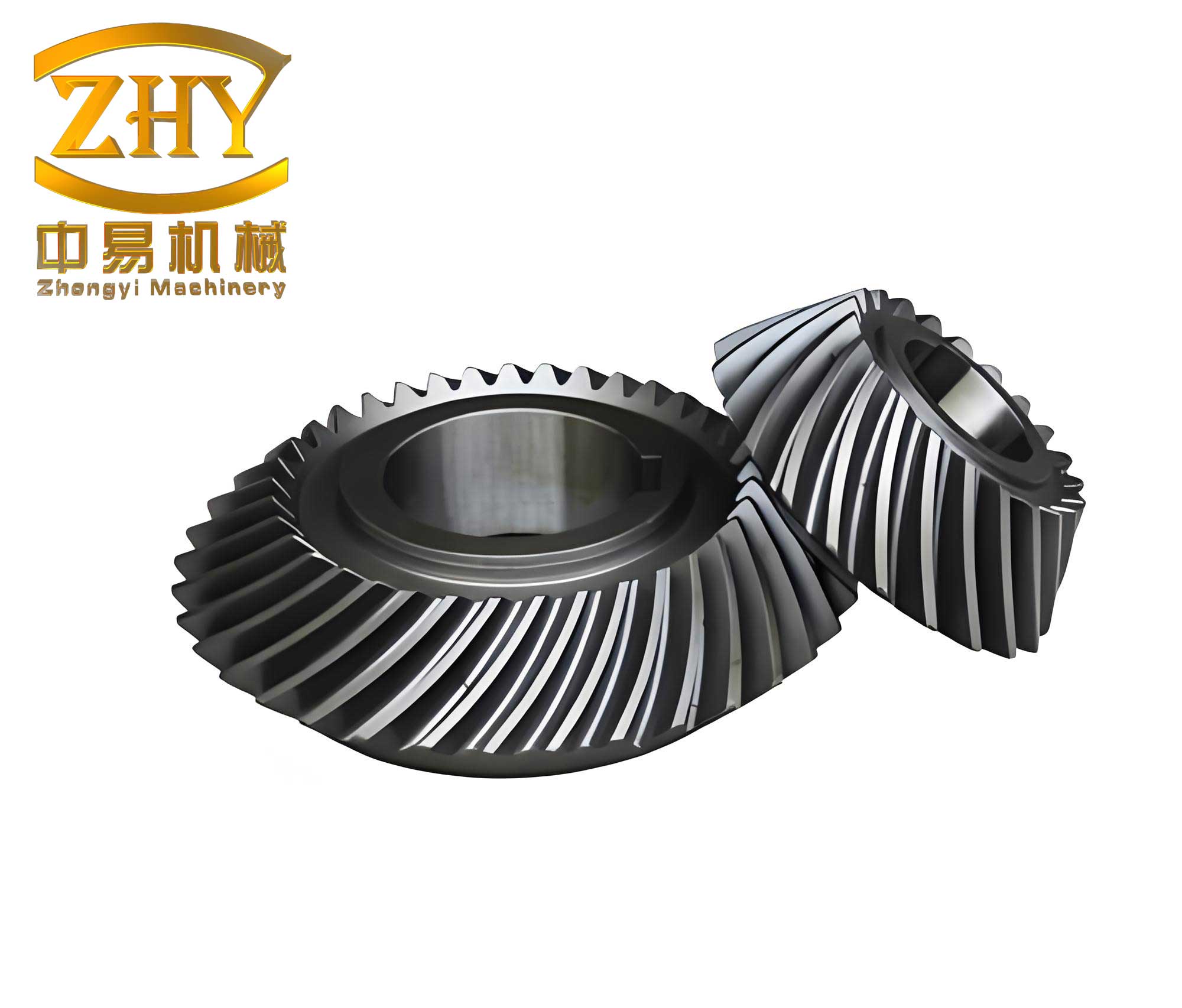
The unique meshing action of spiral gears results in point contact, as opposed to the line contact found in parallel axis helical gears. This point contact is crucial for understanding their stress state. To analyze this, we begin by examining the geometry at the pitch point, where two spiral gear teeth theoretically make contact. For a pair of spiral gears with shaft angle $\Sigma$, the helix angles are denoted as $\beta_1$ and $\beta_2$, and they are related by $\Sigma = \beta_1 + \beta_2$ for gears of the same hand, and $\Sigma = |\beta_1 – \beta_2|$ for gears of opposite hand.
On the tooth surface of a spiral gear, which is an involute helicoid, one of the principal directions aligns with the generating straight line (the tooth trace). The normal curvature in this direction is zero. The other principal direction is perpendicular to this line. If we denote the normal curvatures in this second principal direction for gear 1 and gear 2 as $k_{1}^{(II)}$ and $k_{2}^{(II)}$ respectively, they can be calculated based on the gear geometry:
$$k_{1}^{(II)} = \frac{\cos^2 \beta_1 \tan \alpha_n}{r_1 \cos \beta_1}$$
$$k_{2}^{(II)} = \frac{\cos^2 \beta_2 \tan \alpha_n}{r_2 \cos \beta_2}$$
where $r_1$ and $r_2$ are the pitch radii, and $\alpha_n$ is the normal pressure angle. Since the principal directions of the two contacting tooth surfaces at the pitch point are not aligned, we must find the angle $\omega$ between them. The angles $\phi_1$ and $\phi_2$ that each tooth’s principal direction makes with the common tangent to the helices are:
$$\phi_1 = \frac{\beta_1}{\cos \beta_1 \tan \alpha_n}$$
$$\phi_2 = \frac{\beta_2}{\cos \beta_2 \tan \alpha_n}$$
The total angle between the principal directions of the two surfaces is then $\omega = \phi_1 + \phi_2$. This misalignment is fundamental to the point contact nature of spiral gears.
The contact between two elastic bodies under load at a point forms an elliptical contact patch. The orientation and lengths of the semi-axes of this ellipse are defined by the principal directions and principal relative curvatures of the surfaces. The principal relative (or induced) curvatures, $k_I$ and $k_{II}$, along the major and minor axes of the contact ellipse can be derived. Given $k_{1}^{(I)} = k_{2}^{(I)} = 0$, the formulas are:
$$k_I = \frac{1}{2} \left[ (k_{1}^{(II)} + k_{2}^{(II)}) – \sqrt{ (k_{1}^{(II)} – k_{2}^{(II)})^2 + 4 k_{1}^{(II)} k_{2}^{(II)} \sin^2 \omega } \right]$$
$$k_{II} = \frac{1}{2} \left[ (k_{1}^{(II)} + k_{2}^{(II)}) + \sqrt{ (k_{1}^{(II)} – k_{2}^{(II)})^2 + 4 k_{1}^{(II)} k_{2}^{(II)} \sin^2 \omega } \right]$$
The shape of the contact ellipse, specifically its ellipticity, is determined by the ratio $e_r = k_I / k_{II}$. This ratio $e_r$ is solely a function of the helix angles $\beta_1$, $\beta_2$ and the gear ratio $u = z_2 / z_1$. I have computed this relationship extensively. The following tables summarize the value of $e_r$ for various combinations, illustrating a key geometric characteristic of spiral gears meshing.
| $\beta_1$ (deg) | $\beta_2$ (deg) | $u=1$ | $u=2$ | $u=3$ | $u=5$ |
|---|---|---|---|---|---|
| 10 | 10 | 1.000 | 1.000 | 1.000 | 1.000 |
| 20 | 20 | 1.000 | 1.000 | 1.000 | 1.000 |
| 30 | 30 | 1.000 | 1.000 | 1.000 | 1.000 |
| 10 | 30 | 0.683 | 0.752 | 0.786 | 0.822 |
| 20 | 40 | 0.569 | 0.660 | 0.706 | 0.758 |
| $\beta_1$ (deg) | $\beta_2$ (deg) | $u=1$ | $u=2$ | $u=3$ | $u=5$ |
|---|---|---|---|---|---|
| 10 | -10 | 0.414 | 0.537 | 0.600 | 0.666 |
| 20 | -20 | 0.238 | 0.365 | 0.438 | 0.521 |
| 30 | -30 | 0.143 | 0.245 | 0.310 | 0.391 |
| 10 | -30 | 0.256 | 0.381 | 0.451 | 0.534 |
| 20 | -40 | 0.164 | 0.270 | 0.338 | 0.421 |
The ellipticity of the contact patch directly influences the magnitude of the maximum contact stress. This influence is accounted for by a geometry factor, often denoted as $\mu$ or $\cos \tau$, which is a function of $e_r$ or the related integral $K(e)$. The relationship is well-documented in contact mechanics literature. A key takeaway is that as the contact ellipse becomes more circular ($e_r \to 1$), this factor decreases, leading to higher contact stress for the same load and composite curvature. Conversely, a more elliptical (flatter) patch ($e_r \to 0$) increases this factor, reducing the contact stress. For spiral gears, when $\beta_1 = \beta_2$ and the shaft angle is zero (parallel axes), $e_r = 1$, representing the limiting case of line contact, which is a special case not typical for general spiral gear applications.
Now, proceeding to the core of the design analysis: calculating the contact stress. The classic Hertzian formula for the maximum contact pressure $\sigma_H$ at the center of an elliptical contact area is:
$$\sigma_H = \mu \sqrt[3]{ \frac{F_n E’^2}{\pi^3 \rho’^2} }$$
where $F_n$ is the normal load, $E’$ is the composite elastic modulus $\left( \frac{2}{E’} = \frac{1-\nu_1^2}{E_1} + \frac{1-\nu_2^2}{E_2} \right)$, and $\rho’$ is the effective radius of curvature. For spiral gears, the effective radius $\rho’$ is related to the principal relative curvatures: $\frac{1}{\rho’} = k_I + k_{II}$. The normal load $F_n$ is derived from the transmitted torque $T_1$, pitch diameter $d_1$, and various application factors: $F_n = \frac{2 T_1 K_A K_v}{d_1 \cos \beta_1 \cos \alpha_n}$, where $K_A$ is the application factor and $K_v$ is the dynamic factor.
By substituting the expressions for $k_I$, $k_{II}$, $F_n$, and the geometry factor $\mu$ into the Hertz formula and simplifying, we can derive a design-oriented equation for the contact stress in spiral gears. This process yields:
$$\sigma_H = Z_E Z_H Z_\beta Z_\epsilon \sqrt{ \frac{2 T_1 K_A K_v K_{H\beta}}{d_1^3 b} \cdot \frac{u \pm 1}{u} }$$
While this form resembles the standard gear contact stress formula, the key differences lie in the specific values and definitions of the auxiliary factors $Z_H$ (zone factor) and $Z_\beta$ (helix angle factor) for spiral gears. A more direct formulation specific to the point contact analysis is:
$$\sigma_H = \mu \sqrt[3]{ \frac{2 T_1 K_A K_v K_{H\beta} E’^2}{\pi^3 d_1^2 \cos^2 \beta_1 \cos^2 \alpha_n} \cdot \frac{u + 1}{u} \cdot \frac{1}{\rho’^2} }$$
Where the composite effective curvature $1/\rho’$ is now explicitly a function of $\beta_1, \beta_2, d_1, u,$ and $\alpha_n$. We can define a coefficient $Z_c$ that encapsulates the combined influence of helix angles and gear ratio on the composite curvature:
$$Z_c = \sqrt[3]{\frac{1}{\rho’^2}} = \sqrt[3]{ \left( \frac{\cos^2 \beta_1 \tan \alpha_n}{d_1 \cos \beta_1} \right)^2 \left[ \left( 1 + \frac{\cos^3 \beta_2}{\cos^3 \beta_1} \cdot \frac{1}{u^2} \right)^2 + 4 \frac{\cos^3 \beta_2}{\cos^3 \beta_1} \cdot \frac{1}{u^2} \sin^2 \omega \right] }$$
Thus, the final design formula for checking the contact fatigue strength of spiral gears becomes:
$$\sigma_H = \mu Z_c Z_E \sqrt[3]{ \frac{2 T_1 K_A K_v K_{H\beta}}{\pi^3 d_1^2 \cos^2 \beta_1 \cos^2 \alpha_n} \cdot \frac{u + 1}{u} } \le \sigma_{HP}$$
where $\sigma_{HP}$ is the permissible contact stress, defined as $\sigma_{HP} = \frac{\sigma_{H\lim} Z_N}{S_H}$, with $\sigma_{H\lim}$ as the endurance limit for contact stress, $Z_N$ as the life factor, and $S_H$ as the safety factor. For spiral gears, $\sigma_{H\lim}$ must be obtained from testing under point contact conditions, which typically yields a lower value than that for line contact (as in parallel axis gears). The factor $K_{H\beta}$ is the face load factor; for accurately aligned spiral gears with low face width, it can often be taken as 1.0.
Now, let us analyze the factors influencing the contact fatigue strength of spiral gears, as revealed by the derived formula and the geometric relationships.
1. Influence of Pitch Diameter ($d_1$): This is the most dominant factor. The contact stress $\sigma_H$ is inversely proportional to $d_1^{2/3}$. A relatively small increase in the pinion’s pitch diameter dramatically reduces the contact stress and increases the load-carrying capacity. Notably, and unlike in parallel axis gears where face width $b$ appears under a square root in the denominator, the face width $b$ does not explicitly appear in the core point-contact stress formula derived from Hertz theory. The load-carrying capacity in point contact scales with the contact ellipse area, which is not directly proportional to face width in the same linear way. The load $F_n$ is distributed over the elliptical area, not along a line. Therefore, simply increasing the face width of spiral gears does not significantly improve their contact fatigue strength; increasing the diameter is far more effective.
2. Influence of Helix Angles ($\beta_1$ and $\beta_2$): The helix angles are critical and influence the strength through two distinct, and sometimes competing, mechanisms:
a) Effect on Composite Curvature Radius: Generally, increasing the helix angles (in absolute value) increases the effective radius of curvature $\rho’$. This is because terms like $\cos^3 \beta$ in the denominator of curvature expressions become smaller, reducing $k^{(II)}$. A larger $\rho’$ decreases contact stress ($\sigma_H \propto 1/\rho’^{2/3}$). This effect always works towards improving strength.
b) Effect on Contact Ellipse Shape (via $\mu$): The helix angles, in combination with their hands, determine the ellipticity ratio $e_r$ and thus the geometry factor $\mu$. As shown in Tables 1 and 2:
- For Spiral Gears of Opposite Hand: The ellipticity ratio $e_r$ is generally small, meaning the contact ellipse is very elongated (flat). This results in a larger $\mu$ factor, which reduces contact stress. Furthermore, for a fixed shaft angle $\Sigma$, the smallest difference $|\beta_1 – \beta_2|$ yields the flattest ellipse and the most favorable $\mu$.
- For Spiral Gears of Same Hand: The ellipticity ratio $e_r$ is closer to 1 (more circular). The factor $\mu$ is smaller, leading to higher stress. There often exists a specific combination where $\mu$ reaches a minimum (stress a maximum) for a given gear ratio, which is the worst-case scenario for contact geometry.
The net effect on spiral gears’ strength depends on which of these two mechanisms dominates. For opposite-hand spiral gears, the effect via the ellipse shape ($\mu$) is very strong and beneficial, often dominating the overall trend. For same-hand spiral gears, the geometric shape effect is less beneficial or even detrimental, so the positive effect via increased curvature radius becomes more significant. For example, comparing two same-hand designs: one with $\beta_1=\beta_2=10^\circ$ and another with $\beta_1=\beta_2=20^\circ$. The curvature radius effect will lower the stress, but the ellipse shape effect (moving towards a more circular patch) will increase it. The net result requires calculation but highlights the complex interaction.
3. Influence of Gear Ratio ($u$): The gear ratio $u$ also operates through two synergistic mechanisms:
a) Effect on Composite Curvature: As $u$ increases, the term $(1 + \frac{\cos^3 \beta_2}{\cos^3 \beta_1} \cdot \frac{1}{u^2})$ increases, but is dominated by the “1”. The overall composite curvature $1/\rho’$ generally decreases slightly, increasing $\rho’$ and reducing stress.
b) Effect on Ellipse Shape: As clearly seen in both Tables 1 and 2, for any fixed set of helix angles, increasing the gear ratio $u$ increases the ellipticity ratio $e_r$. This makes the contact patch more circular, which increases the contact stress (lowers $\mu$). However, the increase in $e_r$ is asymptotic. The beneficial effect from the increased effective radius usually outweighs the detrimental shape change, leading to a net increase in contact fatigue strength with higher gear ratios. This is an important consideration when designing spiral gear pairs for high reduction ratios.
4. Influence of Material and Load ($Z_E$, $T_1$, $K$-factors): The composite elasticity modulus $Z_E$ has a direct proportional relationship to stress ($\sigma_H \propto Z_E$). Using materials with lower combined modulus (e.g., polymer with steel) can significantly reduce contact stress. The transmitted torque $T_1$ is directly proportional to the stress cubed ($\sigma_H^3 \propto T_1$), making load a very sensitive factor. The application ($K_A$), dynamic ($K_v$), and load distribution ($K_{H\beta}$) factors all increase the effective load and thus the stress. Proper selection, alignment, and lubrication are essential to minimize these factors in spiral gear applications.
In conclusion, the design of spiral gears for adequate contact fatigue strength requires a dedicated approach that recognizes their unique point-contact geometry. The pitch diameter is the most powerful design parameter for controlling stress. The selection of helix angles involves a trade-off between increasing the effective curvature radius and shaping the contact ellipse favorably; opposite-hand spirals generally offer a more favorable contact ellipse geometry. The gear ratio also plays a complex but generally beneficial role. The derived formula, incorporating the geometry factor $\mu$ and the curvature coefficient $Z_c$, provides a rational basis for calculating contact stress in spiral gears, moving beyond empirical guesswork. Further work to standardize endurance limits $\sigma_{H\lim}$ for point contact under various lubrication conditions will greatly enhance the practical utility of this methodology for engineers deploying spiral gears in innovative mechanical systems.