
The accurate characterization of mesh stiffness is fundamental to the dynamic analysis, vibration prediction, and noise control of gear transmission systems. In high-speed applications, such as those found in aerospace or electric vehicle drivetrains, the operational rotational speed introduces significant inertial effects that are often simplified or neglected in traditional quasi-static stiffness models. This work presents a comprehensive analytical framework, developed from a first-person research perspective, to calculate the dynamic mesh stiffness of spur and pinion gear pairs by rigorously accounting for the centrifugal effects induced by operational driving speeds. The proposed method is grounded in structural dynamics principles and offers a computationally efficient alternative to full-scale transient finite element simulations for capturing speed-dependent stiffness behavior.
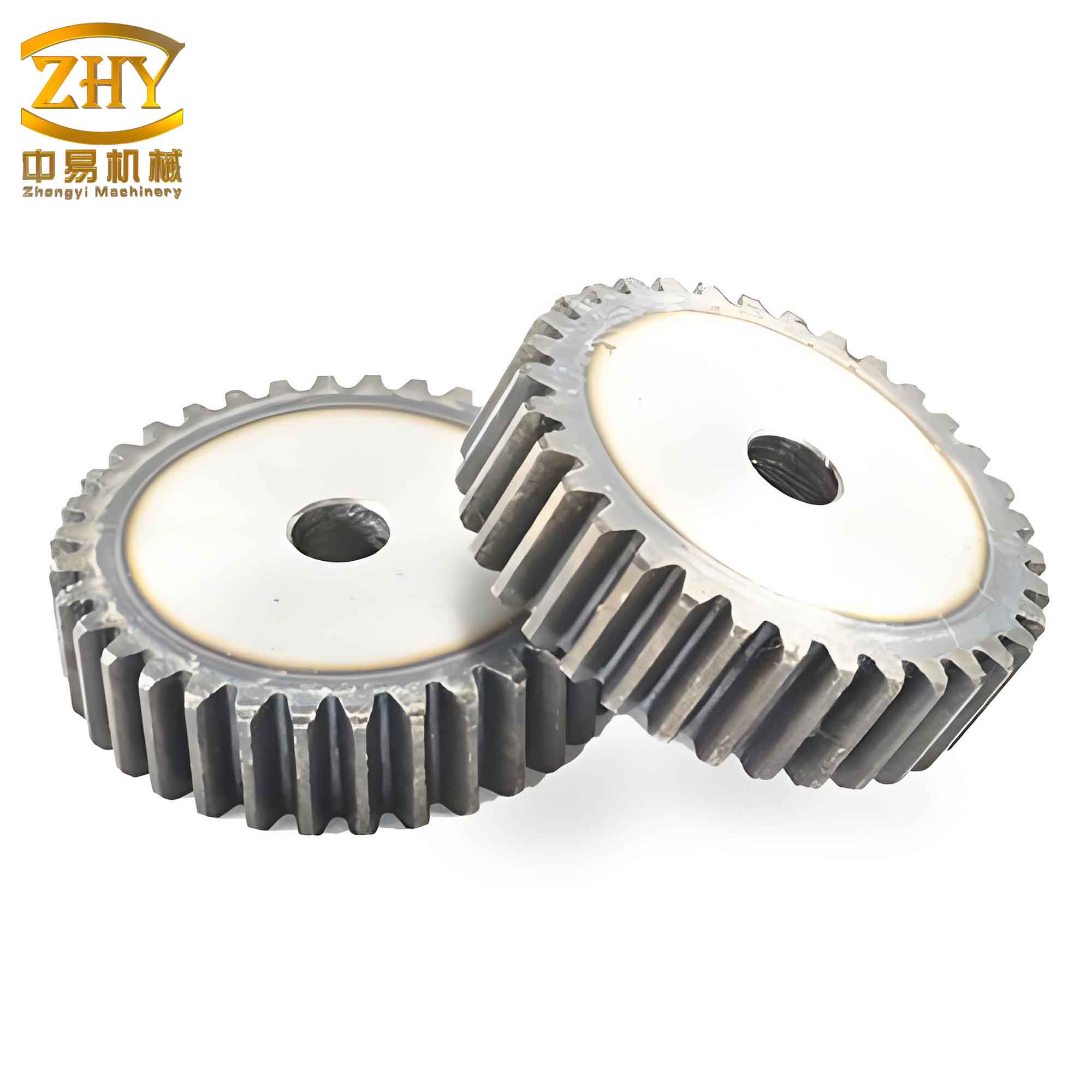
Traditional methods for calculating the mesh stiffness of spur and pinion gear pairs, such as the potential energy method or static finite element analysis, provide a baseline understanding. However, they inherently assume a stationary or low-speed condition. As the driving speed increases, the centrifugal force field acting on the rotating gear body introduces a “spin softening” or “centrifugal stiffening” effect, altering the effective stiffness of the gear teeth modeled as cantilever beams projecting from the gear rim. This phenomenon directly impacts the system’s natural frequencies and the time-varying mesh stiffness—a primary source of parametric excitation in gear dynamics. Ignoring this effect can lead to inaccurate predictions of dynamic response, stress conditions, and acoustic signature, particularly for lightweight or high-speed spur and pinion gear designs. This research aims to bridge this gap by integrating centrifugal field dynamics directly into the mesh stiffness calculation algorithm.
Theoretical Modeling of a Rotating Flexible Spur and Pinion Gear
The core of the model treats each tooth of the spur and pinion gear as a rotating Euler-Bernoulli beam attached to a rigid hub. The coordinate system rotates with the gear at a constant angular velocity $\dot{\theta}$. The total displacement of a point on the tooth includes both rigid-body rotation and elastic deformation due to bending and centrifugal force. The position vector $\mathbf{P_T}$ of a generic point is expressed with respect to the rotating frame attached to the gear center. The detailed derivation begins with the kinematics of a point on the deformed tooth.
Let $u(x,t)$ and $v(x,t)$ represent the axial and transverse elastic displacements of the tooth neutral axis, respectively. Considering a point at location $x$ along the tooth length (from the root) and radial distance $z_{i,x}$ from the central axis, its position vector in the rotating frame, accounting for deformation, is given by:
$$
\mathbf{P_T} = \begin{bmatrix}
x – u_r + u\cos\theta – v\sin\theta \\
z_{i,x} + v_r + u\sin\theta + v\cos\theta
\end{bmatrix}
$$
where $u_r$ and $v_r$ are displacements due to rigid-body rotation. The velocity $\dot{\mathbf{P_T}}$ is then derived by differentiating this position vector. The kinetic energy $T_i$ of the spur and pinion gear tooth segment is obtained by integrating over its volume $V$:
$$
T_i = \frac{1}{2} \rho \int_V \dot{\mathbf{P_T}} \cdot \dot{\mathbf{P_T}} \, dV
$$
where $\rho$ is the material density. The strain energy $U_i$ considers the geometric nonlinearity due to moderate rotations. The axial strain $\epsilon_{xx}$ is:
$$
\epsilon_{xx} = u’ + \frac{1}{2}(v’)^2
$$
The prime ($’$) denotes differentiation with respect to the axial coordinate $x$. The strain energy is then:
$$
U_i = \frac{1}{2} \int_V E \epsilon_{xx}^2 \, dV = \frac{1}{2} \int_0^L \left[ EA (u’)^2 + EI (v”)^2 \right] dx + \frac{1}{2} \int_0^L EA \, u’ (v’)^2 dx + \frac{1}{8} \int_0^L EA (v’)^4 dx
$$
where $E$ is Young’s modulus, $A$ is the cross-sectional area, $I$ is the area moment of inertia, and $L$ is the effective tooth length. Applying Hamilton’s principle,
$$
\delta \int_{t_1}^{t_2} (T_i – U_i) \, dt = 0
$$
yields the equations of motion for the rotating spur and pinion gear tooth. After spatial discretization using standard beam finite elements, the system equations for the entire gear can be assembled into the following matrix form:
$$
(\mathbf{M_t} + \mathbf{M_r})\ddot{\mathbf{X}} + (\mathbf{C_r} + \mathbf{C_p})\dot{\mathbf{X}} + (\mathbf{K_e} + \mathbf{K_v}(\dot{\theta}^2))\mathbf{X} = \mathbf{F} + \mathbf{F_v}(\dot{\theta}^2)
$$
The matrices and vectors in this equation are defined as follows:
| Symbol | Description | Dependence on Speed ($\dot{\theta}$) |
|---|---|---|
| $\mathbf{M_t}$ | Conventional translational mass matrix | Independent |
| $\mathbf{M_r}$ | Rotational inertia mass matrix | Independent |
| $\mathbf{C_r}$ | Rayleigh damping matrix, $\alpha\mathbf{M} + \beta\mathbf{K}$ | Through $\mathbf{K}$ |
| $\mathbf{C_p}$ | Gyroscopic damping matrix | Linear in $\dot{\theta}$ |
| $\mathbf{K_e}$ | Elastic stiffness matrix | Independent |
| $\mathbf{K_v}$ | Centrifugal stiffness matrix (Geometric stiffness) | Proportional to $\dot{\theta}^2$ |
| $\mathbf{F}$ | External meshing force vector | Time-varying |
| $\mathbf{F_v}$ | Centrifugal force vector | Proportional to $\dot{\theta}^2$ |
| $\mathbf{X}$ | Nodal displacement vector | – |
The centrifugal stiffness matrix $\mathbf{K_v}$ is crucial as it captures the softening/stiffening effect. For a beam element of length $\Delta L$, a simplified representation of its contribution related to the transverse degrees of freedom is derived from the work done by the centrifugal tension $N(x)$:
$$
\mathbf{K_v}^e = \int_0^{\Delta L} N(x) \, \mathbf{\Phi}’^T \mathbf{\Phi}’ \, dx, \quad \text{where } N(x) \approx \frac{1}{2} \rho A \dot{\theta}^2 \left[ (R_m + \Delta L)^2 – (R_m + x)^2 \right]
$$
where $\mathbf{\Phi}$ contains the beam shape functions and $R_m$ is the gear root radius. The centrifugal force vector $\mathbf{F_v}$ accounts for the radial displacement of material points.
Algorithm for Dynamic Mesh Stiffness Calculation under Centrifugal Effect
The dynamic mesh stiffness for a spur and pinion gear pair is not a single value but a time-varying function $k_{mesh}(t, \dot{\theta})$ that depends on the instantaneous contact position and the dynamic state of the gears. The algorithm proceeds as follows, simulating the meshing cycle of a single tooth pair from engagement to disengagement:
- System Definition: Define geometry, material properties, and discretize both the pinion and gear teeth into Euler-Bernoulli beam elements. Assemble the global mass $\mathbf{M}$, damping $\mathbf{C}$, and stiffness $\mathbf{K}(\dot{\theta})$ matrices for each spur and pinion gear according to Eq. (3).
- Meshing Force Application: The meshing force $F_i$ is applied at the contact point $i$ along the line of action. The force location changes as the gears rotate. The corresponding nodal force vector $\mathbf{F}_i$ for the finite element model is constructed.
- Dynamic Time Integration: The equations of motion (Eq. 3) are solved using the Newmark-$\beta$ method. The key is using a time step $\Delta t_i$ that corresponds to the movement of the contact point from one discretized node to the next on the tooth flank:
$$
\Delta t_i = \frac{2 \sqrt{\Delta x_i^2 + \Delta y_i^2}}{v_i + v_{i+1}}
$$
where $v_i = \dot{\theta} \sqrt{x_i^2 + z_{i,x}^2}$ is the tangential velocity of the contact point $i$. - Displacement Extraction & Single-Tooth Stiffness: At each contact point $i$, the dynamic displacements $\Delta x_{i,x}$ and $\Delta x_{i,y}$ at the force application node are extracted from the solution vector $\mathbf{X}(t_i)$. The single-tooth dynamic stiffness $k_{t,i}$ for the spur and pinion gear is calculated as the ratio of the applied force to the deflection along the line of action:
$$
k_{t,i}(\dot{\theta}) = \frac{F_i}{\Delta x_{i,x} \sin(\psi_i) + \Delta x_{i,y} \cos(\psi_i)}
$$
where $\psi_i$ is the pressure angle at the contact point $i$. - Mesh Stiffness Synthesis: For a spur and pinion gear pair, the overall time-varying dynamic mesh stiffness $k_{mesh}(t, \dot{\theta})$ is found by combining the stiffnesses of the contacting pinion tooth $k_p$ and gear tooth $k_g$ in series. In double-tooth contact zones, the mesh stiffness is the sum of the stiffnesses from the two engaging pairs:
$$
k_{mesh}(\dot{\theta}) = \sum_{j=1}^{N_c} \left( \frac{1}{k_{p,j}(\dot{\theta})} + \frac{1}{k_{g,j}(\dot{\theta})} \right)^{-1}
$$
where $N_c$ is the number of tooth pairs in contact (1 or 2).
Model Validation and Parametric Analysis
The proposed algorithm is validated against established methods. First, under a quasi-static condition ($\dot{\theta} \rightarrow 0$), the calculated single-tooth stiffness for a standard spur and pinion gear pair aligns perfectly with results from the static potential energy method and static finite element analysis. The parameters for the validation case are listed below:
| Parameter | Pinion | Gear | Unit |
|---|---|---|---|
| Number of Teeth ($z$) | 27 | 41 | – |
| Module ($m_n$) | 2.5 | mm | |
| Pressure Angle ($\alpha$) | 20 | deg | |
| Face Width ($b$) | 10 | mm | |
| Young’s Modulus ($E$) | 207 | GPa | |
| Density ($\rho$) | 7850 | kg/m³ | |
The significant validation step involves comparing dynamic results at high speed. At a pinion speed of $\dot{\theta}_p = 3000$ rpm, the dynamic single-tooth stiffness from the proposed algorithm shows pronounced oscillation around the static stiffness curve, which is absent in a static analysis. The amplitude of this oscillation increases with driving speed, a direct consequence of the dynamic inertia and centrifugal coupling effects captured by the model.
Influence of Driving Speed and Centrifugal Effect
The dynamic mesh stiffness of the spur and pinion gear pair exhibits a strong dependence on the driving speed. The following trends are observed:
- Mean Stiffness Increase: The time-averaged mesh stiffness increases with speed due to the centrifugal stiffening effect. The centrifugal tension in the tooth acts like a pre-tension in a string, increasing its resistance to transverse bending. This is governed by the $\mathbf{K_v} \propto \dot{\theta}^2$ term.
- Dynamic Fluctuation Amplification: The fluctuation amplitude of $k_{mesh}(t)$ within a meshing period also increases with speed. This is attributed to the shorter time intervals between successive contact point transitions at higher speeds, which excites the transient dynamic response of the spur and pinion gear tooth more intensely.
- Frequency Shift: The effective natural frequencies of the spur and pinion gear tooth change with speed. The Campbell diagram below illustrates this for the first few bending modes, showing the split between forward and backward whirl modes due to gyroscopic effects and the shift due to centrifugal stiffness.
The relationship between the percent increase in mean mesh stiffness $\Delta \bar{k}_{mesh}$ and driving speed can be approximated for a given spur and pinion gear design by:
$$
\Delta \bar{k}_{mesh} (\dot{\theta}) \approx \gamma \, \rho \, \dot{\theta}^2 \, R_m^2 / E
$$
where $\gamma$ is a dimensionless geometric factor. This shows the competing influence of material properties.
Effect of Gear Material Properties
The impact of centrifugal effects on the dynamic mesh stiffness of a spur and pinion gear is highly sensitive to the material’s specific stiffness ($E/\rho$). Four common gear materials are analyzed: Hard Aluminum Alloy, Cast Iron, Carbon Fiber Reinforced Polymer (CFRP), and Silicon Nitride Ceramic. Their properties and the resulting dynamic stiffness characteristics at 6000 rpm are summarized:
| Material | Density, $\rho$ (kg/m³) | Elastic Modulus, $E$ (GPa) | Specific Stiffness, $E/\rho$ (MN·m/kg) | Stiffness Increase at 6000 rpm* | Fluctuation Amplitude* |
|---|---|---|---|---|---|
| Hard Aluminum Alloy | 2700 | 70 | 25.9 | High (e.g., ~50%) | High |
| Cast Iron | 7200 | 210 | 29.2 | Moderate-High (~45%) | Moderate-High |
| CFRP (Unidirectional) | 1600 | 150 | 93.8 | Low-Moderate (~20%) | Low |
| Silicon Nitride | 3200 | 310 | 96.9 | Low (~20%) | Low |
*Values are illustrative trends relative to static stiffness.
The analysis reveals a critical insight: High specific stiffness materials suppress the influence of driving speed on dynamic mesh stiffness. For the ceramic and CFRP spur and pinion gear, the stiffness increase and dynamic fluctuation are significantly lower than for aluminum or cast iron. This is because the term $\rho / E$ in Eq. (7) is much smaller. Conversely, materials with low specific stiffness (like aluminum) experience a dramatic change in their dynamic mesh behavior at high speeds. This has direct implications for the design of high-speed spur and pinion gear transmissions, favoring materials like composites or ceramics to maintain more predictable stiffness and vibration properties across the speed range.
Conclusions
This research has established a novel analytical-computational framework for evaluating the dynamic mesh stiffness of spur and pinion gear pairs, with explicit inclusion of centrifugal field effects arising from operational driving speeds. The key findings are:
- The dynamic mesh stiffness is not a static property but a function of speed ($\dot{\theta}$). It exhibits both an increase in mean value and an amplification of periodic fluctuations with increasing driving speed, phenomena directly attributable to centrifugal stiffening and dynamic inertia effects.
- The proposed model, based on rotating Euler-Bernoulli beam theory and dynamic time integration, successfully captures these effects and provides results that align with physical expectations and static benchmarks, offering a more realistic stiffness input for high-speed gear dynamics simulations.
- The material’s specific stiffness ($E/\rho$) is a dominant factor governing the sensitivity of a spur and pinion gear’s dynamic mesh stiffness to speed. Materials with high specific stiffness (e.g., ceramics, advanced composites) demonstrate superior performance in high-speed applications by minimizing speed-induced stiffness variation and associated dynamic excitation.
- The algorithm underscores the importance of including both translational and rotational mass matrices ($\mathbf{M_t}$ and $\mathbf{M_r}$) for accurate high-speed dynamic prediction, as the gyroscopic and centrifugal terms become significant.
This work provides gear designers with a practical method to more accurately predict the dynamic behavior of spur and pinion gear systems operating at high rotational speeds. By accounting for centrifugal effects in the mesh stiffness calculation, it enables better optimization for vibration reduction, noise control, and durability in advanced mechanical transmission systems.