
The pursuit of efficient and high-strength manufacturing methods for power transmission components has consistently driven innovation in metal forming. Among these, the cold forging of cylindrical gears presents a significant advantage over traditional machining. This process not only offers superior material utilization, energy savings, and high production rates but also fundamentally enhances the mechanical properties of the final product. The grain flow lines are contoured to the spur and pinion gear profile, resulting in improved fatigue resistance, impact strength, and overall service life. Consequently, the application of cold extrusion for spur and pinion gear manufacturing is gaining widespread adoption in the automotive and machinery industries.
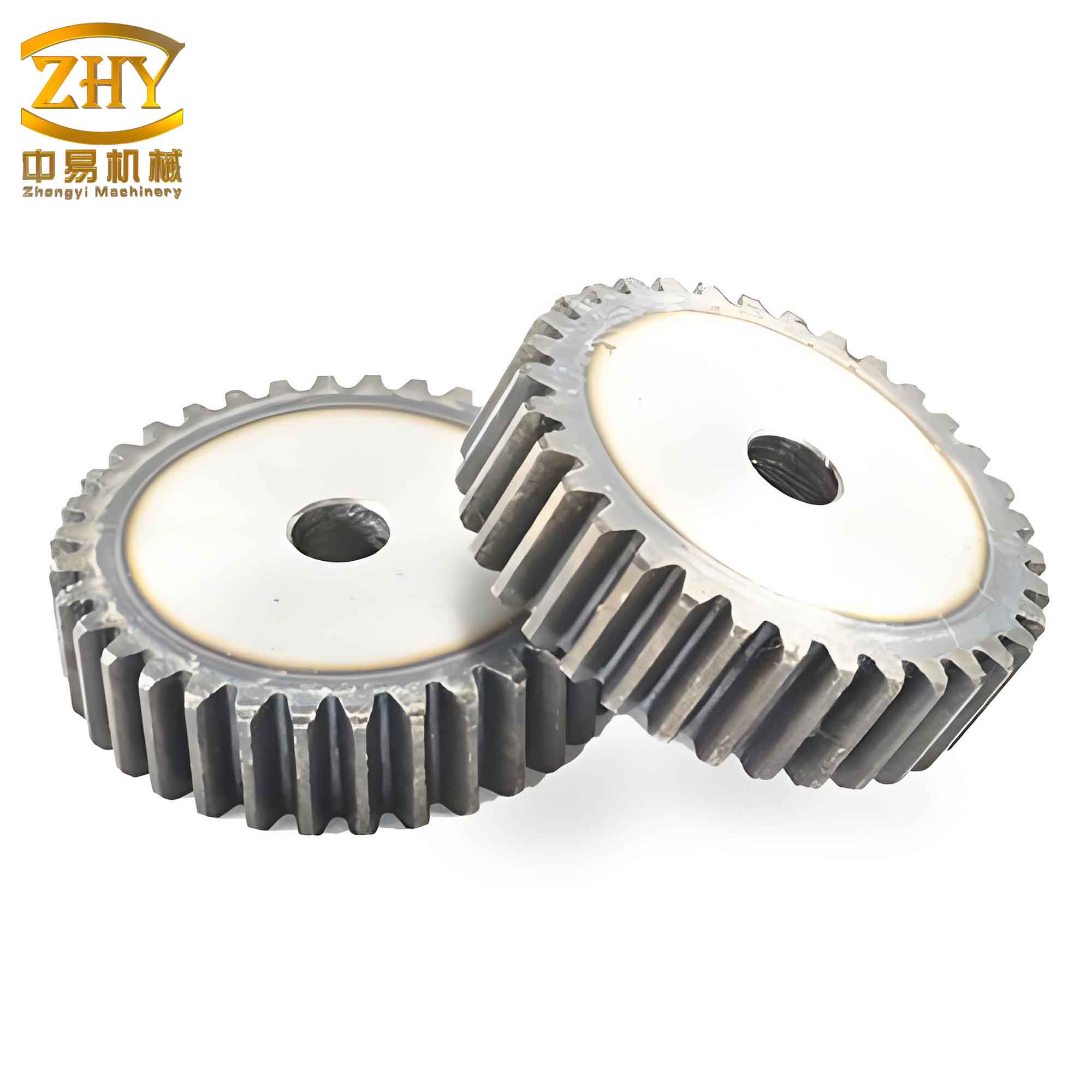
The core challenge in the cold extrusion of spur and pinion gear forms lies in the immense pressures exerted on the forming die cavity, often leading to catastrophic failure through longitudinal cracking. To combat this, a prestressed, multi-layer combined die structure is universally employed. This design utilizes shrink-fit assemblies to induce beneficial compressive pre-stresses in the inner die ring, counteracting the tensile stresses developed during the extrusion process. While established optimization formulas exist for dies with simple cylindrical bores, the complex, non-axisymmetric geometry of a spur and pinion gear cavity renders these direct calculations inadequate. This necessitates a hybrid optimization strategy that synergizes theoretical foundation with computational simulation. The methodology involves an initial design based on thick-walled cylinder theory to establish preliminary dimensions, followed by an iterative finite element analysis (FEA) process to fine-tune the critical interference fits. The ultimate goal is to push the stress state in the innermost, gear-shaped ring to its material’s allowable limit, thereby achieving a minimum-weight, maximum-strength die design.
Fundamentals of Combined Die Design and Initial Sizing
The standard approach for optimizing a three-layer combined die treats each layer as a thick-walled cylinder subjected to internal and external pressures. For a die intended for spur and pinion gear extrusion, this serves as the crucial first approximation. The primary objective, especially when using brittle but hard materials like carbide (e.g., YG20) for the inner ring, is to eliminate tensile hoop stress at the innermost surface (the root of the gear teeth). This condition maximizes the die’s resistance to fatigue and fracture.
Consider a generic thick-walled cylinder with inner radius \( R_1 \), outer radius \( R_2 \), internal pressure \( p_1 \), and external pressure \( p_2 \). The Lamé equations give the radial (\( \sigma_r \)) and hoop (\( \sigma_\theta \)) stresses at any radius \( r \):
$$
\sigma_\theta = \frac{R_1^2 p_1 – R_2^2 p_2}{R_2^2 – R_1^2} + \frac{(p_1 – p_2) R_1^2 R_2^2}{r^2 (R_2^2 – R_1^2)}
$$
$$
\sigma_r = \frac{R_1^2 p_1 – R_2^2 p_2}{R_2^2 – R_1^2} – \frac{(p_1 – p_2) R_1^2 R_2^2}{r^2 (R_2^2 – R_1^2)}
$$
For a three-layer die assembly for a spur and pinion gear, we define the geometry and pressures as shown in the schematic below. Let \( r_1 \) be the inner radius of the gear-shaped ring (approximated by the addendum circle radius for initial calculation), \( r_2 \) the outer radius of the inner ring/ inner radius of the middle ring, \( r_3 \) the outer radius of the middle ring/ inner radius of the outer ring, and \( r_4 \) the outer radius of the outer ring. The corresponding interfacial pressures are \( p_1 \) (working pressure), \( p_2 \), and \( p_3 \). The external pressure \( p_4 \) is typically zero.
To prevent tensile hoop stress at \( r = r_1 \) in the carbide inner ring, we set \( \sigma_{\theta}(r_1) = 0 \). Applying the Lamé formula to the inner ring yields the condition:
$$
p_1 = \frac{2p_2}{1 + Q_1^2}
$$
where \( Q_1 = r_1 / r_2 \).
For the middle and outer rings, typically made of high-strength alloy steels (e.g., H13 and 40Cr), the maximum shear stress (Tresca) theory is applied to prevent yield. Defining \( Q_2 = r_2 / r_3 \) and \( Q_3 = r_3 / r_4 \), we get:
$$
p_2 – p_3 = \frac{[\sigma]_2}{2} (1 – Q_2^2)
$$
$$
p_3 = \frac{[\sigma]_3}{2} (1 – Q_3^2) \quad \text{(since } p_4 = 0\text{)}
$$
Here, \( [\sigma]_2 \) and \( [\sigma]_3 \) are the allowable stresses for the middle and outer ring materials, respectively.
The core principle of optimal design is to distribute the diameter ratios \( Q_1, Q_2, Q_3 \) such that the die can withstand the maximum possible working pressure \( p_1 \). This is found by solving \( \partial p_1 / \partial Q_1 = 0 \) and \( \partial p_1 / \partial Q_2 = 0 \), leading to the following relationships for optimal load sharing:
$$
Q_2 = \frac{p_1}{[\sigma]_2} Q_1, \quad Q_3 = \frac{p_1}{[\sigma]_3} Q_1, \quad \text{and} \quad Q = Q_1 \cdot Q_2 \cdot Q_3 = \frac{r_1}{r_4}
$$
The total diameter ratio \( Q \) is typically constrained between 1/4 and 1/6 for heavy-load applications like spur and pinion gear extrusion. Selecting \( Q = 1/6 \) and knowing the allowable stresses and the estimated forming pressure \( p_1 \) (e.g., 2283 MPa from preliminary FEA), the optimal \( Q_1, Q_2, Q_3 \) can be calculated. The required interference fits at the interfaces are then determined. The radial interference \( \Delta d_2 \) between the inner and middle rings accounts for the different elastic moduli ( \( E_1 \) for carbide, \( E \) for steel) and Poisson’s ratios ( \( u_1, u \) ):
$$
\Delta d_2 = d_2 \cdot p_1 \cdot \frac{(1+Q_1^2)(1-Q_1^2)}{2(1-Q_2)} \times \left[ \frac{1}{E_1}\left(\frac{1+Q_1^2}{1-Q_1^2} – u_1\right) + \frac{1}{E}\left(\frac{1+Q_2^2 Q_3^2}{1-Q_2^2 Q_3^2} + u\right) \right]
$$
The interference \( \Delta d_3 \) between the middle and outer rings is given by:
$$
\Delta d_3 = d_3 \cdot \left( [\sigma]_3 – p_1 Q_2^2 \right) / E
$$
Based on these formulas, the preliminary theoretical dimensions and interferences for a spur and pinion gear extrusion die can be tabulated.
| Component | Inner Diameter (mm) | Outer Diameter (mm) | Radial Interference (mm) |
|---|---|---|---|
| Inner Ring (Carbide) | 33.0 (r1) | 66.5 (r2) | Δd2 = 0.585 |
| Middle Ring (H13 Steel) | 66.5 (r2) | 117.3 (r3) | |
| Outer Ring (40Cr Steel) | 117.3 (r3) | 200.0 (r4) | Δd3 = 0.580 |
Iterative Optimization of Interference Fits Using FEA and Golden Section Search
The preliminary design, while theoretically sound for a cylinder, often proves suboptimal for the actual spur and pinion gear cavity. The stress concentrations at the tooth roots and the non-uniform load distribution mean that applying the theoretically calculated interferences directly in an FEA model may show von Mises stresses exceeding the yield strength of the inner ring material. This validates the need for a secondary, geometry-aware optimization stage focused on the interference values.
The strategy employs the Golden Section Search method, an efficient algorithm for finding the extremum of a unimodal function. The “function” here is the maximum von Mises stress in the carbide inner ring as a function of the interference fit \( \Delta d_2 \) (and simultaneously adjusting \( \Delta d_3 \) proportionally based on the theoretical ratio for simplicity). The search domain is defined between a lower bound (e.g., zero interference) and an upper bound (the theoretical value, 0.58 mm). The target is to find the interference value that brings the maximum inner ring stress as close as possible to, but not exceeding, the material’s allowable stress (e.g., 3300 MPa for YG20).
The iterative procedure is as follows:
- Define Search Interval: Initial interval [a, b] = [0, 0.58] mm.
- Calculate Test Points: Determine two interior points using the golden ratio \( \phi \approx 0.618 \):
$$ x_1 = b – \phi(b-a) $$
$$ x_2 = a + \phi(b-a) $$ - FEA Evaluation: Build two finite element models of the full 3D spur and pinion gear combined die assembly with interferences \( \Delta d_2 = x_1 \) and \( \Delta d_2 = x_2 \). Perform a nonlinear contact analysis to simulate the shrink-fitting process and extract the maximum von Mises stress in the inner ring.
- Interval Reduction: Compare the stress values \( f(x_1) \) and \( f(x_2) \) against the target (3300 MPa). The sub-interment that contains the stress value closest to the target is retained as the new [a, b] interval. The process eliminates the less optimal section of the search space.
- Iterate: Steps 2-4 are repeated until the interval length is sufficiently small, converging to the optimal interference value.
The following table summarizes a typical iteration history for optimizing a spur and pinion gear die:
| Iteration Step | Search Interval [a, b] (mm) | Test Point (mm) | Max. von Mises Stress at Test Point (MPa) | New Interval Decision |
|---|---|---|---|---|
| 0 | [0.000, 0.580] | – | – | – |
| 1 | [0.000, 0.580] | x1=0.224, x2=0.356 | ~1800, ~2308 | Stress at x2 closer to 3300 MPa. New interval = [0.224, 0.580]. |
| 2 | [0.224, 0.580] | x1=0.356, x2=0.448 | ~2308, ~2860 | Stress at x2 closer to target. New interval = [0.356, 0.580]. |
| 3 | [0.356, 0.580] | x1=0.448, x2=0.488 | ~2860, ~3166 | Stress at x2 closer to target. New interval = [0.448, 0.580]. |
| 4 | [0.448, 0.580] | x1=0.488, x2=0.540 | ~3166, ~3512 | Stress at x1 is under 3300 MPa and closer than x2 (over). New interval = [0.448, 0.540]. |
| 5 (Converged) | [0.488, 0.540] | x1=0.514, x2=0.514* | ~3294 | Interval sufficiently small. Optimal Δd2 ≈ 0.514 mm. |
*Note: In later iterations, points may converge.
After convergence, the optimal interference is rounded to a manufacturable value, such as 0.51 mm. A final verification FEA run at this rounded value confirms the stress state is satisfactory (~3268 MPa). The inner ring’s material potential is thus fully utilized without risk of overloading. The final, optimized dimensions for the spur and pinion gear extrusion die are therefore a combination of the theoretically determined radial dimensions and the iteratively optimized interference fits.
| Component | Inner Diameter (mm) | Outer Diameter (mm) | Optimized Radial Interference (mm) |
|---|---|---|---|
| Inner Ring (Carbide) | 33.0 | 66.5 | Δd2 = 0.51 |
| Middle Ring (H13 Steel) | 66.5 | 117.3 | |
| Outer Ring (40Cr Steel) | 117.3 | 200.0 | Δd3 = 0.51* |
*Note: Δd3 is adjusted proportionally from its theoretical value based on the change in Δd2.
Summary of the Integrated Optimization Design Procedure
The successful design of a high-performance combined extrusion die for complex geometries like spur and pinion gear profiles requires a two-stage, integrated approach. The procedure synthesizes classical elasticity theory with modern computational power, ensuring both structural efficiency and operational reliability.
The complete workflow can be summarized as follows:
| Step | Activity | Objective | Key Tools/Formulas |
|---|---|---|---|
| 1 | Preliminary Theoretical Sizing | Determine initial radial dimensions (r2, r3, r4) and interference fits (Δd2, Δd3) based on thick-walled cylinder theory. | Lamé equations, Tresca yield criterion, optimal diameter ratio relations ( \( Q_2 = \frac{p_1}{[\sigma]_2} Q_1 \) ), interference formulas. |
| 2 | Working Pressure Estimation | Obtain a reliable estimate of the maximum forming pressure \( p_1 \) acting on the spur and pinion gear cavity. | Finite Element Analysis of the extrusion process itself. |
| 3 | Initial FEA Validation | Check the stress state in the die assembly using theoretical interferences. Identify over-stress in the gear-tooth region. | Nonlinear FEA with contact for shrink-fit simulation. |
| 4 | Iterative Interference Optimization | Adjust interference fits to achieve target stress (allowable stress) in the inner ring, accounting for actual gear geometry. | Golden Section Search algorithm coupled with iterative FEA runs. |
| 5 | Final Design Specification | Combine the optimal radial dimensions from Step 1 with the optimized interferences from Step 4. Validate with a final simulation. | Documentation of final dimensions and pre-stress state. |
This methodology effectively bridges the gap between simplified analytical models and real-world geometric complexity. For the demanding application of spur and pinion gear cold extrusion, it provides a rational and robust path to designing dies that are both safe and efficient, extending tool life and ensuring consistent part quality. The principle is universally applicable to the design of prestressed dies for other complex, high-pressure forming operations.