
The transmission of power in aerospace and automotive systems critically depends on the performance of hyperboloidal gear pairs. Understanding the dynamic behavior of these complex components under operational conditions is paramount for designing high-performance, reliable drivetrains. This analysis focuses on the dynamic meshing characteristics, which encompass both the transient engagement dynamics—such as contact impact, rotational speed fluctuations, and vibrational responses—and the evolving contact mechanics, including the patterns of contact area, contact stress distribution, and root bending stress throughout the meshing cycle. While static or quasi-static contact analyses are well-documented, the comprehensive study of continuous dynamic meshing, particularly the influence of operational parameters like speed and load, remains an area requiring deeper exploration. This work utilizes nonlinear dynamic theory and explicit finite element analysis to construct a robust simulation model and investigate these phenomena in detail.
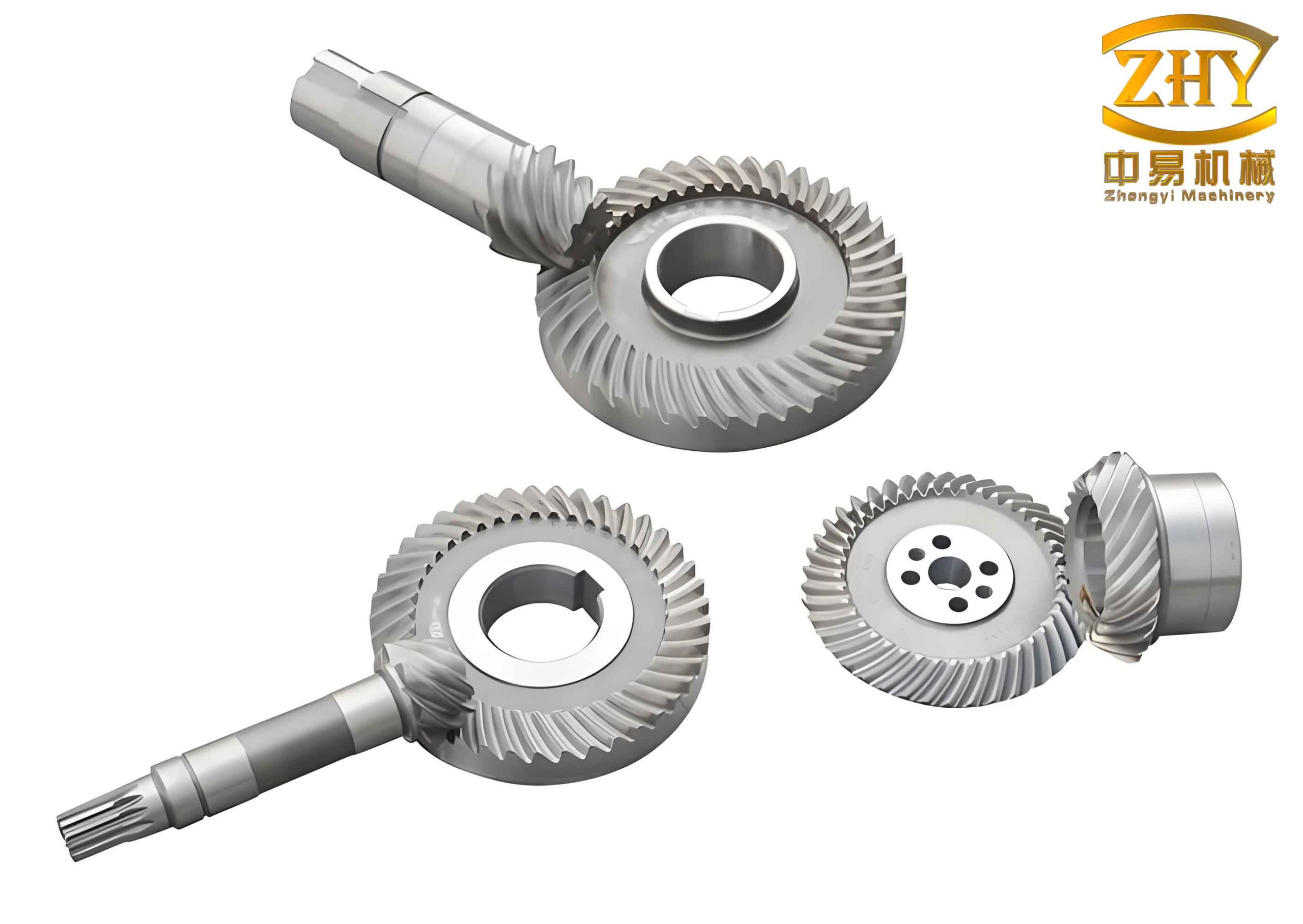
Fundamentals of Dynamic Finite Element Analysis for Gears
The dynamic meshing of hyperboloidal gears constitutes a highly nonlinear boundary value problem. The fundamental equation of motion governing the system’s response is given by:
$$ M\{\ddot{x}\} = P(t) – K\{x\} – C\{\dot{x}\} $$
where \( M \) is the mass matrix, \( P(t) \) is the external load vector, \( K \) is the stiffness matrix, \( C \) is the damping matrix, and \( \{\ddot{x}\} \), \( \{\dot{x}\} \), \( \{x\} \) are the nodal acceleration, velocity, and displacement vectors, respectively. The term \( M\{\ddot{x}\} \) represents the inertial forces, which become the dominant factor in dynamic analysis, especially at high speeds. In explicit finite element solvers like LS-DYNA, this equation is often implemented in a slightly different form to handle complex contact and material nonlinearities:
$$ M\ddot{x}(t) = P(x,t) – F(x,\dot{x}) + H – C\dot{x} $$
Here, \( F(x,\dot{x}) \) is the internal force vector from the element stresses, and \( H \) represents the hourglass control forces used to suppress spurious zero-energy modes inherent in reduced-integration elements. The accurate characterization of mass distribution and its motion is therefore critical for a realistic simulation of hyperboloidal gear dynamics.
Construction of the Finite Element Model for Hyperboloidal Gears
A critical step in analyzing hyperboloidal gears is building a finite element model that balances computational efficiency with the accuracy required to capture dynamic effects. The model development involves several key stages.
Geometric Modeling and Mesh Generation
Precise tooth geometry is paramount. The flank surfaces of the pinion and gear are generated numerically based on their machine settings and basic geometric parameters. These discrete data points are then used to construct accurate 3D solid models of the gear pair. The primary geometric parameters for the example hyperboloidal gear set used in this analysis are summarized in Table 1.
| Parameter | Pinion | Gear |
|---|---|---|
| Number of Teeth | 7 | 39 |
| Face Width (mm) | 68.34 | 63.00 |
| Mean Spiral Angle (deg) | 45.00 | 34.25 |
| Hand of Spiral | Left | Right |
An effective meshing strategy is employed to manage computational cost. The teeth actively participating in the meshing cycle are discretized with a fine mesh (element size ~1 mm) to resolve contact stresses accurately. The remaining portions of the gears are meshed coarsely. A tied contact constraint connects the fine and coarse mesh regions, ensuring structural integrity without the prohibitive cost of a globally fine mesh. This approach is essential for modeling the continuous rotation of hyperboloidal gears over multiple tooth engagements.
Material Definition, Boundary Conditions, and Contact
Both the pinion and gear are modeled as deformable bodies using a linear elastic material model. The material properties are defined as follows: Young’s Modulus \( E = 2.1 \times 10^5 \) MPa, Poisson’s ratio \( \nu = 0.3 \), and density \( \rho = 7.8 \times 10^{-9} \) t/mm³. Solid elements (SOLID164 in LS-DYNA) with single-point integration are used for efficiency. The inner bore of the pinion and the back face of the gear are modeled as rigid bodies using shell elements to facilitate the application of boundary conditions.
The boundary conditions are applied to these rigid regions. The pinion is driven by prescribing a rotational velocity about its axis. The gear is constrained by applying a resisting torque about its axis. All other translational and rotational degrees of freedom for both components are fully constrained, simulating a typical mounted bearing condition. The contact between all potential interacting tooth surfaces is defined using an automatic surface-to-surface contact algorithm with a penalty-based formulation, which is suitable for the large sliding and separation expected in dynamic meshing of hyperboloidal gears.
Dynamic Meshing Performance and Characteristics
Simulating the startup and subsequent steady-state operation reveals critical dynamic phenomena inherent to hyperboloidal gear pairs.
Meshing Contact Impact and Transient Response
A significant finding is the pronounced meshing contact impact during the initial engagement from standstill. When a constant rotational speed is applied to the pinion, the system experiences a sharp initial冲击. The contact force peaks at nearly twice the magnitude of the stabilized steady-state force. This transient冲击 attenuates over time as the system approaches stable meshing. The duration and severity of this impact are functions of the system’s inertial properties, damping, and the applied acceleration rate.
The dynamic response is illustrated by the rotational speeds and accelerations. While the pinion speed is prescribed, the gear’s speed shows a rapid rise followed by oscillatory decay toward its theoretical steady-state value. The angular acceleration of the gear correlates directly with the fluctuating contact force, highlighting the dynamic coupling. The components of the total contact force reveal that the force along the pinion axis is the largest, followed by the radial components, a direct consequence of the offset and spiral angle in hyperboloidal gears.
Evolution of Contact Stress and Bending Stress
The dynamic nature of engagement leads to a characteristic stress distribution pattern. Figure 1 below conceptually shows the stress history on three consecutive teeth on the same flank (Teeth A, B, C in order of engagement).
| Tooth | Engagement Phase | Typical Contact Stress Magnitude | Root Bending Stress Magnitude |
|---|---|---|---|
| Tooth A (First) | Initial Impact & Transition | Lower, Highly Fluctuating | Lower, Highly Fluctuating |
| Tooth B (Middle) | Primary Load Sharing | Highest | Highest |
| Tooth C (Last) | Stabilized Meshing | High, More Stable | High, More Stable |
The middle tooth in the contact zone consistently bears the highest load, and thus exhibits the maximum contact and bending stresses. Both contact stress and root bending stress are found to be greatest at the midpoint of the tooth face width and the root fillet, respectively. The maximum instantaneous contact pressure \( \sigma_{c,max} \) during stable meshing can be related to the dynamic contact force \( F_d(t) \) and the instantaneous contact ellipse dimensions \( a(t) \) and \( b(t) \) via a simplified relation based on Hertzian theory:
$$ \sigma_{c,max}(t) \propto \sqrt[3]{ \frac{F_d(t) \cdot E^*}{ (a(t) \cdot b(t))^{1/2} } } $$
where \( E^* \) is the equivalent modulus of elasticity. The dynamic force \( F_d(t) \) oscillates around the static load \( F_s \), explaining the oscillatory nature of the contact stress.
Parametric Study: Influence of Speed and Load
Operational conditions drastically affect the dynamic behavior of hyperboloidal gears. This section investigates the effects of varying pinion rotational speed and gear load torque.
Effect of Rotational Speed
Speed is a dominant factor in the dynamics of hyperboloidal gears. Analyses were conducted with a constant load torque of 200 N·m but with varying pinion speeds: 12, 120, 600, and 1200 rpm. The key observations are consolidated in Table 3.
| Pinion Speed (rpm) | Meshing Nature | Contact Force Peak (vs. Steady State) | Dominant Force Component |
|---|---|---|---|
| 12 – 120 | Intermittent Contact-Separation | ~1-1.5x | Static Load |
| 600 – 1200 | Oscillatory (Forward-Backward Contact) | ~1.8-2.2x | Inertial Load |
At lower speeds, the engagement is characterized by a simple contact and separation cycle. The initial冲击 is present but less severe. At higher speeds (600 rpm and above), the engagement dynamics become more complex, involving forward contact, separation, and even brief periods of反向接触 due to tooth flank oscillations. The initial meshing contact impact becomes significantly more severe and prolonged as the speed increases. This is because the kinetic energy introduced into the system at startup scales with the square of the rotational speed \( \omega \):
$$ E_{kinetic} = \frac{1}{2} I \omega^2 $$
where \( I \) is the mass moment of inertia. A higher \( \omega \) leads to a larger energy imbalance during initial contact, resulting in a more violent impact.
Effect of Load Torque
The influence of load torque is not independent but is closely coupled with the operational speed. A series of analyses were performed at different pinion speeds (60, 600, 1200, 3600 rpm) with three load levels: 40 N·m, 200 N·m, and 1000 N·m. The results, particularly regarding the maximum contact stress \( \sigma_{c,max} \), are summarized in Table 4.
| Pinion Speed (rpm) | Load Torque Increase (40→200 N·m) | Load Torque Increase (200→1000 N·m) | Dominant Load Mechanism |
|---|---|---|---|
| 60 | σ_max increases by ~16.8% | σ_max increases by ~60.4% | Static Load |
| 600 | σ_max increases by ~1.4% | σ_max increases by ~6.5% | Transitional |
| 1200 | σ_max increases by ~0.7% | σ_max increases by ~2.7% | Inertial Load |
| 3600 | σ_max increases by ~0.3% | σ_max increases by ~1.8% | Inertial Load |
This table reveals a crucial insight: the influence of load diminishes as speed increases. At very low speeds (e.g., 60 rpm), the system is quasi-static, and the applied load is the primary driver of contact stress. Consequently, a five-fold increase in load (200 N·m to 1000 N·m) causes a drastic 60% rise in stress. However, at high speeds, the inertial forces dominate. The inertial load component scales with \( \omega^2 \). Comparing 60 rpm (\( \omega \approx 6.28 \) rad/s) to 3600 rpm (\( \omega \approx 377 \) rad/s), the inertial forces become roughly 3600 times larger. Therefore, the same absolute change in external load torque becomes negligible relative to the massive inertial forces governing the contact dynamics. This has a direct and critical implication for the design of high-speed hyperboloidal gears: mass reduction (lowering inertia) becomes as important as strength for managing contact stresses.
The contact ellipse pattern remains qualitatively similar (elliptical) across different loads at the same speed, but its size and the magnitude of pressure within it change according to the prevailing load regime (static or inertial).
Conclusions and Implications for Gear Design
The explicit dynamic finite element analysis provides a powerful framework for probing the complex nonlinear behavior of hyperboloidal gears. The developed modeling methodology, which strategically combines local mesh refinement with tied constraints, offers a balanced and effective approach for simulating continuous rotational meshing.
The analysis quantitatively captures the meshing contact impact, a critical transient event during startup characterized by contact forces nearly double the steady-state values. The dynamic meshing of hyperboloidal gears induces a predictable stress cycle where the centrally engaged tooth experiences the highest contact and bending stresses.
The parametric studies yield significant design insights:
- Rotational Speed is a primary driver of dynamic severity. Higher speeds exponentially increase inertial loads, intensify the initial meshing contact impact, and alter the fundamental nature of tooth engagement from intermittent to complex oscillatory contact.
- Load Influence is Speed-Dependent. The effect of external load torque on dynamic contact stress is predominant at low speeds but diminishes rapidly as speed increases. At high operational speeds, inertial forces dominate the stress state.
- High-Speed Design Paradigm: For hyperboloidal gears operating at high speeds, traditional design focused solely on strength under static loads is insufficient. A paradigm shift towards lightweighting to reduce rotational inertia is essential for mitigating dynamic contact stresses and improving performance. This finding is particularly crucial for aerospace applications where hyperboloidal gears are common.
Future work can extend this analysis to include the effects of system damping (a sensitive parameter in dynamic simulations), gear shaft flexibility, and bearing compliance to create an even more integrated and predictive model of hyperboloidal gear transmission dynamics.