
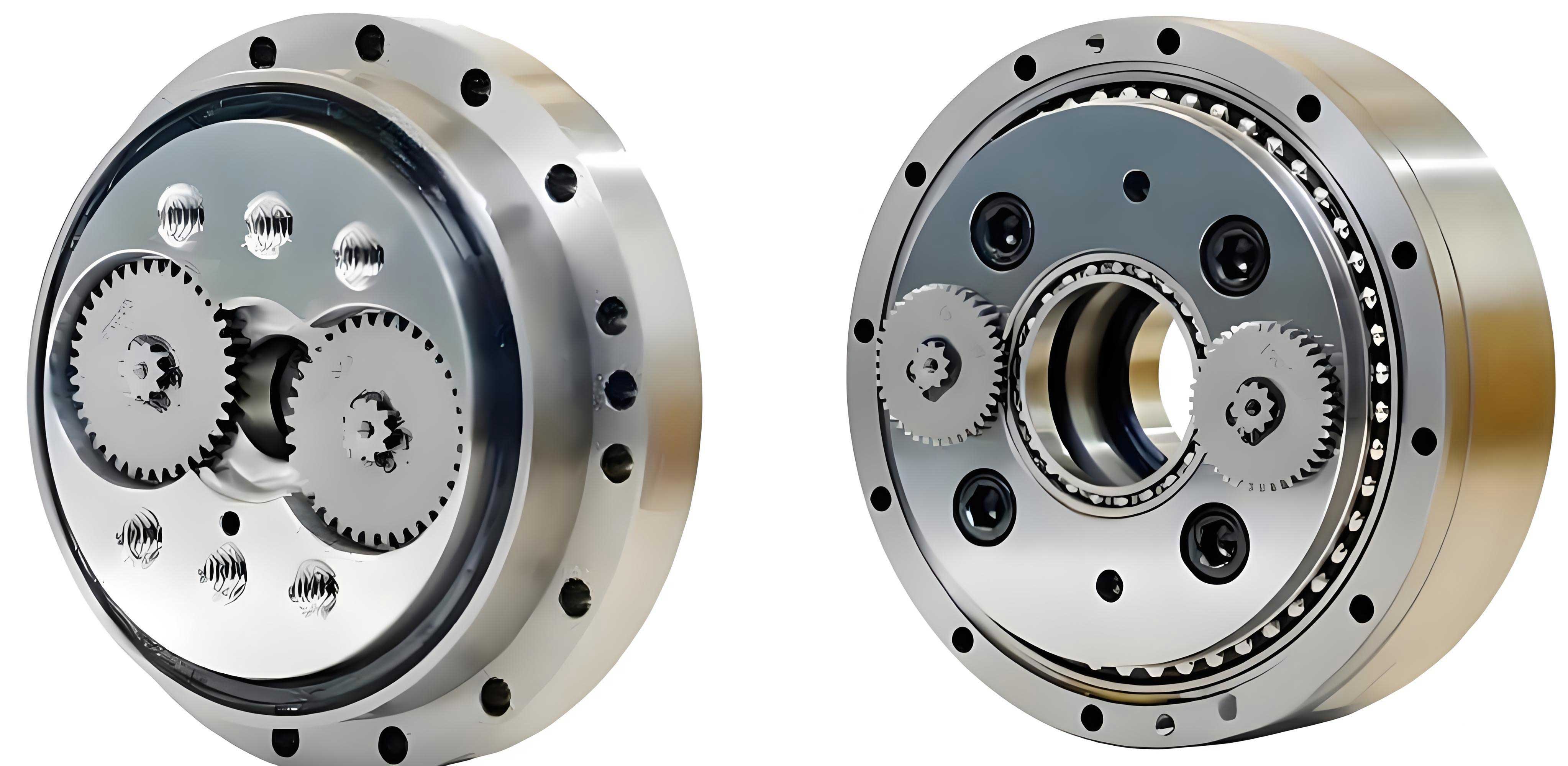
The RV reducer is a pivotal component in industrial robotics and high-precision machinery, renowned for its compact structure, high transmission ratio, excellent efficiency, and superior transmission accuracy. Its architecture typically combines a first-stage involute planetary gear train with a second-stage cycloid-pinion planetary drive and an output mechanism, forming a closed differential system. For robotic applications, an RV reducer must exhibit high motion precision, high torsional stiffness, and minimal backlash. Backlash, defined as the angular lag of the output shaft caused by geometric clearances such as tooth flank gaps and bearing play, is a critical performance metric. It becomes a non-linear factor during motion reversal, momentarily disconnecting the output from the input, which can directly impair feedback control systems and dynamic performance in robots. Therefore, stringent limits, typically within (1~1.5) arcminutes, are imposed on the backlash of robot-grade RV reducers. This analysis focuses on dissecting the sources of backlash within an RV reducer, establishing a mathematical model for its prediction, and proposing integrated strategies—combining tooth profile modification, tolerance optimization, and structural adjustment—to effectively control and minimize it.
The total geometric backlash in an RV reducer is the sum of contributions from its three main subsystems: the involute planetary stage, the cycloid-pinion planetary stage, and the output mechanism. While deformation due to load and temperature also contributes, the primary focus for design and manufacturing control lies on the geometric errors from machining and assembly.
1. Mathematical Model of RV Reducer Backlash
The backlash is a result of the superposition of numerous dimensional and geometric errors, each operating within its tolerance band. A comprehensive mathematical model is essential for analysis and optimization.
1.1 Backlash from the Involute Planetary Stage (First Stage)
The backlash at the output side, contributed by the first stage, is attenuated by the total reduction ratio. Based on established gear flank clearance calculation methods, the equivalent output angular backlash $\Delta\phi_1$ (in arcminutes) can be expressed as:
$$ \Delta\phi_1 = \frac{j_n \times 180 \times 60}{\pi \times i \times r_1} $$
where $i$ is the total reduction ratio of the RV reducer, $r_1$ is the pitch radius of the sun gear, and $j_n$ is the normal flank clearance at the first-stage meshing. The flank clearance $j_n$ is a function of multiple gear errors:
$$ j_{n_{max}} = E_{si1} + E_{si2} \cos\alpha + 1.44(f_a + 0.72(F_{r1}+F_{r2}))\sin\alpha $$
$$ j_{n_{min}} = E_{ss1} + E_{ss2} \cos\alpha – \Delta + 1.44(f_a – 0.72(F_{r1}+F_{r2}))\sin\alpha $$
$$ \Delta = \sqrt{(2f_a \sin\alpha)^2 + 2(F_{\beta})^2 + 2(f_{pb})^2 + (f_x \sin\alpha)^2 + (f_y \cos\alpha)^2} $$
Here, $E_{ss}, E_{si}$ are the upper and lower deviations of base tangent length, $f_a$ is the center distance error, $F_r$ is the radial runout, $F_{\beta}$ is the helix deviation, $f_{pb}$ is the base pitch deviation, and $f_x, f_y$ are the axis parallelism errors. Typically, a standard gear accuracy grade (e.g., Grade 7) defines these tolerances.
1.2 Backlash from the Cycloid-Pinion Stage (Second Stage)
This stage is the most significant contributor to the overall backlash of the RV reducer. Theoretically, a standard cycloid profile mates with pins without clearance. However, to accommodate manufacturing errors, facilitate assembly and lubrication, and prevent interference, a controlled clearance must be introduced via profile modification of the cycloid wheel. The resulting angular backlash $\Delta\phi_2$ is the sum of effects from individual error sources:
$$ \Delta\phi_2 = \sum \Delta\phi_{2i} = \frac{180 \times 60}{\pi \times e \times Z_c} \mathbf{A} \boldsymbol{\delta} $$
where $e$ is the eccentricity, $Z_c$ is the number of teeth on the cycloid wheel, $\mathbf{A}$ is a coefficient matrix derived from the geometry of the cycloid drive, and $\boldsymbol{\delta}$ is the error vector. The error vector encompasses key parameters:
$$ \boldsymbol{\delta} = (\delta_{rp},\ \delta_t,\ \delta_{R_{rp}},\ \delta_{r_{rp}},\ f_p,\ F_{r1},\ \delta_e,\ \Delta r_p,\ \delta_{\Delta r_p},\ \delta_{\Delta r_{rp}})^T $$
The coefficient matrix $\mathbf{A}$ for a standard design is given by:
$$
\mathbf{A} = \begin{bmatrix}
\frac{2\sqrt{1-k_1^2}}{k_1^2} & 1 & \frac{2k_n}{\sqrt{1-k_1^2}} & -2 & -\frac{2}{\sqrt{1-k_1^2}} & 0.5 & -\frac{2k_n}{\sqrt{1-k_1^2}} & -\frac{2}{\sqrt{1-k_1^2}} & -\frac{2}{\sqrt{1-k_1^2}} & 2
\end{bmatrix}
$$
where $k_1$ is the shortening coefficient and $k_n$ is a coefficient related to center distance and modification. The sensitivity of backlash to each parameter can be analyzed from this model.
1.3 Backlash from the Output Mechanism
The output mechanism’s backlash primarily stems from the radial clearance in the crank shaft bearings (e.g., the support bearings for the eccentric cams). This clearance $\Delta u_1$ translates to an output angular error $\Delta\phi_3$:
$$ \Delta\phi_3 = \frac{180 \times 60 \times \Delta u_1}{\pi \times a_0} $$
where $a_0$ is the center distance of the first-stage involute gear train.
1.4 Total Geometric Backlash of the RV Reducer
The overall geometric backlash is the linear sum of contributions from all three stages:
$$ \Delta\phi_{\sum} = \Delta\phi_1 + \Delta\phi_2 + \Delta\phi_3 $$
2. Sensitivity Analysis and Key Error Parameters
A sensitivity analysis based on the model helps identify the most critical parameters affecting the RV reducer’s backlash. The relative sensitivity of backlash to changes in each error parameter, especially with respect to the cycloid modification amounts, is crucial. The first-stage contribution is often small due to the high reduction ratio. The following table summarizes key error parameters for the cycloid stage and their typical influence.
| No. | Parameter | Symbol | Relative Sensitivity (S₀) | Typical Error Range (mm) |
|---|---|---|---|---|
| 1 | Pin Center Circle Radius Error | $\delta_{rp}$ | $\sqrt{1-k_1^2}$ | -0.004 ~ 0.002 |
| 2 | Pin Hole Circumferential Position Error | $\delta_t$ | $k_1$ | -0.003 ~ 0.001 |
| 3 | Pin Hole Radius Error | $\delta_{R_{rp}}$ | 1 | 0.001 ~ 0.004 |
| 4 | Pin Radius Error | $\delta_{r_{rp}}$ | -1 | -0.002 ~ 0 |
| 5 | Cycloid Wheel Pitch Accumulation Error | $f_p$ | $k_1/2$ | -0.007 ~ 0.001 |
| 6 | Cycloid Wheel Radial Runout | $F_{r1}$ | 0.25 | ±0.001 |
| 7 | Eccentricity Error | $\delta_e$ | $-k_n$ | ±0.001 |
| 8 | Profile Shift Modification Error | $\delta_{\Delta r_p}$ | $-\sqrt{1-k_1^2}$ | 0 ~ 0.002 |
| 9 | Equidistant Modification Error | $\delta_{\Delta r_{rp}}$ | 1 | -0.002 ~ 0 |
| 10 | Crank Bearing Radial Clearance | $\Delta u_1$ | $e Z_c / (2 a_0)$ | 0 ~ 0.002 |
The analysis reveals that nearly all parameters, except perhaps the eccentricity error, can cause the total backlash to exceed the strict 1 arcminute limit if their tolerance bands are not carefully controlled. Therefore, a systematic approach involving profile optimization, tolerance allocation, and structural compensation is necessary.
3. Optimization of Cycloid Wheel Profile Modification
Tooth profile modification of the cycloid wheel is the primary method to introduce controlled clearance in the second stage. The choice of modification method and the optimal amount are critical for minimizing backlash while ensuring proper meshing and lubrication.
3.1 Modification Method
Common methods include equidistant modification ($\Delta r_{rp}$), profile shift modification ($\Delta r_p$), and rotation angle modification. A combination of negative equidistant and negative profile shift modification is often preferred. This method creates small radial clearances near the tooth tip and root, resulting in a tooth profile very close to the conjugate one, thereby minimizing transmission error and achieving small, controllable flank clearance. It sacrifices a minimal amount of load-carrying capacity for superior precision.
3.2 Optimization Model Based on Normal Flank Clearance
An effective optimization model aims to achieve a uniform and minimal normal clearance along the tooth profile. This ensures multi-tooth contact, good load distribution, and high precision. Let the design variable be $\mathbf{X} = [\Delta r_{rp},\ \Delta r_p]^T$. The normal clearance $\Delta(\phi_i)$ at a specific roll angle $\phi_i$ can be expressed as:
$$ \Delta(\phi_i) = \Delta r_{rp}(1 – \sin \phi_i S^{-1/2}) – \Delta r_p[1 – \cos(\phi_i – \phi_0)]S^{-1/2} – \delta_e Z_c \sin \phi_i S^{-1/2} $$
where $S = 1 + k_1^2 – 2k_1 \cos(\phi_i – \phi_0)$ and $k_1$ is the shortening factor.
Sampling $n$ points over the engagement range $\phi \in [0, \pi]$, the objective is to minimize the deviation of the actual clearance from a small target value $l_i$. The objective function $F(\mathbf{X})$ can be formulated as:
$$ F(\mathbf{X}) = \sum_{i=1}^{n+1} (\Delta(\phi_i) – l_i)^2 $$
3.3 Constraints
The optimization is subject to several engineering constraints:
$$
\begin{aligned}
&g_1(\mathbf{X}) = \Delta r_{rp} \le 0 \quad \text{(Negative equidistant modification)} \\
&g_2(\mathbf{X}) = \Delta r_{p} \le 0 \quad \text{(Negative shift modification)} \\
&g_3(\mathbf{X}) = \Delta r_{rp} – \Delta r_{p} \ge 0 \quad \text{(Ensures combined negative modification)} \\
&g_4(\mathbf{X}) = \frac{\Delta r_{rp}}{e Z_c} – \frac{\Delta r_{p} \sqrt{1-k_1^2}}{e Z_c} > 0 \quad \text{(Prevents undercutting)} \\
&g_5(\mathbf{X}) = \Delta(\phi_i) \ge 0 \quad \text{(Ensures positive clearance at all points)}
\end{aligned}
$$
4. Case Study: RV-40E-121 Reducer
The following analysis is based on the parameters of an RV-40E-121 type reducer.
| Parameter | Symbol | Unit | Value |
|---|---|---|---|
| Transmission Ratio | $i$ | – | 121 |
| Pin Center Circle Radius | $r_p$ | mm | 64 |
| Pin Radius | $r_{rp}$ | mm | 3 |
| Eccentricity | $e$ | mm | 1.3 |
| Number of Cycloid Teeth | $Z_c$ | – | 39 |
| Shortening Coefficient | $k_1$ | – | 0.8125 |
| Sun Gear Teeth | $z_1$ | – | 12 |
| Planet Gear Teeth | $z_2$ | – | 36 |
| Module | $m$ | mm | 1.5 |
4.1 Optimized Modification Amounts
Using the constrained nonlinear optimization function (e.g., `fmincon` in MATLAB) with the model and constraints described, the optimal modification amounts for this RV reducer are found to be:
$$ \Delta r_{rp}^* = -0.040\ \text{mm}, \quad \Delta r_{p}^* = -0.070\ \text{mm} $$
With these values, the inherent backlash contribution from the optimized profile itself is minimized to approximately $\Delta\phi_{2\text{(mod)}} = 0.11’$.
4.2 Tolerance Band Optimization
Given the optimized profile, the next step is to allocate tolerance bands to the manufacturing errors of the second-stage components. The goal is to find the combination of errors within their allowable ranges that minimizes the additional backlash. This is another optimization problem. Define the error design variable as $\mathbf{X}_{\delta} = [\delta_{rp},\ \delta_t,\ \delta_{R_{rp}},\ \delta_{r_{rp}},\ f_p,\ F_{r1},\ \delta_e,\ \delta_{\Delta r_p},\ \delta_{\Delta r_{rp}}]$. The objective is to minimize the total second-stage backlash $f(\mathbf{X}_{\delta}) = \sum \Delta\phi_{2i}$ subject to the initial, broad tolerance constraints for each parameter. Solving this yields a target set of error values that minimize backlash. By analyzing these results and considering manufacturing feasibility and sensitivity, practical tolerance bands can be assigned, such as those suggested in Table 1.
4.3 Backlash Calculation via Monte Carlo Simulation
To statistically assess the final backlash distribution considering all random errors within their optimized tolerance bands, the Monte Carlo method is employed. Thousands of random samples for each error parameter are generated according to their distributions (e.g., uniform within bounds), and the total backlash $\Delta\phi_{\sum}$ is calculated for each sample using the complete mathematical model.
For the RV-40E-121 example with the optimized tolerances, a 1000-run Monte Carlo simulation typically yields results showing that the contributions are: $\Delta\phi_1$ (first stage) is very small, often below 0.02′; $\Delta\phi_2$ (second stage) is the dominant component, varying roughly between 0.5′ and 1.2′; and $\Delta\phi_3$ (output) is also minor, below 0.2′. The total backlash $\Delta\phi_{\sum}$ often ranges between 0.6′ and 1.3′, with many instances still exceeding the 1′ target. This indicates that even with optimized tooth profile and tight tolerances, meeting the stringent robot-grade backlash requirement remains challenging due to the accumulation of numerous small errors.
5. Structural Anti-Backlash Adjustment: Staggered Assembly of Cycloid Wheels
To compensate for the residual backlash from manufacturing variances, a structural method involving the staggered assembly of the two cycloid wheels is proposed. Instead of mounting the two identical cycloid wheels symmetrically on the eccentric cams, they are assembled with a slight intentional angular offset relative to each other. This creates a pre-torque condition where, depending on the direction of rotation, one wheel’s teeth are biased against one flank of the pins while the other wheel’s teeth are biased against the opposite flank. Effectively, this method eliminates the clearance at the second stage at the cost of introducing a small, controlled preload.
Let $\delta’$ be the intentional angular offset (stagger angle) applied between the two cycloid wheels. The backlash contribution from the second stage after this adjustment becomes:
$$ \Delta\phi’_2 = \Delta\phi_2 – 4\delta’ $$
When $\Delta\phi’_2 \le 0$, the cycloid-pin mesh has zero or negative clearance (slight preload). In practice, $\delta’$ is chosen such that $\Delta\phi’_2$ is slightly negative to ensure elimination of clearance without causing excessive friction or stress. The total backlash of the RV reducer is then recalculated as:
$$ \Delta\phi_{\sum} = \Delta\phi_1 + \Delta\phi’_2 + \Delta\phi_3 \approx \Delta\phi_1 + \Delta\phi_3 $$
since $\Delta\phi’_2 \approx 0$.
This angular offset can be achieved through several manufacturing or assembly techniques: 1) Machining the bearing bores on the cycloid wheels with a tangential phase offset, 2) Rotating the wheel blank by $\delta’$ before cutting the teeth, or 3) Introducing a small tangential phase error in the eccentric lobes of the two crank pins.
Final Result with Structural Adjustment:
Applying a small stagger angle, e.g., $\delta’ = 0.1’$, to the previous Monte Carlo simulation effectively nullifies the dominant $\Delta\phi_2$ component. The recalculated total backlash $\Delta\phi_{\sum}$ now primarily consists of the very small first-stage and output mechanism contributions. The simulation results typically show a total backlash consistently well under 1′, often in the range of 0.1′ to 0.5′, successfully meeting the high-precision requirement for the RV reducer.
6. Conclusion
The precise control of backlash in an RV reducer is a multi-faceted challenge requiring an integrated approach. The analysis leads to the following key conclusions:
1. A comprehensive mathematical model can be established to quantify the geometric backlash of an RV reducer, accounting for errors from the involute stage, the cycloid-pin stage, and the output mechanism. Sensitivity analysis identifies the cycloid stage parameters as the most critical.
2. The use of a combined negative equidistant and negative profile shift modification for the cycloid wheel is an effective method to generate a near-conjugate tooth profile with minimal, controlled clearance. Optimizing the modification amounts based on a normal flank clearance model ensures uniform engagement characteristics.
3. The tolerance bands for key components, especially in the cycloid-pin meshing pair, must be carefully optimized. Monte Carlo simulation is a powerful tool to statistically verify the backlash distribution under given tolerances.
4. Even with optimized design and tight tolerances, achieving sub-arcminute backlash consistently often requires additional compensation. The proposed method of staggered assembly of the two cycloid wheels provides an effective structural means to eliminate residual backlash by introducing a controlled angular preload, ensuring the RV reducer meets the stringent precision demands of robotic applications.
This combined strategy of parametric optimization, statistical tolerance analysis, and intelligent structural design forms a robust methodology for the development and manufacturing of high-precision, low-backlash RV reducers.