
In the field of mechanical engineering, the reliable operation of gear transmission systems is critical for various industrial applications. Among these, cylindrical gears are widely used due to their simplicity and efficiency. However, faults such as cracks and pitting can significantly impact their performance, leading to unexpected failures. Traditional experimental methods for simulating different failure types and degrees in cylindrical gears are often costly and challenging. Therefore, developing accurate dynamic models that can predict the behavior of faulty cylindrical gears is essential for condition monitoring and fault diagnosis. In this study, I present a detailed approach to modeling cylindrical gears with faults, incorporating stiffness calculations, model modifications, and experimental validation to build a robust fault diagnosis database.
The dynamic behavior of cylindrical gears is influenced by time-varying meshing stiffness, which serves as a primary excitation source during operation. To capture this, I employ a lumped parameter method to establish a bending-torsion coupled vibration analysis model for cylindrical gears. This model accounts for the elasticity of shafts and support bearings, as well as gear mesh interactions. The system’s generalized displacement vector is defined as:
$$ \{\delta\} = \{x_p, y_p, \theta_p, x_g, y_g, \theta_g\}^T $$
where $x_p$ and $x_g$ are the translational displacements along the x-axis for the pinion and gear, $y_p$ and $y_g$ are along the y-axis, and $\theta_p$ and $\theta_g$ are the rotational displacements. The relative displacement along the line of action is given by:
$$ y = y_p + R_p\theta_p – y_g + R_g\theta_g $$
Here, $R_p$ and $R_g$ are the base circle radii. The dynamic meshing force $F_p$ and $F_g$ are expressed as:
$$ F_p = c_m \dot{y} + k_m y $$
$$ F_g = -F_p = -c_m \dot{y} – k_m y $$
where $c_m$ is the meshing damping and $k_m$ is the time-varying meshing stiffness. The friction force on the tooth surface is approximated as $F_f = f F_p$, with $f$ being the equivalent friction coefficient. The equations of motion are derived using Newton’s second law, resulting in a matrix form:
$$ M\ddot{\delta} + C\dot{\delta} + K\delta = F $$
The mass matrix $M$, damping matrix $C$, and stiffness matrix $K$ are constructed based on the system parameters. For instance, the mass matrix is diagonal, while the stiffness and damping matrices include terms from support stiffness, meshing stiffness, and coupling effects. Solving these equations using numerical methods like the Runge-Kutta algorithm allows us to obtain the dynamic response of the cylindrical gear system.
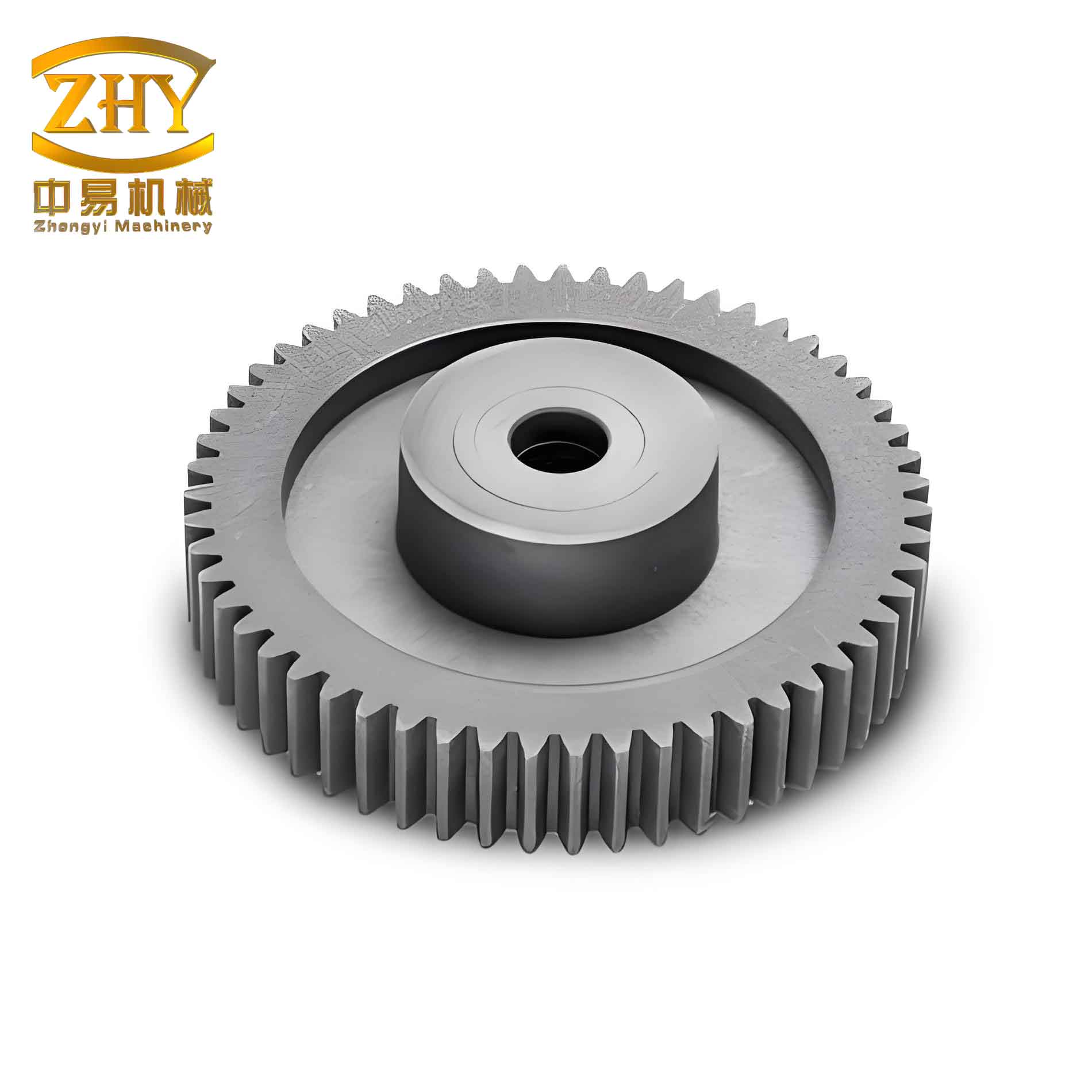
Calculating the time-varying meshing stiffness is crucial for accurate dynamic analysis. I use the energy method, which considers various potential energy components stored in the gear teeth during meshing. These include bending potential energy $U_b$, shear potential energy $U_s$, axial compressive energy $U_a$, Hertzian contact energy $U_h$, and gear body deformation energy $U_f$. The corresponding stiffness values are derived as follows:
$$ \frac{1}{K_b} = \int_0^l \frac{[(l-x)\cos\alpha_p – h\sin\alpha_p]^2}{EI_x} dx $$
$$ \frac{1}{K_s} = \int_0^l \frac{1.2\cos^2\alpha_p}{GA_x} dx $$
$$ \frac{1}{K_a} = \int_0^l \frac{\sin^2\alpha_p}{EA_x} dx $$
$$ \frac{1}{K_h} = \frac{4(1-\nu^2)}{\pi E W} $$
$$ \frac{1}{K_f} = \frac{\cos^2\alpha_p}{WE} \left\{ L^* \left(\frac{u_f}{s_f}\right)^2 + M^* \left(\frac{u_f}{s_f}\right) + P^*(1+Q^*\tan^2\alpha_p) \right\} $$
In these equations, $E$ is the elastic modulus, $G$ is the shear modulus, $I_x$ is the area moment of inertia at distance $x$ from the tooth root, $A_x$ is the cross-sectional area, $\nu$ is Poisson’s ratio, $W$ is the tooth width, and other parameters are defined based on gear geometry. The total meshing stiffness for a gear pair is the sum of individual tooth pair stiffnesses:
$$ K_m(t) = \sum_{i=1}^{N} K_i^j $$
where $N$ is the number of simultaneously meshing tooth pairs, and $K_i^j$ is the stiffness at the meshing point $j$ for the $i$-th pair. For cylindrical gears, this stiffness varies periodically due to single and double tooth contact regions.
When faults such as cracks or pitting occur in cylindrical gears, the meshing stiffness is altered. For crack faults, I model the crack as a straight line starting from the tooth root, with parameters like crack length $q_0$, crack angle $\alpha_c$, and distance from the crack start to the tooth centerline $h_c$. The effective area moment of inertia $I_x$ and cross-sectional area $A_x$ are modified accordingly:
$$ I_x = \begin{cases} \frac{1}{12}(h_x + h_x)^3 W & \text{if } h_x \leq h_q \\ \frac{1}{12}(h_x + h_q)^3 W & \text{if } h_x > h_q \end{cases} $$
$$ A_x = \begin{cases} (h_x + h_x)W & \text{if } h_x \leq h_q \\ (h_x + h_q)W & \text{if } h_x > h_q \end{cases} $$
where $h_q = h_c – q_0 \sin\alpha_c$. These changes reduce the stiffness in the cracked region, affecting the overall meshing stiffness of the cylindrical gear.
For pitting faults, I simplify the pit as a rectangular凹坑 with length $a_s$, width $w_s$, and depth $h_s$. The effective tooth width $\Delta W_x$, cross-sectional area $\Delta A_x$, and area moment of inertia $\Delta I_x$ are adjusted:
$$ \Delta W_x = \begin{cases} W_s & \text{if } x \in [\mu – \frac{a_s}{2}, \mu + \frac{a_s}{2}] \\ 0 & \text{otherwise} \end{cases} $$
$$ \Delta A_x = \begin{cases} \Delta W_x h & \text{if } x \in [\mu – \frac{a_s}{2}, \mu + \frac{a_s}{2}] \\ 0 & \text{otherwise} \end{cases} $$
$$ \Delta I_x = \begin{cases} \frac{1}{12}\Delta W_x h^3 + \frac{A_x \Delta A_x (h_x – \frac{h}{2})^2}{A_x – \Delta A_x} & \text{if } x \in [\mu – \frac{a_s}{2}, \mu + \frac{a_s}{2}] \\ 0 & \text{otherwise} \end{cases} $$
Here, $\mu$ is the distance from the pit center to the tooth root. The modified parameters $I_x’ = I_x – \Delta I_x$, $A_x’ = A_x – \Delta A_x$, and $W_x’ = W – \Delta W_x$ are used to recalculate the stiffness components. This approach allows us to simulate the impact of pitting on the meshing stiffness of cylindrical gears accurately.
To ensure the dynamic model aligns with real-world systems, I apply a model modification method to correct system parameters such as support stiffness and damping. The gear shaft is supported by bearings and housing, which can be modeled as a two-degree-of-freedom system in horizontal and vertical directions. The equations of motion for this subsystem are:
$$ m\ddot{x} + 2(c_{xx}\dot{x} + c_{xy}\dot{y} + k_{xx}x + k_{xy}y) = f_x(t) $$
$$ m\ddot{y} + 2(c_{yx}\dot{x} + c_{yy}\dot{y} + k_{yx}x + k_{yy}y) = f_y(t) $$
where $m$ is the mass, $k_{ij}$ and $c_{ij}$ are the stiffness and damping coefficients in direction $i$ due to force in direction $j$. By applying harmonic excitation and measuring the frequency response functions (FRFs), I can identify these parameters. The acceleration response to harmonic force is:
$$ \begin{bmatrix} X \\ Y \end{bmatrix} = \frac{1}{H} \begin{bmatrix} m – \frac{2j c_{yy}}{\omega} – \frac{2k_{yy}}{\omega^2} & \frac{2k_{xy}}{\omega^2} + \frac{2j c_{xy}}{\omega} \\ \frac{2k_{yx}}{\omega^2} + \frac{2j c_{yx}}{\omega} & m – \frac{2j c_{xx}}{\omega} – \frac{2k_{xx}}{\omega^2} \end{bmatrix} \begin{bmatrix} F_x \\ F_y \end{bmatrix} $$
with $H$ defined as:
$$ H = \left(m – \frac{2j c_{xx}}{\omega} – \frac{2k_{xx}}{\omega^2}\right)\left(m – \frac{2j c_{yy}}{\omega} – \frac{2k_{yy}}{\omega^2}\right) – \left(\frac{2k_{xy}}{\omega^2} + \frac{2j c_{xy}}{\omega}\right)\left(\frac{2k_{yx}}{\omega^2} + \frac{2j c_{yx}}{\omega}\right) $$
The goal is to minimize the error between simulated and experimental FRFs by adjusting $k_{ij}$ and $c_{ij}$. Once identified, these parameters are used to update the support stiffness and damping in the cylindrical gear dynamic model, ensuring better agreement with experimental data.
For simulation analysis, I consider a typical cylindrical gear pair with parameters summarized in Table 1. The pinion is the driving gear, and faults are introduced only on the pinion to reflect common failure scenarios in cylindrical gears.
| Parameter | Pinion | Gear |
|---|---|---|
| Number of Teeth | 23 | 84 |
| Module (mm) | 2 | 2 |
| Pressure Angle (°) | 20 | 20 |
| Tooth Width (mm) | 20 | 20 |
| Mass (kg) | 0.22 | 1.9 |
| Moment of Inertia (kg·m²) | 4.86 × 10⁻⁵ | 3.51 × 10⁻³ |
Under normal conditions, the time-varying meshing stiffness of cylindrical gears shows periodic patterns due to single and double tooth contact. When cracks are present, the stiffness decreases, with deeper cracks leading to more significant reductions. For example, with crack angles of 45° and depths of 1 mm, 1.5 mm, and 2 mm, the stiffness curves deviate increasingly from the normal case. Similarly, for pitting faults, larger pit lengths or widths result in lower meshing stiffness, especially around the pit region. These variations directly influence the dynamic response of cylindrical gears.
The dynamic responses, such as displacement and acceleration, are obtained by solving the governing equations. For normal cylindrical gears, the displacement response is steady, while faulty gears exhibit periodic impulses or amplitude modulations. In the frequency domain, normal gears show dominant meshing frequency components, whereas faulty gears display sidebands around these frequencies due to modulation by the rotational frequency. For instance, crack faults introduce prominent sidebands around the meshing frequency harmonics, while pitting faults cause milder modulations. These characteristics are essential for fault diagnosis in cylindrical gear systems.
To validate the model, I compare simulation results with experimental data from a cylindrical gear test rig. Vibration signals are acquired using accelerometers, sampled at 51,200 Hz, and processed with time synchronous averaging to reduce noise. The experimental setup includes cylindrical gears with seeded faults such as cracks and pitting. The comparison focuses on time-domain waveforms and frequency spectra. For normal cylindrical gears, both simulation and experiment show consistent amplitude stability and dominant meshing frequency peaks. For cracked cylindrical gears, periodic impacts appear in the time domain, with sidebands in the frequency domain. For pitted cylindrical gears, subtle amplitude variations and sidebands are observed. The agreement between simulation and experiment confirms the accuracy of the dynamic model for cylindrical gears with faults.
Furthermore, I simulate various fault degrees to build a comprehensive fault database. For crack faults, different crack depths (e.g., 1 mm, 2 mm, 3 mm) are modeled, and for pitting faults, different pit dimensions (e.g., length, width) are considered. The simulation results show distinct dynamic features for each fault type and degree, enabling the development of statistical indicators for fault quantification. This database supports machine learning algorithms in automated fault diagnosis for cylindrical gear systems.
In conclusion, this study presents a thorough dynamic modeling approach for cylindrical gears with faults. By integrating stiffness calculations, model modifications, and experimental validation, I develop a reliable model that can simulate various failure types and degrees in cylindrical gears. The results demonstrate that the model accurately captures the vibration characteristics of faulty cylindrical gears, providing valuable data for fault diagnosis systems. Future work could explore the effects of damping variations, friction models, and system stability under different operating conditions to further enhance the predictive capabilities for cylindrical gear applications. The insights gained here contribute to the advancement of condition monitoring and preventive maintenance strategies for cylindrical gear transmissions in industrial machinery.